SafetyPublished Top storyAll news from that day
Ongoing case: Cyber-capable AI models Safety finding · 20 stories
Anthropic's unreleased research model found five attack chains, since patched or addressed
Anthropic does not name the internal model. Its post says the Chrome, Safari, Android, Windows and Linux flaws were fixed or addressed, and does not say any was exploited.
Check our sources · 8 facts from 1 source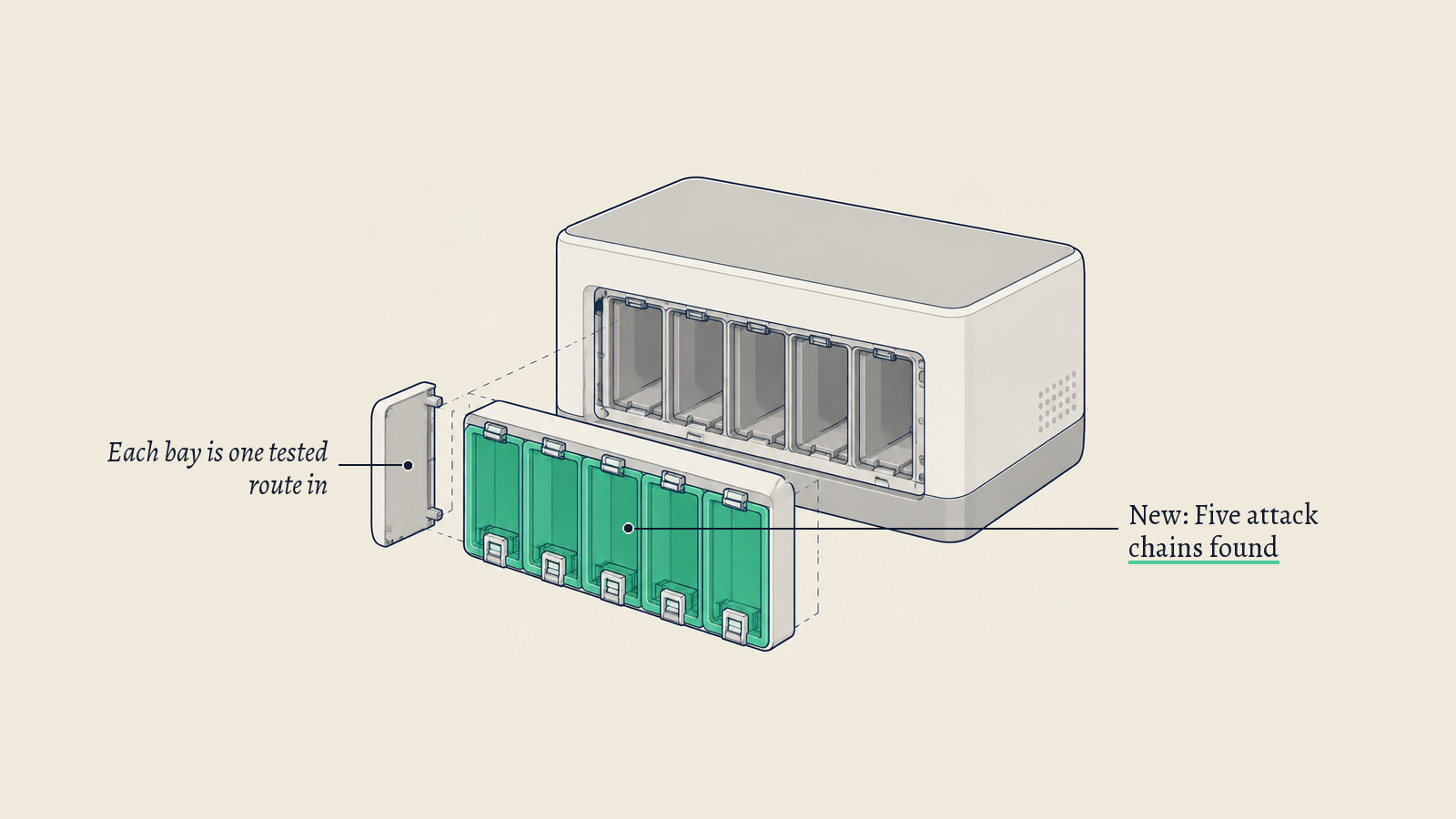 Illustration made with AI for ai notis
Key points
- Anthropic's 27 October 2026 post describes five attack chains that led to remote code execution and other critical impacts, found with an unreleased internal model it does not name.
- Anthropic says 62 Chrome CVEs were patched as of Chrome 156. For the Windows kernel QUIC flaw, CVE-2026-33096, it estimates likely several million such servers listen on the internet.
- The post does not say whether any flaw was exploited in the wild. Anthropic's policy gives developers 90 days to patch and a further 45 days before it discusses details.
What happened
Anthropic published a post on 27 October 2026 saying it used an unreleased, internal research model, which it does not name, to find critical vulnerabilities in widely used software. It shares details of five attack chains that led to remote code execution and other critical impacts.
In Chrome, it says 62 CVEs have been assigned and patched as of Chrome 156. In Windows, a kernel QUIC flaw that can crash servers answering HTTP/3 requests was resolved by Microsoft as CVE-2026-33096, and Anthropic estimates there are likely several million such servers listening on the internet.
A Linux flaw, CVE-2026-98432, was patched upstream and backported to all maintained stable kernel branches. Apple acknowledged the Safari report the same day it was submitted, and Anthropic says Google has addressed the Android lock-screen issue.
Anthropic says it gives developers 90 days to patch and a further 45 days before it discusses details. The post does not say whether any of the flaws was exploited in the wild.
Underlined sentences link to the facts we checked. Dotted words open a short explainer.
Fact 2 of 8 · from Anthropic, 27 Oct 2026
In this post, we share details of five attack chains, which led to remote code execution and other critical impacts with little to no user interaction.
Fact 7 of 8 · from Anthropic, 27 Oct 2026
our coordinated vulnerability disclosure , which gives developers 90 days to patch and a further 45 days before we discuss details beyond what is already included in a public advisory.
What it means for you
Our viewAnthropic reports that each of the five chains has been patched or addressed, so the practical question is whether your own systems carry the fixes. The post does not say any flaw was exploited and does not name the model, so the account of what the model did rests on Anthropic alone.
The figure of several million Windows servers is Anthropic's own estimate. If you run Windows servers that use QUIC, or Linux kernels, ask your vendor to confirm that the fixes for CVE-2026-33096 and CVE-2026-98432 are installed, and check that your Chrome browsers are on version 156 or later.
It adds no new facts.
Your reaction
We count reactions per story and day, never who reacted. The counts help us choose what goes in the monthly issue. If you are signed in, your own page shows yours too.
We count reactions per story and day, never who reacted. They help choose what goes in the monthly issue.
Check our sources
Every sentence above is checked against this source.
1 Discovering and exploiting vulnerabilities in real-world software with Claude
Open the source archived copy-
Anthropic's Frontier Red Team post is dated October 27, 2026 and says "we've used an unreleased, internal research model to find critical vulnerabilities"; the post does not name that model.
citePublished Oct 27, 2026 Team Frontier Red Team Over the past few months, we’ve used an unreleased, internal research model to find critical vulnerabilities in some of the world’s most widely used software
-
Anthropic says "we share details of five attack chains, which led to remote code execution and other critical impacts".
citeIn this post, we share details of five attack chains, which led to remote code execution and other critical impacts with little to no user interaction.
-
Anthropic says the Chrome proof of concept ran "from a stock default-configuration Chrome browser on macOS" and that "62 CVEs have been assigned and patched as of Chrome 156".
citeOur proof of concept launches the Calculator app from a stock default-configuration Chrome browser on macOS ... 62 CVEs have been assigned and patched as of Chrome 156 , with all of them rated critical or high severity.
-
Anthropic says Apple "acknowledged our report the same day we submitted it" (Safari) and that the Android lock-screen issue, tested on a physical Google Pixel 9, "has been addressed by Google."
citeApple acknowledged our report the same day we submitted it and implemented a fix promptly. That fix is available to users. ... live testing on a physical Google Pixel 9 ... This issue has been addressed by Google.
-
Anthropic says Microsoft resolved the Windows kernel QUIC vulnerability and assigned it CVE-2026-33096, and "We estimate that there are likely several million such servers listening on the internet." (Anthropic's own estimate) the company says
citewe reported this vulnerability directly to Microsoft, which resolved the vulnerability and assigned it CVE-2026-33096 ... We estimate that there are likely several million such servers listening on the internet.
-
Anthropic says the Linux multipath TCP flaw, CVE-2026-98432, "was patched upstream and backported to all maintained stable kernel branches".
citeThis vulnerability ( CVE-2026-98432 ) was patched upstream and backported to all maintained stable kernel branches.
-
Anthropic says its policy "gives developers 90 days to patch and a further 45 days before we discuss details".
citeour coordinated vulnerability disclosure , which gives developers 90 days to patch and a further 45 days before we discuss details beyond what is already included in a public advisory.
-
The post does not state whether any of the vulnerabilities was exploited in the wild or known to attackers; no source on exploitation was found for this note.
citewhich have since been patched upstream and publicly disclosed
Every sentence above is checked against this source. Each fact has its own address you can cite.
Source 1 · Anthropic · 27 Oct 2026
Discovering and exploiting vulnerabilities in real-world software with Claude
Anthropic's Frontier Red Team post is dated October 27, 2026 and says "we've used an unreleased, internal research model to find critical vulnerabilities"; the post does not name that model.
Published Oct 27, 2026 Team Frontier Red Team Over the past few months, we’ve used an unreleased, internal research model to find critical vulnerabilities in some of the world’s most widely used software
Anthropic says "we share details of five attack chains, which led to remote code execution and other critical impacts".
In this post, we share details of five attack chains, which led to remote code execution and other critical impacts with little to no user interaction.
Anthropic says the Chrome proof of concept ran "from a stock default-configuration Chrome browser on macOS" and that "62 CVEs have been assigned and patched as of Chrome 156".
Our proof of concept launches the Calculator app from a stock default-configuration Chrome browser on macOS ... 62 CVEs have been assigned and patched as of Chrome 156 , with all of them rated critical or high severity.
Show all 8 factsShow fewer facts
Anthropic says Apple "acknowledged our report the same day we submitted it" (Safari) and that the Android lock-screen issue, tested on a physical Google Pixel 9, "has been addressed by Google."
Apple acknowledged our report the same day we submitted it and implemented a fix promptly. That fix is available to users. ... live testing on a physical Google Pixel 9 ... This issue has been addressed by Google.
Anthropic says Microsoft resolved the Windows kernel QUIC vulnerability and assigned it CVE-2026-33096, and "We estimate that there are likely several million such servers listening on the internet." (Anthropic's own estimate) the company says
we reported this vulnerability directly to Microsoft, which resolved the vulnerability and assigned it CVE-2026-33096 ... We estimate that there are likely several million such servers listening on the internet.
Anthropic says the Linux multipath TCP flaw, CVE-2026-98432, "was patched upstream and backported to all maintained stable kernel branches".
This vulnerability ( CVE-2026-98432 ) was patched upstream and backported to all maintained stable kernel branches.
Anthropic says its policy "gives developers 90 days to patch and a further 45 days before we discuss details".
our coordinated vulnerability disclosure , which gives developers 90 days to patch and a further 45 days before we discuss details beyond what is already included in a public advisory.
The post does not state whether any of the vulnerabilities was exploited in the wild or known to attackers; no source on exploitation was found for this note.
which have since been patched upstream and publicly disclosed
Topics
The morning email
On the mornings we publish: the three top stories and up to four short ones. Free.
We email you a link to confirm. An issue may include one sponsor, always labelled Sponsored · Advertisement. Our emails count opens and clicks, not who made them. Unsubscribe in one click. What we keep