SafetyPublished ExplainedAll news from that day
How a CVSS score is built, and why Java4Shell has three different ones
OpenJDK, Amazon and Calif scored Java4Shell 8.1, 8.8 and 9.2, using different versions and answers; the score ranks severity, and exploitation sits in separate metrics.
Check our sources · 20 facts from 7 sources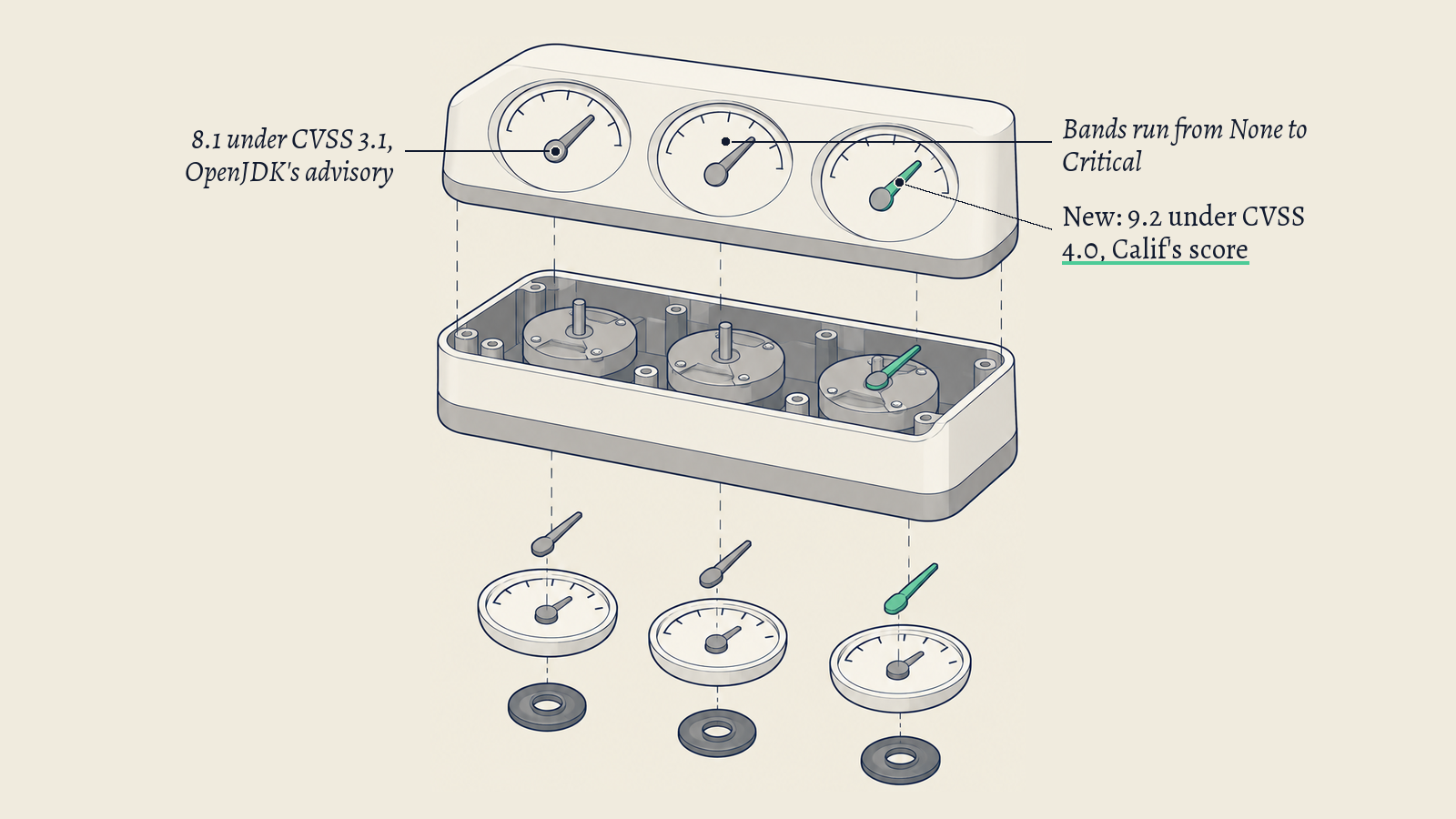 Illustration made with AI for ai notis
Key points
- CVSS maps Base scores to Low (0.1 to 3.9), Medium (4.0 to 6.9), High (7.0 to 8.9) and Critical (9.0 to 10.0): 8.1 and 8.8 are High, 9.2 is Critical.
- OpenJDK and Amazon score Java4Shell under CVSS 3.1, at 8.1 and 8.8; Calif uses CVSS 4.0, which adds Attack Requirements, and gets 9.2.
- FIRST says CVSS scores show severity relative to other vulnerabilities; its Threat and Environmental metrics, covering attack likelihood and your own controls, are not required but highly recommended.
What happened
One flaw, three scores: Java4Shell, the OpenJDK bug disclosed on 17 November, is rated 8.1 in OpenJDK's advisory, 8.8 on Amazon's security page and 9.2 by the Calif researchers who found it. All three are CVSS scores, and the gap between them shows what the number does and does not tell you.
CVSS, the Common Vulnerability Scoring System, is an open framework for communicating the characteristics and severity of software vulnerabilities. Its Base score reflects severity according to the flaw's intrinsic characteristics, and the score maps onto a rating: 0.1 to 3.9 is Low, 4.0 to 6.9 Medium, 7.0 to 8.9 High and 9.0 to 10.0 Critical. So 8.1 and 8.8 are High, and 9.2 is Critical.
The score is built from answers to a fixed set of questions. In version 3.1 they cover how the attack is delivered (Attack Vector), how hard it is (Attack Complexity), the privileges needed (Privileges Required), whether a user must act (User Interaction), and the damage to confidentiality, integrity and availability.
Version 4.0 keeps most of these and adds Attack Requirements, and it scores impact on the vulnerable system and on subsequent systems separately. OpenJDK and Amazon score Java4Shell with CVSS 3.1; Calif uses CVSS 4.0.
Different answers move the number. Calif says a remote attacker with no credentials can reach code execution. Amazon's page says exploitation could crash the JVM for unauthenticated users, and could give code execution to an authenticated low-privileged user, and its vector lists the privileges needed as low.
Different scorers can also use different scales altogether: nginx's own advisory page calls one of two HTTP/2 flaws "major" and the other "medium", while Wiz rates both Critical, 9.2 under CVSS 4.0.
The score is not a measure of whether anyone is attacking you. CVSS 3.1 says its scores show severity relative to other vulnerabilities, and that things like the number of customers or the money at stake are outside its scope. Base scores are usually produced by the organisation that maintains the product.
The Threat metrics, which include Exploit Maturity (the likelihood of the flaw being attacked), and the Environmental metrics, which reflect your own setup, are not required, though CVSS 4.0 says assessing them is highly recommended.
For Java4Shell that means the reading is more useful than the number. Check whether your build is in the affected range and whether your processors support AVX-512 VBMI. Then check whether anyone reports exploitation: Calif says it has published a proof of concept that triggers the corruption but holds back product-specific exploits, and that no universal exploit exists.
What it means for you
Our viewRead a CVSS score as a severity ranking, not as your own risk. For Java4Shell, Calif says the flaw affects OpenJDK from version 17.0.6 and needs an x86-64 CPU with AVX-512 VBMI, and all three scores place it at High or Critical. When an advisory gives a score, find which CVSS version and whose answers produced it, then check your own build and processors against the affected range.
It adds no new facts.
Your reaction
We count reactions per story and day, never who reacted. The counts help us choose what goes in the monthly issue. If you are signed in, your own page shows yours too.
We count reactions per story and day, never who reacted. They help choose what goes in the monthly issue.
Check our sources
Every sentence above is checked against these 7 sources.
1 OpenJDK Vulnerability Advisory: 2026/11/17
Open the source-
OpenJDK's vulnerability advisory dated 17 November 2026 lists CVE-2026-114938 with a CVSS 3.1 base score of 8.1.
cite
2 CVE-2026-114938
Open the source archived copy-
Amazon's security page for CVE-2026-114938 gives a CVSS 3.1 base score of 8.8 with the vector CVSS:3.1/AV:N/AC:L/PR:L/UI:N/S:U/C:H/I:H/A:H.
citeCVSS Scores Score Type Score Vector Amazon Linux CVSSv3 8.8 CVSS:3.1/AV:N/AC:L/PR:L/UI:N/S:U/C:H/I:H/A:H
-
Amazon's page says exploitation of CVE-2026-114938 could result in a JVM crash for unauthenticated users or, in certain application environments, code execution by an authenticated low-privileged user.
citeDepending on the deployment context, exploitation could result in a JVM crash for unauthenticated users or, in certain application environments, code execution by an authenticated low-privileged user.
3 Java4Shell: Write once, RCE everywhere
Open the source-
Calif scores Java4Shell 9.2 out of 10 (Critical) under CVSS 4.0.
citeUnder CVSS 4.0, this vulnerability scores 9.2 out of 10 (CRITICAL).
-
Calif says a remote attacker with no credentials can overwrite heap memory and reach remote code execution through Java4Shell.
citeA remote attacker with no credentials can overwrite heap memory, read it in the style of Heartbleed, and reach remote code execution.
-
Calif says it published a proof of concept that triggers the memory corruption, is holding back application-specific exploits until everyone has had a chance to upgrade, and that there is no universal exploit.
citeHere is a self-contained proof of concept. ... We are holding back the application-specific exploits for now. ... The weaponized chains for individual products stay private until everyone has had a chance to upgrade. ... There is no universal payload.
-
Calif says Java4Shell affects OpenJDK from version 17.0.6 or newer and requires an x86-64 CPU with AVX-512 VBMI.
citeJava4Shell affects OpenJDK from version 17.0.6 or newer. ... Java4Shell also requires an x86-64 processor with AVX-512 VBMI support.
4 CVSS v4.0 Specification Document
Open the source archived copy-
FIRST's CVSS v4.0 specification says CVSS is an open framework for communicating the characteristics and severity of software vulnerabilities.
citeThe Common Vulnerability Scoring System (CVSS) is an open framework for communicating the characteristics and severity of software vulnerabilities.
-
FIRST's CVSS v4.0 specification says the Base Score reflects the severity of a vulnerability according to its intrinsic characteristics.
citeThe Base Score reflects the severity of a vulnerability according to its intrinsic characteristics which are constant over time and assumes the reasonable worst-case impact across different deployed environments.
-
FIRST's CVSS v4.0 specification lists the Base metrics Attack Vector, Attack Complexity, Attack Requirements, Privileges Required and User Interaction, with separate Confidentiality, Integrity and Availability impact metrics for the vulnerable system and for the subsequent system.
citeBase | Attack Vector (AV) | Attack Complexity (AC) | Attack Requirements (AT) | Privileges Required (PR) | User Interaction (UI) | Vulnerable System Confidentiality Impact (VC) | Vulnerable System Integrity Impact (VI) | ... These impacts are established by two sets of impact metrics: Vulnerable System impact and Subsequent System impact
-
FIRST's CVSS v4.0 specification says its Exploit Maturity metric measures the likelihood of the vulnerability being attacked.
citeExploit Maturity (E) This metric measures the likelihood of the vulnerability being attacked, and is based on the current state of exploit techniques, exploit code availability, or active, in-the-wild exploitation.
-
FIRST's CVSS v4.0 specification says assessment of the Threat and Environmental metrics is not required, but is highly recommended for more meaningful results.
citeAssessment of the Threat and Environmental metrics is not required, but is highly recommended for more meaningful results.
5 CVSS v3.1 Specification Document
Open the source archived copy-
FIRST's CVSS specifications give the qualitative severity scale as None 0.0, Low 0.1 to 3.9, Medium 4.0 to 6.9, High 7.0 to 8.9 and Critical 9.0 to 10.0.
citeTable 14: Qualitative severity rating scale Rating CVSS Score None 0.0 Low 0.1 - 3.9 Medium 4.0 - 6.9 High 7.0 - 8.9 Critical 9.0 - 10.0
-
FIRST's CVSS v3.1 specification lists the Base metrics Attack Vector, Attack Complexity, Privileges Required and User Interaction, with Confidentiality, Integrity and Availability impact metrics and Scope.
cite2.1.1. Attack Vector (AV) ... 2.1.2. Attack Complexity (AC) ... 2.1.3. Privileges Required (PR) ... 2.1.4. User Interaction (UI) ... 2.2. Scope (S) ... 2.3.1. Confidentiality (C) ... 2.3.2. Integrity (I) ... 2.3.3. Availability (A)
-
FIRST's CVSS v3.1 specification says its outputs include numerical scores indicating the severity of a vulnerability relative to other vulnerabilities.
citeThe Common Vulnerability Scoring System (CVSS) captures the principal technical characteristics of software, hardware and firmware vulnerabilities. Its outputs include numerical scores indicating the severity of a vulnerability relative to other vulnerabilities.
-
FIRST's CVSS v3.1 specification says factors such as the number of customers, monetary losses, or life and property threatened are outside CVSS's scope.
citeSuch factors may include: number of customers on a product line, monetary losses due to a breach, life or property threatened, or public sentiment on highly publicized vulnerabilities. These are outside the scope of CVSS.
-
FIRST's CVSS v3.1 specification says Base Scores are usually produced by the organization maintaining the vulnerable product.
citeBase Scores are usually produced by the organization maintaining the vulnerable product, or a third party scoring on their behalf.
-
FIRST's CVSS v3.1 specification says Environmental metrics are specified by end-user organizations and reflect their own controls and asset importance.
citeThe Environmental metrics are specified by end-user organizations because they are best able to assess the potential impact of a vulnerability within their own computing environment.
6 nginx security advisories
Open the source-
nginx.org's security advisories page lists CVE-2026-123007 as severity "major" and CVE-2026-123633 as severity "medium".
cite
7 Unauthenticated Remote Code Execution in NGINX: CVE-2026-123633 and CVE-2026-123007
Open the source-
Wiz says CVE-2026-123633 and CVE-2026-123007 are both rated Critical, with a CVSS 4.0 score of 9.2.
cite
Every sentence above is checked against these 7 sources. Each fact has its own address you can cite.
Source 1 · OpenJDK · 17 Nov 2026
OpenJDK Vulnerability Advisory: 2026/11/17
OpenJDK's vulnerability advisory dated 17 November 2026 lists CVE-2026-114938 with a CVSS 3.1 base score of 8.1.
Source 2 · Amazon Linux Security Center · 17 Nov 2026
CVE-2026-114938
Amazon's security page for CVE-2026-114938 gives a CVSS 3.1 base score of 8.8 with the vector CVSS:3.1/AV:N/AC:L/PR:L/UI:N/S:U/C:H/I:H/A:H.
CVSS Scores Score Type Score Vector Amazon Linux CVSSv3 8.8 CVSS:3.1/AV:N/AC:L/PR:L/UI:N/S:U/C:H/I:H/A:H
Amazon's page says exploitation of CVE-2026-114938 could result in a JVM crash for unauthenticated users or, in certain application environments, code execution by an authenticated low-privileged user.
Depending on the deployment context, exploitation could result in a JVM crash for unauthenticated users or, in certain application environments, code execution by an authenticated low-privileged user.
Source 3 · Calif Research · 17 Nov 2026
Java4Shell: Write once, RCE everywhere
Calif scores Java4Shell 9.2 out of 10 (Critical) under CVSS 4.0.
Under CVSS 4.0, this vulnerability scores 9.2 out of 10 (CRITICAL).
Calif says a remote attacker with no credentials can overwrite heap memory and reach remote code execution through Java4Shell.
A remote attacker with no credentials can overwrite heap memory, read it in the style of Heartbleed, and reach remote code execution.
Calif says it published a proof of concept that triggers the memory corruption, is holding back application-specific exploits until everyone has had a chance to upgrade, and that there is no universal exploit.
Here is a self-contained proof of concept. ... We are holding back the application-specific exploits for now. ... The weaponized chains for individual products stay private until everyone has had a chance to upgrade. ... There is no universal payload.
Show all 4 factsShow fewer facts
Calif says Java4Shell affects OpenJDK from version 17.0.6 or newer and requires an x86-64 CPU with AVX-512 VBMI.
Java4Shell affects OpenJDK from version 17.0.6 or newer. ... Java4Shell also requires an x86-64 processor with AVX-512 VBMI support.
Source 4 · FIRST
CVSS v4.0 Specification Document
FIRST's CVSS v4.0 specification says CVSS is an open framework for communicating the characteristics and severity of software vulnerabilities.
The Common Vulnerability Scoring System (CVSS) is an open framework for communicating the characteristics and severity of software vulnerabilities.
FIRST's CVSS v4.0 specification says the Base Score reflects the severity of a vulnerability according to its intrinsic characteristics.
The Base Score reflects the severity of a vulnerability according to its intrinsic characteristics which are constant over time and assumes the reasonable worst-case impact across different deployed environments.
FIRST's CVSS v4.0 specification lists the Base metrics Attack Vector, Attack Complexity, Attack Requirements, Privileges Required and User Interaction, with separate Confidentiality, Integrity and Availability impact metrics for the vulnerable system and for the subsequent system.
Base | Attack Vector (AV) | Attack Complexity (AC) | Attack Requirements (AT) | Privileges Required (PR) | User Interaction (UI) | Vulnerable System Confidentiality Impact (VC) | Vulnerable System Integrity Impact (VI) | ... These impacts are established by two sets of impact metrics: Vulnerable System impact and Subsequent System impact
Show all 5 factsShow fewer facts
FIRST's CVSS v4.0 specification says its Exploit Maturity metric measures the likelihood of the vulnerability being attacked.
Exploit Maturity (E) This metric measures the likelihood of the vulnerability being attacked, and is based on the current state of exploit techniques, exploit code availability, or active, in-the-wild exploitation.
FIRST's CVSS v4.0 specification says assessment of the Threat and Environmental metrics is not required, but is highly recommended for more meaningful results.
Assessment of the Threat and Environmental metrics is not required, but is highly recommended for more meaningful results.
Source 5 · FIRST
CVSS v3.1 Specification Document
FIRST's CVSS specifications give the qualitative severity scale as None 0.0, Low 0.1 to 3.9, Medium 4.0 to 6.9, High 7.0 to 8.9 and Critical 9.0 to 10.0.
Table 14: Qualitative severity rating scale Rating CVSS Score None 0.0 Low 0.1 - 3.9 Medium 4.0 - 6.9 High 7.0 - 8.9 Critical 9.0 - 10.0
FIRST's CVSS v3.1 specification lists the Base metrics Attack Vector, Attack Complexity, Privileges Required and User Interaction, with Confidentiality, Integrity and Availability impact metrics and Scope.
2.1.1. Attack Vector (AV) ... 2.1.2. Attack Complexity (AC) ... 2.1.3. Privileges Required (PR) ... 2.1.4. User Interaction (UI) ... 2.2. Scope (S) ... 2.3.1. Confidentiality (C) ... 2.3.2. Integrity (I) ... 2.3.3. Availability (A)
FIRST's CVSS v3.1 specification says its outputs include numerical scores indicating the severity of a vulnerability relative to other vulnerabilities.
The Common Vulnerability Scoring System (CVSS) captures the principal technical characteristics of software, hardware and firmware vulnerabilities. Its outputs include numerical scores indicating the severity of a vulnerability relative to other vulnerabilities.
Show all 6 factsShow fewer facts
FIRST's CVSS v3.1 specification says factors such as the number of customers, monetary losses, or life and property threatened are outside CVSS's scope.
Such factors may include: number of customers on a product line, monetary losses due to a breach, life or property threatened, or public sentiment on highly publicized vulnerabilities. These are outside the scope of CVSS.
FIRST's CVSS v3.1 specification says Base Scores are usually produced by the organization maintaining the vulnerable product.
Base Scores are usually produced by the organization maintaining the vulnerable product, or a third party scoring on their behalf.
FIRST's CVSS v3.1 specification says Environmental metrics are specified by end-user organizations and reflect their own controls and asset importance.
The Environmental metrics are specified by end-user organizations because they are best able to assess the potential impact of a vulnerability within their own computing environment.
Source 6 · nginx.org · 18 Nov 2026
nginx security advisories
nginx.org's security advisories page lists CVE-2026-123007 as severity "major" and CVE-2026-123633 as severity "medium".
Source 7 · Wiz · 18 Nov 2026
Unauthenticated Remote Code Execution in NGINX: CVE-2026-123633 and CVE-2026-123007
Wiz says CVE-2026-123633 and CVE-2026-123007 are both rated Critical, with a CVSS 4.0 score of 9.2.
Topics
The morning email
On the mornings we publish: the three top stories and up to four short ones. Free.
We email you a link to confirm. An issue may include one sponsor, always labelled Sponsored · Advertisement. Our emails count opens and clicks, not who made them. Unsubscribe in one click. What we keep