LawsPublished ExplainedAll news from that day
What the H200 export rule requires before China licences get case-by-case review
BIS's final rule moves exports of Nvidia's H200 and equivalent chips to China from a presumption of denial to case-by-case review, if the exporter certifies set conditions.
Check our sources · 18 facts from 4 sources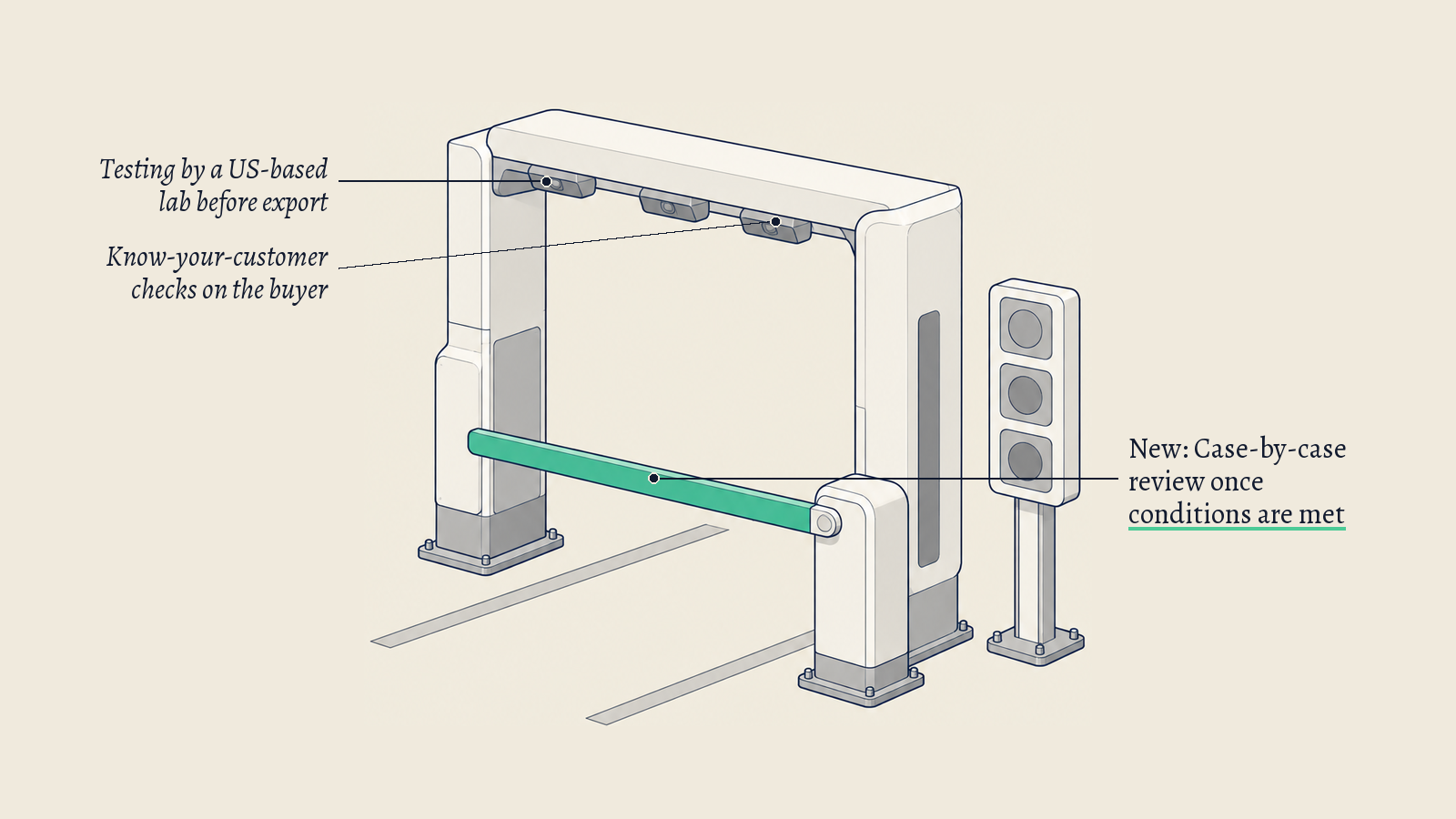 Illustration made with AI for ai notis
Key points
- From 15 January 2026, BIS reviews China and Macau licences case by case for chips under 21,000 TPP and 6,500 GB/s DRAM bandwidth, such as the Nvidia H200.
- Exporters must certify US orders are not delayed and China and Macau shipments are no more than 50% of US-bound ones; a qualified US lab must review shipments first.
- The rule keeps a presumption of denial for entities headquartered in Macau or a Country Group D:5 destination, and for reexports and transfers to those destinations.
What happened
Applications to export Nvidia's H200 and equivalent chips to China have been reviewed case by case, rather than with a presumption of denial, since 15 January 2026, provided the exporter meets set conditions. The change is in a final rule from the Commerce Department's Bureau of Industry and Security (BIS), published in the Federal Register on that date.
Under the old policy, licence applications for these chips started from a presumption of denial. Under the new one, BIS and the reviewing agencies decide each application on the records the applicant supplies, on a case-by-case basis.
The rule covers chips with a total processing performance (TPP) below 21,000 and total DRAM bandwidth below 6,500 GB/s, such as the Nvidia H200 or AMD MI325X, that were commercially available in the United States when the rule was published.
The exporter has to certify several things. US supply must be sufficient that exporting the product would not delay any existing or new US order for advanced-node chips. Shipments of the product to China and Macau in total must be no more than 50% of what is shipped to customers for use in the United States.
The receiving customer must use rigorous know-your-customer procedures to stop unauthorised remote access, and the rule's licence conditions also have the applicant pass a description of those procedures from the ultimate consignee to BIS.
The chips also have to be checked before they leave. A qualified third-party lab must review the shipment's technical capabilities, and BIS says a representative sample of a batch can be tested instead of every chip. The lab must be headquartered in the United States, do the testing there, and hold no financial interest in any party to the transaction.
The rule uses "diverted" about factory capacity. The exporter must certify that global foundry capacity that would otherwise make similar or more advanced chips for US customers will not be diverted to make the exported ones.
A separate BIS text, the Know Your Customer guidance in Supplement No. 3 to Part 732 of the Export Administration Regulations, covers what a firm must do about a customer's story.
It tells firms to look for red flags, meaning abnormal circumstances in a transaction that indicate an export may be destined for an inappropriate end-use, end-user or destination. If red flags come up, a firm has a duty to check them out and inquire.
Absent red flags (or an express requirement in the EAR), the guidance says there is no affirmative duty to inquire, verify or go behind the customer's representations. It also tells firms not to self-blind, that is, not to cut off the flow of information that comes to them in the normal course of business.
Much stays refused. The presumption of denial remains for entities headquartered in, or with a parent headquartered in, Macau or a Country Group D:5 destination, wherever the end user is located. It also remains for reexports and in-country transfers to Macau or D:5 destinations.
The current electronic Code of Federal Regulations text of section 742.6, read on 9 November 2026, carries the same case-by-case policy at the same two thresholds.
What to check: a review policy is not a licence. The rule sets the conditions under which an application can move from a presumption of denial to case-by-case review. In its paperwork section, BIS puts the increase at 100 more licence applications per year, since industry is more likely to apply when review is case by case.
Underlined sentences link to the facts we checked. Dotted words open a short explainer.
Fact 6 of 18 · from Bureau of Industry and Security, US Department of Commerce, 15 Jan 2026
the aggregate shipments of the product to China and Macau will be no more than 50% of the total product shipped to customers for end use in the United States of that product
Fact 9 of 18 · from Bureau of Industry and Security, US Department of Commerce, 15 Jan 2026
Among the qualifications for a third-party testing lab, it must be headquartered in the United States, not otherwise under the control of a company or other entity headquartered in or whose ultimate parent company or other entity is headquartered in Country Group D:5 or Macau, and the testing must take place in the United States. Further, the lab must not have any financial interest or ownership in any party to the transaction
Fact 16 of 18 · from Electronic Code of Federal Regulations (BIS)
(3) Do not self-blind. Do not cut off the flow of information that comes to your firm in the normal course of business.
What it means for you
Our viewIf you sell, resell or host AI hardware that could reach China, this rule asks for evidence, and each application is decided on the records it supplies.
The conditions cover supply, the share of shipments, third-party testing, foundry capacity and screening for unauthorised remote access, and the applicant must pass the buyer's Know Your Customer procedures to BIS. BIS's separate guidance says red flags create a duty to inquire and that a firm should not cut off information that reaches it in the normal course of business.
Ask your hardware supplier which of these certifications it makes for the chips you buy, and what it would do if a red flag appeared.
It adds no new facts.
Your reaction
We count reactions per story and day, never who reacted. The counts help us choose what goes in the monthly issue. If you are signed in, your own page shows yours too.
We count reactions per story and day, never who reacted. They help choose what goes in the monthly issue.
Check our sources
Every sentence above is checked against these 4 sources.
1 Revision to License Review Policy for Advanced Computing Commodities (Federal Register 2026-00789)
Open the source archived copy-
BIS's final rule in Federal Register document 2026-00789 (15 CFR Parts 742, 744 and 748) revises the license review policy for exports of certain semiconductors to China and Macau from a presumption of denial to a case-by-case review; its effective date is January 15, 2026.
cite[FR Doc No: 2026-00789] ... 15 CFR Parts 742, 744, and 748 ... The Bureau of Industry and Security (BIS) is revising its license review policy for exports of certain semiconductors to China and Macau--changing it from a presumption of denial to a case-by-case review. ... Effective date: The effective date of this rule is January 15, 2026.
-
The rule says the semiconductors covered are the Nvidia H200 and its equivalents, as well as less advanced chips, provided they are commercially available in the United States at the time of publication of the rule and the exporter makes the required certifications.
citeThe semiconductors covered by this rule are the Nvidia H200 and its equivalents, as well as less advanced chips--provided that (1) the semiconductors are commercially available in the United States at the time of publication of this rule and (2) the exporter certifies that:
-
The rule says BIS and reviewing agencies will determine, on a case-by-case basis and based on the records and information provided in the application, whether to approve or deny the license.
citeBased on the records and information provided as part of the application process, BIS and reviewing agencies will determine, on a case-by-case basis, whether to approve or deny the license of these specific commodities.
-
The rule applies to advanced computing commodities with a TPP less than 21,000 and a total DRAM bandwidth less than 6,500 GB/s, such as the NVIDIA H200 or AMD MI325X.
citefor advanced computing commodities with a TPP less than 21,000 (as defined in Technical Note 2 to 3A090.a and 3A090.b), and a `total DRAM bandwidth' less than 6,500 GB/s (as defined in the notes to paragraph (dd)(1) in supplement no. 2 to part 748), such as the NVIDIA H200 or AMD MI325X
-
The rule requires the applicant to certify that there is sufficient supply of the product in the United States such that the export would not delay fulfilling any existing or new orders of advanced-node integrated circuits from US customers for end use in the United States.
citethere is sufficient supply of the product in the United States such that export of the product authorized by this license would not result in any delay in fulfilling any existing or new orders of any of its ``advanced-node integrated circuits'' from customers in the United States for end use in the United States (taking into account normal lead times)
-
The rule requires the applicant to certify that aggregate shipments of the product to China and Macau will be no more than 50% of the total product shipped to customers for end use in the United States of that product.
citethe aggregate shipments of the product to China and Macau will be no more than 50% of the total product shipped to customers for end use in the United States of that product
-
The rule requires the applicant to certify that the ultimate consignee will employ rigorous Know Your Customer procedures to screen and prevent unauthorized remote access to unauthorized parties.
citethe ultimate consignee will employ rigorous Know Your Customer (KYC) procedures to screen and prevent unauthorized remote access to unauthorized parties (e.g., prohibited part 744 parties)
-
The rule requires that, prior to export from the United States, a qualified third-party testing lab review the shipment to confirm the technical capabilities and functions of the commodities, and says the review can be of a representative sampling of a batch chosen by the lab rather than every individual semiconductor.
citeprior to export from the United States, every shipment of advance computing commodities will be reviewed by a qualified third- party testing lab to confirm the technical capabilities and functions of the AI commodities ... Such a review can be performed by a representative sampling of a batch of semiconductors chosen by the lab, rather than the lab reviewing every individual semiconductor that the exporter intends to export.
-
The rule says the third-party testing lab must be headquartered in the United States, the testing must take place in the United States, and the lab must not have any financial interest or ownership in any party to the transaction.
citeAmong the qualifications for a third-party testing lab, it must be headquartered in the United States, not otherwise under the control of a company or other entity headquartered in or whose ultimate parent company or other entity is headquartered in Country Group D:5 or Macau, and the testing must take place in the United States. Further, the lab must not have any financial interest or ownership in any party to the transaction
-
The rule requires the applicant to certify that global foundry capacity that would otherwise be used to produce similar node or more advanced integrated circuits for end users in the United States will not be diverted to produce the commodities authorized by the license for export to China.
citethat global foundry capacity that would otherwise be used to produce similar node or more advanced integrated circuits for end users in the United States will not be diverted to produce the commodities authorized by this license for exports to China
-
The rule maintains a presumption of denial licensing policy for exports to entities that are headquartered, or have a parent company headquartered, in Macau or a Country Group D:5 destination, including end users located outside those destinations, and for reexports and transfers (in-country) of these commodities to Macau or Country Group D:5 destinations.
citeFor reexports (including exports from abroad) and transfers (in-country) of AI commodities subject to the EAR with a TPP less than 21,000, and a `total DRAM bandwidth' less than 6,500 GB/s, when destined to either Macau or a destination specified in Country Group D:5, the licensing policy remains a presumption of denial. For exports to entities that are headquartered or have a parent company headquartered in Macau or a destination in Country Group D:5, including end-users located outside of destinations in Country Group D:5 or Macau, the licensing policy is a presumption of denial.
-
The rule's paperwork section puts the increase at 100 more license applications per year, because industry is more likely to submit licenses when there is a case-by-case review versus a presumption of denial license review policy.
Toned down to what the source says
citewill affect the collection under control number 0694-0088, for the multipurpose application because of the increase of 100 more license applications per year, because industry is more likely to submit licenses when there is a case-by-case review versus a presumption of denial license review policy.
-
The rule specifies conditions that, if satisfied, allow license applicants to move from a presumption of denial to a case-by-case license review policy for exports from the United States to China or Macau.
Toned down to what the source says
citethis final rule specifies certain conditions that, if satisfied, allow for license applicants to move from a presumption of denial to a case-by-case license review policy for exports from the United States destined to China or Macau.
2 Supplement No. 3 to Part 732: BIS's Know Your Customer Guidance and Red Flags
Open the source archived copy-
BIS's Know Your Customer guidance (Supplement No. 3 to Part 732) says red flags are abnormal circumstances in a transaction that indicate that the export may be destined for an inappropriate end-use, end-user, or destination.
cite(1) Decide whether there are “red flags”. Take into account any abnormal circumstances in a transaction that indicate that the export may be destined for an inappropriate end-use, end-user, or destination. Such circumstances are referred to as “red flags”.
-
The guidance says that when red flags are raised in information that comes to a firm, it has a duty to check out the suspicious circumstances and inquire about the end-use, end-user or ultimate country of destination; and that absent red flags (or an express requirement in the EAR) there is no affirmative duty to inquire, verify or go behind the customer's representations.
Toned down to what the source says
citeabsent “red flags” (or an express requirement in the EAR), there is no affirmative duty upon exporters to inquire, verify, or otherwise “go behind” the customer's representations. However, when “red flags” are raised in information that comes to your firm, you have a duty to check out the suspicious circumstances and inquire about the end-use, end-user, or ultimate country of destination.
-
The guidance says not to self-blind: do not cut off the flow of information that comes to the firm in the normal course of business.
cite(3) Do not self-blind. Do not cut off the flow of information that comes to your firm in the normal course of business.
3 15 CFR 742.6 Regional stability
Open the source archived copy-
The eCFR text of 15 CFR 742.6(b)(10)(iii)(A)(1), as read on 9 November 2026, provides a case-by-case license review policy for exports of commodities with a TPP less than 21,000 and a total DRAM bandwidth less than 6,500 GB/s destined to end users located in China or Macau, provided the applicant provides the additional information in supplement no. 2 to part 748 paragraph (dd).
citeThere is a case-by-case license review policy for license applications for exports of commodities with a TPP (as defined in Technical Note 2 to 3A090.a and 3A090.b) less than 21,000, and a 'total DRAM bandwidth' (as defined in the notes to paragraph (dd)(1) in supplement no. 2 to part 748) less than 6,500 GB/s, when destined to end-users located in China or Macau, provided the applicant provides the additional information described in supplement no. 2 to part 748 under paragraph (dd).
4 Revision to License Review Policy for Advanced Computing Commodities
Open the source archived copy-
The rule's new paragraph (dd)(1)(v) of supplement no. 2 to part 748 requires the applicant to obtain from the ultimate consignee a description of its Know Your Customer procedures to prevent remote access by the end uses or end users the rule excludes, and to submit that information to BIS.
cite
Every sentence above is checked against these 4 sources. Each fact has its own address you can cite.
Source 1 · Bureau of Industry and Security, US Department of Commerce · 15 Jan 2026
Revision to License Review Policy for Advanced Computing Commodities (Federal Register 2026-00789)
BIS's final rule in Federal Register document 2026-00789 (15 CFR Parts 742, 744 and 748) revises the license review policy for exports of certain semiconductors to China and Macau from a presumption of denial to a case-by-case review; its effective date is January 15, 2026.
[FR Doc No: 2026-00789] ... 15 CFR Parts 742, 744, and 748 ... The Bureau of Industry and Security (BIS) is revising its license review policy for exports of certain semiconductors to China and Macau--changing it from a presumption of denial to a case-by-case review. ... Effective date: The effective date of this rule is January 15, 2026.
The rule says the semiconductors covered are the Nvidia H200 and its equivalents, as well as less advanced chips, provided they are commercially available in the United States at the time of publication of the rule and the exporter makes the required certifications.
The semiconductors covered by this rule are the Nvidia H200 and its equivalents, as well as less advanced chips--provided that (1) the semiconductors are commercially available in the United States at the time of publication of this rule and (2) the exporter certifies that:
The rule says BIS and reviewing agencies will determine, on a case-by-case basis and based on the records and information provided in the application, whether to approve or deny the license.
Based on the records and information provided as part of the application process, BIS and reviewing agencies will determine, on a case-by-case basis, whether to approve or deny the license of these specific commodities.
Show all 13 factsShow fewer facts
The rule applies to advanced computing commodities with a TPP less than 21,000 and a total DRAM bandwidth less than 6,500 GB/s, such as the NVIDIA H200 or AMD MI325X.
for advanced computing commodities with a TPP less than 21,000 (as defined in Technical Note 2 to 3A090.a and 3A090.b), and a `total DRAM bandwidth' less than 6,500 GB/s (as defined in the notes to paragraph (dd)(1) in supplement no. 2 to part 748), such as the NVIDIA H200 or AMD MI325X
The rule requires the applicant to certify that there is sufficient supply of the product in the United States such that the export would not delay fulfilling any existing or new orders of advanced-node integrated circuits from US customers for end use in the United States.
there is sufficient supply of the product in the United States such that export of the product authorized by this license would not result in any delay in fulfilling any existing or new orders of any of its ``advanced-node integrated circuits'' from customers in the United States for end use in the United States (taking into account normal lead times)
The rule requires the applicant to certify that aggregate shipments of the product to China and Macau will be no more than 50% of the total product shipped to customers for end use in the United States of that product.
the aggregate shipments of the product to China and Macau will be no more than 50% of the total product shipped to customers for end use in the United States of that product
The rule requires the applicant to certify that the ultimate consignee will employ rigorous Know Your Customer procedures to screen and prevent unauthorized remote access to unauthorized parties.
the ultimate consignee will employ rigorous Know Your Customer (KYC) procedures to screen and prevent unauthorized remote access to unauthorized parties (e.g., prohibited part 744 parties)
The rule requires that, prior to export from the United States, a qualified third-party testing lab review the shipment to confirm the technical capabilities and functions of the commodities, and says the review can be of a representative sampling of a batch chosen by the lab rather than every individual semiconductor.
prior to export from the United States, every shipment of advance computing commodities will be reviewed by a qualified third- party testing lab to confirm the technical capabilities and functions of the AI commodities ... Such a review can be performed by a representative sampling of a batch of semiconductors chosen by the lab, rather than the lab reviewing every individual semiconductor that the exporter intends to export.
The rule says the third-party testing lab must be headquartered in the United States, the testing must take place in the United States, and the lab must not have any financial interest or ownership in any party to the transaction.
Among the qualifications for a third-party testing lab, it must be headquartered in the United States, not otherwise under the control of a company or other entity headquartered in or whose ultimate parent company or other entity is headquartered in Country Group D:5 or Macau, and the testing must take place in the United States. Further, the lab must not have any financial interest or ownership in any party to the transaction
The rule requires the applicant to certify that global foundry capacity that would otherwise be used to produce similar node or more advanced integrated circuits for end users in the United States will not be diverted to produce the commodities authorized by the license for export to China.
that global foundry capacity that would otherwise be used to produce similar node or more advanced integrated circuits for end users in the United States will not be diverted to produce the commodities authorized by this license for exports to China
The rule maintains a presumption of denial licensing policy for exports to entities that are headquartered, or have a parent company headquartered, in Macau or a Country Group D:5 destination, including end users located outside those destinations, and for reexports and transfers (in-country) of these commodities to Macau or Country Group D:5 destinations.
For reexports (including exports from abroad) and transfers (in-country) of AI commodities subject to the EAR with a TPP less than 21,000, and a `total DRAM bandwidth' less than 6,500 GB/s, when destined to either Macau or a destination specified in Country Group D:5, the licensing policy remains a presumption of denial. For exports to entities that are headquartered or have a parent company headquartered in Macau or a destination in Country Group D:5, including end-users located outside of destinations in Country Group D:5 or Macau, the licensing policy is a presumption of denial.
The rule's paperwork section puts the increase at 100 more license applications per year, because industry is more likely to submit licenses when there is a case-by-case review versus a presumption of denial license review policy.
Toned down to what the source sayswill affect the collection under control number 0694-0088, for the multipurpose application because of the increase of 100 more license applications per year, because industry is more likely to submit licenses when there is a case-by-case review versus a presumption of denial license review policy.
The rule specifies conditions that, if satisfied, allow license applicants to move from a presumption of denial to a case-by-case license review policy for exports from the United States to China or Macau.
Toned down to what the source saysthis final rule specifies certain conditions that, if satisfied, allow for license applicants to move from a presumption of denial to a case-by-case license review policy for exports from the United States destined to China or Macau.
Source 2 · Electronic Code of Federal Regulations (BIS)
Supplement No. 3 to Part 732: BIS's Know Your Customer Guidance and Red Flags
BIS's Know Your Customer guidance (Supplement No. 3 to Part 732) says red flags are abnormal circumstances in a transaction that indicate that the export may be destined for an inappropriate end-use, end-user, or destination.
(1) Decide whether there are “red flags”. Take into account any abnormal circumstances in a transaction that indicate that the export may be destined for an inappropriate end-use, end-user, or destination. Such circumstances are referred to as “red flags”.
The guidance says that when red flags are raised in information that comes to a firm, it has a duty to check out the suspicious circumstances and inquire about the end-use, end-user or ultimate country of destination; and that absent red flags (or an express requirement in the EAR) there is no affirmative duty to inquire, verify or go behind the customer's representations.
Toned down to what the source saysabsent “red flags” (or an express requirement in the EAR), there is no affirmative duty upon exporters to inquire, verify, or otherwise “go behind” the customer's representations. However, when “red flags” are raised in information that comes to your firm, you have a duty to check out the suspicious circumstances and inquire about the end-use, end-user, or ultimate country of destination.
The guidance says not to self-blind: do not cut off the flow of information that comes to the firm in the normal course of business.
(3) Do not self-blind. Do not cut off the flow of information that comes to your firm in the normal course of business.
Source 3 · Electronic Code of Federal Regulations (BIS)
15 CFR 742.6 Regional stability
The eCFR text of 15 CFR 742.6(b)(10)(iii)(A)(1), as read on 9 November 2026, provides a case-by-case license review policy for exports of commodities with a TPP less than 21,000 and a total DRAM bandwidth less than 6,500 GB/s destined to end users located in China or Macau, provided the applicant provides the additional information in supplement no. 2 to part 748 paragraph (dd).
There is a case-by-case license review policy for license applications for exports of commodities with a TPP (as defined in Technical Note 2 to 3A090.a and 3A090.b) less than 21,000, and a 'total DRAM bandwidth' (as defined in the notes to paragraph (dd)(1) in supplement no. 2 to part 748) less than 6,500 GB/s, when destined to end-users located in China or Macau, provided the applicant provides the additional information described in supplement no. 2 to part 748 under paragraph (dd).
Source 4 · Federal Register (BIS) · 15 Jan 2026
Revision to License Review Policy for Advanced Computing Commodities
The rule's new paragraph (dd)(1)(v) of supplement no. 2 to part 748 requires the applicant to obtain from the ultimate consignee a description of its Know Your Customer procedures to prevent remote access by the end uses or end users the rule excludes, and to submit that information to BIS.
Topics
The morning email
On the mornings we publish: the three top stories and up to four short ones. Free.
We email you a link to confirm. An issue may include one sponsor, always labelled Sponsored · Advertisement. Our emails count opens and clicks, not who made them. Unsubscribe in one click. What we keep