ComputePublished ExplainedAll news from that day
How confidential computing protects data in use, and what falls outside it
Google says TPU 8tx keeps data and model weights isolated during use; the Confidential Computing Consortium defines that promise as attested, hardware-based protection of data in use.
Check our sources · 12 facts from 2 sources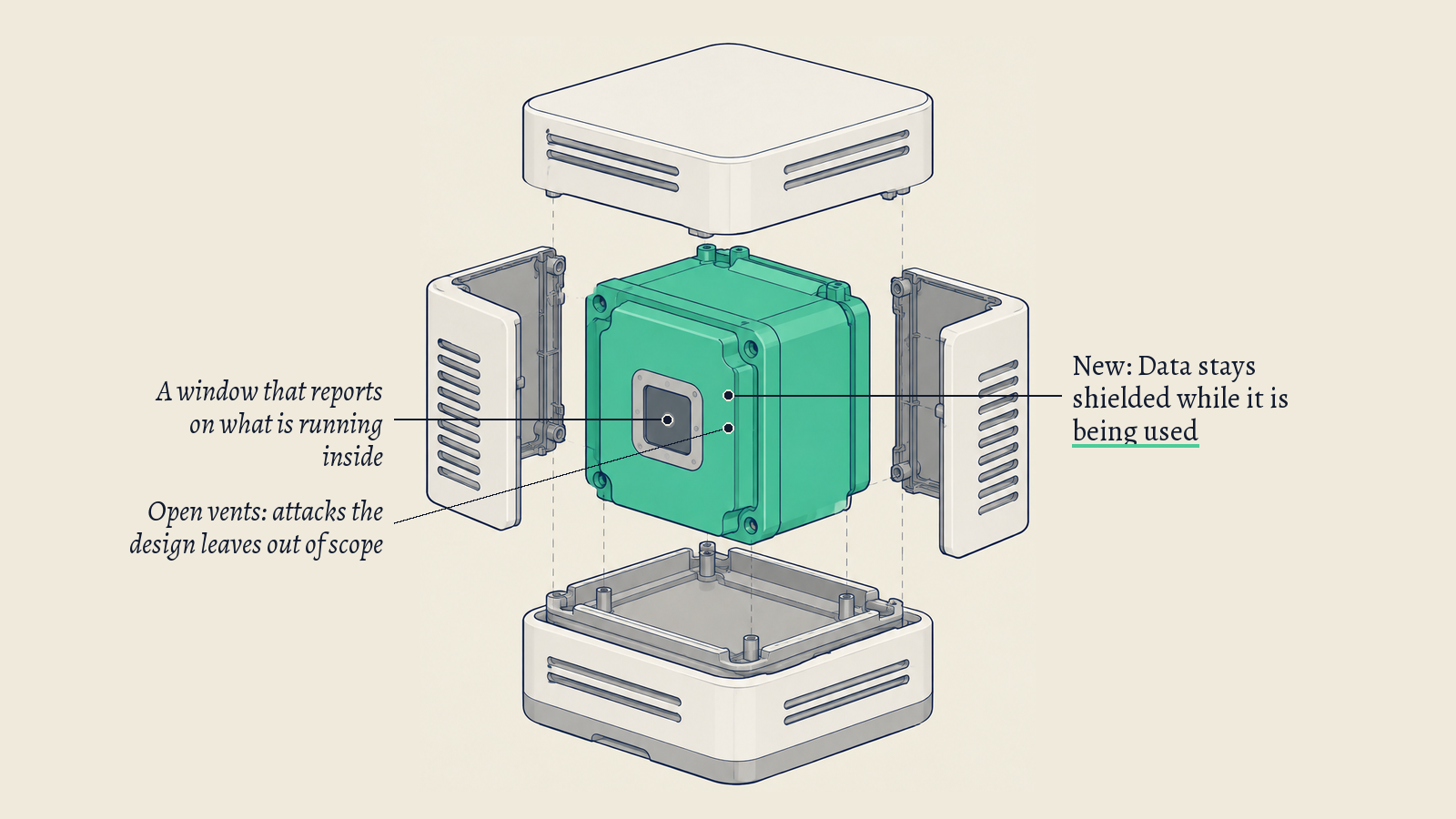 Illustration made with AI for ai notis
Key points
- The Confidential Computing Consortium's paper, version 1.3, defines it as protecting data in use by performing computation in a hardware-based, attested trusted execution environment.
- A trusted execution environment assures data confidentiality, data integrity and code integrity against unauthorised entities, including the host operating system, hypervisor, system administrators and the infrastructure owner.
- The paper treats sophisticated physical attacks, hardware supply-chain attacks and denial-of-service as generally out of scope, and says confidentiality assumes no exploitable side channels.
What happened
Google's new TPU 8tx, announced on 9 November 2026, is pitched at regulated buyers because Google says it keeps data and model weights isolated during active use. That is the promise of confidential computing.
The Confidential Computing Consortium's technical analysis (version 1.3) defines it as the protection of data in use, by performing computation in a hardware-based, attested trusted execution environment. Data in transit moves over networks and data at rest sits in storage.
The paper calls protecting data in use the third state and the new frontier, since the first two are already commonly protected with cryptography.
A trusted execution environment, or TEE, is an environment that gives a level of assurance of three properties. Data confidentiality means unauthorized entities cannot view data while it is in use inside it. Data integrity and code integrity mean they cannot add, remove or alter the data or the code running there.
The paper lists who the unauthorized entities can be: other applications on the host, the host operating system and hypervisor, system administrators, service providers, the infrastructure owner, or anyone with physical access to the hardware.
Attestation is how a customer checks the claim. The paper describes it as a process in which a verifier assesses the trustworthiness of a peer, the attester, by getting an authentic, accurate and timely report about its software and data state.
In its example the verifier sends a challenge, the trusted hardware signs evidence of the platform's state together with that challenge, and the verifier checks the signature against reference values it trusts.
The limits are written into the same paper. It treats long-term invasive physical attacks, attacks on the hardware supply chain and denial-of-service attacks as generally out of scope. It also says the confidentiality assurance rests on there being no exploitable side channels, and that researchers have demonstrated side-channel attacks on the design of certain TEEs.
The paper adds that its definition is not limited to CPUs, since trusted processing may also sit in a GPU or a network interface card, and not limited to cloud use. Google's post says TPU 8tx uses the same silicon as TPU 8t with AMD EPYC host CPUs, and gives no availability date or price.
Underlined sentences link to the facts we checked. Dotted words open a short explainer.
Fact 3 of 12 · from Confidential Computing Consortium, 1 Nov 2022
Confidential Computing is the protection of data in use by performing computation in a hardware-based, attested Trusted Execution Environment.
Fact 7 of 12 · from Confidential Computing Consortium, 1 Nov 2022
In the context of confidential computing, unauthorized entities could include other applications on the host, the host operating system and hypervisor, system administrators, service providers, and the infrastructure owner--or anyone else with physical access to the hardware.
Fact 8 of 12 · from Confidential Computing Consortium, 1 Nov 2022
Attestation is the process by which one party, called a "Verifier", assesses the trustworthiness of a potentially untrusted peer, i.e., the "Attester". ... by obtaining an authentic, accurate, and timely report about the software and data state of the Attester.
Fact 11 of 12 · from Confidential Computing Consortium, 1 Nov 2022
However, this assurance rests on some assumptions, a key one being that there are no exploitable side-channels the owner (or any other entities with access to the system) could use to infer information about the data or execution. Over the last few years, academic researchers have identified and demonstrated vulnerabilities in the design of certain TEEs that allow for side-channel attacks
Fact 12 of 12 · from Confidential Computing Consortium, 1 Nov 2022
Importantly, the definition is not limited to "cloud" uses ... It is also not limited to such trusted execution being done by any particular processor, since trusted processing might also be in various other places such as a GPU or a network interface card.
What it means for you
Our viewWhen a vendor says data is protected while in use, check which threats on the paper's list the hardware covers and which it leaves out, since physical, supply-chain and denial-of-service attacks are generally out of scope and side channels are an assumption.
Attestation is how you test the claim: a verifier receives signed evidence about the platform's state and appraises it against reference values it trusts. Google's post gives no availability date or price for TPU 8tx, so any evaluation has to wait for those.
Before relying on a confidential service, ask the provider for its attestation process and what it says about side channels.
It adds no new facts.
Your reaction
We count reactions per story and day, never who reacted. The counts help us choose what goes in the monthly issue. If you are signed in, your own page shows yours too.
We count reactions per story and day, never who reacted. They help choose what goes in the monthly issue.
Check our sources
Every sentence above is checked against these 2 sources.
1 TPU 8tx and TPU 8i Max
Open the source archived copy-
Google says TPU 8tx builds security directly into the hardware layer, keeping data and model weights isolated during active use, in a blog post of November 9, 2026.
citeBuilt on the same silicon as TPU 8t and paired with 5th Generation AMD EPYC CPU hosts, TPU 8tx builds security directly into the hardware layer, keeping sensitive data and model weights protected and isolated even while in active use.
-
Google says TPU 8tx uses the same silicon as TPU 8t and is paired with 5th Generation AMD EPYC CPU hosts, and the post gives no availability date or pricing for it.
citeBuilt on the same silicon as TPU 8t and paired with 5th Generation AMD EPYC CPU hosts
2 A Technical Analysis of Confidential Computing, v1.3
Open the source archived copy-
The Confidential Computing Consortium's technical analysis, version 1.3, defines Confidential Computing as the protection of data in use by performing computation in a hardware-based, attested Trusted Execution Environment.
citeConfidential Computing is the protection of data in use by performing computation in a hardware-based, attested Trusted Execution Environment.
-
The paper says data in transit is moving over a network, data in storage is at rest, and data being processed is in use, and that protecting data in use is the new frontier because techniques to protect data in transit and at rest are now commonly deployed.
citeData traversing the network is "in transit," data in storage is "at rest," and data being processed is "in use." ... While techniques to protect data in transit and at rest are now commonly deployed, the third state - protecting data in use - is the new frontier.
-
The paper says the CCC defines a Trusted Execution Environment as an environment that provides a level of assurance of three properties: data confidentiality, data integrity and code integrity.
citeA Trusted Execution Environment (TEE) is defined by the CCC, following common industry practice, as an environment that provides a level of assurance of the following three properties:
-
The paper defines data confidentiality as unauthorized entities not being able to view data while it is in use within the TEE, and data integrity and code integrity as unauthorized entities not being able to add, remove or alter the data or the code executing in the TEE.
citeData confidentiality: Unauthorized entities cannot view data while it is in use within the TEE. Data integrity: Unauthorized entities cannot add, remove, or alter data while it is in use within the TEE. Code integrity: Unauthorized entities cannot add, remove, or alter code executing in the TEE.
-
The paper says that in the context of confidential computing, unauthorized entities could include other applications on the host, the host operating system and hypervisor, system administrators, service providers, and the infrastructure owner, or anyone else with physical access to the hardware.
citeIn the context of confidential computing, unauthorized entities could include other applications on the host, the host operating system and hypervisor, system administrators, service providers, and the infrastructure owner--or anyone else with physical access to the hardware.
-
The paper describes attestation as the process by which one party, the Verifier, assesses the trustworthiness of a potentially untrusted peer, the Attester, by obtaining an authentic, accurate and timely report about the software and data state of the Attester.
citeAttestation is the process by which one party, called a "Verifier", assesses the trustworthiness of a potentially untrusted peer, i.e., the "Attester". ... by obtaining an authentic, accurate, and timely report about the software and data state of the Attester.
-
In the paper's example attestation protocol, the Verifier sends a challenge, the Attester's trusted hardware component gathers evidence and signs it together with the challenge, and the Verifier verifies the signature and appraises the evidence against reference values deemed trustworthy.
citethe Verifier generates a challenge and sends it to the Attester; ... The trusted hardware component gathers the evidence on the attesting platform and signs the attestation data and challenge; ... The Verifier verifies the signature and appraises the evidence by applying some appraisal policy, such as comparing the attested platform state against a set of reference values that are deemed to be trustworthy
-
The paper lists sophisticated physical attacks, upstream hardware supply-chain attacks and availability attacks such as DoS or DDoS as threat vectors generally considered out of scope for Confidential Computing.
citeThreat vectors which are generally considered to be out-of-scope for Confidential Computing include: Sophisticated physical attacks: these are physical attacks that typically require long-term and/or invasive access to hardware ... Upstream hardware supply-chain attacks ... Availability attacks (such as DoS or DDoS) attacks
-
The paper says the data confidentiality assurance of TEEs rests on assumptions, a key one being that there are no exploitable side-channels, and that academic researchers have demonstrated vulnerabilities in the design of certain TEEs that allow side-channel attacks.
citeHowever, this assurance rests on some assumptions, a key one being that there are no exploitable side-channels the owner (or any other entities with access to the system) could use to infer information about the data or execution. Over the last few years, academic researchers have identified and demonstrated vulnerabilities in the design of certain TEEs that allow for side-channel attacks
-
The paper says the definition is not limited to cloud uses and not limited to any particular processor, since trusted processing might also be in a GPU or a network interface card.
citeImportantly, the definition is not limited to "cloud" uses ... It is also not limited to such trusted execution being done by any particular processor, since trusted processing might also be in various other places such as a GPU or a network interface card.
Every sentence above is checked against these 2 sources. Each fact has its own address you can cite.
Source 1 · Google · 9 Nov 2026
TPU 8tx and TPU 8i Max
Google says TPU 8tx builds security directly into the hardware layer, keeping data and model weights isolated during active use, in a blog post of November 9, 2026.
Built on the same silicon as TPU 8t and paired with 5th Generation AMD EPYC CPU hosts, TPU 8tx builds security directly into the hardware layer, keeping sensitive data and model weights protected and isolated even while in active use.
Google says TPU 8tx uses the same silicon as TPU 8t and is paired with 5th Generation AMD EPYC CPU hosts, and the post gives no availability date or pricing for it.
Built on the same silicon as TPU 8t and paired with 5th Generation AMD EPYC CPU hosts
Source 2 · Confidential Computing Consortium · 1 Nov 2022
A Technical Analysis of Confidential Computing, v1.3
The Confidential Computing Consortium's technical analysis, version 1.3, defines Confidential Computing as the protection of data in use by performing computation in a hardware-based, attested Trusted Execution Environment.
Confidential Computing is the protection of data in use by performing computation in a hardware-based, attested Trusted Execution Environment.
The paper says data in transit is moving over a network, data in storage is at rest, and data being processed is in use, and that protecting data in use is the new frontier because techniques to protect data in transit and at rest are now commonly deployed.
Data traversing the network is "in transit," data in storage is "at rest," and data being processed is "in use." ... While techniques to protect data in transit and at rest are now commonly deployed, the third state - protecting data in use - is the new frontier.
The paper says the CCC defines a Trusted Execution Environment as an environment that provides a level of assurance of three properties: data confidentiality, data integrity and code integrity.
A Trusted Execution Environment (TEE) is defined by the CCC, following common industry practice, as an environment that provides a level of assurance of the following three properties:
Show all 10 factsShow fewer facts
The paper defines data confidentiality as unauthorized entities not being able to view data while it is in use within the TEE, and data integrity and code integrity as unauthorized entities not being able to add, remove or alter the data or the code executing in the TEE.
Data confidentiality: Unauthorized entities cannot view data while it is in use within the TEE. Data integrity: Unauthorized entities cannot add, remove, or alter data while it is in use within the TEE. Code integrity: Unauthorized entities cannot add, remove, or alter code executing in the TEE.
The paper says that in the context of confidential computing, unauthorized entities could include other applications on the host, the host operating system and hypervisor, system administrators, service providers, and the infrastructure owner, or anyone else with physical access to the hardware.
In the context of confidential computing, unauthorized entities could include other applications on the host, the host operating system and hypervisor, system administrators, service providers, and the infrastructure owner--or anyone else with physical access to the hardware.
The paper describes attestation as the process by which one party, the Verifier, assesses the trustworthiness of a potentially untrusted peer, the Attester, by obtaining an authentic, accurate and timely report about the software and data state of the Attester.
Attestation is the process by which one party, called a "Verifier", assesses the trustworthiness of a potentially untrusted peer, i.e., the "Attester". ... by obtaining an authentic, accurate, and timely report about the software and data state of the Attester.
In the paper's example attestation protocol, the Verifier sends a challenge, the Attester's trusted hardware component gathers evidence and signs it together with the challenge, and the Verifier verifies the signature and appraises the evidence against reference values deemed trustworthy.
the Verifier generates a challenge and sends it to the Attester; ... The trusted hardware component gathers the evidence on the attesting platform and signs the attestation data and challenge; ... The Verifier verifies the signature and appraises the evidence by applying some appraisal policy, such as comparing the attested platform state against a set of reference values that are deemed to be trustworthy
The paper lists sophisticated physical attacks, upstream hardware supply-chain attacks and availability attacks such as DoS or DDoS as threat vectors generally considered out of scope for Confidential Computing.
Threat vectors which are generally considered to be out-of-scope for Confidential Computing include: Sophisticated physical attacks: these are physical attacks that typically require long-term and/or invasive access to hardware ... Upstream hardware supply-chain attacks ... Availability attacks (such as DoS or DDoS) attacks
The paper says the data confidentiality assurance of TEEs rests on assumptions, a key one being that there are no exploitable side-channels, and that academic researchers have demonstrated vulnerabilities in the design of certain TEEs that allow side-channel attacks.
However, this assurance rests on some assumptions, a key one being that there are no exploitable side-channels the owner (or any other entities with access to the system) could use to infer information about the data or execution. Over the last few years, academic researchers have identified and demonstrated vulnerabilities in the design of certain TEEs that allow for side-channel attacks
The paper says the definition is not limited to cloud uses and not limited to any particular processor, since trusted processing might also be in a GPU or a network interface card.
Importantly, the definition is not limited to "cloud" uses ... It is also not limited to such trusted execution being done by any particular processor, since trusted processing might also be in various other places such as a GPU or a network interface card.
Topics
The morning email
On the mornings we publish: the three top stories and up to four short ones. Free.
We email you a link to confirm. An issue may include one sponsor, always labelled Sponsored · Advertisement. Our emails count opens and clicks, not who made them. Unsubscribe in one click. What we keep