ResearchPublished ExplainedAll news from that day
How distillation works and when it becomes an attack
Distillation trains a less capable model on a stronger one's outputs; Anthropic calls it an attack when done covertly, at industrial scale, without the original developer's authorisation.
Check our sources · 19 facts from 4 sources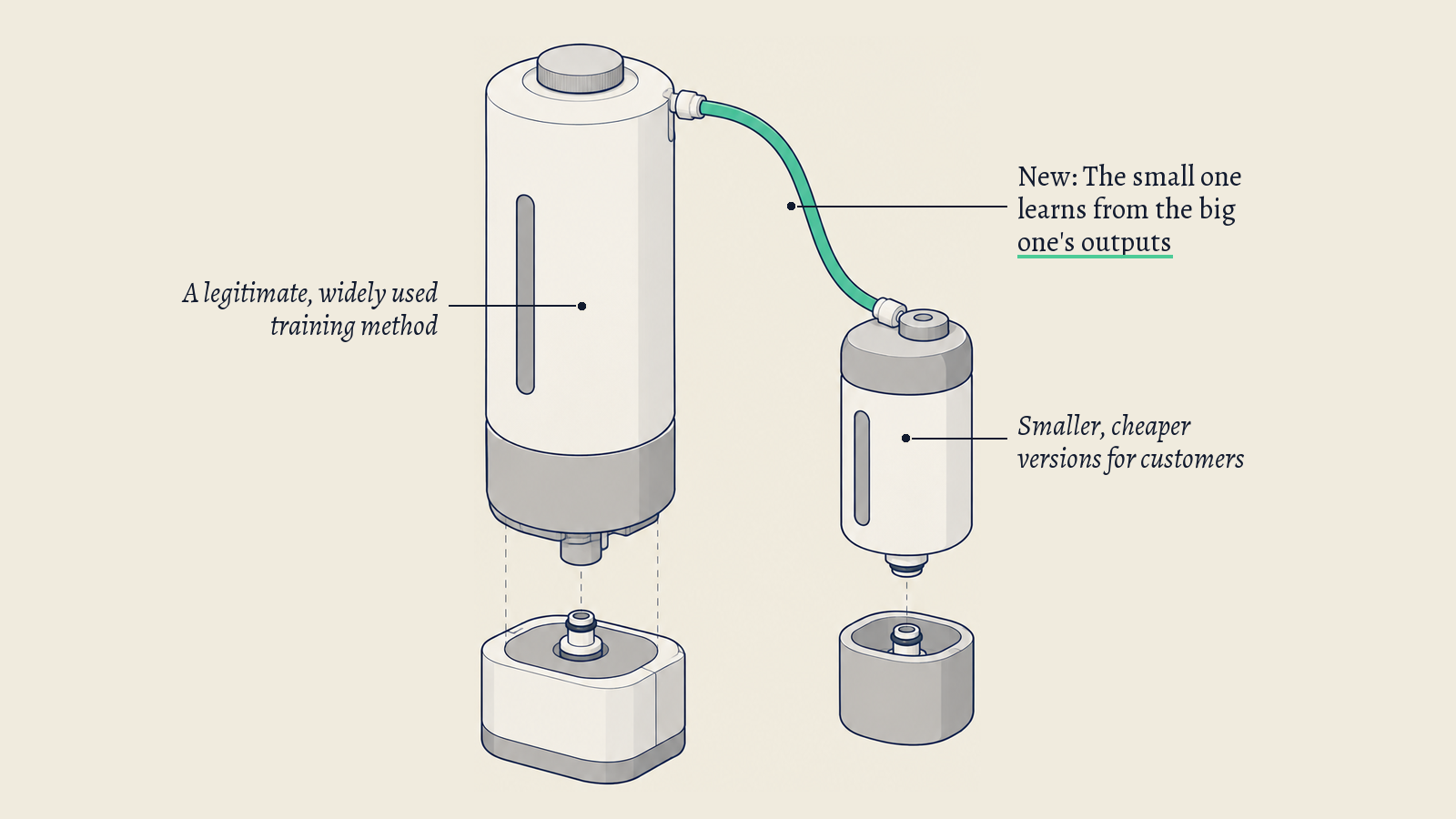 Illustration made with AI for ai notis
Key points
- Distillation means training a less capable model on the outputs of a stronger one, which Anthropic calls a widely used and legitimate training method.
- The 2015 paper by Hinton, Vinyals and Dean trains the small model on the large model's class probabilities as soft targets, using a higher temperature during training and 1 afterwards.
- In February 2026 Anthropic said DeepSeek, Moonshot and MiniMax generated over 16 million exchanges with Claude through approximately 24,000 fraudulent accounts.
What happened
Distillation means training a less capable model on the outputs of a stronger one. Anthropic calls it a widely used and legitimate training method, and says frontier labs routinely distil their own models to make smaller, cheaper versions for their customers.
The paper "Distilling the Knowledge in a Neural Network" is by Geoffrey Hinton, Oriol Vinyals and Jeff Dean, and was submitted to arXiv on 9 March 2015. Its abstract says that making predictions using a whole ensemble of models is cumbersome and may be too computationally expensive to allow deployment to a large number of users.
It says Rich Caruana and his collaborators showed that the knowledge in an ensemble can be compressed into a single model that is much easier to deploy, and that the authors develop this approach further using a different compression technique.
The paper's idea is to use the class probabilities produced by the large, cumbersome model as soft targets for training the small model. A trained model assigns probabilities to all the wrong answers too, and the paper says the relative probabilities of the incorrect answers tell us a lot about how the large model generalises.
Its example is that an image of a BMW has a very small chance of being mistaken for a garbage truck, but that is still many times more probable than mistaking it for a carrot. The paper says soft targets with high entropy give much more information per training case than hard targets.
To make those small probabilities usable, the softmax that turns scores into probabilities has a temperature, T, normally set to 1; a higher value gives a softer distribution.
The large model produces soft targets at a high temperature, the small model is trained at the same high temperature, and afterwards it uses a temperature of 1. The authors report that distilling an ensemble into one model significantly improved the acoustic model of a heavily used commercial system.
The same idea works on the outputs of a model someone else runs. In February 2026 Anthropic wrote that what distinguishes a distillation attack from normal usage is the pattern, and that illicitly distilled models lack necessary safeguards.
Anthropic attributes over 16 million exchanges with Claude, through approximately 24,000 fraudulent accounts, to three labs it names: DeepSeek, Moonshot and MiniMax.
In its 12 October post Anthropic describes such attacks as covert, industrial-scale campaigns to extract the capabilities of one model and replicate them in another, without the authorisation of the original model's developers.
In Anthropic's own test, a pretrained Claude model trained on full reasoning transcripts from Claude Opus 4.8 scored 80.4% on SWE-bench Verified, against 71.8% when trained on summarised transcripts.
By Anthropic's own estimate, on its own platform, extraction of reasoning tokens by distillers is consistently 10 to 100 times lower since it introduced a classifier.
Underlined sentences link to the facts we checked. Dotted words open a short explainer.
Fact 7 of 19 · from arXiv, 9 Mar 2015
[Submitted on 9 Mar 2015] ... Authors: Geoffrey Hinton, Oriol Vinyals, Jeff Dean
Fact 8 of 19 · from arXiv, 9 Mar 2015
Unfortunately, making predictions using a whole ensemble of models is cumbersome and may be too computationally expensive to allow deployment to a large number of users, especially if the individual models are large neural nets.
Fact 9 of 19 · from arXiv, 9 Mar 2015
Caruana and his collaborators have shown that it is possible to compress the knowledge in an ensemble into a single model which is much easier to deploy and we develop this approach further using a different compression technique.
Fact 13 of 19 · from arXiv, 9 Mar 2015
An image of a BMW, for example, may only have a very small chance of being mistaken for a garbage truck, but that mistake is still many times more probable than mistaking it for a carrot.
What it means for you
Our viewAnthropic says distillation is routine when a lab does it to its own models. Anthropic says what separates an attack from normal usage is the pattern, and the accusation against the three named labs is Anthropic's, as are its test and its estimate of what its defences achieved.
If you use a model through an API, check your provider's terms on training another model on its outputs, and whether your own heavy use could resemble the pattern a provider's safeguards block.
It adds no new facts.
Your reaction
We count reactions per story and day, never who reacted. The counts help us choose what goes in the monthly issue. If you are signed in, your own page shows yours too.
We count reactions per story and day, never who reacted. They help choose what goes in the monthly issue.
Check our sources
Every sentence above is checked against these 4 sources.
1 Detecting and preventing distillation attacks
Open the source archived copy-
Anthropic's February 2026 post describes distillation as "training a less capable model on the outputs of a stronger one."
citeFeb 23, 2026 ... These labs used a technique called "distillation," which involves training a less capable model on the outputs of a stronger one.
-
Anthropic's post says "Distillation is a widely used and legitimate training method."
citeDistillation is a widely used and legitimate training method.
-
Anthropic's post says "frontier AI labs routinely distill their own models to create smaller, cheaper versions for their customers."
citeFor example, frontier AI labs routinely distill their own models to create smaller, cheaper versions for their customers.
-
Anthropic's February 2026 post says "What distinguishes a distillation attack from normal usage is the pattern."
citeWhat distinguishes a distillation attack from normal usage is the pattern.
-
Anthropic's February 2026 post says "Illicitly distilled models lack necessary safeguards, creating significant national security risks."
citeIllicitly distilled models lack necessary safeguards, creating significant national security risks.
-
Anthropic's February 2026 post says three labs it names, DeepSeek, Moonshot and MiniMax, generated "over 16 million exchanges with Claude through approximately 24,000 fraudulent accounts."
Toned down to what the source says
citeWe have identified industrial-scale campaigns by three AI laboratories—DeepSeek, Moonshot, and MiniMax—to illicitly extract Claude's capabilities to improve their own models. These labs generated over 16 million exchanges with Claude through approximately 24,000 fraudulent accounts
2 Distilling the Knowledge in a Neural Network
Open the source archived copy-
"Distilling the Knowledge in a Neural Network" is by Geoffrey Hinton, Oriol Vinyals and Jeff Dean and was submitted to arXiv on 9 March 2015.
cite[Submitted on 9 Mar 2015] ... Authors: Geoffrey Hinton, Oriol Vinyals, Jeff Dean
-
The paper's abstract says making predictions using a whole ensemble of models "is cumbersome and may be too computationally expensive to allow deployment to a large number of users".
citeUnfortunately, making predictions using a whole ensemble of models is cumbersome and may be too computationally expensive to allow deployment to a large number of users, especially if the individual models are large neural nets.
-
The abstract says Rich Caruana and his collaborators showed that the knowledge in an ensemble can be compressed into a single model "which is much easier to deploy", and that the authors "develop this approach further using a different compression technique."
Toned down to what the source says
citeCaruana and his collaborators have shown that it is possible to compress the knowledge in an ensemble into a single model which is much easier to deploy and we develop this approach further using a different compression technique.
-
The abstract says "we can significantly improve the acoustic model of a heavily used commercial system by distilling the knowledge in an ensemble of models into a single model."
citewe show that we can significantly improve the acoustic model of a heavily used commercial system by distilling the knowledge in an ensemble of models into a single model.
3 Distilling the Knowledge in a Neural Network (full text)
Open the source archived copy-
The paper says: "An obvious way to transfer the generalization ability of the cumbersome model to a small model is to use the class probabilities produced by the cumbersome model as 'soft targets' for training the small model."
citeAn obvious way to transfer the generalization ability of the cumbersome model to a small model is to use the class probabilities produced by the cumbersome model as "soft targets" for training the small model.
-
The paper says "The relative probabilities of incorrect answers tell us a lot about how the cumbersome model tends to generalize."
citethe trained model assigns probabilities to all of the incorrect answers and even when these probabilities are very small, some of them are much larger than others. The relative probabilities of incorrect answers tell us a lot about how the cumbersome model tends to generalize.
-
The paper's example is that an image of a BMW "may only have a very small chance of being mistaken for a garbage truck, but that mistake is still many times more probable than mistaking it for a carrot."
citeAn image of a BMW, for example, may only have a very small chance of being mistaken for a garbage truck, but that mistake is still many times more probable than mistaking it for a carrot.
-
The paper says: "When the soft targets have high entropy, they provide much more information per training case than hard targets".
citeWhen the soft targets have high entropy, they provide much more information per training case than hard targets and much less variance in the gradient between training cases
-
The paper's softmax uses a temperature T, "normally set to 1", and "Using a higher value for T produces a softer probability distribution over classes."
citewhere T is a temperature that is normally set to 1. Using a higher value for T produces a softer probability distribution over classes.
-
The paper says the same high temperature "is used when training the distilled model, but after it has been trained it uses a temperature of 1."
citeusing a soft target distribution for each case in the transfer set that is produced by using the cumbersome model with a high temperature in its softmax. The same high temperature is used when training the distilled model, but after it has been trained it uses a temperature of 1.
4 Strengthening our defenses against distillation attacks
Open the source archived copy-
Anthropic's 12 October 2026 post describes distillation attacks as "covert, industrial-scale campaigns to extract the capabilities of one model and replicate them in another."
citeDistillation attacks are covert, industrial-scale campaigns to extract the capabilities of one model and replicate them in another, without the authorization of the original model's developers.
-
The 12 October post says that in Anthropic's own test a pretrained Claude model trained on full reasoning transcripts from Claude Opus 4.8 scored 80.4% on SWE-bench Verified, against 71.8% when trained on summarised transcripts.
Toned down to what the source says
citeWe tested how well a pretrained Claude model performed on the SWE-bench Verified coding benchmark after it was trained on transcripts from Claude Opus 4.8. When training on the full transcripts, the distilled model achieved 80.4%; with only the summarized transcripts, it achieved 71.8%.
-
The 12 October post says that, by Anthropic's own estimate on its own platform, after it introduced the classifier the number of reasoning tokens extracted by distillers is "consistently 10 to 100 times lower than it was before."
Toned down to what the source says
citeTo measure the effectiveness of our system, we estimate how many tokens of Claude's reasoning distillers have extracted on our own platform. After introducing the classifier, the number of reasoning tokens extracted by distillers is consistently 10 to 100 times lower than it was before
Every sentence above is checked against these 4 sources. Each fact has its own address you can cite.
Source 1 · Anthropic · 23 Feb 2026
Detecting and preventing distillation attacks
Anthropic's February 2026 post describes distillation as "training a less capable model on the outputs of a stronger one."
Feb 23, 2026 ... These labs used a technique called "distillation," which involves training a less capable model on the outputs of a stronger one.
Anthropic's post says "Distillation is a widely used and legitimate training method."
Distillation is a widely used and legitimate training method.
Anthropic's post says "frontier AI labs routinely distill their own models to create smaller, cheaper versions for their customers."
For example, frontier AI labs routinely distill their own models to create smaller, cheaper versions for their customers.
Show all 6 factsShow fewer facts
Anthropic's February 2026 post says "What distinguishes a distillation attack from normal usage is the pattern."
What distinguishes a distillation attack from normal usage is the pattern.
Anthropic's February 2026 post says "Illicitly distilled models lack necessary safeguards, creating significant national security risks."
Illicitly distilled models lack necessary safeguards, creating significant national security risks.
Anthropic's February 2026 post says three labs it names, DeepSeek, Moonshot and MiniMax, generated "over 16 million exchanges with Claude through approximately 24,000 fraudulent accounts."
Toned down to what the source saysWe have identified industrial-scale campaigns by three AI laboratories—DeepSeek, Moonshot, and MiniMax—to illicitly extract Claude's capabilities to improve their own models. These labs generated over 16 million exchanges with Claude through approximately 24,000 fraudulent accounts
Source 2 · arXiv · 9 Mar 2015
Distilling the Knowledge in a Neural Network
"Distilling the Knowledge in a Neural Network" is by Geoffrey Hinton, Oriol Vinyals and Jeff Dean and was submitted to arXiv on 9 March 2015.
[Submitted on 9 Mar 2015] ... Authors: Geoffrey Hinton, Oriol Vinyals, Jeff Dean
The paper's abstract says making predictions using a whole ensemble of models "is cumbersome and may be too computationally expensive to allow deployment to a large number of users".
Unfortunately, making predictions using a whole ensemble of models is cumbersome and may be too computationally expensive to allow deployment to a large number of users, especially if the individual models are large neural nets.
The abstract says Rich Caruana and his collaborators showed that the knowledge in an ensemble can be compressed into a single model "which is much easier to deploy", and that the authors "develop this approach further using a different compression technique."
Toned down to what the source saysCaruana and his collaborators have shown that it is possible to compress the knowledge in an ensemble into a single model which is much easier to deploy and we develop this approach further using a different compression technique.
Show all 4 factsShow fewer facts
The abstract says "we can significantly improve the acoustic model of a heavily used commercial system by distilling the knowledge in an ensemble of models into a single model."
we show that we can significantly improve the acoustic model of a heavily used commercial system by distilling the knowledge in an ensemble of models into a single model.
Source 3 · arXiv · 9 Mar 2015
Distilling the Knowledge in a Neural Network (full text)
The paper says: "An obvious way to transfer the generalization ability of the cumbersome model to a small model is to use the class probabilities produced by the cumbersome model as 'soft targets' for training the small model."
An obvious way to transfer the generalization ability of the cumbersome model to a small model is to use the class probabilities produced by the cumbersome model as "soft targets" for training the small model.
The paper says "The relative probabilities of incorrect answers tell us a lot about how the cumbersome model tends to generalize."
the trained model assigns probabilities to all of the incorrect answers and even when these probabilities are very small, some of them are much larger than others. The relative probabilities of incorrect answers tell us a lot about how the cumbersome model tends to generalize.
The paper's example is that an image of a BMW "may only have a very small chance of being mistaken for a garbage truck, but that mistake is still many times more probable than mistaking it for a carrot."
An image of a BMW, for example, may only have a very small chance of being mistaken for a garbage truck, but that mistake is still many times more probable than mistaking it for a carrot.
Show all 6 factsShow fewer facts
The paper says: "When the soft targets have high entropy, they provide much more information per training case than hard targets".
When the soft targets have high entropy, they provide much more information per training case than hard targets and much less variance in the gradient between training cases
The paper's softmax uses a temperature T, "normally set to 1", and "Using a higher value for T produces a softer probability distribution over classes."
where T is a temperature that is normally set to 1. Using a higher value for T produces a softer probability distribution over classes.
The paper says the same high temperature "is used when training the distilled model, but after it has been trained it uses a temperature of 1."
using a soft target distribution for each case in the transfer set that is produced by using the cumbersome model with a high temperature in its softmax. The same high temperature is used when training the distilled model, but after it has been trained it uses a temperature of 1.
Source 4 · Anthropic · 12 Oct 2026
Strengthening our defenses against distillation attacks
Anthropic's 12 October 2026 post describes distillation attacks as "covert, industrial-scale campaigns to extract the capabilities of one model and replicate them in another."
Distillation attacks are covert, industrial-scale campaigns to extract the capabilities of one model and replicate them in another, without the authorization of the original model's developers.
The 12 October post says that in Anthropic's own test a pretrained Claude model trained on full reasoning transcripts from Claude Opus 4.8 scored 80.4% on SWE-bench Verified, against 71.8% when trained on summarised transcripts.
Toned down to what the source saysWe tested how well a pretrained Claude model performed on the SWE-bench Verified coding benchmark after it was trained on transcripts from Claude Opus 4.8. When training on the full transcripts, the distilled model achieved 80.4%; with only the summarized transcripts, it achieved 71.8%.
The 12 October post says that, by Anthropic's own estimate on its own platform, after it introduced the classifier the number of reasoning tokens extracted by distillers is "consistently 10 to 100 times lower than it was before."
Toned down to what the source saysTo measure the effectiveness of our system, we estimate how many tokens of Claude's reasoning distillers have extracted on our own platform. After introducing the classifier, the number of reasoning tokens extracted by distillers is consistently 10 to 100 times lower than it was before
Topics
The morning email
On the mornings we publish: the three top stories and up to four short ones. Free.
We email you a link to confirm. An issue may include one sponsor, always labelled Sponsored · Advertisement. Our emails count opens and clicks, not who made them. Unsubscribe in one click. What we keep