SafetyPublished ExplainedAll news from that day
What an LLM router can read, and the settings that limit it
A router ends the connection to the model, so it reads requests in plain text; a study of 428 routers and OpenRouter's documents show what limits that.
Check our sources · 22 facts from 4 sources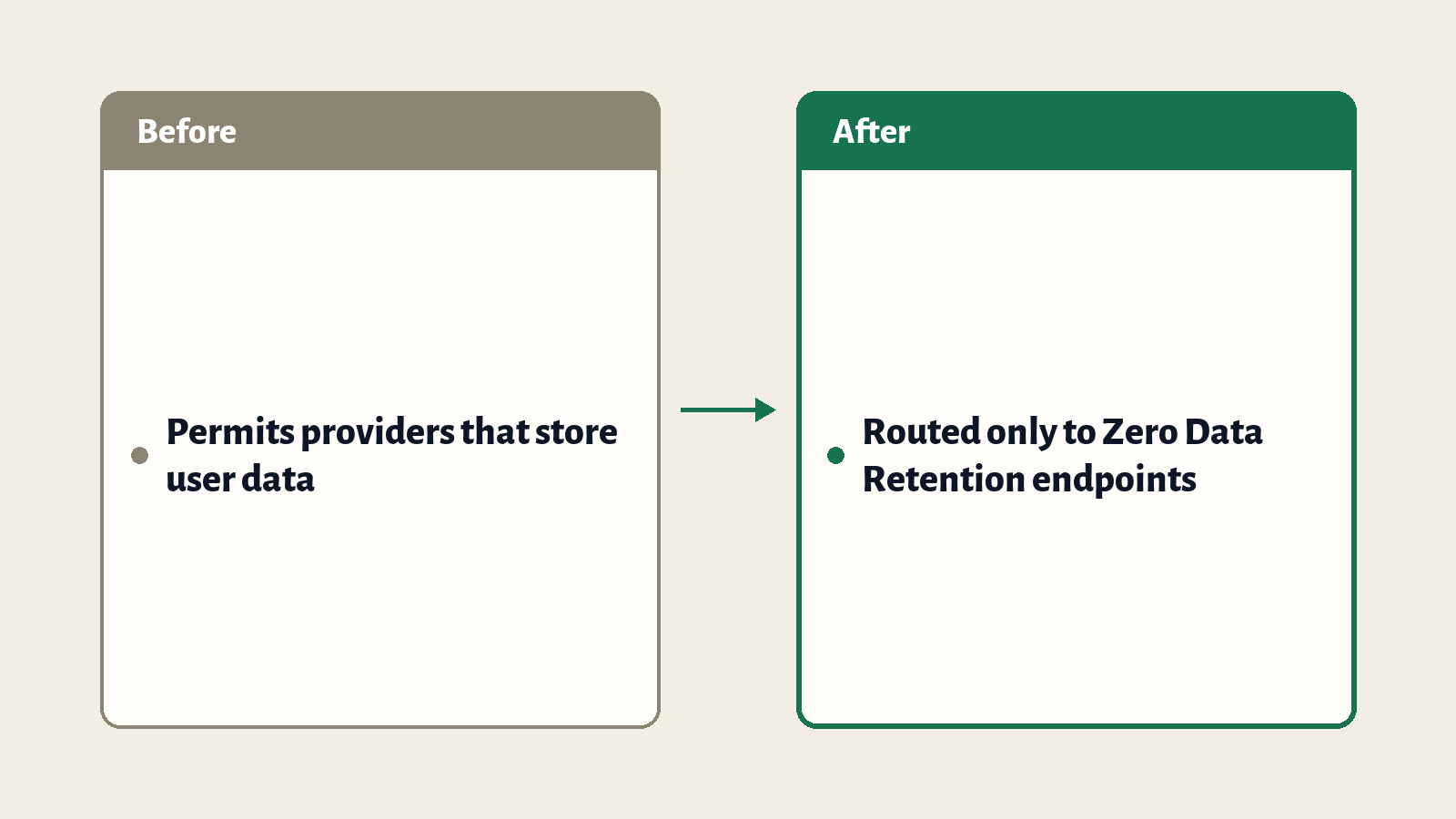 Drawing: notis. No AI in this picture.
Key points
- A router ends the client's connection and opens a separate one upstream, so it can access tool definitions, prompts, tool outputs, API keys and returned tool-call payloads, the paper says.
- In the paper's test of 428 routers, 9 injected malicious code and 17 abused researcher-owned credentials; one free router drained ETH from a researcher-owned private key.
- OpenRouter's data_collection setting defaults to "allow"; "deny" uses only providers that do not collect user data, and zdr set to true restricts routing to zero-data-retention endpoints.
What happened
OpenRouter said on 22 November that it off-boarded three providers and removed 125 endpoints from zero-data-retention eligibility, after researchers reported that some providers' data policies were not being upheld. The question behind it is what a router, or the provider behind it, can read of what you send.
In the paper's measurement of 428 commodity routers, researchers found 9 that injected malicious code and 17 that abused researcher-owned credentials. One router drained cryptocurrency from a researcher-owned key. The study, "Your Agent Is Mine", was posted to arXiv on 9 April 2026 and is listed for the ACM CCS '26 conference.
An LLM API router is a service that sits between an application and the companies that run models. The paper describes routers as letting developers "aggregate dozens of providers behind a single base-URL change", and the 428 it tested were 28 paid ones from Taobao, Xianyu and Shopify storefronts and 400 free ones.
A router can read what passes through it because it ends the connection from the application. The paper says "the router terminates the client-side TLS connection" and opens "a separate TLS connection upstream", so no certificate forgery is needed: the client itself is configured with the router's address.
The paper lists what the router can access as "tool definitions, prompts, tool outputs, API keys, and returned tool-call payloads", and says no cryptographic integrity check exists between client and model.
That gives two kinds of attack, in the paper's terms: payload injection, where the router changes what comes back, and secret exfiltration, where it copies what goes through. In one poisoning study, a researcher-owned OpenAI key that the researchers leaked on purpose generated 100M GPT-5.4 tokens.
In another, decoy routers exposed 99 unique credentials across 440 Codex sessions, and 401 of the 440 ran in YOLO mode, where tool calls run without approval.
OpenRouter's own privacy policy describes the same hand-off: "those Inputs are transmitted to the Model Provider you select". It also says OpenRouter does not use inputs or outputs for model training, and that some model providers may. The paper describes OpenRouter as a service that connects users to more than 300 active models from over 60 providers.
OpenRouter's documentation gives a request-level control over which providers see your data. Its data_collection setting defaults to "allow", which permits providers that store user data and may train on it; "deny" uses only providers that do not collect user data. Setting zdr to true restricts routing to zero-data-retention endpoints, and the only and ignore lists name which providers a request may use or skip.
The paper tested three client-side defences: a fail-closed policy gate, response-side anomaly screening and append-only transparency logging. The policy gate for high-risk tools blocked every AC-1 and AC-1.a shell-rewrite sample at a 1.0% false-positive rate, but a simple adaptive test bypassed it in 100% of samples.
Transparency logging cost 12.0 MB per 1,000 sessions and helps trace what happened, but does not stop manipulation.
Underlined sentences link to the facts we checked. Dotted words open a short explainer.
Fact 10 of 22 · from arXiv, 9 Apr 2026
We intentionally leaked a researcher-owned OpenAI key on Chinese forums and in WeChat and Telegram groups; that single key generated 100M GPT-5.4 tokens and more than seven Codex sessions.
Fact 15 of 22 · from arXiv, 9 Apr 2026
Our measurement of 428 commodity routers found 9 injecting malicious code and 17 abusing researcher-owned credentials
What it means for you
Our viewTreat any router as a party that can read everything you send it, and set controls on each request.
The paper's policy gate for high-risk tools blocked every tested shell-rewrite sample at a 1.0% false-positive rate but was bypassed in a simple adaptive test, and transparency logging helps trace what happened without stopping manipulation.
So the settings above limit which providers see a request, and do not replace checks on what your agents run. This week, list the providers your routing allows and set the only or ignore lists to match.
It adds no new facts.
Your reaction
We count reactions per story and day, never who reacted. The counts help us choose what goes in the monthly issue. If you are signed in, your own page shows yours too.
We count reactions per story and day, never who reacted. They help choose what goes in the monthly issue.
Check our sources
Every sentence above is checked against these 4 sources.
1 Your Agent Is Mine: Measuring Malicious Intermediary Attacks on the LLM Supply Chain
Open the source archived copy-
The arXiv paper "Your Agent Is Mine: Measuring Malicious Intermediary Attacks on the LLM Supply Chain" (arXiv:2604.08407, v1) was submitted on 9 April 2026, and its metadata lists the ACM Conference on Computer and Communications Security (CCS '26).
citeYour Agent Is Mine: Measuring Malicious Intermediary Attacks on the LLM Supply Chain ... arXiv:2604.08407v1 ... 09 Apr 2026 ... Conference: ACM Conference on Computer and Communications Security; October 2026; Salt Lake City, UT, USA
-
The paper tested 28 paid routers (from Taobao, Xianyu and Shopify storefronts) and 400 free routers.
citeAcross 28 paid routers purchased from Taobao, Xianyu, and Shopify-hosted storefronts and 400 free routers collected from public communities
-
The paper reports that 1 paid and 8 free routers injected malicious code, and that 17 free routers touched researcher-owned AWS canary credentials.
citewe find 1 paid and 8 free routers actively injecting malicious code ... Among the free-router set, 17 routers touch at least one researcher-owned AWS canary credential
-
The paper reports that one free router drained ETH from a researcher-owned private key.
cite1 drains ETH from a researcher-owned Ethereum private key
-
The paper describes routers as letting developers "aggregate dozens of providers behind a single base-URL change" (section 2.1).
citeLiteLLM (BerriAI, 2024) and OpenRouter (OpenRouter, 2024) let individual developers and startups aggregate dozens of providers behind a single base-URL change.
-
The paper's section 1 says "the router terminates the client-side TLS connection" and then opens "a separate TLS connection upstream", and that no TLS downgrade or certificate forgery is needed because the client configures the router's URL itself.
citeUnlike a traditional network MITM, no TLS downgrade or certificate forgery is required: the client voluntarily configures the router's URL as the API endpoint, the router terminates the client-side TLS connection, and it originates a separate TLS connection upstream.
-
The paper's abstract says routers have "full plaintext access to every in-flight JSON payload" and that no cryptographic integrity check exists between client and model.
citeThese routers operate as application-layer proxies with full plaintext access to every in-flight JSON payload, yet no provider enforces cryptographic integrity between client and upstream model.
-
The paper's section 3 lists what the router can access as "tool definitions, prompts, tool outputs, API keys, and returned tool-call payloads".
citeThis includes tool definitions, prompts, tool outputs, API keys, and returned tool-call payloads across OpenAI-, Anthropic-, and Gemini-style interfaces.
-
The paper defines two core attack classes, payload injection and secret exfiltration, plus two adaptive evasion variants.
cite4.1.1 AC-1: Response-Side Payload Injection 4.1.2 AC-2: Passive Secret Exfiltration 4.2 Adaptive Evasion Variants 4.2.1 AC-1.a: Dependency-Targeted Injection ... AC-1.b: Conditional Delivery
-
The paper says a researcher-owned OpenAI key it leaked on purpose generated 100M GPT-5.4 tokens.
Toned down to what the source says
citeWe intentionally leaked a researcher-owned OpenAI key on Chinese forums and in WeChat and Telegram groups; that single key generated 100M GPT-5.4 tokens and more than seven Codex sessions.
-
The paper's section 5.3 says decoy weak routers exposed "99 unique credentials across 440 Codex sessions spanning 398 different projects or hosts", and that 401 of the 440 sessions ran in YOLO mode, meaning tool execution was auto-approved.
citeexposed 99 unique credentials across 440 Codex sessions spanning 398 different projects or hosts. All 440 sessions were command-injectable, and 401 already operated in [autonomous YOLO mode]
-
The paper's section 1 describes OpenRouter as a service that connects users to more than 300 active models from over 60 providers.
citeOpenRouter (OpenRouter, 2024) connects users to more than 300 active models from over 60 providers
-
The paper's section 7.1 says its high-risk tool policy gate blocks every AC-1 and AC-1.a sample with a 1.0% false positive rate, and that it was bypassed in 100% of samples in a simple adaptive benchmark.
citeA fail-closed policy gate blocks all AC-1 and AC-1.a shell-rewrite samples at 1.0% false positives ... In a simple adaptive benchmark that uses those two strategies, the policy gate is bypassed in 100% of samples.
-
The paper's section 7.3 says append-only transparency logging costs 12.0 MB per 1,000 sessions, aids forensic scoping and does not prevent manipulation.
citeTransparency log Audit ... 12.0 MB/1k sessions; 1.26 KB/entry
-
The paper's conclusion says its measurement of 428 commodity routers found 9 injecting malicious code and 17 abusing researcher-owned credentials.
citeOur measurement of 428 commodity routers found 9 injecting malicious code and 17 abusing researcher-owned credentials
-
The paper's abstract says its Mine research proxy was used to evaluate three deployable client-side defenses: a fail-closed policy gate, response-side anomaly screening, and append-only transparency logging.
citeWe build Mine, a research proxy that implements all four attack classes against four public agent frameworks, and use it to evaluate three deployable client-side defenses: a fail-closed policy gate, response-side anomaly screening, and append-only transparency logging.
2 Privacy Policy
Open the source archived copy-
OpenRouter's privacy policy says: "When you submit Inputs through the Service, those Inputs are transmitted to the Model Provider you select, or that is selected through automatic routing, as applicable."
Toned down to what the source says
citeWhen you submit Inputs through the Service, those Inputs are transmitted to the Model Provider you select, or that is selected through automatic routing, as applicable.
-
OpenRouter's privacy policy says "OpenRouter does not use your Inputs or Outputs for model training" and that some Model Providers may use inputs and outputs for model training or improvement.
citeOpenRouter does not use your Inputs or Outputs for model training. ... Some Model Providers may use your Inputs and Outputs for model training or improvement.
3 Provider Routing, OpenRouter documentation
Open the source archived copy-
OpenRouter's provider-routing documentation lists data_collection as "allow" or "deny", with "allow" the default, which permits providers that store user data non-transiently and may train on it, and "deny" which uses only providers that do not collect user data.
citedata_collection allow | deny, default allow: Control whether to use providers that may store data. allow: (default) allow providers which store user data non-transiently and may train on it. deny: use only providers which do not collect user data
-
OpenRouter's provider-routing documentation says that when zdr is set to true the request is routed only to Zero Data Retention endpoints, and lists only and ignore as string arrays of provider slugs to allow or skip for a request.
citezdr boolean - Restrict routing to only ZDR (Zero Data Retention) endpoints. ... only string[] - List of provider slugs to allow for this request. ... ignore string[] - List of provider slugs to skip for this request.
4 Data Processing Incidents on Inference Providers
Open the source archived copy-
OpenRouter's post of 22 November 2026 says it off-boarded three providers after security researchers reported that certain inference providers had data compromised or showed evidence that their data policies were not being upheld.
citeOff-boarded three providers from OpenRouter, based on the results of our investigations. ... certain inference providers had data compromised or otherwise shown evidence that their data policies were not being upheld
-
OpenRouter's post of 22 November 2026 says it removed 125 endpoints from Zero Data Retention (ZDR) eligibility.
citeRemoved 125 endpoints from Zero Data Retention (ZDR) eligibility.
Every sentence above is checked against these 4 sources. Each fact has its own address you can cite.
Source 1 · arXiv · 9 Apr 2026
Your Agent Is Mine: Measuring Malicious Intermediary Attacks on the LLM Supply Chain
The arXiv paper "Your Agent Is Mine: Measuring Malicious Intermediary Attacks on the LLM Supply Chain" (arXiv:2604.08407, v1) was submitted on 9 April 2026, and its metadata lists the ACM Conference on Computer and Communications Security (CCS '26).
Your Agent Is Mine: Measuring Malicious Intermediary Attacks on the LLM Supply Chain ... arXiv:2604.08407v1 ... 09 Apr 2026 ... Conference: ACM Conference on Computer and Communications Security; October 2026; Salt Lake City, UT, USA
The paper tested 28 paid routers (from Taobao, Xianyu and Shopify storefronts) and 400 free routers.
Across 28 paid routers purchased from Taobao, Xianyu, and Shopify-hosted storefronts and 400 free routers collected from public communities
The paper reports that 1 paid and 8 free routers injected malicious code, and that 17 free routers touched researcher-owned AWS canary credentials.
we find 1 paid and 8 free routers actively injecting malicious code ... Among the free-router set, 17 routers touch at least one researcher-owned AWS canary credential
Show all 16 factsShow fewer facts
The paper reports that one free router drained ETH from a researcher-owned private key.
1 drains ETH from a researcher-owned Ethereum private key
The paper describes routers as letting developers "aggregate dozens of providers behind a single base-URL change" (section 2.1).
LiteLLM (BerriAI, 2024) and OpenRouter (OpenRouter, 2024) let individual developers and startups aggregate dozens of providers behind a single base-URL change.
The paper's section 1 says "the router terminates the client-side TLS connection" and then opens "a separate TLS connection upstream", and that no TLS downgrade or certificate forgery is needed because the client configures the router's URL itself.
Unlike a traditional network MITM, no TLS downgrade or certificate forgery is required: the client voluntarily configures the router's URL as the API endpoint, the router terminates the client-side TLS connection, and it originates a separate TLS connection upstream.
The paper's abstract says routers have "full plaintext access to every in-flight JSON payload" and that no cryptographic integrity check exists between client and model.
These routers operate as application-layer proxies with full plaintext access to every in-flight JSON payload, yet no provider enforces cryptographic integrity between client and upstream model.
The paper's section 3 lists what the router can access as "tool definitions, prompts, tool outputs, API keys, and returned tool-call payloads".
This includes tool definitions, prompts, tool outputs, API keys, and returned tool-call payloads across OpenAI-, Anthropic-, and Gemini-style interfaces.
The paper defines two core attack classes, payload injection and secret exfiltration, plus two adaptive evasion variants.
4.1.1 AC-1: Response-Side Payload Injection 4.1.2 AC-2: Passive Secret Exfiltration 4.2 Adaptive Evasion Variants 4.2.1 AC-1.a: Dependency-Targeted Injection ... AC-1.b: Conditional Delivery
The paper says a researcher-owned OpenAI key it leaked on purpose generated 100M GPT-5.4 tokens.
Toned down to what the source saysWe intentionally leaked a researcher-owned OpenAI key on Chinese forums and in WeChat and Telegram groups; that single key generated 100M GPT-5.4 tokens and more than seven Codex sessions.
The paper's section 5.3 says decoy weak routers exposed "99 unique credentials across 440 Codex sessions spanning 398 different projects or hosts", and that 401 of the 440 sessions ran in YOLO mode, meaning tool execution was auto-approved.
exposed 99 unique credentials across 440 Codex sessions spanning 398 different projects or hosts. All 440 sessions were command-injectable, and 401 already operated in [autonomous YOLO mode]
The paper's section 1 describes OpenRouter as a service that connects users to more than 300 active models from over 60 providers.
OpenRouter (OpenRouter, 2024) connects users to more than 300 active models from over 60 providers
The paper's section 7.1 says its high-risk tool policy gate blocks every AC-1 and AC-1.a sample with a 1.0% false positive rate, and that it was bypassed in 100% of samples in a simple adaptive benchmark.
A fail-closed policy gate blocks all AC-1 and AC-1.a shell-rewrite samples at 1.0% false positives ... In a simple adaptive benchmark that uses those two strategies, the policy gate is bypassed in 100% of samples.
The paper's section 7.3 says append-only transparency logging costs 12.0 MB per 1,000 sessions, aids forensic scoping and does not prevent manipulation.
Transparency log Audit ... 12.0 MB/1k sessions; 1.26 KB/entry
The paper's conclusion says its measurement of 428 commodity routers found 9 injecting malicious code and 17 abusing researcher-owned credentials.
Our measurement of 428 commodity routers found 9 injecting malicious code and 17 abusing researcher-owned credentials
The paper's abstract says its Mine research proxy was used to evaluate three deployable client-side defenses: a fail-closed policy gate, response-side anomaly screening, and append-only transparency logging.
We build Mine, a research proxy that implements all four attack classes against four public agent frameworks, and use it to evaluate three deployable client-side defenses: a fail-closed policy gate, response-side anomaly screening, and append-only transparency logging.
Source 2 · OpenRouter
Privacy Policy
OpenRouter's privacy policy says: "When you submit Inputs through the Service, those Inputs are transmitted to the Model Provider you select, or that is selected through automatic routing, as applicable."
Toned down to what the source saysWhen you submit Inputs through the Service, those Inputs are transmitted to the Model Provider you select, or that is selected through automatic routing, as applicable.
OpenRouter's privacy policy says "OpenRouter does not use your Inputs or Outputs for model training" and that some Model Providers may use inputs and outputs for model training or improvement.
OpenRouter does not use your Inputs or Outputs for model training. ... Some Model Providers may use your Inputs and Outputs for model training or improvement.
Source 3 · OpenRouter
Provider Routing, OpenRouter documentation
OpenRouter's provider-routing documentation lists data_collection as "allow" or "deny", with "allow" the default, which permits providers that store user data non-transiently and may train on it, and "deny" which uses only providers that do not collect user data.
data_collection allow | deny, default allow: Control whether to use providers that may store data. allow: (default) allow providers which store user data non-transiently and may train on it. deny: use only providers which do not collect user data
OpenRouter's provider-routing documentation says that when zdr is set to true the request is routed only to Zero Data Retention endpoints, and lists only and ignore as string arrays of provider slugs to allow or skip for a request.
zdr boolean - Restrict routing to only ZDR (Zero Data Retention) endpoints. ... only string[] - List of provider slugs to allow for this request. ... ignore string[] - List of provider slugs to skip for this request.
Source 4 · OpenRouter · 22 Nov 2026
Data Processing Incidents on Inference Providers
OpenRouter's post of 22 November 2026 says it off-boarded three providers after security researchers reported that certain inference providers had data compromised or showed evidence that their data policies were not being upheld.
Off-boarded three providers from OpenRouter, based on the results of our investigations. ... certain inference providers had data compromised or otherwise shown evidence that their data policies were not being upheld
OpenRouter's post of 22 November 2026 says it removed 125 endpoints from Zero Data Retention (ZDR) eligibility.
Removed 125 endpoints from Zero Data Retention (ZDR) eligibility.
Topics
The morning email
On the mornings we publish: the three top stories and up to four short ones. Free.
We email you a link to confirm. An issue may include one sponsor, always labelled Sponsored · Advertisement. Our emails count opens and clicks, not who made them. Unsubscribe in one click. What we keep