ToolingPublished ExplainedAll news from that day
What zero data retention covers and excludes in Anthropic's and OpenAI's APIs
Anthropic defines zero data retention as not storing prompts or responses at rest after answering, OpenAI as keeping approved customers' content out of abuse logs, and each applies per feature.
Check our sources · 22 facts from 5 sources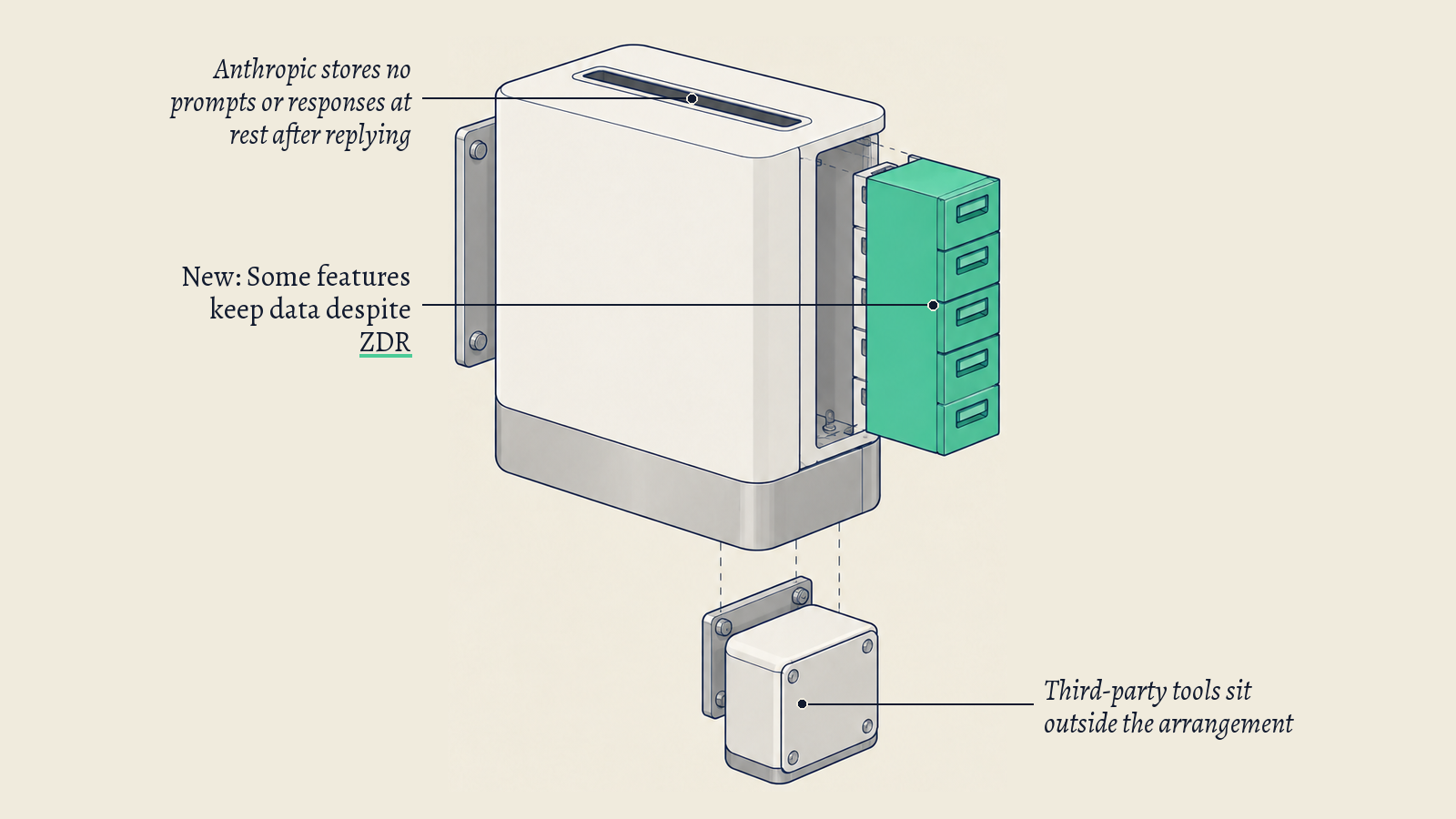 Illustration made with AI for ai notis
Key points
- Anthropic says that under zero data retention it does not store prompts or responses at rest after the API response is returned, and enables it for each organization separately.
- OpenAI says its abuse monitoring logs keep content for up to 30 days by default; approved ZDR customers are excluded, and the store parameter is always treated as false.
- Both providers list features outside ZDR: Anthropic's Batch API, Files API and code execution tool, and OpenAI's Conversations, Files and Batches endpoints.
What happened
Fireworks AI says it has not detected any impact, on its investigation to date, to the parts of its platform that are zero data retention by default, yet attackers still reached billing information and, for certain customers, datasets and incomplete model weights through an internal application. The case shows what the term does and does not promise.
Zero data retention, or ZDR, is an arrangement with an AI provider about what it keeps after answering, and each provider defines it for itself. Anthropic's documentation defines it as Anthropic not storing customer prompts or responses at rest after the API response is returned.
It is not a default: Anthropic enables it for one organization at a time through its account team, and each new organization needs it enabled separately.
OpenAI's page describes its Zero Data Retention control in different terms: eligible customers it approves can have their content excluded from its abuse monitoring logs. The control is subject to prior approval by OpenAI.
Anthropic says ZDR applies to the Messages and Token Counting APIs for eligible features, and to Claude Code used with API keys from a commercial organization.
Features that must keep state are marked not eligible: the Batch API holds data for 29 days, the Files API until the file is deleted or reaches its configured expiration, and code execution containers for up to 30 days. Anthropic says nothing blocks a request that uses one of them.
Using it is a choice to step outside ZDR for that data.
OpenAI starts from a different default. Its abuse monitoring logs, which may hold prompts and responses, are kept for up to 30 days, and approved customers can have their content excluded by choosing Zero Data Retention or Modified Abuse Monitoring.
Under ZDR the store parameter on the Responses and Chat Completions endpoints is always treated as false. OpenAI's table lists endpoints that keep state until deleted, such as Conversations, Files and Batches, as not ZDR-eligible.
Neither promise is absolute. Anthropic says it may retain data where the law requires it or where its safety systems flag it, and may keep a flagged chat's inputs and outputs for up to two years.
Its Fable 5.2 and Mythos 5.2 models, among others, require 30-day retention and are not available under ZDR unless Anthropic expressly authorizes it, though an organization with ZDR can turn on 30-day retention for a single workspace.
OpenAI says it reserves the right to make models ineligible for ZDR for specific customers, with advance written notice.
This week's launches show the edges. Anthropic says Claude Meetings is not available in the beta to organizations with ZDR, and its retention page lists Claude Managed Agents as not eligible because session transcripts persist until deleted, with self-hosted Managed Agents the exception because the customer stores them.
To check a product, look up each feature you use, not the product's name. Anthropic says third-party integrations are not covered, and OpenAI says data sent to a remote MCP server is subject to that server's own retention policy. Fireworks' first bulletin said it does not store prompts or outputs by default because its platform is ZDR, and its later update shows data of other kinds was still reached.
Underlined sentences link to the facts we checked. Dotted words open a short explainer.
Fact 6 of 22 · from Anthropic
Claude Messages and Token Counting APIs: ZDR applies to these endpoints for eligible features listed in the feature eligibility table. ... Claude Code with API keys: ZDR applies when Claude Code is used with API keys from a Commercial organization
Fact 12 of 22 · from Anthropic
Claude Managed Agents: Claude Managed Agents is a stateful resource; session transcripts persist until you delete them. The exception is self-hosted Claude Managed Agents, where you store the transcripts yourself
What it means for you
Our viewFireworks says it has not detected impact, on its investigation to date, to the products it describes as zero data retention by default. The internal application the attackers reached still gave access to billing information and, for certain customers, a subset of incomplete model weights and datasets.
Anthropic's definition covers prompts and responses at rest, and each provider's eligibility table is feature by feature. Anthropic also says third-party integrations are not covered, and OpenAI says data sent to a remote MCP server follows that server's own retention policy.
For each AI product you use, list the features you rely on and check each one against the provider's eligibility table.
It adds no new facts.
Your reaction
We count reactions per story and day, never who reacted. The counts help us choose what goes in the monthly issue. If you are signed in, your own page shows yours too.
We count reactions per story and day, never who reacted. They help choose what goes in the monthly issue.
Check our sources
Every sentence above is checked against these 5 sources.
1 Update on October 2026 security incident (Fireworks bulletin, last updated 9 November 2026)
Open the source archived copy-
Fireworks' update (last updated November 9, 2026) says it has not detected any impact to Inference, Training SDK and Nexus, which are all zero data retention (ZDR) by default.
citeWe have not detected any impact to Inference, Training SDK and Nexus, which are all zero data retention (ZDR) by default.
-
Fireworks says the affected internal application provided access to resource metadata, billing information, and for certain customers a subset of incomplete model weights and datasets.
citeThe affected internal application provided access to the following categories of information: Resource metadata ... Billing information ... Model weights and datasets, for certain customers, a subset of incomplete model weights and datasets were accessed.
-
Fireworks' update says that after its first bulletin it discovered impacts to account and billing information, and for a limited set of accounts to secrets, datasets and incomplete models.
citeSince then, we discovered impacts to account and billing information. For a limited set of accounts, we also discovered impact to secrets, datasets, and incomplete models.
2 API and data retention (Claude Platform docs)
Open the source archived copy-
Anthropic's API and data retention page says that under a ZDR arrangement Anthropic does not store customer prompts or responses at rest after the API response is returned.
citeUnder a ZDR arrangement, Anthropic does not store customer prompts or responses at rest after the API response is returned.
-
The page says ZDR is enabled per organization by the Anthropic account team, that each new organization requires ZDR to be enabled separately, and that enablement does not automatically extend to other organizations under the same account.
citeZDR is enabled per organization; each new organization requires ZDR to be enabled separately by your account team, and enablement does not automatically extend to other organizations under the same account.
-
The page says ZDR applies to the Claude Messages and Token Counting APIs for eligible features, and to Claude Code used with API keys from a Commercial organization.
citeClaude Messages and Token Counting APIs: ZDR applies to these endpoints for eligible features listed in the feature eligibility table. ... Claude Code with API keys: ZDR applies when Claude Code is used with API keys from a Commercial organization
-
The page's feature table lists Batch processing as not ZDR eligible with 29-day retention, the Files API as not eligible with files retained until explicitly deleted or expired, and the code execution tool as not eligible with container data retained up to 30 days.
citeBatch processing /v1/messages/batches No No 29-day retention; async storage required. ... Files API /v1/files No No Files retained until explicitly deleted or they reach their configured expiration. ... Code execution tool /v1/messages with code_execution tool No No Container data retained up to 30 days.
-
The page says that nothing blocks a request that uses a feature marked No for ZDR, and that using one is a choice to step outside the ZDR arrangement for that specific data, under the feature's own documented retention policy.
citeUnder ZDR, the API does not block these features; using one is a choice to step outside your ZDR arrangement for that specific data, and the feature’s own documented retention policy applies.
-
Anthropic's page says that even with ZDR or HIPAA arrangements in place it may retain data where required by law or where flagged by its automated trust and safety systems, and that if a chat or session is flagged it may retain inputs and outputs for up to 2 years.
citeEven with ZDR or HIPAA arrangements in place, Anthropic may retain data where required by law or where it has been flagged by Anthropic’s automated trust and safety systems. As a result, if a chat or session is flagged, Anthropic may retain inputs and outputs for up to 2 years.
-
The page says Claude Fable 5.2, Claude Mythos 5.2 and earlier Fable and Mythos models are designated Covered Models that require 30-day data retention and are not available under ZDR unless expressly authorized by Anthropic.
citeClaude Fable 5.2, Claude Mythos 5.2, Claude Fable 5.1, Claude Mythos 5.1, Claude Fable 5, and Claude Mythos 5 are designated Covered Models. ... They require 30-day data retention. ZDR is therefore not available for any of them unless expressly authorized by Anthropic.
-
The page says organizations with a ZDR arrangement can make Covered Models available in a specific workspace by enabling 30-day retention for that workspace only, while other workspaces keep zero data retention.
citeOrganizations with a ZDR arrangement can make these models available in a specific workspace by enabling 30-day retention for that workspace only. Other workspaces in the organization keep zero data retention.
-
Anthropic's page lists Claude Managed Agents as not covered by ZDR because it is a stateful resource whose session transcripts persist until deleted, with the exception of self-hosted Claude Managed Agents, where the customer stores the transcripts.
citeClaude Managed Agents: Claude Managed Agents is a stateful resource; session transcripts persist until you delete them. The exception is self-hosted Claude Managed Agents, where you store the transcripts yourself
-
The page says that data processed by third-party websites, tools or other integrations is not covered by ZDR.
citeThird-party integrations: Data processed by third-party websites, tools, or other integrations is not covered, though some may have similar offerings.
3 Data controls in the OpenAI platform
Open the source archived copy-
OpenAI's data controls page says that the Zero Data Retention and Modified Abuse Monitoring controls are subject to prior approval by OpenAI and acceptance of additional requirements.
citeCurrently, these controls are subject to prior approval by OpenAI and acceptance of additional requirements.
-
OpenAI's page says abuse monitoring logs, which may contain customer content such as prompts and responses, are by default generated for all API feature usage and retained for up to 30 days, unless longer retention is required by law or is reasonably necessary to protect services or a third party from harm.
citeAbuse monitoring logs may contain certain customer content, such as prompts and responses, as well as metadata derived from that customer content, such as classifier outputs. By default, abuse monitoring logs are generated for all API feature usage and retained for up to 30 days, unless longer retention is required by law, or is reasonably necessary to protect our services or any third party from harm.
-
OpenAI's page says eligible customers may have their customer content excluded from abuse monitoring logs by getting approved for the Zero Data Retention or Modified Abuse Monitoring controls.
citeEligible customers may have their customer content excluded from these abuse monitoring logs, subject to the limitations below, by getting approved for the Zero Data Retention or Modified Abuse Monitoring controls.
-
OpenAI's page says that with Zero Data Retention the store parameter for /v1/responses and /v1/chat/completions will always be treated as false, even if the request attempts to set it to true.
citethe store parameter for /v1/responses and v1/chat/completions will always be treated as false, even if the request attempts to set the value to true.
-
OpenAI's endpoint table lists /v1/conversations, /v1/files and /v1/batches as not eligible for Zero Data Retention, with application state retained until deleted.
cite/v1/conversations No Until deleted Until deleted No No ... /v1/files No 30 days Until deleted* No No ... /v1/batches No 30 days Until deleted No No
-
OpenAI's page says that for customers approved for Zero Data Retention or Modified Abuse Monitoring it reserves the right to make models ineligible for those controls for specific customers, as notified in advance in writing.
citeFor customers approved for Zero Data Retention or Modified Abuse Monitoring, we reserve the right to make models ineligible for Zero Data Retention or Modified Abuse Monitoring for specific customers, as notified in advance to the impacted customers in writing.
-
OpenAI's page says MCP servers used with the remote MCP server tool are third-party services, and data sent to an MCP server is subject to their data retention policies.
citeMCP servers (used with the remote MCP server tool) are third-party services, and data sent to an MCP server is subject to their data retention policies.
4 Introducing Claude Meetings, now in beta
Open the source archived copy-
Anthropic says that while Claude Meetings is in beta it isn't available to some organizations, including those with zero data retention (ZDR), HIPAA-ready configuration, or customer-managed encryption keys (CMEK).
cite
5 Fireworks October 2026 security incident (bulletin, last updated 10 October 2026)
Open the source archived copy-
Fireworks' first bulletin says Fireworks does not store prompts or outputs by default, as its platform is ZDR.
cite
Every sentence above is checked against these 5 sources. Each fact has its own address you can cite.
Source 1 · Fireworks AI · 9 Nov 2026
Update on October 2026 security incident (Fireworks bulletin, last updated 9 November 2026)
Fireworks' update (last updated November 9, 2026) says it has not detected any impact to Inference, Training SDK and Nexus, which are all zero data retention (ZDR) by default.
We have not detected any impact to Inference, Training SDK and Nexus, which are all zero data retention (ZDR) by default.
Fireworks says the affected internal application provided access to resource metadata, billing information, and for certain customers a subset of incomplete model weights and datasets.
The affected internal application provided access to the following categories of information: Resource metadata ... Billing information ... Model weights and datasets, for certain customers, a subset of incomplete model weights and datasets were accessed.
Fireworks' update says that after its first bulletin it discovered impacts to account and billing information, and for a limited set of accounts to secrets, datasets and incomplete models.
Since then, we discovered impacts to account and billing information. For a limited set of accounts, we also discovered impact to secrets, datasets, and incomplete models.
Source 2 · Anthropic
API and data retention (Claude Platform docs)
Anthropic's API and data retention page says that under a ZDR arrangement Anthropic does not store customer prompts or responses at rest after the API response is returned.
Under a ZDR arrangement, Anthropic does not store customer prompts or responses at rest after the API response is returned.
The page says ZDR is enabled per organization by the Anthropic account team, that each new organization requires ZDR to be enabled separately, and that enablement does not automatically extend to other organizations under the same account.
ZDR is enabled per organization; each new organization requires ZDR to be enabled separately by your account team, and enablement does not automatically extend to other organizations under the same account.
The page says ZDR applies to the Claude Messages and Token Counting APIs for eligible features, and to Claude Code used with API keys from a Commercial organization.
Claude Messages and Token Counting APIs: ZDR applies to these endpoints for eligible features listed in the feature eligibility table. ... Claude Code with API keys: ZDR applies when Claude Code is used with API keys from a Commercial organization
Show all 10 factsShow fewer facts
The page's feature table lists Batch processing as not ZDR eligible with 29-day retention, the Files API as not eligible with files retained until explicitly deleted or expired, and the code execution tool as not eligible with container data retained up to 30 days.
Batch processing /v1/messages/batches No No 29-day retention; async storage required. ... Files API /v1/files No No Files retained until explicitly deleted or they reach their configured expiration. ... Code execution tool /v1/messages with code_execution tool No No Container data retained up to 30 days.
The page says that nothing blocks a request that uses a feature marked No for ZDR, and that using one is a choice to step outside the ZDR arrangement for that specific data, under the feature's own documented retention policy.
Under ZDR, the API does not block these features; using one is a choice to step outside your ZDR arrangement for that specific data, and the feature’s own documented retention policy applies.
Anthropic's page says that even with ZDR or HIPAA arrangements in place it may retain data where required by law or where flagged by its automated trust and safety systems, and that if a chat or session is flagged it may retain inputs and outputs for up to 2 years.
Even with ZDR or HIPAA arrangements in place, Anthropic may retain data where required by law or where it has been flagged by Anthropic’s automated trust and safety systems. As a result, if a chat or session is flagged, Anthropic may retain inputs and outputs for up to 2 years.
The page says Claude Fable 5.2, Claude Mythos 5.2 and earlier Fable and Mythos models are designated Covered Models that require 30-day data retention and are not available under ZDR unless expressly authorized by Anthropic.
Claude Fable 5.2, Claude Mythos 5.2, Claude Fable 5.1, Claude Mythos 5.1, Claude Fable 5, and Claude Mythos 5 are designated Covered Models. ... They require 30-day data retention. ZDR is therefore not available for any of them unless expressly authorized by Anthropic.
The page says organizations with a ZDR arrangement can make Covered Models available in a specific workspace by enabling 30-day retention for that workspace only, while other workspaces keep zero data retention.
Organizations with a ZDR arrangement can make these models available in a specific workspace by enabling 30-day retention for that workspace only. Other workspaces in the organization keep zero data retention.
Anthropic's page lists Claude Managed Agents as not covered by ZDR because it is a stateful resource whose session transcripts persist until deleted, with the exception of self-hosted Claude Managed Agents, where the customer stores the transcripts.
Claude Managed Agents: Claude Managed Agents is a stateful resource; session transcripts persist until you delete them. The exception is self-hosted Claude Managed Agents, where you store the transcripts yourself
The page says that data processed by third-party websites, tools or other integrations is not covered by ZDR.
Third-party integrations: Data processed by third-party websites, tools, or other integrations is not covered, though some may have similar offerings.
Source 3 · OpenAI
Data controls in the OpenAI platform
OpenAI's data controls page says that the Zero Data Retention and Modified Abuse Monitoring controls are subject to prior approval by OpenAI and acceptance of additional requirements.
Currently, these controls are subject to prior approval by OpenAI and acceptance of additional requirements.
OpenAI's page says abuse monitoring logs, which may contain customer content such as prompts and responses, are by default generated for all API feature usage and retained for up to 30 days, unless longer retention is required by law or is reasonably necessary to protect services or a third party from harm.
Abuse monitoring logs may contain certain customer content, such as prompts and responses, as well as metadata derived from that customer content, such as classifier outputs. By default, abuse monitoring logs are generated for all API feature usage and retained for up to 30 days, unless longer retention is required by law, or is reasonably necessary to protect our services or any third party from harm.
OpenAI's page says eligible customers may have their customer content excluded from abuse monitoring logs by getting approved for the Zero Data Retention or Modified Abuse Monitoring controls.
Eligible customers may have their customer content excluded from these abuse monitoring logs, subject to the limitations below, by getting approved for the Zero Data Retention or Modified Abuse Monitoring controls.
Show all 7 factsShow fewer facts
OpenAI's page says that with Zero Data Retention the store parameter for /v1/responses and /v1/chat/completions will always be treated as false, even if the request attempts to set it to true.
the store parameter for /v1/responses and v1/chat/completions will always be treated as false, even if the request attempts to set the value to true.
OpenAI's endpoint table lists /v1/conversations, /v1/files and /v1/batches as not eligible for Zero Data Retention, with application state retained until deleted.
/v1/conversations No Until deleted Until deleted No No ... /v1/files No 30 days Until deleted* No No ... /v1/batches No 30 days Until deleted No No
OpenAI's page says that for customers approved for Zero Data Retention or Modified Abuse Monitoring it reserves the right to make models ineligible for those controls for specific customers, as notified in advance in writing.
For customers approved for Zero Data Retention or Modified Abuse Monitoring, we reserve the right to make models ineligible for Zero Data Retention or Modified Abuse Monitoring for specific customers, as notified in advance to the impacted customers in writing.
OpenAI's page says MCP servers used with the remote MCP server tool are third-party services, and data sent to an MCP server is subject to their data retention policies.
MCP servers (used with the remote MCP server tool) are third-party services, and data sent to an MCP server is subject to their data retention policies.
Source 4 · Anthropic · 12 Nov 2026
Introducing Claude Meetings, now in beta
Anthropic says that while Claude Meetings is in beta it isn't available to some organizations, including those with zero data retention (ZDR), HIPAA-ready configuration, or customer-managed encryption keys (CMEK).
Source 5 · Fireworks AI · 9 Oct 2026
Fireworks October 2026 security incident (bulletin, last updated 10 October 2026)
Fireworks' first bulletin says Fireworks does not store prompts or outputs by default, as its platform is ZDR.
Topics
The morning email
On the mornings we publish: the three top stories and up to four short ones. Free.
We email you a link to confirm. An issue may include one sponsor, always labelled Sponsored · Advertisement. Our emails count opens and clicks, not who made them. Unsubscribe in one click. What we keep