SafetyPublished ExplainedAll news from that day
How NIST describes voluntary US government access to AI models before release
After Google said Gemini 4 Carbon is in the US government's voluntary testing process, NIST's pages describe access agreements and planned evaluations, and leave timing and terms open.
Check our sources · 11 facts from 3 sources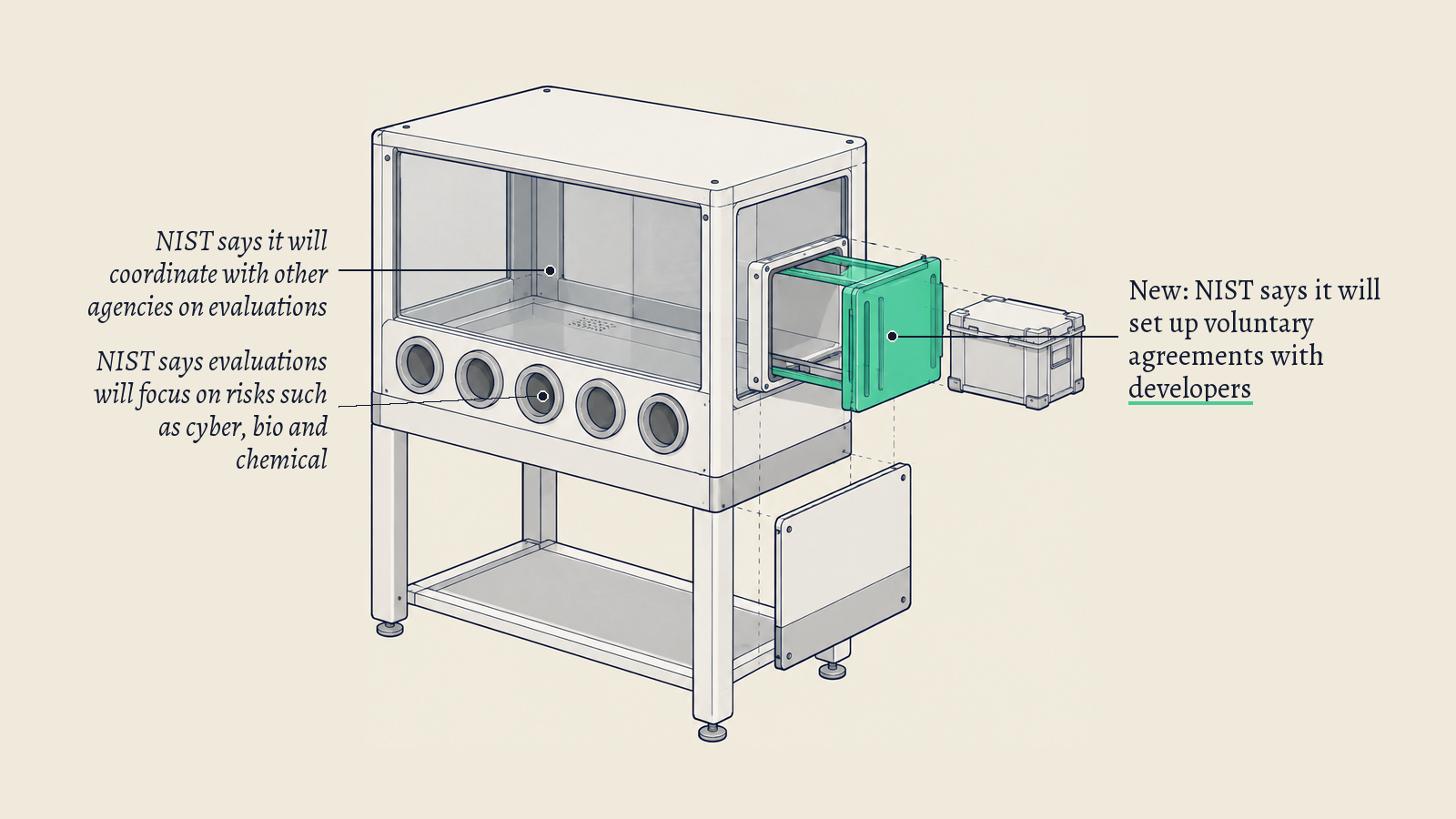 Illustration made with AI for ai notis
Key points
- NIST's 29 August 2024 announcement says Anthropic and OpenAI memoranda set up a framework for the US AI Safety Institute to receive access to new models before and after release.
- NIST says CAISSI will establish voluntary agreements with developers and lead unclassified evaluations of national-security risks, focused on cybersecurity, biosecurity and chemical weapons.
- The CAISSI page does not say when an evaluation happens relative to release or describe agreement terms; Google's post does not say what testing of Carbon involves.
What happened
When Google announced Gemini 4 Carbon on 28 October 2026, it said it was engaged in the US government's voluntary process for pre-release model testing.
The website of the National Institute of Standards and Technology (NIST) has a page titled the Center for Advancing Innovation and Standards for Super Intelligence, CAISSI. The page says the centre will be industry's primary point of contact within the US government for testing and collaborative research on commercial systems.
NIST announced on 29 August 2024 agreements with Anthropic and OpenAI. Each company's memorandum of understanding sets up a framework for the US AI Safety Institute to receive access to major new models from the company before and after their public release.
NIST says CAISSI will establish voluntary agreements with private-sector developers and evaluators, and will lead unclassified evaluations of capabilities that may pose risks to national security.
NIST says that in conducting these evaluations CAISSI will focus on demonstrable risks such as cybersecurity, biosecurity and chemical weapons. In 2024 NIST said the institute planned to give the two companies feedback on possible safety improvements to their models, together with the UK AI Safety Institute.
The page for CAISSI says the centre will coordinate with the Departments of Defense, Energy and Homeland Security, the Office of Science and Technology Policy and the Intelligence Community to develop evaluation methods. The pages leave some things open.
The CAISSI page does not use the phrase pre-deployment testing, does not say when an evaluation takes place relative to release, and does not describe the terms of the agreements. Google's post does not say what the testing of Carbon involves or what it has found, and it does not say whether Google has signed an agreement.
Underlined sentences link to the facts we checked. Dotted words open a short explainer.
Fact 5 of 11 · from NIST
In conducting these evaluations, CAISSI will focus on demonstrable risks, such as cybersecurity, biosecurity, and chemical weapons.
Fact 7 of 11 · from NIST
To that end, CAISSI will: ... Establish voluntary agreements with private sector SI developers and evaluators, and lead unclassified evaluations of SI capabilities that may pose risks to national security.
What it means for you
Our viewNIST writes about CAISSI in the future tense, and its page leaves out timing and terms, so the government's voluntary process Google names tells a buyer little about what was tested. Google's post gives no findings. If you rely on a vendor's mention of government testing in a risk assessment, ask the vendor in writing what was tested, when, and whether an agreement is signed.
It adds no new facts.
Your reaction
We count reactions per story and day, never who reacted. The counts help us choose what goes in the monthly issue. If you are signed in, your own page shows yours too.
We count reactions per story and day, never who reacted. They help choose what goes in the monthly issue.
Check our sources
Every sentence above is checked against these 3 sources.
1 Gemini 4 Carbon: our next frontier model
Open the source archived copy-
Google says in its 28 October 2026 post on Gemini 4 Carbon: "We're taking a deliberate approach to rollout and are actively engaged in the U.S. government’s voluntary process for pre-release model testing."
citeWe're taking a deliberate approach to rollout and are actively engaged in the U.S. government’s voluntary process for pre-release model testing.
-
Google's post on Gemini 4 Carbon does not say what the government testing of Carbon involves or found, and does not say whether Google has signed an agreement.
citeWe're taking a deliberate approach to rollout and are actively engaged in the U.S. government’s voluntary process for pre-release model testing.
2 Center for Advancing Innovation and Standards for Super Intelligence (CAISSI)
Open the source archived copy-
NIST's CAISSI page is titled "Center for Advancing Innovation and Standards for Super Intelligence (CAISSI)" and says it "will serve as industry’s primary point of contact within the U.S. government to facilitate testing and collaborative research related to harnessing and securing the potential of commercial SI systems."
citeThe Center for Advancing Innovation and Standards for Super Intelligence (CAISSI) will serve as industry’s primary point of contact within the U.S. government to facilitate testing and collaborative research related to harnessing and securing the potential of commercial SI systems.
-
NIST says CAISSI will "Establish voluntary agreements with private sector SI developers and evaluators, and lead unclassified evaluations of SI capabilities that may pose risks to national security."
citeEstablish voluntary agreements with private sector SI developers and evaluators, and lead unclassified evaluations of SI capabilities that may pose risks to national security.
-
NIST says: "In conducting these evaluations, CAISSI will focus on demonstrable risks, such as cybersecurity, biosecurity, and chemical weapons."
citeIn conducting these evaluations, CAISSI will focus on demonstrable risks, such as cybersecurity, biosecurity, and chemical weapons.
-
NIST says CAISSI will "Coordinate with other federal agencies and entities, including the Department of Defense, the Department of Energy, the Department of Homeland Security, the Office of Science and Technology Policy, and the Intelligence Community, to develop evaluation methods, as well as conduct evaluations and assessments."
citeCoordinate with other federal agencies and entities, including the Department of Defense, the Department of Energy, the Department of Homeland Security, the Office of Science and Technology Policy, and the Intelligence Community, to develop evaluation methods, as well as conduct evaluations and assessments.
-
The CAISSI page does not use the phrase pre-deployment testing, does not say when an evaluation takes place relative to a model's release, and does not describe the terms of the agreements.
citeTo that end, CAISSI will: ... Establish voluntary agreements with private sector SI developers and evaluators, and lead unclassified evaluations of SI capabilities that may pose risks to national security.
3 U.S. AI Safety Institute Signs Agreements Regarding AI Safety Research, Testing and Evaluation With Anthropic and OpenAI
Open the source archived copy-
NIST's announcement dated 29 August 2024 says: "Each company’s Memorandum of Understanding establishes the framework for the U.S. AI Safety Institute to receive access to major new models from each company prior to and following their public release." The companies are Anthropic and OpenAI.
citeEach company’s Memorandum of Understanding establishes the framework for the U.S. AI Safety Institute to receive access to major new models from each company prior to and following their public release.
-
NIST's announcement says: "The agreements will enable collaborative research on how to evaluate capabilities and safety risks, as well as methods to mitigate those risks."
citeThe agreements will enable collaborative research on how to evaluate capabilities and safety risks, as well as methods to mitigate those risks.
-
NIST's announcement says the institute "plans to provide feedback to Anthropic and OpenAI on potential safety improvements to their models, in close collaboration with its partners at the U.K. AI Safety Institute."
citeAdditionally, the U.S. AI Safety Institute plans to provide feedback to Anthropic and OpenAI on potential safety improvements to their models, in close collaboration with its partners at the U.K. AI Safety Institute.
-
The NIST announcement page carries a note: "In June 2025, AISI was re-established as CAISI by Secretary of Commerce Howard Lutnick."
citeIn June 2025, AISI was re-established as CAISI by Secretary of Commerce Howard Lutnick.
Every sentence above is checked against these 3 sources. Each fact has its own address you can cite.
Source 1 · Google · 28 Oct 2026
Gemini 4 Carbon: our next frontier model
Google says in its 28 October 2026 post on Gemini 4 Carbon: "We're taking a deliberate approach to rollout and are actively engaged in the U.S. government’s voluntary process for pre-release model testing."
We're taking a deliberate approach to rollout and are actively engaged in the U.S. government’s voluntary process for pre-release model testing.
Google's post on Gemini 4 Carbon does not say what the government testing of Carbon involves or found, and does not say whether Google has signed an agreement.
We're taking a deliberate approach to rollout and are actively engaged in the U.S. government’s voluntary process for pre-release model testing.
Source 2 · NIST
Center for Advancing Innovation and Standards for Super Intelligence (CAISSI)
NIST's CAISSI page is titled "Center for Advancing Innovation and Standards for Super Intelligence (CAISSI)" and says it "will serve as industry’s primary point of contact within the U.S. government to facilitate testing and collaborative research related to harnessing and securing the potential of commercial SI systems."
The Center for Advancing Innovation and Standards for Super Intelligence (CAISSI) will serve as industry’s primary point of contact within the U.S. government to facilitate testing and collaborative research related to harnessing and securing the potential of commercial SI systems.
NIST says CAISSI will "Establish voluntary agreements with private sector SI developers and evaluators, and lead unclassified evaluations of SI capabilities that may pose risks to national security."
Establish voluntary agreements with private sector SI developers and evaluators, and lead unclassified evaluations of SI capabilities that may pose risks to national security.
NIST says: "In conducting these evaluations, CAISSI will focus on demonstrable risks, such as cybersecurity, biosecurity, and chemical weapons."
In conducting these evaluations, CAISSI will focus on demonstrable risks, such as cybersecurity, biosecurity, and chemical weapons.
Show all 5 factsShow fewer facts
NIST says CAISSI will "Coordinate with other federal agencies and entities, including the Department of Defense, the Department of Energy, the Department of Homeland Security, the Office of Science and Technology Policy, and the Intelligence Community, to develop evaluation methods, as well as conduct evaluations and assessments."
Coordinate with other federal agencies and entities, including the Department of Defense, the Department of Energy, the Department of Homeland Security, the Office of Science and Technology Policy, and the Intelligence Community, to develop evaluation methods, as well as conduct evaluations and assessments.
The CAISSI page does not use the phrase pre-deployment testing, does not say when an evaluation takes place relative to a model's release, and does not describe the terms of the agreements.
To that end, CAISSI will: ... Establish voluntary agreements with private sector SI developers and evaluators, and lead unclassified evaluations of SI capabilities that may pose risks to national security.
Source 3 · NIST · 29 Aug 2024
U.S. AI Safety Institute Signs Agreements Regarding AI Safety Research, Testing and Evaluation With Anthropic and OpenAI
NIST's announcement dated 29 August 2024 says: "Each company’s Memorandum of Understanding establishes the framework for the U.S. AI Safety Institute to receive access to major new models from each company prior to and following their public release." The companies are Anthropic and OpenAI.
Each company’s Memorandum of Understanding establishes the framework for the U.S. AI Safety Institute to receive access to major new models from each company prior to and following their public release.
NIST's announcement says: "The agreements will enable collaborative research on how to evaluate capabilities and safety risks, as well as methods to mitigate those risks."
The agreements will enable collaborative research on how to evaluate capabilities and safety risks, as well as methods to mitigate those risks.
NIST's announcement says the institute "plans to provide feedback to Anthropic and OpenAI on potential safety improvements to their models, in close collaboration with its partners at the U.K. AI Safety Institute."
Additionally, the U.S. AI Safety Institute plans to provide feedback to Anthropic and OpenAI on potential safety improvements to their models, in close collaboration with its partners at the U.K. AI Safety Institute.
Show all 4 factsShow fewer facts
The NIST announcement page carries a note: "In June 2025, AISI was re-established as CAISI by Secretary of Commerce Howard Lutnick."
In June 2025, AISI was re-established as CAISI by Secretary of Commerce Howard Lutnick.
Topics
The morning email
On the mornings we publish: the three top stories and up to four short ones. Free.
We email you a link to confirm. An issue may include one sponsor, always labelled Sponsored · Advertisement. Our emails count opens and clicks, not who made them. Unsubscribe in one click. What we keep