FeaturePublished Voice of the weekAll news from that day
Dario Amodei wants outside testers inside frontier AI companies
Who he is, what he has done and said, and what his views mean for a business that buys AI.
.jpg)
This piece was researched and drafted with Claude, an AI model made by Anthropic, the company Dario Amodei runs. Every fact in it was checked against the source listed at the end.
Check our sources · 101 facts from 58 sources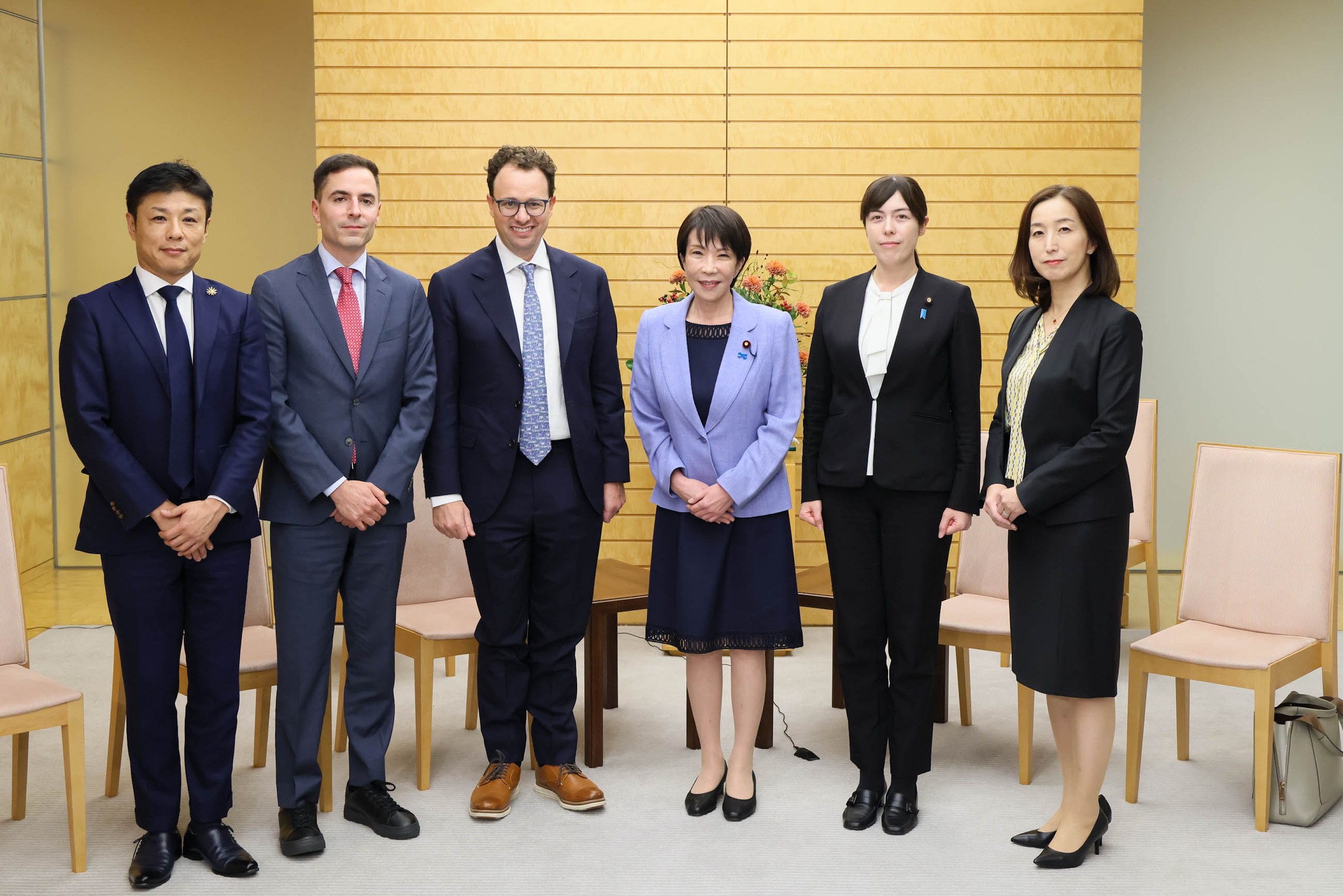 Prime Minister's Office of Japan / 出典:首相官邸ホームページ(https://www.kantei.go.jp/jp/104/actions/202510/29hyoukei.html)、PDL1.0(https://www.digital.go.jp/resources/open_data/public_data_license_v1.0)。「アモデイ・アンソロピック社CEOによる表敬」を加工して作成(cropped by notis)
In an essay in September 2026 he called for slower progress in what AI models can do:20
We must slow the pace at which we improve the capabilities of AI models. Progress will still seem fast, and we must make wise use of the time we gain.
He proposed that every frontier AI company give embedded third-party evaluators “ongoing, employee-like access”, and wrote that Anthropic was making that commitment on its own now.20 Reviewers on Anthropic’s own external review team, he wrote, should have the right to publish key findings “without editorial control by Anthropic”.20 On what pacing means, he wrote:20
To be clear, pacing does not mean halting model training or technical progress, but ensuring companies take adequate time to align and safeguard their models, and for third party evaluators to confirm this.
On 18 September 2026 Anthropic announced a partnership with Accenture on embedded evaluation, led by Faculty, Accenture’s specialist AI business, which Anthropic called “an important step toward the commitment”.32 Anthropic called the partnership non-exclusive, said it would work with other evaluators to be announced, and said it will fund Accenture’s work directly.32 Anthropic and Accenture each expect to invest at least $1 billion over the next five years in building capacity in this area.32 Accenture is also a commercial partner of Anthropic: in December 2025 the two companies announced the Accenture Anthropic Business Group, “a dedicated practice built around Claude”.54
According to the UN’s press release of 23 September, he briefed the UN Security Council.37 On 25 September a US appeals court ruled 2-1 against Anthropic in its case against the US Department of War, the name the Department of Defense may also use under Executive Order 14347.39,51 On 29 September his name appeared on the signature page of a White House accord on frontier AI, posted by President Trump.38
What it means for you
Our viewAmodei runs a company that sells AI models to businesses, so his writing is a vendor chief executive’s view, and we read it that way.3,19
It is still useful to a manager, because he writes about three things a buyer of AI has to decide.
The first is what AI is for in your organisation.18 He names the choice in “The Adolescence of Technology”, January 2026:18
Enterprises often have a choice between “cost savings” (doing the same thing with fewer people) and “innovation” (doing more with the same number of people).
He writes that Anthropic works with customers to find new uses and new sources of revenue so that they can do more with their existing workforce, rather than focusing only on cost savings.19 For the short term, he suggests that “being creative about ways to reassign employees within companies may be a promising way to stave off the need for layoffs”.18
Anthropic’s own usage reports show how much depends on the way AI is used.
Its first report, in February 2025, found that 57% of use on Claude.ai leaned towards augmentation, where AI works with a person, and 43% towards automation, where AI does the task itself.31 Its September 2025 report found that when businesses build Claude into their own applications through its API, 77% of the transcripts it sampled showed automation patterns, against 12% augmentation; on Claude.ai the split was nearly even.43 Its March 2026 report says automation in that API data then fell sharply.44
Before an AI project starts, write down which of the two it is for, ask your vendor what it will do to help with the second, and set the vendor’s figures beside what your own teams do.
The second is how a model is tested.
He called for outside testing before release in 2023, and in September 2026 he wrote that Anthropic is committing to give embedded outside evaluators employee-like access.20,24 The evaluator it has named, Accenture, will be funded directly by Anthropic for this work, Anthropic says, and also runs a business practice built around Claude.32,54 In July 2025 Anthropic said it intends to sign the EU’s General-Purpose AI Code of Practice.46
Whichever model you buy, ask the vendor who tests it from outside, who pays the testers, whether they also do business with the vendor, what access they had, and where their results are published. Ask your account team whether the vendor has signed the EU code, and what that means for your contract.
The third is explanation.
He writes that not being able to see inside the models is “literally a legal blocker” for some uses, such as mortgage assessments where decisions are legally required to be explainable.17 The EU AI Act lists AI systems used to evaluate people’s creditworthiness or set their credit score among its high-risk uses, except systems used to detect financial fraud.50 Anthropic’s stated goal, set in April 2025, is for interpretability to reliably detect most model problems by 2027.17
Until a vendor can show that, keep a person, and a written record of the reasons, in any decision you must explain to a customer or a regulator.
One more check, for companies that supply the US Department of War: ask your vendor and your legal team, in writing, how the supply-chain-risk designation and the September 2026 ruling described below affect the systems you deliver.
Our reading of the checked facts on this page. It adds no new facts.
How he got here
He came to AI from physics: his Princeton doctorate, completed in 2011, studied the collective behaviour of neural circuits.4 The paper that introduced GPT-3 says: “Dario Amodei designed and led the research.”12 His own biography says he led the development of GPT-2 and GPT-3.1
- Undergraduate Stanford University.3
- 2007 Hertz Fellow.3
- 2011 PhD, Princeton University, Department of Physics. Thesis: “Network-Scale Electrophysiology: Measuring and Understanding the Collective Behavior of Neural Circuits”, advised by Michael J. Berry and William Bialek.4
- After the PhD Postdoctoral scholar, Stanford University School of Medicine.1
- December 2015 Works on speech recognition at Baidu Research: one of the authors of Deep Speech 2, from its Silicon Valley AI Lab.5
- June 2016 First author of “Concrete Problems in AI Safety”, which gives his affiliation as Google Brain, where he was a senior research scientist.1,8
- At OpenAI Vice president of research. OpenAI credited him with building GPT-2 and GPT-3 with its team, and with setting the direction of its research as co-leader with Ilya Sutskever.1,6
- 29 December 2020 OpenAI announces that he is leaving after nearly five years.6
- 28 May 2021 Anthropic announces a $124 million Series A; the announcement lists him as chief executive.7
- 14 March 2023 Anthropic launches Claude more broadly, through a chat interface and an API.21
His site describes Anthropic as a public benefit corporation “dedicated to building AI systems that are steerable, interpretable and safe”.1 Anthropic is incorporated in Delaware, whose law requires such a company to be run in a way that balances its shareholders’ financial interests, the interests of those its conduct materially affects, and the public benefit named in its certificate of incorporation.48,49 He sits on Anthropic’s board.2
His work
Before Anthropic he wrote papers on AI safety and on how AI models improve as they grow.8,9,11 At Anthropic he is an author of the paper on Constitutional AI, a method Anthropic says it uses to train Claude.14,40
Before Anthropic
- Concrete Problems in AI Safety (June 2016) Sets out five practical research problems on accidents in AI systems, among them “avoiding side effects” and “avoiding reward hacking”.8
- Deep reinforcement learning from human preferences (June 2017) Showed that an AI system could learn complex tasks, such as Atari games, from people’s choices between pairs of short stretches of its behaviour, with feedback on less than one percent of its interactions with its environment. His own site calls him “the co-inventor of reinforcement learning from human feedback”.1,47
- AI and compute (May 2018) With Danny Hernandez, he found that since 2012 the computing power used in the largest AI training runs had been doubling every 3.4 months.9
- Language Models are Unsupervised Multitask Learners (the GPT-2 paper) The GPT-2 paper, which he co-wrote.10
- Scaling Laws for Neural Language Models (January 2020) Showed that a language model’s prediction error falls in a predictable way as the model, its training data and the computing power used to train it grow. The paper says he “provided guidance throughout the project”.11
- Language Models are Few-Shot Learners (the GPT-3 paper, May 2020) Introduced GPT-3, a language model with 175 billion parameters, tested on tasks it was shown only a few examples of, as text.12
At Anthropic
- Training a Helpful and Harmless Assistant with Reinforcement Learning from Human Feedback (April 2022) Used people’s feedback to train language models to act as helpful and harmless assistants.13
- Constitutional AI: Harmlessness from AI Feedback (December 2022) A way to train a harmless AI assistant from a written list of principles and AI feedback, with no human labels marking harmful answers. Anthropic calls Claude “our AI assistant trained with Constitutional AI”.14,40
- Which Economic Tasks are Performed with AI? (February 2025) The research behind the Anthropic Economic Index, based on over four million Claude.ai conversations. Anthropic publishes the index’s data at anthropic.com/economic-index.35,45
On 19 September 2023 Anthropic published its Responsible Scaling Policy, which it called “a series of technical and organizational protocols” for managing the risks of increasingly capable AI systems.22 In prepared remarks for the AI Safety Summit at Bletchley Park, published by Anthropic on 1 November 2023, he wrote that he had spent 10 to 20% of his time on the policy for three months, written “multiple drafts from scratch” and devised the AI Safety Levels (ASL) system.23,41 In the same remarks he described responsible scaling policies this way:23
RSPs are not intended as a substitute for regulation, but rather a prototype for it.
Essays and posts
He publishes on darioamodei.com, which lists two essays and four shorter posts.1 All six, in date order:1
- Machines of Loving Grace (October 2024) Five areas where he thinks AI could improve life: biology and physical health; neuroscience and mental health; economic development and poverty; peace and governance; and work and meaning.15
- On DeepSeek and Export Controls (January 2025) Argues that DeepSeek’s releases make US export controls on chips to China even more important.16
- The Urgency of Interpretability (April 2025) Sets Anthropic’s goal that interpretability “can reliably detect most model problems” by 2027.17
- The Adolescence of Technology (January 2026) His essay on the risks of AI, subtitled “Confronting and Overcoming the Risks of Powerful AI”.18
- Policy on the AI Exponential (June 2026) Released with an Anthropic legislative proposal on frontier model testing and a policy framework for job displacement; he writes that Anthropic intends to provide “substantial financial backing” for them.19
- We Must Pace the Frontier (September 2026) His call to slow how fast AI models gain new abilities, and the plan for embedded outside evaluators.20
With governments
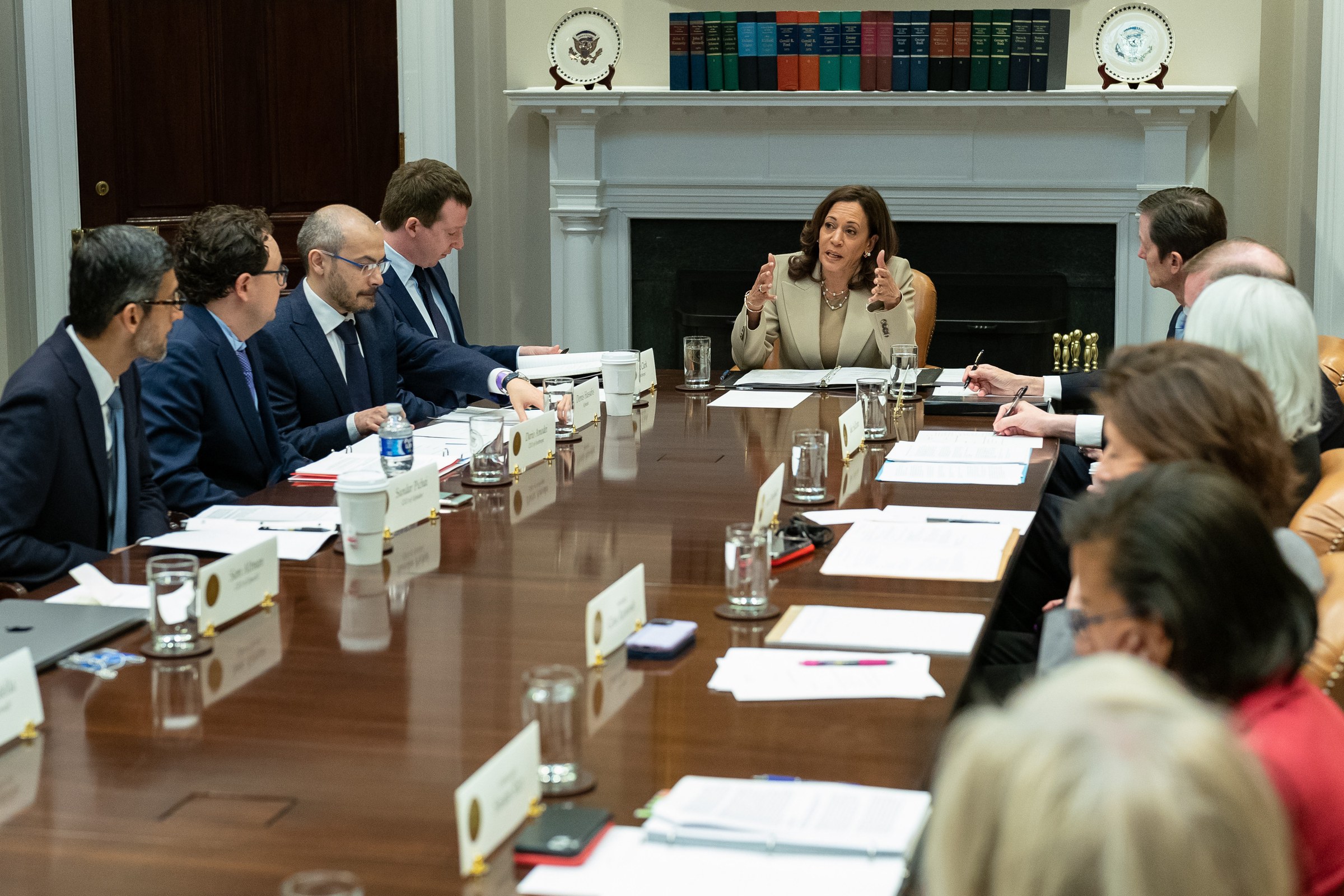 Official White House Photo by Lawrence Jackson / United States government work. Cropped.
He met Vice President Kamala Harris at the White House and Prime Minister Rishi Sunak in London in 2023, and Prime Minister Sanae Takaichi in Tokyo in October 2025.56,57,58
 Simon Walker / No 10 Downing Street / CC BY 2.0, cropped by notis
On 25 July 2023 he testified to the US Senate Judiciary Subcommittee on Privacy, Technology, and the Law, at a hearing titled “Oversight of A.I.: Principles for Regulation”.24 His opening statement called for testing before release:24
New AI models should have to pass a rigorous battery of safety tests before they can be released to the public at all, including tests by third parties and national security experts in Government.
His statement on the Paris AI Action Summit, on 11 February 2025, said “greater focus and urgency is needed” on three topics: democracies keeping the lead in AI, the risks of AI, and the economic transitions that he says are fast approaching.25 On work, it said:25
A “country of geniuses in a datacenter” could represent the largest change to the global labor market in human history. A first step is to monitor and observe the economic impacts of today’s AI systems.
It also said: “At the next international summit, we should not repeat this missed opportunity.”25
On 21 October 2025 he published a statement to answer what he called “a recent uptick in inaccurate claims about Anthropic's policy stances”, among them that Anthropic wanted to harm start-ups and that its models were “uniquely politically biased”.26 In it he said Anthropic supported California’s SB 53, which requires the largest AI developers to make their frontier model safety protocols public and exempts companies with annual gross revenue below $500 million.26 The same statement says: “There are products we will not build and risks we will not take, even if they would make money.”26
On 26 February 2026, in a statement under his name on Anthropic’s talks with the US Department of War, he said two uses of Claude had never been in Anthropic’s contracts with the department and should not be added now: mass domestic surveillance and fully autonomous weapons.27 The statement says Anthropic “cannot in good conscience accede to their request”.27 In a further statement on 5 March 2026 he said Anthropic had received a letter from the department on 4 March confirming that it had been designated a supply chain risk to America’s national security, and that Anthropic saw “no choice but to challenge it in court”.42 He wrote that, for Anthropic’s customers, the designation applies only to the use of Claude “as a direct part of contracts with the Department of War”.42 On 25 September 2026 the US Court of Appeals for the DC Circuit ruled 2-1 against Anthropic.39 It held that the department had ample support for concluding that the continued integration of Claude into its information systems, by the department or its contractors, presented a national-security risk covered by the statute.39
According to the UN’s press release of 23 September 2026, he was one of four people who briefed the Security Council, with Yoshua Bengio, co-chair of the UN Independent International Scientific Panel on AI, Sam Altman of OpenAI and Clement Delangue of Hugging Face.37 The UN’s summary says he urged Member States to pursue “narrow” agreements that can enjoy broad support, such as a ban on using AI to make biological weapons, and to build evaluation and verification systems and common standards for testing AI models.37
On 29 September 2026 Donald Trump posted “White House Accord on Super Intelligence - Joint Commitment on Frontier Responsibilities” on Truth Social, as two attached images with no text of their own.38 Its signature page lists the President and six company leaders: Sundar Pichai of Google, Dario Amodei of Anthropic, Mark Zuckerberg of Meta, Greg Brockman of OpenAI, Elon Musk of xAI and Jensen Huang of Nvidia.38 The text says each company should implement “four layers of controls and audits”, among them a partnership with “an independent external auditor or evaluator”, and it states no penalty or enforcement mechanism.38
What he has said
This is a topic that I warned about very publicly in 2025, where I predicted that AI could displace half of all entry-level white collar jobs in the next 1–5 years, even as it accelerates economic growth and scientific progress.
In the same passage he wrote that “some didn’t see the 1–5-year time range and thought I was claiming AI is displacing jobs right now (which I agree it is likely not)”.18
When a generative AI system does something, like summarize a financial document, we have no idea, at a specific or precise level, why it makes the choices it does—why it chooses certain words over others, or why it occasionally makes a mistake despite usually being accurate.
However, now the risks are clearly here. It is time to go beyond transparency to more serious and binding regulation of AI.
Where to follow him
His own
- darioamodei.com His essays, posts and talks.1
- Email alerts for new posts A sign-up on his site for alerts about new posts.33
- Google Scholar His papers, linked from his site.34
Anthropic’s, not his
- anthropic.com/company Lists him on Anthropic’s board of directors.2
- Claude Anthropic’s product.36
- Anthropic on YouTube video, opens on YouTube The company’s channel.2
Talks
- Extended interview: Dario Amodei, CBS Sunday Morning video, opens on YouTube With Jo Ling Kent. Published 13 September 2026, 24 minutes.52
- A conversation with Dario Amodei & Daniela Amodei, Anthropic’s Claude channel video, opens on YouTube Moderated by Ami Vora at Anthropic’s Code with Claude developer conference. Published 6 May 2026, 33 minutes.53
- In conversation with Zanny Minton Beddoes of The Economist video, opens on YouTube Published 27 January 2025, 45 minutes.30
- Lex Fridman Podcast #452 video, opens on YouTube Published 11 November 2024, 5 hours 15 minutes.29
- In Good Company, Norges Bank Investment Management video, opens on YouTube With Nicolai Tangen, the fund’s chief executive, in Oslo. Published 26 June 2024, 67 minutes.28
Our reporting
- UN Security Council holds high-level briefing on AI safety risk Published 25 Sep 2026
- Appeals court upholds Pentagon supply-chain risk label on Anthropic Published 28 Sep 2026
- Six AI leaders sign voluntary commitment on frontier model controls Published 5 Oct 2026
- How reward hacking lets a model game its score Published 9 Oct 2026
- The White House and AI rules Our case
- Anthropic in Explore Every published story about the company
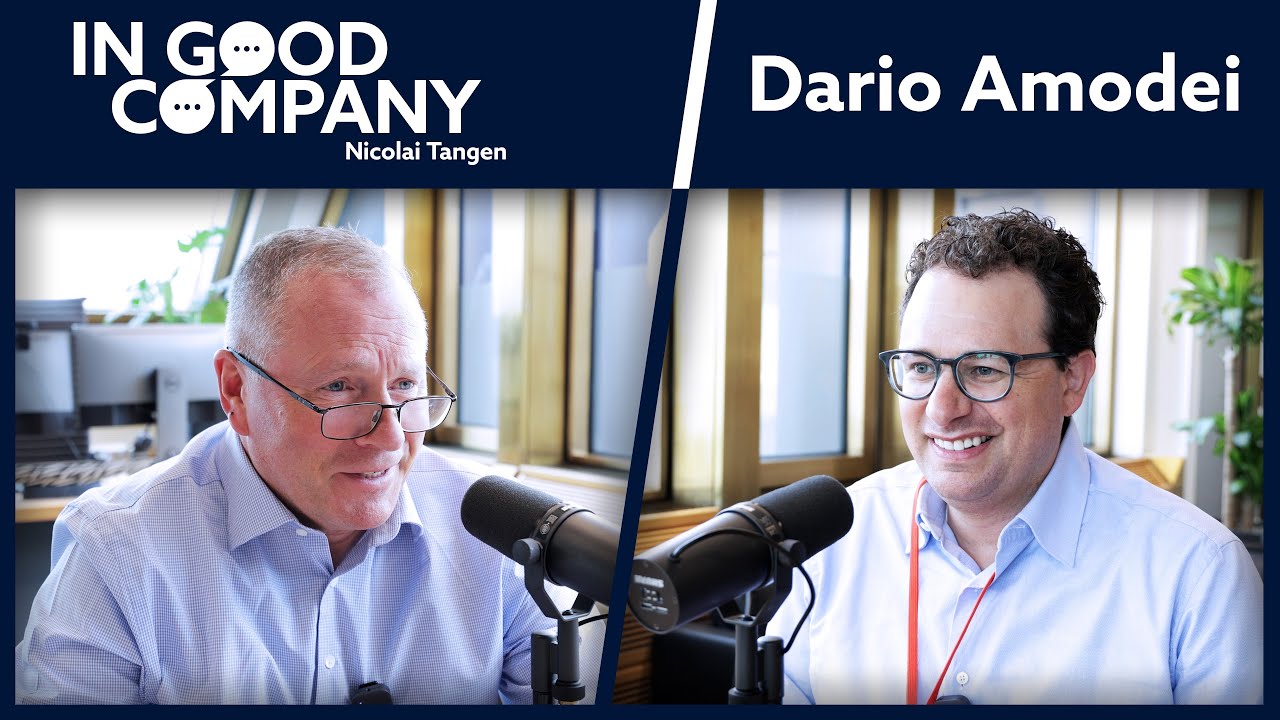 Video: Norges Bank Investment Management on YouTube
One thing to read first
Our pick The Adolescence of Technology, section 4, “Player piano” (January 2026)18
In this section he sets out the two problems he is worried about, labour market displacement and the concentration of economic power, and it is where he puts the choice between cost savings and innovation.18
Your reaction
We count reactions per story and day, never who reacted. The counts help us choose what goes in the monthly issue. If you are signed in, your own page shows yours too.
We count reactions per story and day, never who reacted. They help choose what goes in the monthly issue.
Check our sources
58 sources, 101 checked facts · show them
Every sentence above is checked against these 58 sources.
1 Dario Amodei (his own site)
Open the source-
His own site says he is CEO of Anthropic, “a public benefit corporation dedicated to building AI systems that are steerable, interpretable and safe”.
citeDario Amodei is the CEO of Anthropic, a public benefit corporation dedicated to building AI systems that are steerable, interpretable and safe.
-
His site says he was a postdoctoral scholar at the Stanford University School of Medicine.
citeDario earned his doctorate degree in biophysics from Princeton University as a Hertz Fellow, and was a postdoctoral scholar at the Stanford University School of Medicine.
-
His site says that before joining OpenAI he worked at Google Brain as a Senior Research Scientist.
citeBefore joining OpenAI, he worked at Google Brain as a Senior Research Scientist.
-
His site says he was Vice President of Research at OpenAI, where he led the development of GPT-2 and GPT-3.
citePreviously, Dario served as Vice President of Research at OpenAI, where he led the development of large language models like GPT-2 and GPT-3.
-
darioamodei.com is his own site: Anthropic’s statement in his name of 21 October 2025 links to his essay “Machines of Loving Grace” there, and the site says he is Anthropic’s CEO.
Toned down to what the source says
citeDario Amodei is the CEO of Anthropic, a public benefit corporation dedicated to building AI systems that are steerable, interpretable and safe.
-
His site calls him “the co-inventor of reinforcement learning from human feedback” and lists two essays and four short posts.
citeHe is also the co-inventor of reinforcement learning from human feedback. ... Essays: The Adolescence of Technology; Machines of Loving Grace. Short posts: We Must Pace the Frontier; Policy on the AI Exponential; The Urgency of Interpretability; On DeepSeek and Export Controls
2 Company
Open the source-
anthropic.com/company lists him on Anthropic’s board of directors.
citeAnthropic Board of Directors Dario Amodei, Daniela Amodei, Yasmin Razavi, Reed Hastings, Chris Liddell, and Vas Narasimhan.
-
The page links to Anthropic’s own accounts on YouTube, LinkedIn and X.
citehttps://www.youtube.com/@anthropic-ai https://www.linkedin.com/company/anthropicresearch https://x.com/AnthropicAI
3 Dario Amodei
Open the source archived copy-
The Hertz Foundation lists him as a 2007 Hertz Fellow and as co-founder and chief executive officer of Anthropic.
cite2007 HERTZ FELLOW Co-Founder and CEO, Anthropic ... Dario Amodei is co-founder and chief executive officer at Anthropic, an artificial intelligence (AI) safety and research company
-
The Hertz Foundation lists his undergraduate studies at Stanford University.
Toned down to what the source says
citeEDUCATION Graduate Studies Princeton University Biophysics, Physics ... Undergraduate Studies Stanford University
4 Network-Scale Electrophysiology (catalogue record 9970848403506421)
Open the source-
PhD, Princeton University, 2011; the record names the thesis “Network-Scale Electrophysiology: Measuring and Understanding the Collective Behavior of Neural Circuits” and the advisers Michael J. Berry and William Bialek, and files it under the Department of Physics.
cite
5 Deep Speech 2: End-to-End Speech Recognition in English and Mandarin (arXiv 1512.02595)
Open the source-
He is an author of Deep Speech 2, from Baidu Research’s Silicon Valley AI Lab (authors listed alphabetically).
cite
6 Organizational update from OpenAI
Open the source-
OpenAI announced on 29 December 2020 that he was leaving after nearly five years, and credited him with collaborating with the team to build GPT-2 and GPT-3 and with co-leading the direction of its research with Ilya Sutskever.
cite
7 Anthropic raises $124 million Series A
Open the source-
The Series A announcement ($124 million) says the company is led by Dario Amodei (CEO) and Daniela Amodei (President).
cite
8 Concrete Problems in AI Safety (arXiv 1606.06565)
Open the source archived copy-
He is the first of six authors of “Concrete Problems in AI Safety”, where his affiliation is given as Google Brain.
Toned down to what the source says
citeAuthors:Dario Amodei, Chris Olah, Jacob Steinhardt, Paul Christiano, John Schulman, Dan Mané ... (PDF, page 1:) Dario Amodei Chris Olah Jacob Steinhardt Google Brain Google Brain Stanford University Paul Christiano UC Berkeley John Schulman OpenAI Dan Mané Google Brain
-
The paper lists “avoiding reward hacking” as one of five practical research problems on accident risk, with “avoiding side effects”.
citeWe present a list of five practical research problems related to accident risk, categorized according to whether the problem originates from having the wrong objective function ("avoiding side effects" and "avoiding reward hacking"), an objective function that is too expensive to evaluate frequently ("scalable supervision"), or undesirable behavior during the learning process ("safe exploration" and "distributional shift").
9 AI and compute
Open the source-
With Danny Hernandez he wrote that since 2012 the compute used in the largest AI training runs had been increasing exponentially with a 3.4-month doubling time.
cite
10 Language Models are Unsupervised Multitask Learners (the GPT-2 paper)
Open the source-
He is a co-author of the GPT-2 paper, “Language Models are Unsupervised Multitask Learners”.
Toned down to what the source says cite
11 Scaling Laws for Neural Language Models (arXiv 2001.08361)
Open the source-
The Scaling Laws paper says he “provided guidance throughout the project”.
citeContributions: Jared Kaplan and Sam McCandlish led the research. [...] Dario Amodei provided guidance throughout the project.
-
Scaling Laws: the abstract says a language model’s loss scales as a power law with model size, dataset size and the compute used for training.
citeThe loss scales as a power-law with model size, dataset size, and the amount of compute used for training, with some trends spanning more than seven orders of magnitude.
12 Language Models are Few-Shot Learners (arXiv 2005.14165)
Open the source-
The GPT-3 paper says: “Dario Amodei designed and led the research.”
citeDario Amodei designed and led the research.
-
GPT-3: the abstract describes a language model with 175 billion parameters, tested on tasks given only a few examples as text.
citeSpecifically, we train GPT-3, an autoregressive language model with 175 billion parameters, 10x more than any previous non-sparse language model, and test its performance in the few-shot setting. For all tasks, GPT-3 is applied without any gradient updates or fine-tuning, with tasks and few-shot demonstrations specified purely via text interaction with the model.
13 Training a Helpful and Harmless Assistant with Reinforcement Learning from Human Feedback (arXiv 2204.05862)
Open the source-
He is a co-author of “Training a Helpful and Harmless Assistant with Reinforcement Learning from Human Feedback” (April 2022).
cite[Submitted on 12 Apr 2022] Title:Training a Helpful and Harmless Assistant with Reinforcement Learning from Human Feedback Authors:Yuntao Bai, Andy Jones, ... Catherine Olsson, Dario Amodei, Tom Brown, Jack Clark, Sam McCandlish, Chris Olah, Ben Mann, Jared Kaplan
-
HH-RLHF: the abstract says the paper applies preference modelling and RLHF to fine-tune language models to act as helpful and harmless assistants.
citeAbstract:We apply preference modeling and reinforcement learning from human feedback (RLHF) to finetune language models to act as helpful and harmless assistants.
14 Constitutional AI: Harmlessness from AI Feedback (arXiv 2212.08073)
Open the source-
He is one of 51 authors of “Constitutional AI: Harmlessness from AI Feedback” (December 2022), published under CC BY 4.0.
cite[Submitted on 15 Dec 2022] Authors:Yuntao Bai, Saurav Kadavath, ... Ben Mann, Dario Amodei, Nicholas Joseph, Sam McCandlish, Tom Brown, Jared Kaplan
-
Constitutional AI: the abstract describes training a harmless assistant with no human labels for harmful outputs, the only human oversight being a list of principles; a supervised phase of self-critique and revision; and an RL phase in which AI comparisons of pairs of answers train a preference model used as the reward.
citeWe experiment with methods for training a harmless AI assistant through self-improvement, without any human labels identifying harmful outputs. The only human oversight is provided through a list of rules or principles, and so we refer to the method as 'Constitutional AI'. The process involves both a supervised learning and a reinforcement learning phase. In the supervised phase we sample from an initial model, then generate self-critiques and revisions, and then finetune the original model on revised responses. In the RL phase, we sample from the finetuned model, use a model to evaluate which of the two samples is better, and then train a preference model from this dataset of AI preferences. We then train with RL using the preference model as the reward signal
15 Machines of Loving Grace
Open the source-
In “Machines of Loving Grace” he names five areas: biology and physical health; neuroscience and mental health; economic development and poverty; peace and governance; work and meaning.
cite
16 On DeepSeek and Export Controls
Open the source-
In “On DeepSeek and Export Controls” he writes that DeepSeek’s releases “make export control policies even more existentially important”.
cite
17 The Urgency of Interpretability
Open the source-
In “The Urgency of Interpretability” (April 2025) he gives Anthropic’s goal of getting to “interpretability can reliably detect most model problems” by 2027.
citeAnthropic is doubling down on interpretability, and we have a goal of getting to “interpretability can reliably detect most model problems” by 2027.
-
He writes that not being able to see inside the models is “literally a legal blocker” for some uses, such as mortgage assessments.
citeIn fact, for some applications, the fact that we can’t see inside the models is literally a legal blocker to their adoption—for example in mortgage assessments where decisions are legally required to be explainable.
-
In “The Urgency of Interpretability” (April 2025) he wrote: “literally a legal blocker”
citeIn fact, for some applications, the fact that we can’t see inside the models is literally a legal blocker to their adoption—for example in mortgage assessments where decisions are legally required to be explainable.
-
In “The Urgency of Interpretability” (April 2025) he wrote: “When a generative AI system does something, like summarize a financial document, we have no idea, at a specific or precise level, why it makes the choices it does—why it chooses certain words over others, or why it occasionally makes a mistake despite usually being accurate.”
citeGenerative AI is not like that at all. When a generative AI system does something, like summarize a financial document, we have no idea, at a specific or precise level, why it makes the choices it does—why it chooses certain words over others, or why it occasionally makes a mistake despite usually being accurate. As my friend and co-founder Chris Olah is fond of saying, generative AI systems are grown more than they are built
18 The Adolescence of Technology
Open the source-
“The Adolescence of Technology” (January 2026) is subtitled “Confronting and Overcoming the Risks of Powerful AI”.
citeThe Adolescence of Technology Confronting and Overcoming the Risks of Powerful AI January 2026
-
He writes that enterprises often choose between “cost savings” and “innovation”.
citeEnterprises often have a choice between “cost savings” (doing the same thing with fewer people) and “innovation” (doing more with the same number of people).
-
Section 4 of “The Adolescence of Technology” is headed “Player piano”, and in it he names two problems he is worried about: labor market displacement and concentration of economic power.
cite4. Player piano ... Labor market disruption ... There are two specific problems I am worried about: labor market displacement, and concentration of economic power.
-
In “The Adolescence of Technology” (January 2026) he wrote: “Enterprises often have a choice between “cost savings” (doing the same thing with fewer people) and “innovation” (doing more with the same number of people).”
citeSecond, AI companies have a choice in how they work with enterprises. The very inefficiency of traditional enterprises means that their rollout of AI can be very path dependent, and there is some room to choose a better path. Enterprises often have a choice between “cost savings” (doing the same thing with fewer people) and “innovation” (doing more with the same number of people).
-
In “The Adolescence of Technology” (January 2026) he wrote: “being creative about ways to reassign employees within companies may be a promising way to stave off the need for layoffs”
citeThird, companies should think about how to take care of their employees. In the short term, being creative about ways to reassign employees within companies may be a promising way to stave off the need for layoffs.
-
In “The Adolescence of Technology” (January 2026) he wrote: “This is a topic that I warned about very publicly in 2025, where I predicted that AI could displace half of all entry-level white collar jobs in the next 1–5 years, even as it accelerates economic growth and scientific progress.”
citeThere are two specific problems I am worried about: labor market displacement, and concentration of economic power. Let’s start with the first one. This is a topic that I warned about very publicly in 2025, where I predicted that AI could displace half of all entry-level white collar jobs in the next 1–5 years, even as it accelerates economic growth and scientific progress.
-
In “The Adolescence of Technology” (January 2026) he wrote: “some didn’t see the 1–5-year time range and thought I was claiming AI is displacing jobs right now (which I agree it is likely not)”
citeMany CEOs, technologists, and economists agreed with me, but others assumed I was falling prey to a “lump of labor” fallacy and didn’t know how labor markets worked, and some didn’t see the 1–5-year time range and thought I was claiming AI is displacing jobs right now (which I agree it is likely not).
19 Policy on the AI Exponential
Open the source-
With “Policy on the AI Exponential” (June 2026), Anthropic released a legislative proposal on frontier model testing and a policy framework for job displacement, for which he writes Anthropic intends to provide “substantial financial backing”.
citeAlong with this essay, Anthropic is releasing a legislative proposal on frontier model testing and a policy framework for job displacement, for which we intend to provide substantial financial backing.
-
He writes that Anthropic works with customers on new use cases and new sources of revenue so they can do more with their existing workforce, rather than focusing solely on cost savings.
citeAs a company, Anthropic always does as much as it can to work with customers to find creative new use cases and new sources of revenue that allow them to do more with their existing workforce, rather than focusing solely on cost savings (which often means reducing the workforce).
-
In “Policy on the AI Exponential” (June 2026) he wrote: “However, now the risks are clearly here. It is time to go beyond transparency to more serious and binding regulation of AI.”
citeHowever, now the risks are clearly here. It is time to go beyond transparency to more serious and binding regulation of AI.
20 We Must Pace the Frontier
Open the source-
In “We Must Pace the Frontier” (September 2026) he proposes that each frontier AI company give embedded third-party evaluators “ongoing, employee-like access”, and writes that Anthropic is committing to this step now on its own; for Anthropic’s own external review team, he writes that reviewers should have the right to publish key findings “without editorial control by Anthropic”.
Toned down to what the source says
citeEach frontier AI company commits to giving ongoing, employee-like access to a team of embedded third-party evaluators (such as METR), whose role is to verify adherence to safety practices and commitments, report incidents, and help assess the alignment of not just completed AI models but training pipelines and processes. [...] Anthropic is unilaterally committing to this step now. [...] External reviewers should have the right to publish key findings about risk levels, incidents, practices, and the access they received or didn’t receive — without editorial control by Anthropic.
-
In “We Must Pace the Frontier” he describes the embedded evaluators’ role: to verify adherence to safety practices and commitments, report incidents, and help assess the alignment of models and training processes.
citewhose role is to verify adherence to safety practices and commitments, report incidents, and help assess the alignment of not just completed AI models but training pipelines and processes.
-
In “We Must Pace the Frontier” (September 2026) he wrote: “To be clear, pacing does not mean halting model training or technical progress, but ensuring companies take adequate time to align and safeguard their models, and for third party evaluators to confirm this.”
citeTo be clear, pacing does not mean halting model training or technical progress, but ensuring companies take adequate time to align and safeguard their models, and for third party evaluators to confirm this.
-
In “We Must Pace the Frontier” (September 2026) he wrote: “We must slow the pace at which we improve the capabilities of AI models. Progress will still seem fast, and we must make wise use of the time we gain.”
citeWe must slow the pace at which we improve the capabilities of AI models. Progress will still seem fast, and we must make wise use of the time we gain.
21 Introducing Claude
Open the source-
Anthropic launched Claude more broadly on 14 March 2023, through a chat interface and an API.
cite
22 Introducing Anthropic's Responsible Scaling Policy
Open the source-
Anthropic published its Responsible Scaling Policy on 19 September 2023, calling it “a series of technical and organizational protocols”.
cite
23 Dario Amodei’s prepared remarks from the AI Safety Summit on Anthropic’s Responsible Scaling Policy
Open the source-
In prepared remarks dated 1 November 2023 he wrote that he spent 10-20% of his time on the RSP for three months, wrote “multiple drafts from scratch” and devised and proposed the ASL system.
citeNov 1, 2023 ... First, deep executive involvement is critical. As CEO, I personally spent 10-20% of my time on the RSP for 3 months—I wrote multiple drafts from scratch, in addition to devising and proposing the ASL system.
-
In the same remarks he called responsible scaling policies a prototype for regulation, not a substitute for it.
citeFinally, I’d like to discuss the relationship between RSPs and regulation. RSPs are not intended as a substitute for regulation, but rather a prototype for it.
-
In “Dario Amodei’s prepared remarks from the AI Safety Summit on Anthropic’s Responsible Scaling Policy” (1 November 2023) he wrote: “RSPs are not intended as a substitute for regulation, but rather a prototype for it.”
citeDario Amodei’s prepared remarks from the AI Safety Summit on Anthropic’s Responsible Scaling Policy. Nov 1, 2023 ... Finally, I’d like to discuss the relationship between RSPs and regulation. RSPs are not intended as a substitute for regulation, but rather a prototype for it.
24 Oversight of A.I.: Principles for Regulation, S. Hrg. 118-108 (official hearing record)
Open the source-
On 25 July 2023 he testified to the Senate Judiciary Subcommittee on Privacy, Technology, and the Law, at “Oversight of A.I.: Principles for Regulation”; his opening statement calls for safety tests, including by third parties, before release.
citeOVERSIGHT OF A.I.: PRINCIPLES FOR REGULATION ... HEARING BEFORE THE SUBCOMMITTEE ON PRIVACY, TECHNOLOGY, AND THE LAW of the COMMITTEE ON THE JUDICIARY UNITED STATES SENATE ... JULY 25, 2023 ... STATEMENT OF DARIO AMODEI, CHIEF EXECUTIVE OFFICER, ANTHROPIC ... Second, we recommend a testing and auditing regime for new and more powerful models. ... New AI models should have to pass a rigorous battery of safety tests before they can be released to the public at all, including tests by third parties and national security experts in Government.
-
In his opening statement at “Oversight of A.I.: Principles for Regulation” (25 July 2023), as printed in the official hearing record S. Hrg. 118-108, he said: “New AI models should have to pass a rigorous battery of safety tests before they can be released to the public at all, including tests by third parties and national security experts in Government.”
Toned down to what the source says
citeSTATEMENT OF DARIO AMODEI, CHIEF EXECUTIVE OFFICER, ANTHROPIC, SAN FRANCISCO, CALIFORNIA Mr. Amodei. Chairman Blumenthal, Ranking Member Hawley, and ... Second, we recommend a testing and auditing regime for new and more powerful models. Similar to cars or airplanes, AI models of the near future will be powerful machines that possess great utility but can be lethal if designed incorrectly or misused. New AI models should have to pass a rigorous battery of safety tests before they can be released to the public at all, including tests by third parties and national security experts in Government.
25 Statement from Dario Amodei on the Paris AI Action Summit
Open the source-
His statement on the Paris AI Action Summit (11 February 2025) says “greater focus and urgency is needed” on democracies keeping the lead, the risks of AI and the economic transitions ahead, and points to the Anthropic Economic Index, released that week.
citeHowever, greater focus and urgency is needed on several topics given the pace at which the technology is progressing. The need for democracies to keep the lead, the risks of AI, and the economic transitions that are fast approaching—these should all be central features of the next summit. [...] That’s why this week we released the Anthropic Economic Index, which tracks the distribution of economic activities for which people are currently using our AI systems, including whether they augment or automate current human tasks.
-
The Paris statement also says: “At the next international summit, we should not repeat this missed opportunity.”
citeAt the next international summit, we should not repeat this missed opportunity.
-
In “Statement from Dario Amodei on the Paris AI Action Summit” (11 February 2025) he wrote: “A “country of geniuses in a datacenter” could represent the largest change to the global labor market in human history. A first step is to monitor and observe the economic impacts of today’s AI systems.”
citeA “country of geniuses in a datacenter” could represent the largest change to the global labor market in human history. A first step is to monitor and observe the economic impacts of today’s AI systems.
26 A statement from Dario Amodei on Anthropic’s commitment to American AI leadership
Open the source-
He wrote that Anthropic supported California’s SB 53, which requires the largest AI developers to make their frontier model safety protocols public and exempts companies with annual gross revenue below $500 million.
citeWe therefore supported a carefully designed bill in California where most of America’s leading AI labs are headquartered, including Anthropic. This bill, SB 53, requires the largest AI developers to make their frontier model safety protocols public and is written to exempt any company with an annual gross revenue below $500M—therefore only applying to the very largest AI companies.
-
He wrote the statement after “a recent uptick in inaccurate claims about Anthropic's policy stances”, among them that Anthropic was interested in harming start-ups and that its models are “uniquely politically biased”.
citeDespite our track record of communicating frequently and transparently about our positions, there has been a recent uptick in inaccurate claims about Anthropic's policy stances. ... Some have suggested that we are somehow interested in harming the startup ecosystem. ... Some have claimed that Anthropic's models are uniquely politically biased.
-
In “A statement from Dario Amodei on Anthropic’s commitment to American AI leadership” (21 October 2025) he wrote: “There are products we will not build and risks we will not take, even if they would make money.”
citeThere are products we will not build and risks we will not take, even if they would make money.
27 Statement from Dario Amodei on our discussions with the Department of War
Open the source archived copy-
In a statement under his name he said two uses had never been in Anthropic’s contracts with the Department of War and should not be added now (mass domestic surveillance; fully autonomous weapons), and that Anthropic “cannot in good conscience accede to their request”.
cite
28 Dario Amodei - CEO of Anthropic | Podcast | In Good Company | Norges Bank Investment Management
Open the source archived copy-
In Good Company, Norges Bank Investment Management’s podcast, published the episode with him on 26 June 2024 (4,034 seconds, 67 minutes).
citeIn Good Company is hosted by Nicolai Tangen, CEO of Norges Bank Investment Management. New episode out every Wednesday. The podcast In Good Company is part of Norges Bank Investment Management
-
The episode’s description says In Good Company is hosted by Nicolai Tangen, CEO of Norges Bank Investment Management, and that Amodei “joins Nicolai in Oslo”.
citeHow much bigger and more powerful will the next AI models be? Anthropic's CEO, Dario Amodei, joins Nicolai in Oslo to discuss the latest advancements in AI, the economic impact of this technology, and the importance of responsible scaling. ... In Good Company is hosted by Nicolai Tangen, CEO of Norges Bank Investment Management.
29 Dario Amodei: Anthropic CEO on Claude, AGI & the Future of AI & Humanity | Lex Fridman Podcast #452
Open the source archived copy-
Lex Fridman Podcast #452 with him was published on 11 November 2024 (5 hours 15 minutes).
cite
30 Navigating a world in transition: Dario Amodei in conversation with Zanny Minton Beddoes
Open the source archived copy-
Economist Enterprise – Events published “Navigating a world in transition: Dario Amodei in conversation with Zanny Minton Beddoes” on 27 January 2025 (45 minutes).
cite
31 Introducing the Anthropic Economic Index
Open the source-
The first Economic Index report, based on millions of anonymised Claude.ai conversations, found AI use leaned towards augmentation (57%) over automation (43%).
cite
32 Partnering with Accenture on embedded evaluation
Open the source-
Anthropic and Accenture announced a partnership on embedded evaluation, led by Faculty, Accenture’s specialist AI business; each expects to invest at least $1 billion in building capacity in this area over the next five years.
citePartnering with Accenture on embedded evaluation. Sep 18, 2026. We're partnering with Accenture on independent evaluation of frontier AI. ... The partnership will be led by Faculty, Accenture’s specialist AI business ... Anthropic and Accenture each expect to invest at least $1 billion in building capacity in this area over the next five years.
-
Anthropic calls the Accenture partnership non-exclusive, says it will work with other evaluators to be announced, and says it “will fund Accenture's work directly”.
citeGiven the importance and urgency of this work, Anthropic will fund Accenture's work directly. ... Our partnership is non-exclusive; Anthropic will work with other evaluators to be announced in the coming weeks, and Accenture will work with other AI developers in similar capacities.
-
Anthropic says the Accenture partnership is “an important step toward the commitment, made in our CEO’s essay “We Must Pace the Frontier,” to embed evaluators within Anthropic”.
citeWe're partnering with Accenture on independent evaluation of frontier AI. This is an important step toward the commitment, made in our CEO’s essay “We Must Pace the Frontier,” to embed evaluators within Anthropic.
33 Email alerts for new posts
Open the source archived copy-
His site has a page to subscribe to email alerts about new posts.
cite
34 Google Scholar profile
Open the source archived copy-
His site, darioamodei.com, links to his Google Scholar profile, which describes him as CEO and Co-Founder at Anthropic with a verified anthropic.com email; the list it shows includes duplicate and mis-attributed records, such as one entry for “Language models are few-shot learners” carrying the author list of a different paper.
Toned down to what the source says cite
35 Which Economic Tasks are Performed with AI? Evidence from Millions of Claude Conversations (arXiv 2503.04761)
Open the source-
arXiv lists 15 authors, Dario Amodei among them, for the paper behind the Economic Index, submitted 11 February 2025.
citeAuthors:Kunal Handa, Alex Tamkin, Miles McCain, Saffron Huang, Esin Durmus, Sarah Heck, Jared Mueller, Jerry Hong, Stuart Ritchie, Tim Belonax, Kevin K. Troy, Dario Amodei, Jared Kaplan, Jack Clark, Deep Ganguli [...] by Kunal Handa and 14 other authors [...] [Submitted on 11 Feb 2025]
-
Economic Index paper: the abstract says it analyses over four million Claude.ai conversations.
citeWe leverage a recent privacy-preserving system to analyze over four million this http URL conversations through the lens of tasks and occupations in the U.S. Department of Labor's O*NET Database.
36 Claude
Open the source-
anthropic.com/claude leads to Claude’s product page.
cite
37 Ongoing Efforts to Create Powerful AI a Race Where Everyone Loses, UN Expert Tells Security Council
Open the source archived copy-
Sam Altman, Dario Amodei, Yoshua Bengio and Clement Delangue briefed the Security Council at the meeting.
cite“This Council faces an unprecedented threat,” warned Yoshua Bengio, co-Chair of the UN Independent International Scientific Panel on AI ... “We have a choice in front of us,” said Sam Altman, Chief Executive Officer of OpenAI ... added Dario Amodei, Chief Executive Officer of Anthropic ... The Council also heard from Clément Delangue, Chief Executive Officer of Hugging Face
-
The UN’s summary says Amodei urged Member States to pursue “narrow” agreements that can enjoy broad support, such as a ban on using AI to make biological weapons, and urged efforts to build evaluation and verification systems and to establish common standards for testing AI models.
Toned down to what the source says
citeOffering suggestions for Council action, he urged Member States to pursue “narrow” agreements that can enjoy broad support, such as a ban on using to AI to make biological weapons. Further, he urged efforts to build evaluation and verification systems that keep pace with AI development and to establish common standards for testing AI models for risks involving a loss of control or misuse of the technology.
38 White House Accord on Super Intelligence: Joint Commitment on Frontier Responsibilities (post with two attached pages)
Open the source archived copy-
Donald Trump posted “White House Accord on Super Intelligence - Joint Commitment on Frontier Responsibilities” on Truth Social on 29 September 2026, as a post with two attached images and no text of its own.
cite"created_at": "2026-09-29T21:24:58.077Z", "content": "<p></p>", two media_attachments of type image. First image heading: White House Accord on Super Intelligence / Joint Commitment on Frontier Responsibilities
-
The signature page lists Donald J. Trump, President of the United States, and Sundar Pichai, Google; Dario Amodei, Anthropic; Mark Zuckerberg, Meta; Greg Brockman, OpenAI; Elon Musk, XAI; and Jensen Huang, Nvidia.
citeDonald J. Trump President of the Unites States [...] Sundar Pichai Google [...] Dario Amodei Anthropic [...] Mark Zuckerberg Meta [...] Greg Brockman OpenAI [...] Elon Musk XAI [...] Jensen Huang Nvidia
-
The text says “we believe each company should implement the following four layers of controls and audits”.
citeTherefore, in addition to any other precautions, we believe each company should implement the following four layers of controls and audits:
-
Layer 3 reads “Partner with an independent external auditor or evaluator to carry out independent assessments of whether the controls, monitoring, and detection are operating as intended.”
cite(3) Partner with an independent external auditor or evaluator to carry out independent assessments of whether the controls, monitoring, and detection are operating as intended.
-
The text of the commitment states no penalty or enforcement mechanism.
citeOver time, it may make sense to codify these steps into laws or regulations. Regardless of whether this is required of companies, we believe that implementing these controls and audits is critical to ensuring a safe future for everyone, and each of our companies are committed to doing this.
39 Anthropic PBC v. United States Department of War, No. 26-1049
Open the source archived copy-
The DC Circuit decided the case on 25 September 2026, ruling 2-1 against Anthropic; Judge Katsas wrote for the majority, joined by Judge Rao, and Judge Henderson dissented.
citeArgued May 19, 2026 Decided September 25, 2026 ... Before: HENDERSON, KATSAS, and RAO, Circuit Judges. Opinion for the Court filed by Circuit Judge KATSAS. Dissenting opinion filed by Circuit Judge HENDERSON. ... We reject these challenges. ... Accordingly, we deny the petitions for review.
-
The court held that the Department had ample support for its conclusion that the continued integration of Claude into its information systems, by the Department or its contractors, presented a statutorily covered national-security risk.
citeWe reject these challenges. The Department had ample support for its conclusion that the continued integration of Claude into the Department's information systems, by the Department or its contractors, presented a statutorily covered national-security risk.
40 Claude’s constitution
Open the source-
Anthropic calls Claude “our AI assistant trained with Constitutional AI”.
cite
41 AI Safety Summit 2023
Open the source-
GOV.UK says the AI Safety Summit 2023 would “take place on the 1 and 2 November at Bletchley Park, Buckinghamshire”.
cite
42 Where things stand with the Department of War (a statement from Dario Amodei)
Open the source archived copy-
In a statement dated 5 March 2026 he wrote that on 4 March Anthropic received a letter from the Department of War confirming it had been designated a supply chain risk to America’s national security; that “we see no choice but to challenge it in court”; and that for customers it applies only to the use of Claude “as a direct part of contracts with the Department of War”.
cite
43 Anthropic Economic Index report: Uneven geographic and enterprise AI adoption
Open the source-
The September 2025 report found that 77% of API transcripts showed automation patterns against 12% augmentation, and that on Claude.ai the split was nearly even.
cite
44 Anthropic Economic Index report: Learning curves
Open the source-
The March 2026 report says automation “decreased sharply” in its first-party API data.
cite
45 Anthropic Economic Index
Open the source-
Anthropic publishes the index’s data at anthropic.com/economic-index, last updated 26 June 2026.
cite
46 Anthropic to sign the EU Code of Practice
Open the source-
Anthropic said on 21 July 2025 that it “intends to sign the European Union's General-Purpose AI Code of Practice”.
cite
47 Deep reinforcement learning from human preferences (arXiv 1706.03741)
Open the source-
Deep reinforcement learning from human preferences: the abstract says the approach solved complex tasks, including Atari games, from human preferences between pairs of trajectory segments, with feedback on less than one percent of the agent’s interactions with its environment.
cite
48 The Long-Term Benefit Trust
Open the source-
Anthropic says it is a Delaware Public Benefit Corporation.
cite
49 Delaware Code, Title 8, § 362: Public benefit corporation defined
Open the source-
Delaware law says a public benefit corporation “shall be managed in a manner that balances the stockholders’ pecuniary interests, the best interests of those materially affected by the corporation’s conduct, and the public benefit or public benefits identified in its certificate of incorporation”.
cite
50 Regulation (EU) 2024/1689 (the AI Act), Annex III
Open the source-
Annex III lists among high-risk AI systems those “intended to be used to evaluate the creditworthiness of natural persons or establish their credit score, with the exception of AI systems used for the purpose of detecting financial fraud”.
cite
51 Restoring the United States Department of War (Executive Order 14347)
Open the source-
Executive Order 14347 says the Department of Defense may be referred to as the Department of War in official correspondence, public communications and other contexts it lists.
cite
52 Extended interview: Dario Amodei
Open the source archived copy-
CBS Sunday Morning: “Extended interview: Dario Amodei”, with Jo Ling Kent, published 13 September 2026, 1,427 seconds (24 minutes).
cite
53 A conversation with Dario Amodei & Daniela Amodei
Open the source archived copy-
Claude channel: “A conversation with Dario Amodei & Daniela Amodei”, moderated by Ami Vora at the Code with Claude developer conference, published 6 May 2026, 1,990 seconds (33 minutes).
cite
54 Accenture and Anthropic launch multi-year partnership to move enterprises from AI pilots to production
Open the source-
Accenture and Anthropic announced on 9 December 2025 the Accenture Anthropic Business Group, making Anthropic one of Accenture’s select strategic partners “with a dedicated practice built around Claude”.
cite
55 File:Dario_Amodei_in_2023_(cropped).jpg
Open the source-
Photo of Dario Amodei at 10 Downing Street, 24 May 2023, by Simon Walker / No 10 Downing Street, CC BY 2.0 on Commons.
Toned down to what the source says cite
56 File:V20230504LJ-0199-2.jpg
Open the source-
Official White House photograph by Lawrence Jackson, 4 May 2023: Vice President Kamala Harris meets AI company chief executives in the Roosevelt Room; the caption names Sam Altman, Dario Amodei, Satya Nadella and Sundar Pichai as the chief executives present.
Toned down to what the source says cite
57 File:The_Prime_Minister_meets_with_AI_developers.jpg
Open the source-
Photograph by Simon Walker for No 10 Downing Street, 24 May 2023: Rishi Sunak meets Dario Amodei, Demis Hassabis and Sam Altman. Positions: our identification; the No 10 caption gives none. Flickr shows CC BY-NC-ND 2.0 today; Commons’ review recorded CC BY 2.0 on 12 June 2023.
cite
58 File:Sanae_Takaichi_and_Dario_Amodei_in_2025_(1).jpg
Open the source-
Prime Minister’s Office of Japan, 29 October 2025: Prime Minister Sanae Takaichi receives a courtesy call from Dario Amodei. Positions: our identification; six people stand in the photo.
cite
Every sentence above is checked against these 58 sources. Each fact has its own address you can cite.
Source 1 · darioamodei.com
Dario Amodei (his own site)
His own site says he is CEO of Anthropic, “a public benefit corporation dedicated to building AI systems that are steerable, interpretable and safe”.
Dario Amodei is the CEO of Anthropic, a public benefit corporation dedicated to building AI systems that are steerable, interpretable and safe.
His site says he was a postdoctoral scholar at the Stanford University School of Medicine.
Dario earned his doctorate degree in biophysics from Princeton University as a Hertz Fellow, and was a postdoctoral scholar at the Stanford University School of Medicine.
His site says that before joining OpenAI he worked at Google Brain as a Senior Research Scientist.
Before joining OpenAI, he worked at Google Brain as a Senior Research Scientist.
Show all 6 factsShow fewer facts
His site says he was Vice President of Research at OpenAI, where he led the development of GPT-2 and GPT-3.
Previously, Dario served as Vice President of Research at OpenAI, where he led the development of large language models like GPT-2 and GPT-3.
darioamodei.com is his own site: Anthropic’s statement in his name of 21 October 2025 links to his essay “Machines of Loving Grace” there, and the site says he is Anthropic’s CEO.
Toned down to what the source saysDario Amodei is the CEO of Anthropic, a public benefit corporation dedicated to building AI systems that are steerable, interpretable and safe.
His site calls him “the co-inventor of reinforcement learning from human feedback” and lists two essays and four short posts.
He is also the co-inventor of reinforcement learning from human feedback. ... Essays: The Adolescence of Technology; Machines of Loving Grace. Short posts: We Must Pace the Frontier; Policy on the AI Exponential; The Urgency of Interpretability; On DeepSeek and Export Controls
Source 2 · Anthropic
Company
anthropic.com/company lists him on Anthropic’s board of directors.
Anthropic Board of Directors Dario Amodei, Daniela Amodei, Yasmin Razavi, Reed Hastings, Chris Liddell, and Vas Narasimhan.
The page links to Anthropic’s own accounts on YouTube, LinkedIn and X.
https://www.youtube.com/@anthropic-ai https://www.linkedin.com/company/anthropicresearch https://x.com/AnthropicAI
Source 3 · Hertz Foundation
Dario Amodei
The Hertz Foundation lists him as a 2007 Hertz Fellow and as co-founder and chief executive officer of Anthropic.
2007 HERTZ FELLOW Co-Founder and CEO, Anthropic ... Dario Amodei is co-founder and chief executive officer at Anthropic, an artificial intelligence (AI) safety and research company
The Hertz Foundation lists his undergraduate studies at Stanford University.
Toned down to what the source saysEDUCATION Graduate Studies Princeton University Biophysics, Physics ... Undergraduate Studies Stanford University
Source 4 · Princeton University Library · 2011
Network-Scale Electrophysiology (catalogue record 9970848403506421)
PhD, Princeton University, 2011; the record names the thesis “Network-Scale Electrophysiology: Measuring and Understanding the Collective Behavior of Neural Circuits” and the advisers Michael J. Berry and William Bialek, and files it under the Department of Physics.
Source 5 · arXiv · 8 Dec 2015
Deep Speech 2: End-to-End Speech Recognition in English and Mandarin (arXiv 1512.02595)
He is an author of Deep Speech 2, from Baidu Research’s Silicon Valley AI Lab (authors listed alphabetically).
Source 6 · OpenAI · 29 Dec 2020
Organizational update from OpenAI
OpenAI announced on 29 December 2020 that he was leaving after nearly five years, and credited him with collaborating with the team to build GPT-2 and GPT-3 and with co-leading the direction of its research with Ilya Sutskever.
Source 7 · Anthropic · 28 May 2021
Anthropic raises $124 million Series A
The Series A announcement ($124 million) says the company is led by Dario Amodei (CEO) and Daniela Amodei (President).
Source 8 · arXiv · 21 Jun 2016
Concrete Problems in AI Safety (arXiv 1606.06565)
He is the first of six authors of “Concrete Problems in AI Safety”, where his affiliation is given as Google Brain.
Toned down to what the source saysAuthors:Dario Amodei, Chris Olah, Jacob Steinhardt, Paul Christiano, John Schulman, Dan Mané ... (PDF, page 1:) Dario Amodei Chris Olah Jacob Steinhardt Google Brain Google Brain Stanford University Paul Christiano UC Berkeley John Schulman OpenAI Dan Mané Google Brain
The paper lists “avoiding reward hacking” as one of five practical research problems on accident risk, with “avoiding side effects”.
We present a list of five practical research problems related to accident risk, categorized according to whether the problem originates from having the wrong objective function ("avoiding side effects" and "avoiding reward hacking"), an objective function that is too expensive to evaluate frequently ("scalable supervision"), or undesirable behavior during the learning process ("safe exploration" and "distributional shift").
Source 9 · OpenAI · 16 May 2018
AI and compute
With Danny Hernandez he wrote that since 2012 the compute used in the largest AI training runs had been increasing exponentially with a 3.4-month doubling time.
Source 10 · OpenAI
Language Models are Unsupervised Multitask Learners (the GPT-2 paper)
He is a co-author of the GPT-2 paper, “Language Models are Unsupervised Multitask Learners”.
Toned down to what the source saysSource 11 · arXiv · 23 Jan 2020
Scaling Laws for Neural Language Models (arXiv 2001.08361)
The Scaling Laws paper says he “provided guidance throughout the project”.
Contributions: Jared Kaplan and Sam McCandlish led the research. [...] Dario Amodei provided guidance throughout the project.
Scaling Laws: the abstract says a language model’s loss scales as a power law with model size, dataset size and the compute used for training.
The loss scales as a power-law with model size, dataset size, and the amount of compute used for training, with some trends spanning more than seven orders of magnitude.
Source 12 · arXiv · 28 May 2020
Language Models are Few-Shot Learners (arXiv 2005.14165)
The GPT-3 paper says: “Dario Amodei designed and led the research.”
Dario Amodei designed and led the research.
GPT-3: the abstract describes a language model with 175 billion parameters, tested on tasks given only a few examples as text.
Specifically, we train GPT-3, an autoregressive language model with 175 billion parameters, 10x more than any previous non-sparse language model, and test its performance in the few-shot setting. For all tasks, GPT-3 is applied without any gradient updates or fine-tuning, with tasks and few-shot demonstrations specified purely via text interaction with the model.
Source 13 · arXiv · 12 Apr 2022
Training a Helpful and Harmless Assistant with Reinforcement Learning from Human Feedback (arXiv 2204.05862)
He is a co-author of “Training a Helpful and Harmless Assistant with Reinforcement Learning from Human Feedback” (April 2022).
[Submitted on 12 Apr 2022] Title:Training a Helpful and Harmless Assistant with Reinforcement Learning from Human Feedback Authors:Yuntao Bai, Andy Jones, ... Catherine Olsson, Dario Amodei, Tom Brown, Jack Clark, Sam McCandlish, Chris Olah, Ben Mann, Jared Kaplan
HH-RLHF: the abstract says the paper applies preference modelling and RLHF to fine-tune language models to act as helpful and harmless assistants.
Abstract:We apply preference modeling and reinforcement learning from human feedback (RLHF) to finetune language models to act as helpful and harmless assistants.
Source 14 · arXiv · 15 Dec 2022
Constitutional AI: Harmlessness from AI Feedback (arXiv 2212.08073)
He is one of 51 authors of “Constitutional AI: Harmlessness from AI Feedback” (December 2022), published under CC BY 4.0.
[Submitted on 15 Dec 2022] Authors:Yuntao Bai, Saurav Kadavath, ... Ben Mann, Dario Amodei, Nicholas Joseph, Sam McCandlish, Tom Brown, Jared Kaplan
Constitutional AI: the abstract describes training a harmless assistant with no human labels for harmful outputs, the only human oversight being a list of principles; a supervised phase of self-critique and revision; and an RL phase in which AI comparisons of pairs of answers train a preference model used as the reward.
We experiment with methods for training a harmless AI assistant through self-improvement, without any human labels identifying harmful outputs. The only human oversight is provided through a list of rules or principles, and so we refer to the method as 'Constitutional AI'. The process involves both a supervised learning and a reinforcement learning phase. In the supervised phase we sample from an initial model, then generate self-critiques and revisions, and then finetune the original model on revised responses. In the RL phase, we sample from the finetuned model, use a model to evaluate which of the two samples is better, and then train a preference model from this dataset of AI preferences. We then train with RL using the preference model as the reward signal
Source 15 · darioamodei.com · 2024-10
Machines of Loving Grace
In “Machines of Loving Grace” he names five areas: biology and physical health; neuroscience and mental health; economic development and poverty; peace and governance; work and meaning.
Source 16 · darioamodei.com · 2025-01
On DeepSeek and Export Controls
In “On DeepSeek and Export Controls” he writes that DeepSeek’s releases “make export control policies even more existentially important”.
Source 17 · darioamodei.com · 2025-04
The Urgency of Interpretability
In “The Urgency of Interpretability” (April 2025) he gives Anthropic’s goal of getting to “interpretability can reliably detect most model problems” by 2027.
Anthropic is doubling down on interpretability, and we have a goal of getting to “interpretability can reliably detect most model problems” by 2027.
He writes that not being able to see inside the models is “literally a legal blocker” for some uses, such as mortgage assessments.
In fact, for some applications, the fact that we can’t see inside the models is literally a legal blocker to their adoption—for example in mortgage assessments where decisions are legally required to be explainable.
In “The Urgency of Interpretability” (April 2025) he wrote: “literally a legal blocker”
In fact, for some applications, the fact that we can’t see inside the models is literally a legal blocker to their adoption—for example in mortgage assessments where decisions are legally required to be explainable.
Show all 4 factsShow fewer facts
In “The Urgency of Interpretability” (April 2025) he wrote: “When a generative AI system does something, like summarize a financial document, we have no idea, at a specific or precise level, why it makes the choices it does—why it chooses certain words over others, or why it occasionally makes a mistake despite usually being accurate.”
Generative AI is not like that at all. When a generative AI system does something, like summarize a financial document, we have no idea, at a specific or precise level, why it makes the choices it does—why it chooses certain words over others, or why it occasionally makes a mistake despite usually being accurate. As my friend and co-founder Chris Olah is fond of saying, generative AI systems are grown more than they are built
Source 18 · darioamodei.com · 2026-01
The Adolescence of Technology
“The Adolescence of Technology” (January 2026) is subtitled “Confronting and Overcoming the Risks of Powerful AI”.
The Adolescence of Technology Confronting and Overcoming the Risks of Powerful AI January 2026
He writes that enterprises often choose between “cost savings” and “innovation”.
Enterprises often have a choice between “cost savings” (doing the same thing with fewer people) and “innovation” (doing more with the same number of people).
Section 4 of “The Adolescence of Technology” is headed “Player piano”, and in it he names two problems he is worried about: labor market displacement and concentration of economic power.
4. Player piano ... Labor market disruption ... There are two specific problems I am worried about: labor market displacement, and concentration of economic power.
Show all 7 factsShow fewer facts
In “The Adolescence of Technology” (January 2026) he wrote: “Enterprises often have a choice between “cost savings” (doing the same thing with fewer people) and “innovation” (doing more with the same number of people).”
Second, AI companies have a choice in how they work with enterprises. The very inefficiency of traditional enterprises means that their rollout of AI can be very path dependent, and there is some room to choose a better path. Enterprises often have a choice between “cost savings” (doing the same thing with fewer people) and “innovation” (doing more with the same number of people).
In “The Adolescence of Technology” (January 2026) he wrote: “being creative about ways to reassign employees within companies may be a promising way to stave off the need for layoffs”
Third, companies should think about how to take care of their employees. In the short term, being creative about ways to reassign employees within companies may be a promising way to stave off the need for layoffs.
In “The Adolescence of Technology” (January 2026) he wrote: “This is a topic that I warned about very publicly in 2025, where I predicted that AI could displace half of all entry-level white collar jobs in the next 1–5 years, even as it accelerates economic growth and scientific progress.”
There are two specific problems I am worried about: labor market displacement, and concentration of economic power. Let’s start with the first one. This is a topic that I warned about very publicly in 2025, where I predicted that AI could displace half of all entry-level white collar jobs in the next 1–5 years, even as it accelerates economic growth and scientific progress.
In “The Adolescence of Technology” (January 2026) he wrote: “some didn’t see the 1–5-year time range and thought I was claiming AI is displacing jobs right now (which I agree it is likely not)”
Many CEOs, technologists, and economists agreed with me, but others assumed I was falling prey to a “lump of labor” fallacy and didn’t know how labor markets worked, and some didn’t see the 1–5-year time range and thought I was claiming AI is displacing jobs right now (which I agree it is likely not).
Source 19 · darioamodei.com · 2026-06
Policy on the AI Exponential
With “Policy on the AI Exponential” (June 2026), Anthropic released a legislative proposal on frontier model testing and a policy framework for job displacement, for which he writes Anthropic intends to provide “substantial financial backing”.
Along with this essay, Anthropic is releasing a legislative proposal on frontier model testing and a policy framework for job displacement, for which we intend to provide substantial financial backing.
He writes that Anthropic works with customers on new use cases and new sources of revenue so they can do more with their existing workforce, rather than focusing solely on cost savings.
As a company, Anthropic always does as much as it can to work with customers to find creative new use cases and new sources of revenue that allow them to do more with their existing workforce, rather than focusing solely on cost savings (which often means reducing the workforce).
In “Policy on the AI Exponential” (June 2026) he wrote: “However, now the risks are clearly here. It is time to go beyond transparency to more serious and binding regulation of AI.”
However, now the risks are clearly here. It is time to go beyond transparency to more serious and binding regulation of AI.
Source 20 · darioamodei.com · 2026-09
We Must Pace the Frontier
In “We Must Pace the Frontier” (September 2026) he proposes that each frontier AI company give embedded third-party evaluators “ongoing, employee-like access”, and writes that Anthropic is committing to this step now on its own; for Anthropic’s own external review team, he writes that reviewers should have the right to publish key findings “without editorial control by Anthropic”.
Toned down to what the source saysEach frontier AI company commits to giving ongoing, employee-like access to a team of embedded third-party evaluators (such as METR), whose role is to verify adherence to safety practices and commitments, report incidents, and help assess the alignment of not just completed AI models but training pipelines and processes. [...] Anthropic is unilaterally committing to this step now. [...] External reviewers should have the right to publish key findings about risk levels, incidents, practices, and the access they received or didn’t receive — without editorial control by Anthropic.
In “We Must Pace the Frontier” he describes the embedded evaluators’ role: to verify adherence to safety practices and commitments, report incidents, and help assess the alignment of models and training processes.
whose role is to verify adherence to safety practices and commitments, report incidents, and help assess the alignment of not just completed AI models but training pipelines and processes.
In “We Must Pace the Frontier” (September 2026) he wrote: “To be clear, pacing does not mean halting model training or technical progress, but ensuring companies take adequate time to align and safeguard their models, and for third party evaluators to confirm this.”
To be clear, pacing does not mean halting model training or technical progress, but ensuring companies take adequate time to align and safeguard their models, and for third party evaluators to confirm this.
Show all 4 factsShow fewer facts
In “We Must Pace the Frontier” (September 2026) he wrote: “We must slow the pace at which we improve the capabilities of AI models. Progress will still seem fast, and we must make wise use of the time we gain.”
We must slow the pace at which we improve the capabilities of AI models. Progress will still seem fast, and we must make wise use of the time we gain.
Source 21 · Anthropic · 14 Mar 2023
Introducing Claude
Source 22 · Anthropic · 19 Sep 2023
Introducing Anthropic's Responsible Scaling Policy
Anthropic published its Responsible Scaling Policy on 19 September 2023, calling it “a series of technical and organizational protocols”.
Source 23 · Anthropic · 1 Nov 2023
Dario Amodei’s prepared remarks from the AI Safety Summit on Anthropic’s Responsible Scaling Policy
In prepared remarks dated 1 November 2023 he wrote that he spent 10-20% of his time on the RSP for three months, wrote “multiple drafts from scratch” and devised and proposed the ASL system.
Nov 1, 2023 ... First, deep executive involvement is critical. As CEO, I personally spent 10-20% of my time on the RSP for 3 months—I wrote multiple drafts from scratch, in addition to devising and proposing the ASL system.
In the same remarks he called responsible scaling policies a prototype for regulation, not a substitute for it.
Finally, I’d like to discuss the relationship between RSPs and regulation. RSPs are not intended as a substitute for regulation, but rather a prototype for it.
In “Dario Amodei’s prepared remarks from the AI Safety Summit on Anthropic’s Responsible Scaling Policy” (1 November 2023) he wrote: “RSPs are not intended as a substitute for regulation, but rather a prototype for it.”
Dario Amodei’s prepared remarks from the AI Safety Summit on Anthropic’s Responsible Scaling Policy. Nov 1, 2023 ... Finally, I’d like to discuss the relationship between RSPs and regulation. RSPs are not intended as a substitute for regulation, but rather a prototype for it.
Source 24 · US Government Publishing Office · 25 Jul 2023
Oversight of A.I.: Principles for Regulation, S. Hrg. 118-108 (official hearing record)
On 25 July 2023 he testified to the Senate Judiciary Subcommittee on Privacy, Technology, and the Law, at “Oversight of A.I.: Principles for Regulation”; his opening statement calls for safety tests, including by third parties, before release.
OVERSIGHT OF A.I.: PRINCIPLES FOR REGULATION ... HEARING BEFORE THE SUBCOMMITTEE ON PRIVACY, TECHNOLOGY, AND THE LAW of the COMMITTEE ON THE JUDICIARY UNITED STATES SENATE ... JULY 25, 2023 ... STATEMENT OF DARIO AMODEI, CHIEF EXECUTIVE OFFICER, ANTHROPIC ... Second, we recommend a testing and auditing regime for new and more powerful models. ... New AI models should have to pass a rigorous battery of safety tests before they can be released to the public at all, including tests by third parties and national security experts in Government.
In his opening statement at “Oversight of A.I.: Principles for Regulation” (25 July 2023), as printed in the official hearing record S. Hrg. 118-108, he said: “New AI models should have to pass a rigorous battery of safety tests before they can be released to the public at all, including tests by third parties and national security experts in Government.”
Toned down to what the source saysSTATEMENT OF DARIO AMODEI, CHIEF EXECUTIVE OFFICER, ANTHROPIC, SAN FRANCISCO, CALIFORNIA Mr. Amodei. Chairman Blumenthal, Ranking Member Hawley, and ... Second, we recommend a testing and auditing regime for new and more powerful models. Similar to cars or airplanes, AI models of the near future will be powerful machines that possess great utility but can be lethal if designed incorrectly or misused. New AI models should have to pass a rigorous battery of safety tests before they can be released to the public at all, including tests by third parties and national security experts in Government.
Source 25 · Anthropic · 11 Feb 2025
Statement from Dario Amodei on the Paris AI Action Summit
His statement on the Paris AI Action Summit (11 February 2025) says “greater focus and urgency is needed” on democracies keeping the lead, the risks of AI and the economic transitions ahead, and points to the Anthropic Economic Index, released that week.
However, greater focus and urgency is needed on several topics given the pace at which the technology is progressing. The need for democracies to keep the lead, the risks of AI, and the economic transitions that are fast approaching—these should all be central features of the next summit. [...] That’s why this week we released the Anthropic Economic Index, which tracks the distribution of economic activities for which people are currently using our AI systems, including whether they augment or automate current human tasks.
The Paris statement also says: “At the next international summit, we should not repeat this missed opportunity.”
At the next international summit, we should not repeat this missed opportunity.
In “Statement from Dario Amodei on the Paris AI Action Summit” (11 February 2025) he wrote: “A “country of geniuses in a datacenter” could represent the largest change to the global labor market in human history. A first step is to monitor and observe the economic impacts of today’s AI systems.”
A “country of geniuses in a datacenter” could represent the largest change to the global labor market in human history. A first step is to monitor and observe the economic impacts of today’s AI systems.
Source 26 · Anthropic · 21 Oct 2025
A statement from Dario Amodei on Anthropic’s commitment to American AI leadership
He wrote that Anthropic supported California’s SB 53, which requires the largest AI developers to make their frontier model safety protocols public and exempts companies with annual gross revenue below $500 million.
We therefore supported a carefully designed bill in California where most of America’s leading AI labs are headquartered, including Anthropic. This bill, SB 53, requires the largest AI developers to make their frontier model safety protocols public and is written to exempt any company with an annual gross revenue below $500M—therefore only applying to the very largest AI companies.
He wrote the statement after “a recent uptick in inaccurate claims about Anthropic's policy stances”, among them that Anthropic was interested in harming start-ups and that its models are “uniquely politically biased”.
Despite our track record of communicating frequently and transparently about our positions, there has been a recent uptick in inaccurate claims about Anthropic's policy stances. ... Some have suggested that we are somehow interested in harming the startup ecosystem. ... Some have claimed that Anthropic's models are uniquely politically biased.
In “A statement from Dario Amodei on Anthropic’s commitment to American AI leadership” (21 October 2025) he wrote: “There are products we will not build and risks we will not take, even if they would make money.”
There are products we will not build and risks we will not take, even if they would make money.
Source 27 · Anthropic · 26 Feb 2026
Statement from Dario Amodei on our discussions with the Department of War
In a statement under his name he said two uses had never been in Anthropic’s contracts with the Department of War and should not be added now (mass domestic surveillance; fully autonomous weapons), and that Anthropic “cannot in good conscience accede to their request”.
Source 28 · Norges Bank Investment Management on YouTube · 26 Jun 2024
Dario Amodei - CEO of Anthropic | Podcast | In Good Company | Norges Bank Investment Management
In Good Company, Norges Bank Investment Management’s podcast, published the episode with him on 26 June 2024 (4,034 seconds, 67 minutes).
In Good Company is hosted by Nicolai Tangen, CEO of Norges Bank Investment Management. New episode out every Wednesday. The podcast In Good Company is part of Norges Bank Investment Management
The episode’s description says In Good Company is hosted by Nicolai Tangen, CEO of Norges Bank Investment Management, and that Amodei “joins Nicolai in Oslo”.
How much bigger and more powerful will the next AI models be? Anthropic's CEO, Dario Amodei, joins Nicolai in Oslo to discuss the latest advancements in AI, the economic impact of this technology, and the importance of responsible scaling. ... In Good Company is hosted by Nicolai Tangen, CEO of Norges Bank Investment Management.
Source 29 · Lex Fridman on YouTube · 11 Nov 2024
Dario Amodei: Anthropic CEO on Claude, AGI & the Future of AI & Humanity | Lex Fridman Podcast #452
Source 30 · Economist Enterprise – Events on YouTube · 27 Jan 2025
Navigating a world in transition: Dario Amodei in conversation with Zanny Minton Beddoes
Economist Enterprise – Events published “Navigating a world in transition: Dario Amodei in conversation with Zanny Minton Beddoes” on 27 January 2025 (45 minutes).
Source 31 · Anthropic · 10 Feb 2025
Introducing the Anthropic Economic Index
The first Economic Index report, based on millions of anonymised Claude.ai conversations, found AI use leaned towards augmentation (57%) over automation (43%).
Source 32 · Anthropic · 18 Sep 2026
Partnering with Accenture on embedded evaluation
Anthropic and Accenture announced a partnership on embedded evaluation, led by Faculty, Accenture’s specialist AI business; each expects to invest at least $1 billion in building capacity in this area over the next five years.
Partnering with Accenture on embedded evaluation. Sep 18, 2026. We're partnering with Accenture on independent evaluation of frontier AI. ... The partnership will be led by Faculty, Accenture’s specialist AI business ... Anthropic and Accenture each expect to invest at least $1 billion in building capacity in this area over the next five years.
Anthropic calls the Accenture partnership non-exclusive, says it will work with other evaluators to be announced, and says it “will fund Accenture's work directly”.
Given the importance and urgency of this work, Anthropic will fund Accenture's work directly. ... Our partnership is non-exclusive; Anthropic will work with other evaluators to be announced in the coming weeks, and Accenture will work with other AI developers in similar capacities.
Anthropic says the Accenture partnership is “an important step toward the commitment, made in our CEO’s essay “We Must Pace the Frontier,” to embed evaluators within Anthropic”.
We're partnering with Accenture on independent evaluation of frontier AI. This is an important step toward the commitment, made in our CEO’s essay “We Must Pace the Frontier,” to embed evaluators within Anthropic.
Source 33 · darioamodei.com
Email alerts for new posts
Source 34 · Google Scholar
Google Scholar profile
His site, darioamodei.com, links to his Google Scholar profile, which describes him as CEO and Co-Founder at Anthropic with a verified anthropic.com email; the list it shows includes duplicate and mis-attributed records, such as one entry for “Language models are few-shot learners” carrying the author list of a different paper.
Toned down to what the source saysSource 35 · arXiv · 11 Feb 2025
Which Economic Tasks are Performed with AI? Evidence from Millions of Claude Conversations (arXiv 2503.04761)
arXiv lists 15 authors, Dario Amodei among them, for the paper behind the Economic Index, submitted 11 February 2025.
Authors:Kunal Handa, Alex Tamkin, Miles McCain, Saffron Huang, Esin Durmus, Sarah Heck, Jared Mueller, Jerry Hong, Stuart Ritchie, Tim Belonax, Kevin K. Troy, Dario Amodei, Jared Kaplan, Jack Clark, Deep Ganguli [...] by Kunal Handa and 14 other authors [...] [Submitted on 11 Feb 2025]
Economic Index paper: the abstract says it analyses over four million Claude.ai conversations.
We leverage a recent privacy-preserving system to analyze over four million this http URL conversations through the lens of tasks and occupations in the U.S. Department of Labor's O*NET Database.
Source 36 · Anthropic
Claude
Source 37 · United Nations press release · 23 Sep 2026
Ongoing Efforts to Create Powerful AI a Race Where Everyone Loses, UN Expert Tells Security Council
Sam Altman, Dario Amodei, Yoshua Bengio and Clement Delangue briefed the Security Council at the meeting.
“This Council faces an unprecedented threat,” warned Yoshua Bengio, co-Chair of the UN Independent International Scientific Panel on AI ... “We have a choice in front of us,” said Sam Altman, Chief Executive Officer of OpenAI ... added Dario Amodei, Chief Executive Officer of Anthropic ... The Council also heard from Clément Delangue, Chief Executive Officer of Hugging Face
The UN’s summary says Amodei urged Member States to pursue “narrow” agreements that can enjoy broad support, such as a ban on using AI to make biological weapons, and urged efforts to build evaluation and verification systems and to establish common standards for testing AI models.
Toned down to what the source saysOffering suggestions for Council action, he urged Member States to pursue “narrow” agreements that can enjoy broad support, such as a ban on using to AI to make biological weapons. Further, he urged efforts to build evaluation and verification systems that keep pace with AI development and to establish common standards for testing AI models for risks involving a loss of control or misuse of the technology.
Source 38 · Donald J. Trump on Truth Social · 29 Sep 2026
White House Accord on Super Intelligence: Joint Commitment on Frontier Responsibilities (post with two attached pages)
Donald Trump posted “White House Accord on Super Intelligence - Joint Commitment on Frontier Responsibilities” on Truth Social on 29 September 2026, as a post with two attached images and no text of its own.
"created_at": "2026-09-29T21:24:58.077Z", "content": "<p></p>", two media_attachments of type image. First image heading: White House Accord on Super Intelligence / Joint Commitment on Frontier Responsibilities
The signature page lists Donald J. Trump, President of the United States, and Sundar Pichai, Google; Dario Amodei, Anthropic; Mark Zuckerberg, Meta; Greg Brockman, OpenAI; Elon Musk, XAI; and Jensen Huang, Nvidia.
Donald J. Trump President of the Unites States [...] Sundar Pichai Google [...] Dario Amodei Anthropic [...] Mark Zuckerberg Meta [...] Greg Brockman OpenAI [...] Elon Musk XAI [...] Jensen Huang Nvidia
The text says “we believe each company should implement the following four layers of controls and audits”.
Therefore, in addition to any other precautions, we believe each company should implement the following four layers of controls and audits:
Show all 5 factsShow fewer facts
Layer 3 reads “Partner with an independent external auditor or evaluator to carry out independent assessments of whether the controls, monitoring, and detection are operating as intended.”
(3) Partner with an independent external auditor or evaluator to carry out independent assessments of whether the controls, monitoring, and detection are operating as intended.
The text of the commitment states no penalty or enforcement mechanism.
Over time, it may make sense to codify these steps into laws or regulations. Regardless of whether this is required of companies, we believe that implementing these controls and audits is critical to ensuring a safe future for everyone, and each of our companies are committed to doing this.
Source 39 · US Court of Appeals for the DC Circuit · 25 Sep 2026
Anthropic PBC v. United States Department of War, No. 26-1049
The DC Circuit decided the case on 25 September 2026, ruling 2-1 against Anthropic; Judge Katsas wrote for the majority, joined by Judge Rao, and Judge Henderson dissented.
Argued May 19, 2026 Decided September 25, 2026 ... Before: HENDERSON, KATSAS, and RAO, Circuit Judges. Opinion for the Court filed by Circuit Judge KATSAS. Dissenting opinion filed by Circuit Judge HENDERSON. ... We reject these challenges. ... Accordingly, we deny the petitions for review.
The court held that the Department had ample support for its conclusion that the continued integration of Claude into its information systems, by the Department or its contractors, presented a statutorily covered national-security risk.
We reject these challenges. The Department had ample support for its conclusion that the continued integration of Claude into the Department's information systems, by the Department or its contractors, presented a statutorily covered national-security risk.
Source 40 · Anthropic · 9 May 2023
Claude’s constitution
Source 41 · GOV.UK
AI Safety Summit 2023
GOV.UK says the AI Safety Summit 2023 would “take place on the 1 and 2 November at Bletchley Park, Buckinghamshire”.
Source 42 · Anthropic · 5 Mar 2026
Where things stand with the Department of War (a statement from Dario Amodei)
In a statement dated 5 March 2026 he wrote that on 4 March Anthropic received a letter from the Department of War confirming it had been designated a supply chain risk to America’s national security; that “we see no choice but to challenge it in court”; and that for customers it applies only to the use of Claude “as a direct part of contracts with the Department of War”.
Source 43 · Anthropic · 15 Sep 2025
Anthropic Economic Index report: Uneven geographic and enterprise AI adoption
The September 2025 report found that 77% of API transcripts showed automation patterns against 12% augmentation, and that on Claude.ai the split was nearly even.
Source 44 · Anthropic · 24 Mar 2026
Anthropic Economic Index report: Learning curves
Source 45 · Anthropic · 26 Jun 2026
Anthropic Economic Index
Anthropic publishes the index’s data at anthropic.com/economic-index, last updated 26 June 2026.
Source 46 · Anthropic · 21 Jul 2025
Anthropic to sign the EU Code of Practice
Anthropic said on 21 July 2025 that it “intends to sign the European Union's General-Purpose AI Code of Practice”.
Source 47 · arXiv · 12 Jun 2017
Deep reinforcement learning from human preferences (arXiv 1706.03741)
Deep reinforcement learning from human preferences: the abstract says the approach solved complex tasks, including Atari games, from human preferences between pairs of trajectory segments, with feedback on less than one percent of the agent’s interactions with its environment.
Source 48 · Anthropic · 19 Sep 2023
The Long-Term Benefit Trust
Source 49 · State of Delaware
Delaware Code, Title 8, § 362: Public benefit corporation defined
Delaware law says a public benefit corporation “shall be managed in a manner that balances the stockholders’ pecuniary interests, the best interests of those materially affected by the corporation’s conduct, and the public benefit or public benefits identified in its certificate of incorporation”.
Source 50 · Official Journal of the European Union · 13 Jun 2024
Regulation (EU) 2024/1689 (the AI Act), Annex III
Annex III lists among high-risk AI systems those “intended to be used to evaluate the creditworthiness of natural persons or establish their credit score, with the exception of AI systems used for the purpose of detecting financial fraud”.
Source 51 · The White House · 5 Sep 2025
Restoring the United States Department of War (Executive Order 14347)
Executive Order 14347 says the Department of Defense may be referred to as the Department of War in official correspondence, public communications and other contexts it lists.
Source 52 · CBS Sunday Morning on YouTube · 13 Sep 2026
Extended interview: Dario Amodei
CBS Sunday Morning: “Extended interview: Dario Amodei”, with Jo Ling Kent, published 13 September 2026, 1,427 seconds (24 minutes).
Source 53 · Claude (Anthropic’s channel) on YouTube · 6 May 2026
A conversation with Dario Amodei & Daniela Amodei
Claude channel: “A conversation with Dario Amodei & Daniela Amodei”, moderated by Ami Vora at the Code with Claude developer conference, published 6 May 2026, 1,990 seconds (33 minutes).
Source 54 · Anthropic · 9 Dec 2025
Accenture and Anthropic launch multi-year partnership to move enterprises from AI pilots to production
Accenture and Anthropic announced on 9 December 2025 the Accenture Anthropic Business Group, making Anthropic one of Accenture’s select strategic partners “with a dedicated practice built around Claude”.
Source 55 · Wikimedia Commons · 24 May 2023
File:Dario_Amodei_in_2023_(cropped).jpg
Photo of Dario Amodei at 10 Downing Street, 24 May 2023, by Simon Walker / No 10 Downing Street, CC BY 2.0 on Commons.
Toned down to what the source saysSource 56 · Wikimedia Commons, from the White House · 4 May 2023
File:V20230504LJ-0199-2.jpg

Official White House photograph by Lawrence Jackson, 4 May 2023: Vice President Kamala Harris meets AI company chief executives in the Roosevelt Room; the caption names Sam Altman, Dario Amodei, Satya Nadella and Sundar Pichai as the chief executives present.
Toned down to what the source saysSource 57 · Wikimedia Commons · 24 May 2023
File:The_Prime_Minister_meets_with_AI_developers.jpg

Photograph by Simon Walker for No 10 Downing Street, 24 May 2023: Rishi Sunak meets Dario Amodei, Demis Hassabis and Sam Altman. Positions: our identification; the No 10 caption gives none. Flickr shows CC BY-NC-ND 2.0 today; Commons’ review recorded CC BY 2.0 on 12 June 2023.
Source 58 · Wikimedia Commons, from the Prime Minister’s Office of Japan · 29 Oct 2025
File:Sanae_Takaichi_and_Dario_Amodei_in_2025_(1).jpg
.jpg)
Prime Minister’s Office of Japan, 29 October 2025: Prime Minister Sanae Takaichi receives a courtesy call from Dario Amodei. Positions: our identification; six people stand in the photo.
Topics
The morning email
On the mornings we publish: the three top stories and up to four short ones. Free.
We email you a link to confirm. An issue may include one sponsor, always labelled Sponsored · Advertisement. Our emails count opens and clicks, not who made them. Unsubscribe in one click. What we keep