ModelsPublished ExplainedAll news from that day
What open weights leave out that open source AI requires
The Open Source Initiative says open weights are only final parameters, while its Open Source AI definition also requires code and data information; licences on downloadable models differ.
Check our sources · 26 facts from 7 sources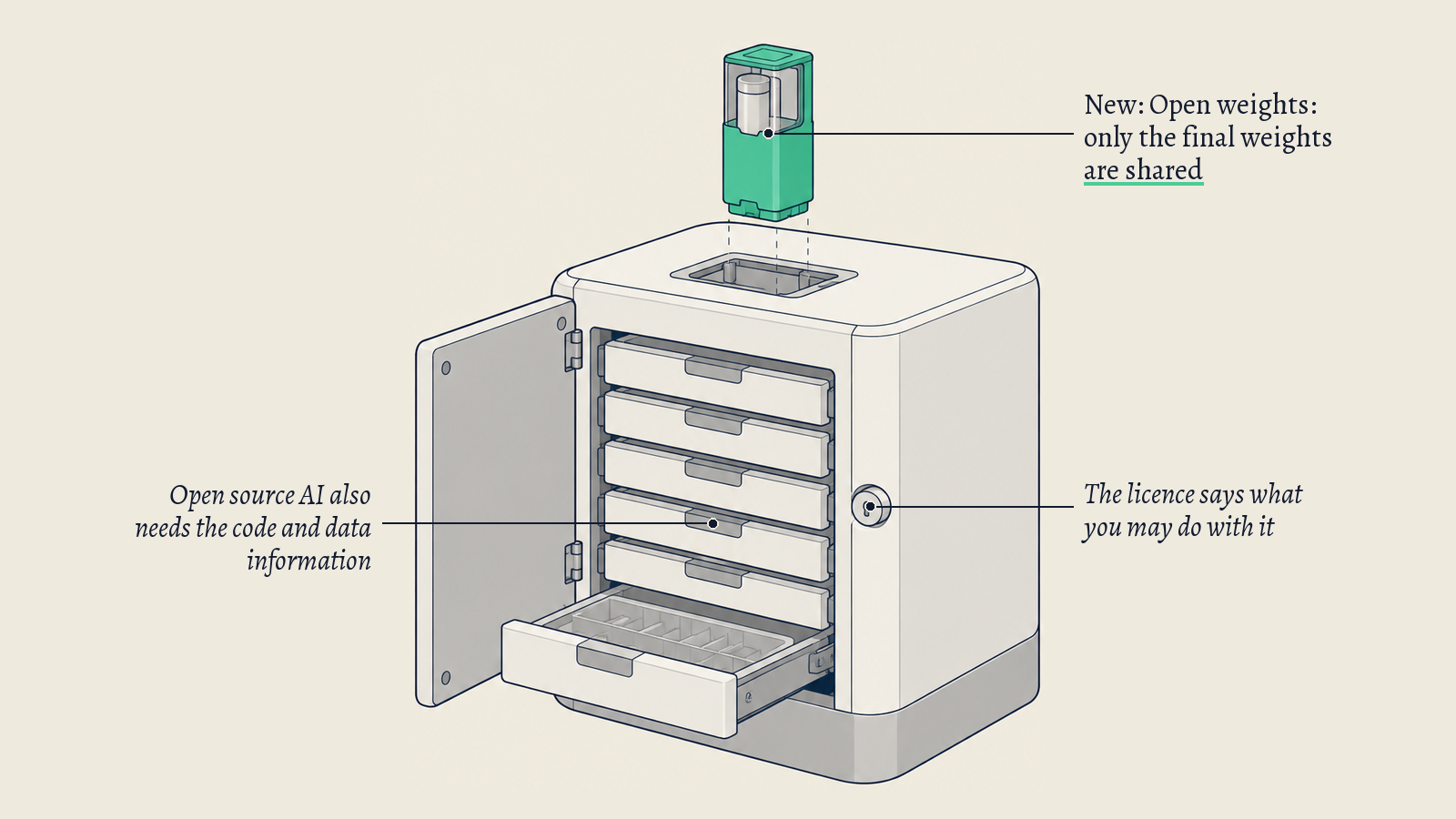 Illustration made with AI for ai notis
Key points
- The Open Source Initiative's Open Source AI Definition 1.0 asks for four freedoms: to use, study, modify and share a system.
- The definition says the preferred form to make modifications must include three elements: data information, code and parameters. The Initiative says open weights are only the final weights and biases.
- Licences differ: Google's Gemma Terms of Use let Google restrict usage it believes violates them, while Gemma 4 was released under Apache 2.0 and Qwen3.5-9B lists apache-2.0.
What happened
The Open Source Initiative's Open Source AI Definition, version 1.0, says an Open Source AI is an AI system made available under terms and in a way that grant four freedoms.
The four freedoms are to use the system for any purpose and without having to ask for permission; to study how the system works and inspect its components; to modify the system for any purpose, including to change its output; and to share the system for others to use, with or without modifications, for any purpose.
The definition says a precondition to exercising these freedoms is access to the preferred form to make modifications to the system.
The definition says AI weights are the set of learned parameters that overlay the model architecture to produce an output from a given input. For a machine-learning system, it says the preferred form to make modifications must include three elements: data information, code and parameters.
Data information means sufficiently detailed information about the data used to train the system, so that a skilled person can build a substantially equivalent system. Code means the complete source code used to train and run the system, and parameters means the model parameters, such as weights or other configuration settings.
The definition says "Open Source models" and "Open Source weights" must include the data information and code used to derive those parameters. It also says it does not require a specific legal mechanism for assuring that the model parameters are freely available to all.
The Open Source Initiative has a separate page on open weights.
It says "Open Weights refer to the final weights and biases of a trained neural network." It says open weights differ from Open Source AI because they do not include training code, the training dataset ("when legally possible") or comprehensive data transparency, meaning full details about dataset composition such as source domains, cleaning methods or balancing techniques.
It says that by withholding these elements, developers "only provide a glimpse into the final state of the model, making it difficult for others to replicate, audit, or deeply understand the training process."
The Gemma Terms of Use say the terms apply to the Gemma models listed in the Appendix at the bottom of the page. Google's Gemma Terms of Use, last modified on 1 April 2026, say you may use, reproduce, modify, distribute, perform or display Gemma only in accordance with the agreement.
They say you must not use the Gemma services for the restricted uses in the Gemma Prohibited Use Policy, which is incorporated by reference, or in violation of applicable laws and regulations. They also say Google reserves the right to restrict, remotely or otherwise, usage that it reasonably believes violates the agreement.
The same page says Gemma 4 has its own licence. Google's Open Source Blog said on 2 April 2026 that Gemma 4 models are the first in the Gemmaverse to be released under the OSI-approved Apache 2.0 license. The Hugging Face model card for Qwen3.5-9B lists its licence as apache-2.0.
Underlined sentences link to the facts we checked. Dotted words open a short explainer.
Fact 1 of 26 · from Open Source Initiative
An Open Source AI is an AI system made available under terms and in a way that grant the freedoms 1 to:
Fact 2 of 26 · from Open Source Initiative
Use the system for any purpose and without having to ask for permission. Study how the system works and inspect its components. Modify the system for any purpose, including to change its output. Share the system for others to use with or without modifications, for any purpose.
Fact 3 of 26 · from Open Source Initiative
A precondition to exercising these freedoms is to have access to the preferred form to make modifications to the system.
Fact 4 of 26 · from Open Source Initiative
AI weights are the set of learned parameters that overlay the model architecture to produce an output from a given input.
Fact 5 of 26 · from Open Source Initiative
The preferred form of making modifications to a machine-learning system must include all the elements below: Data Information ... Code ... Parameters
Fact 6 of 26 · from Open Source Initiative
Data Information: Sufficiently detailed information about the data used to train the system so that a skilled person can build a substantially equivalent system.
Fact 7 of 26 · from Open Source Initiative
Code: The complete source code used to train and run the system. ... Parameters: The model parameters, such as weights or other configuration settings.
Fact 8 of 26 · from Open Source Initiative
“Open Source models” and “Open Source weights” must include the data information and code used to derive those parameters.
Fact 9 of 26 · from Open Source Initiative
The Open Source AI Definition does not require a specific legal mechanism for assuring that the model parameters are freely available to all.
Fact 11 of 26 · from https://ai.google.dev/gemma/terms, 1 Apr 2026
You may use, reproduce, modify, Distribute, perform or display any of the Gemma Services only in accordance with the terms of this Agreement
Fact 12 of 26 · from https://ai.google.dev/gemma/terms, 1 Apr 2026
You must not use any of the Gemma Services: for the restricted uses set forth in the Gemma Prohibited Use Policy at ai.google.dev/gemma/prohibited_use_policy (" Prohibited Use Policy "), which is hereby incorporated by reference into this Agreement; or in violation of applicable laws and regulations.
Fact 13 of 26 · from https://ai.google.dev/gemma/terms, 1 Apr 2026
To the maximum extent permitted by law, Google reserves the right to restrict (remotely or otherwise) usage of any of the Gemma Services that Google reasonably believes are in violation of this Agreement.
Fact 14 of 26 · from https://ai.google.dev/gemma/terms, 1 Apr 2026
For Gemma 4 terms, see the Gemma 4 license .
Fact 15 of 26 · from https://ai.google.dev/gemma/terms, 1 Apr 2026
The terms below apply to Gemma models listed in the Appendix at bottom of this page.
Fact 16 of 26 · from Google Open Source Blog, 2 Apr 2026
Gemma 4 models are the first in the Gemmaverse to be released under the OSI-approved Apache 2.0 license.
Fact 18 of 26 · from Hugging Face (Qwen)
License: apache-2.0
Fact 26 of 26 · from Open Source Initiative
By withholding these critical elements, developers only provide a glimpse into the final state of the model, making it difficult for others to replicate, audit, or deeply understand the training process.
What it means for you
Our viewWhen a vendor calls a model open, ask which of three things you actually get: the weights, the training code and information about the training data. The Open Source Initiative says open weights cover only the first.
The licence is a separate question, because the terms attached to downloadable models differ: Google's Gemma Terms of Use incorporate a prohibited use policy, while Gemma 4 was released under Apache 2.0.
If your company has an open source policy, check whether it covers downloadable models, and read the licence of any model you plan to deploy instead of relying on the word open.
It adds no new facts.
Your reaction
We count reactions per story and day, never who reacted. The counts help us choose what goes in the monthly issue. If you are signed in, your own page shows yours too.
We count reactions per story and day, never who reacted. They help choose what goes in the monthly issue.
Check our sources
Every sentence above is checked against these 7 sources.
1 The Open Source AI Definition 1.0
Open the source-
The Open Source Initiative's Open Source AI Definition, version 1.0, says an Open Source AI is an AI system made available under terms and in a way that grant four freedoms.
citeAn Open Source AI is an AI system made available under terms and in a way that grant the freedoms 1 to:
-
The four freedoms are to use the system for any purpose and without having to ask for permission; to study how the system works and inspect its components; to modify the system for any purpose, including to change its output; and to share the system for others to use, with or without modifications, for any purpose.
citeUse the system for any purpose and without having to ask for permission. Study how the system works and inspect its components. Modify the system for any purpose, including to change its output. Share the system for others to use with or without modifications, for any purpose.
-
The definition says a precondition to exercising these freedoms is access to the preferred form to make modifications to the system.
citeA precondition to exercising these freedoms is to have access to the preferred form to make modifications to the system.
-
The definition says AI weights are the set of learned parameters that overlay the model architecture to produce an output from a given input.
citeAI weights are the set of learned parameters that overlay the model architecture to produce an output from a given input.
-
For a machine-learning system, it says the preferred form to make modifications must include three elements: data information, code and parameters.
citeThe preferred form of making modifications to a machine-learning system must include all the elements below: Data Information ... Code ... Parameters
-
Data information means sufficiently detailed information about the data used to train the system, so that a skilled person can build a substantially equivalent system.
citeData Information: Sufficiently detailed information about the data used to train the system so that a skilled person can build a substantially equivalent system.
-
Code means the complete source code used to train and run the system, and parameters means the model parameters, such as weights or other configuration settings.
citeCode: The complete source code used to train and run the system. ... Parameters: The model parameters, such as weights or other configuration settings.
-
The definition says "Open Source models" and "Open Source weights" must include the data information and code used to derive those parameters.
cite“Open Source models” and “Open Source weights” must include the data information and code used to derive those parameters.
-
It also says it does not require a specific legal mechanism for assuring that the model parameters are freely available to all.
citeThe Open Source AI Definition does not require a specific legal mechanism for assuring that the model parameters are freely available to all.
2 https://ai.google.dev/gemma/terms
Open the source archived copy-
The Gemma Terms of Use say they apply to the Gemma models listed in their appendix, and point to a separate licence for Gemma 4.
Toned down to what the source says
citeThe terms below apply to Gemma models listed in the Appendix at bottom of this page. For Gemma 4 terms, see the Gemma 4 license .
-
Google's Gemma Terms of Use, last modified on 1 April 2026, say you may use, reproduce, modify, distribute, perform or display Gemma only in accordance with the agreement.
citeYou may use, reproduce, modify, Distribute, perform or display any of the Gemma Services only in accordance with the terms of this Agreement
-
They say you must not use the Gemma services for the restricted uses in the Gemma Prohibited Use Policy, which is incorporated by reference, or in violation of applicable laws and regulations.
citeYou must not use any of the Gemma Services: for the restricted uses set forth in the Gemma Prohibited Use Policy at ai.google.dev/gemma/prohibited_use_policy (" Prohibited Use Policy "), which is hereby incorporated by reference into this Agreement; or in violation of applicable laws and regulations.
-
They also say Google reserves the right to restrict, remotely or otherwise, usage that it reasonably believes violates the agreement.
citeTo the maximum extent permitted by law, Google reserves the right to restrict (remotely or otherwise) usage of any of the Gemma Services that Google reasonably believes are in violation of this Agreement.
-
The same page says Gemma 4 has its own licence.
citeFor Gemma 4 terms, see the Gemma 4 license .
-
The Gemma Terms of Use say the terms apply to the Gemma models listed in the Appendix at the bottom of the page.
citeThe terms below apply to Gemma models listed in the Appendix at bottom of this page.
3 Gemma 4: Expanding the Gemmaverse with Apache 2.0
Open the source archived copy-
Google's Open Source Blog said on 2 April 2026 that Gemma 4 models are the first in the Gemmaverse to be released under the OSI-approved Apache 2.0 license.
citeGemma 4 models are the first in the Gemmaverse to be released under the OSI-approved Apache 2.0 license.
-
Google's Open Source Blog post on Gemma 4 says Gemma 4 allows local, private execution that does not rely on cloud-only infrastructure.
citeGemma 4 allows for local, private execution that doesn't rely on cloud-only infrastructure.
4 Qwen/Qwen3.5-9B model card
Open the source archived copy-
The Hugging Face model card for Qwen3.5-9B lists its licence as apache-2.0.
citeLicense: apache-2.0
5 AI models may be capable of self-replicating without access to a datacenter
Open the source archived copy-
Anthropic's self-replication post of 12 October 2026 ran Gemma4-26B-A4B distributed over 15 inexpensive off-brand Android TV boxes, about $55 each, at 0.39 tokens per second.
citeWe run Gemma4-26B-A4B, distributed over 15 inexpensive off-brand Android TV boxes (~$55 each) that we bought and networked together, at 0.39 tokens per second.
-
The same post says GLM-5.2 was the only model in its set of tested open-weight models capable of full end-to-end replication in its simplified test, assuming its capabilities could be packed into Llama3.1-8B.
Toned down to what the source says
citeOnly GLM-5.2 out of our set of tested open-weight models is capable of full end-to-end replication (assuming its capabilities could be packed into Llama3.1-8B).
6 Strengthening our defenses against distillation attacks
Open the source archived copy-
Anthropic's distillation post of 12 October says the US Center for Advancing Innovation and Standards for Super Intelligence has assessed GLM-5.3 as the most cyber-capable open-weights model released to date.
citeEarly evidence suggests that these methods have reduced the amount of data harvested by distillers by around 90 to 99%.
7 Open Weights
Open the source archived copy-
The Open Source Initiative's page on open weights says "Open Weights refer to the final weights and biases of a trained neural network."
citeOpen Weights refer to the final weights and biases of a trained neural network.
-
The same page says open weights differ from Open Source AI because they do not include training code, which it describes as "The scripts or frameworks used to create and curate the training dataset."
citeHowever, Open Weights differ significantly from Open Source AI because they do not include: Training code - The scripts or frameworks used to create and curate the training dataset.
-
The same page says open weights do not include the training dataset, which it describes as "The full dataset used for training, when legally possible."
citeTraining dataset - The full dataset used for training, when legally possible.
-
The same page says open weights do not include comprehensive data transparency, which it describes as "Full details about dataset composition, such as source domains, cleaning methods, or balancing techniques."
citeAs an alternative, when distribution of the training dataset is not legally possible, Comprehensive data transparency - Full details about dataset composition, such as source domains, cleaning methods, or balancing techniques.
-
The same page says that by withholding these elements, developers "only provide a glimpse into the final state of the model, making it difficult for others to replicate, audit, or deeply understand the training process."
citeBy withholding these critical elements, developers only provide a glimpse into the final state of the model, making it difficult for others to replicate, audit, or deeply understand the training process.
Every sentence above is checked against these 7 sources. Each fact has its own address you can cite.
Source 1 · Open Source Initiative
The Open Source AI Definition 1.0
The Open Source Initiative's Open Source AI Definition, version 1.0, says an Open Source AI is an AI system made available under terms and in a way that grant four freedoms.
An Open Source AI is an AI system made available under terms and in a way that grant the freedoms 1 to:
The four freedoms are to use the system for any purpose and without having to ask for permission; to study how the system works and inspect its components; to modify the system for any purpose, including to change its output; and to share the system for others to use, with or without modifications, for any purpose.
Use the system for any purpose and without having to ask for permission. Study how the system works and inspect its components. Modify the system for any purpose, including to change its output. Share the system for others to use with or without modifications, for any purpose.
The definition says a precondition to exercising these freedoms is access to the preferred form to make modifications to the system.
A precondition to exercising these freedoms is to have access to the preferred form to make modifications to the system.
Show all 9 factsShow fewer facts
The definition says AI weights are the set of learned parameters that overlay the model architecture to produce an output from a given input.
AI weights are the set of learned parameters that overlay the model architecture to produce an output from a given input.
For a machine-learning system, it says the preferred form to make modifications must include three elements: data information, code and parameters.
The preferred form of making modifications to a machine-learning system must include all the elements below: Data Information ... Code ... Parameters
Data information means sufficiently detailed information about the data used to train the system, so that a skilled person can build a substantially equivalent system.
Data Information: Sufficiently detailed information about the data used to train the system so that a skilled person can build a substantially equivalent system.
Code means the complete source code used to train and run the system, and parameters means the model parameters, such as weights or other configuration settings.
Code: The complete source code used to train and run the system. ... Parameters: The model parameters, such as weights or other configuration settings.
The definition says "Open Source models" and "Open Source weights" must include the data information and code used to derive those parameters.
“Open Source models” and “Open Source weights” must include the data information and code used to derive those parameters.
It also says it does not require a specific legal mechanism for assuring that the model parameters are freely available to all.
The Open Source AI Definition does not require a specific legal mechanism for assuring that the model parameters are freely available to all.
Source 2 · 1 Apr 2026
https://ai.google.dev/gemma/terms
The Gemma Terms of Use say they apply to the Gemma models listed in their appendix, and point to a separate licence for Gemma 4.
Toned down to what the source saysThe terms below apply to Gemma models listed in the Appendix at bottom of this page. For Gemma 4 terms, see the Gemma 4 license .
Google's Gemma Terms of Use, last modified on 1 April 2026, say you may use, reproduce, modify, distribute, perform or display Gemma only in accordance with the agreement.
You may use, reproduce, modify, Distribute, perform or display any of the Gemma Services only in accordance with the terms of this Agreement
They say you must not use the Gemma services for the restricted uses in the Gemma Prohibited Use Policy, which is incorporated by reference, or in violation of applicable laws and regulations.
You must not use any of the Gemma Services: for the restricted uses set forth in the Gemma Prohibited Use Policy at ai.google.dev/gemma/prohibited_use_policy (" Prohibited Use Policy "), which is hereby incorporated by reference into this Agreement; or in violation of applicable laws and regulations.
Show all 6 factsShow fewer facts
They also say Google reserves the right to restrict, remotely or otherwise, usage that it reasonably believes violates the agreement.
To the maximum extent permitted by law, Google reserves the right to restrict (remotely or otherwise) usage of any of the Gemma Services that Google reasonably believes are in violation of this Agreement.
The Gemma Terms of Use say the terms apply to the Gemma models listed in the Appendix at the bottom of the page.
The terms below apply to Gemma models listed in the Appendix at bottom of this page.
Source 3 · Google Open Source Blog · 2 Apr 2026
Gemma 4: Expanding the Gemmaverse with Apache 2.0
Google's Open Source Blog said on 2 April 2026 that Gemma 4 models are the first in the Gemmaverse to be released under the OSI-approved Apache 2.0 license.
Gemma 4 models are the first in the Gemmaverse to be released under the OSI-approved Apache 2.0 license.
Google's Open Source Blog post on Gemma 4 says Gemma 4 allows local, private execution that does not rely on cloud-only infrastructure.
Gemma 4 allows for local, private execution that doesn't rely on cloud-only infrastructure.
Source 4 · Hugging Face (Qwen)
Qwen/Qwen3.5-9B model card
The Hugging Face model card for Qwen3.5-9B lists its licence as apache-2.0.
License: apache-2.0
Source 5 · Anthropic (Frontier Red Team) · 12 Oct 2026
AI models may be capable of self-replicating without access to a datacenter
Anthropic's self-replication post of 12 October 2026 ran Gemma4-26B-A4B distributed over 15 inexpensive off-brand Android TV boxes, about $55 each, at 0.39 tokens per second.
We run Gemma4-26B-A4B, distributed over 15 inexpensive off-brand Android TV boxes (~$55 each) that we bought and networked together, at 0.39 tokens per second.
The same post says GLM-5.2 was the only model in its set of tested open-weight models capable of full end-to-end replication in its simplified test, assuming its capabilities could be packed into Llama3.1-8B.
Toned down to what the source saysOnly GLM-5.2 out of our set of tested open-weight models is capable of full end-to-end replication (assuming its capabilities could be packed into Llama3.1-8B).
Source 6 · Anthropic · 12 Oct 2026
Strengthening our defenses against distillation attacks
Anthropic's distillation post of 12 October says the US Center for Advancing Innovation and Standards for Super Intelligence has assessed GLM-5.3 as the most cyber-capable open-weights model released to date.
Early evidence suggests that these methods have reduced the amount of data harvested by distillers by around 90 to 99%.
Source 7 · Open Source Initiative
Open Weights
The Open Source Initiative's page on open weights says "Open Weights refer to the final weights and biases of a trained neural network."
Open Weights refer to the final weights and biases of a trained neural network.
The same page says open weights differ from Open Source AI because they do not include training code, which it describes as "The scripts or frameworks used to create and curate the training dataset."
However, Open Weights differ significantly from Open Source AI because they do not include: Training code - The scripts or frameworks used to create and curate the training dataset.
The same page says open weights do not include the training dataset, which it describes as "The full dataset used for training, when legally possible."
Training dataset - The full dataset used for training, when legally possible.
Show all 5 factsShow fewer facts
The same page says open weights do not include comprehensive data transparency, which it describes as "Full details about dataset composition, such as source domains, cleaning methods, or balancing techniques."
As an alternative, when distribution of the training dataset is not legally possible, Comprehensive data transparency - Full details about dataset composition, such as source domains, cleaning methods, or balancing techniques.
The same page says that by withholding these elements, developers "only provide a glimpse into the final state of the model, making it difficult for others to replicate, audit, or deeply understand the training process."
By withholding these critical elements, developers only provide a glimpse into the final state of the model, making it difficult for others to replicate, audit, or deeply understand the training process.
Topics
The morning email
On the mornings we publish: the three top stories and up to four short ones. Free.
We email you a link to confirm. An issue may include one sponsor, always labelled Sponsored · Advertisement. Our emails count opens and clicks, not who made them. Unsubscribe in one click. What we keep