SafetyPublished Top storyAll news from that day
Case: Anthropic's AI-accelerated research 3 storiesKimberly White/Getty Images for TechCrunch / Dario Amodei at TechCrunch Disrupt 2023 / CC BY 2.0, cropped
Anthropic's model scores grew about 1.9 times faster since October 2025, METR estimates
METR's guess is that perhaps about 80% of the acceleration at Anthropic is due to AI, but Anthropic redacted a majority of the evidence METR found most informative.
Check our sources · 12 facts from 1 source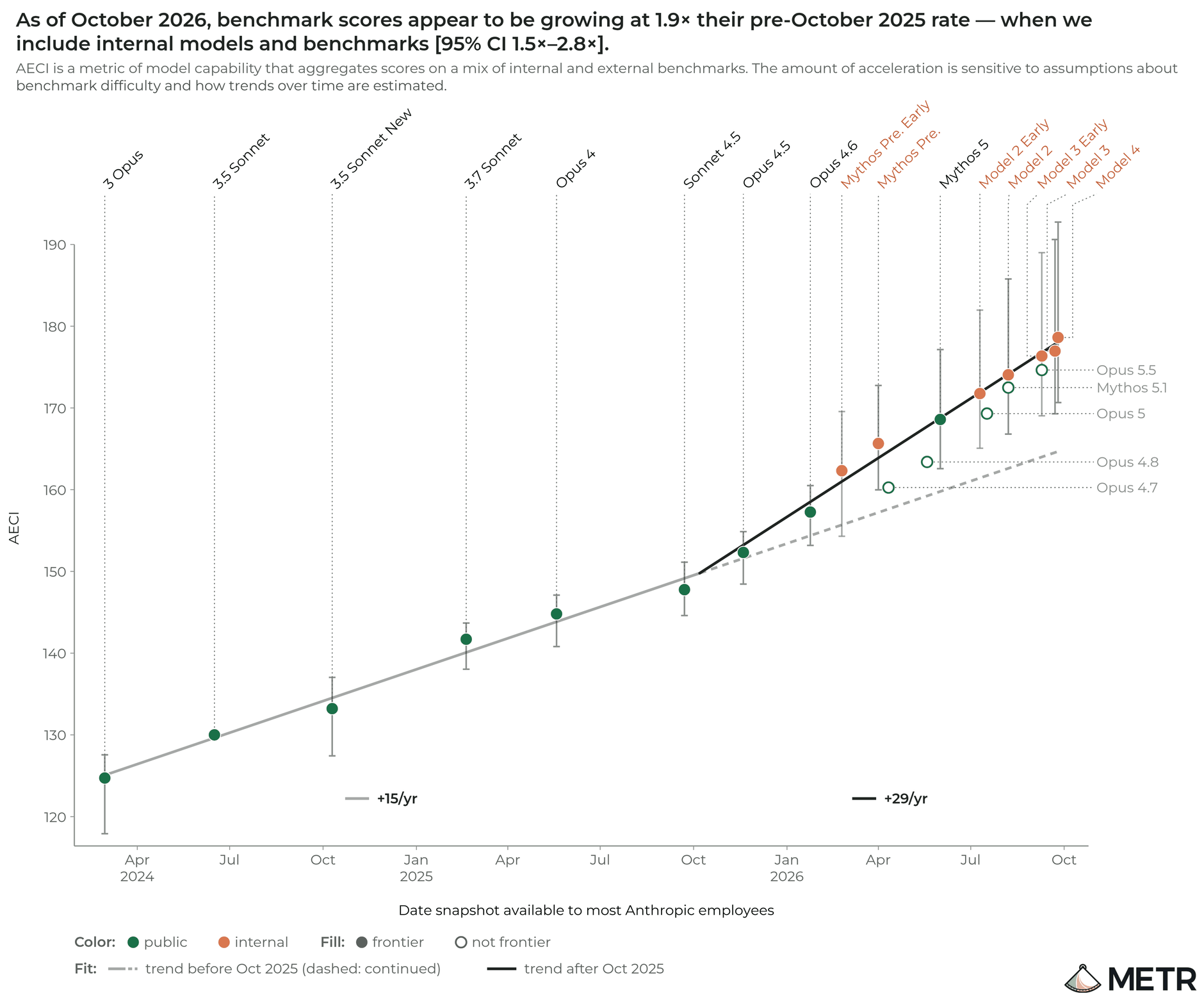 Image: METR
Key points
- METR estimates scores on AECI, Anthropic's version of the Epoch Capabilities Index, have grown since October 2025 at about 1.9 times the earlier rate (95% interval 1.5 to 2.8 times).
- METR guesses a majority, perhaps about 80%, of the current acceleration is due to AI, and is confident it was not due to faster scaling of training compute.
- Anthropic redacted a majority of the evidence METR found most informative, and METR says the public has to rely on its judgment much more than would be ideal.
What happened
METR estimates that benchmark scores for Anthropic's models have grown at about 1.9 times the rate before October 2025, with a 95% confidence interval of 1.5 to 2.8 times. It says that is roughly two years of historical progress in the last year.
The figure comes from METR's assessment of AI R&D acceleration at Anthropic, published on 5 November 2026 by Tom Cunningham, Nate Rush, Parker Whitfill and Hjalmar Wijk. They worked at Anthropic over eleven weeks, from 12 August to 29 October.
The measure is AECI, Anthropic's version of the Epoch Capabilities Index. METR's own guess is that a majority, perhaps about 80%, of the current acceleration is due to AI, with substantial uncertainty. It says it is confident the acceleration did not come from faster scaling of training compute.
Other analysis choices move the number between 1.1 and 2.9 times. METR says it would be surprised by no acceleration or by more than 3 times.
Most of the evidence is not public. Anthropic held redaction rights, and METR says Anthropic redacted a majority of the evidence METR found most informative. Anthropic described the redactions as aimed at removing confidential information that could accelerate other AI developers. METR says the public therefore has to rely on its judgment more than would be ideal.
METR also used Anthropic's self-reports. It says Anthropic staff polls put average self-reported uplift from AI at about 12 times for the most capable internal model in October 2026, and calls that very loose evidence.
The assessment drew on Anthropic's AI as well. METR says Anthropic provided free tokens that METR used mainly for AI-assisted data analysis and visualization.
On the near term, METR says it saw no evidence of significant bottlenecks in algorithmic progress, training compute, experiment compute or data over the next 12 months.
Underlined sentences link to the facts we checked. Dotted words open a short explainer.
Fact 7 of 12 · from METR, 5 Nov 2026
Anthropic redacted a majority of the evidence we found most informative for these conclusions.
Fact 9 of 12 · from METR, 5 Nov 2026
As a consequence, the public has to rely on METR’s judgment much more than would be ideal, given the weight of the questions answered here.
Fact 11 of 12 · from METR, 5 Nov 2026
Anthropic provided free tokens for this assessment, which we primarily used for AI-assisted data analysis and visualization.
Fact 12 of 12 · from METR, 5 Nov 2026
We did not see evidence for significant bottlenecks which would prevent further capabilities progress due to limits on algorithmic progress, training compute, experiment compute, or data in the next 12 months.
What it means for you
Our viewThe 1.9 times figure is an outside estimate from METR's eleven weeks at Anthropic, and METR says other analysis choices move it between 1.1 and 2.9 times. Because Anthropic redacted most of the key evidence, treat it as METR's judgment rather than a measurement anyone else can reproduce.
METR also calls Anthropic staff's self-reported uplift from AI, about 12 times, very loose evidence. The practical reading is that progress at this lab is running faster than its earlier pace, on METR's estimate, and METR saw no evidence of significant bottlenecks over the next 12 months.
If you depend on one Anthropic model, run your own test set against each successor when it appears.
It adds no new facts.
Your reaction
We count reactions per story and day, never who reacted. The counts help us choose what goes in the monthly issue. If you are signed in, your own page shows yours too.
We count reactions per story and day, never who reacted. They help choose what goes in the monthly issue.
Check our sources
Every sentence above is checked against this source.
1 Independent assessment of AI R&D acceleration at Anthropic
Open the source archived copy-
METR estimates that benchmark scores (AECI, Anthropic's version of the Epoch Capabilities Index) for Anthropic's models have grown since October 2025 at about 1.9x the pre-October 2025 rate (95% confidence interval 1.5 to 2.8x), implying roughly two years of historical progress over the last year.
citeSince October 2025, benchmark scores (measured via AECI, Anthropic’s version of the Epoch Capabilities Index) for Anthropic’s models have been growing at an estimated 1.9x the pre-October 2025 rate [95% confidence interval: 1.5–2.8x], implying that Anthropic has made roughly two years of historical progress over the last year.
-
The METR report 'Independent assessment of AI R&D acceleration at Anthropic' was published on 5 November 2026; its authors are Tom Cunningham, Nate Rush, Parker Whitfill and Hjalmar Wijk.
citeIndependent Assessment of AI R&D Acceleration at Anthropic in October 2026 DATE November 5, 2026 ... Authors: Tom Cunningham, Nate Rush, Parker Whitfill and Hjalmar Wijk.
-
METR staff performed the high-access evaluation at Anthropic from 12 August to 29 October 2026, over eleven weeks.
citeFrom August 12 to October 29, 2026, METR staff performed a high-access evaluation at Anthropic ... The METR staff worked over eleven weeks
-
METR says: 'We guess that a majority (perhaps ~80%) of the current (October 2026) acceleration is due to AI', given with substantial uncertainty.
citeWe guess that a majority (perhaps ≈80%) of the current (October 2026) acceleration is due to AI. This judgment is given with substantial uncertainty
-
METR says it is confident that the acceleration was not due to an acceleration in the scaling of training compute.
citeWe are confident that the acceleration was not due to an acceleration in the scaling of training compute.
-
METR reports that alternative analysis choices give acceleration estimates between 1.1x and 2.9x, and that it would be surprised by no acceleration or acceleration above 3x.
citeRobustness analyses find acceleration rates between 1.1x and 2.9x. We would be surprised if the true evolution of benchmark scores (e.g. as measured by an improved version of AECI) showed no acceleration or acceleration above 3x.
-
METR says Anthropic redacted a majority of the evidence METR found most informative for its conclusions.
citeAnthropic redacted a majority of the evidence we found most informative for these conclusions.
-
METR reports that Anthropic described the redactions as 'aimed at removing confidential information that could accelerate other AI developers.'
citeAnthropic described the redactions as “aimed at removing confidential information that could accelerate other AI developers.”
-
METR says the public has to rely on its judgment much more than would be ideal.
citeAs a consequence, the public has to rely on METR’s judgment much more than would be ideal, given the weight of the questions answered here.
-
METR reports that for the most capable internal model in October 2026, Anthropic staff's average self-reported uplift was about 12x, and says it considers this only very loose evidence.
citeFor the most capable internal model in October 2026, average self-reported uplift was ≈12x. ... We consider this to be only very loose evidence, as the responses reflect low-effort consideration.
-
METR says Anthropic provided free tokens for the assessment, which METR primarily used for AI-assisted data analysis and visualization.
citeAnthropic provided free tokens for this assessment, which we primarily used for AI-assisted data analysis and visualization.
-
METR says it did not see evidence for significant bottlenecks in algorithmic progress, training compute, experiment compute or data that would take effect in the next 12 months.
citeWe did not see evidence for significant bottlenecks which would prevent further capabilities progress due to limits on algorithmic progress, training compute, experiment compute, or data in the next 12 months.
Every sentence above is checked against this source. Each fact has its own address you can cite.
Source 1 · METR · 5 Nov 2026
Independent assessment of AI R&D acceleration at Anthropic
METR estimates that benchmark scores (AECI, Anthropic's version of the Epoch Capabilities Index) for Anthropic's models have grown since October 2025 at about 1.9x the pre-October 2025 rate (95% confidence interval 1.5 to 2.8x), implying roughly two years of historical progress over the last year.
Since October 2025, benchmark scores (measured via AECI, Anthropic’s version of the Epoch Capabilities Index) for Anthropic’s models have been growing at an estimated 1.9x the pre-October 2025 rate [95% confidence interval: 1.5–2.8x], implying that Anthropic has made roughly two years of historical progress over the last year.
The METR report 'Independent assessment of AI R&D acceleration at Anthropic' was published on 5 November 2026; its authors are Tom Cunningham, Nate Rush, Parker Whitfill and Hjalmar Wijk.
Independent Assessment of AI R&D Acceleration at Anthropic in October 2026 DATE November 5, 2026 ... Authors: Tom Cunningham, Nate Rush, Parker Whitfill and Hjalmar Wijk.
METR staff performed the high-access evaluation at Anthropic from 12 August to 29 October 2026, over eleven weeks.
From August 12 to October 29, 2026, METR staff performed a high-access evaluation at Anthropic ... The METR staff worked over eleven weeks
Show all 12 factsShow fewer facts
METR says: 'We guess that a majority (perhaps ~80%) of the current (October 2026) acceleration is due to AI', given with substantial uncertainty.
We guess that a majority (perhaps ≈80%) of the current (October 2026) acceleration is due to AI. This judgment is given with substantial uncertainty
METR says it is confident that the acceleration was not due to an acceleration in the scaling of training compute.
We are confident that the acceleration was not due to an acceleration in the scaling of training compute.
METR reports that alternative analysis choices give acceleration estimates between 1.1x and 2.9x, and that it would be surprised by no acceleration or acceleration above 3x.
Robustness analyses find acceleration rates between 1.1x and 2.9x. We would be surprised if the true evolution of benchmark scores (e.g. as measured by an improved version of AECI) showed no acceleration or acceleration above 3x.
METR says Anthropic redacted a majority of the evidence METR found most informative for its conclusions.
Anthropic redacted a majority of the evidence we found most informative for these conclusions.
METR reports that Anthropic described the redactions as 'aimed at removing confidential information that could accelerate other AI developers.'
Anthropic described the redactions as “aimed at removing confidential information that could accelerate other AI developers.”
METR says the public has to rely on its judgment much more than would be ideal.
As a consequence, the public has to rely on METR’s judgment much more than would be ideal, given the weight of the questions answered here.
METR reports that for the most capable internal model in October 2026, Anthropic staff's average self-reported uplift was about 12x, and says it considers this only very loose evidence.
For the most capable internal model in October 2026, average self-reported uplift was ≈12x. ... We consider this to be only very loose evidence, as the responses reflect low-effort consideration.
METR says Anthropic provided free tokens for the assessment, which METR primarily used for AI-assisted data analysis and visualization.
Anthropic provided free tokens for this assessment, which we primarily used for AI-assisted data analysis and visualization.
METR says it did not see evidence for significant bottlenecks in algorithmic progress, training compute, experiment compute or data that would take effect in the next 12 months.
We did not see evidence for significant bottlenecks which would prevent further capabilities progress due to limits on algorithmic progress, training compute, experiment compute, or data in the next 12 months.
Topics
The morning email
On the mornings we publish: the three top stories and up to four short ones. Free.
We email you a link to confirm. An issue may include one sponsor, always labelled Sponsored · Advertisement. Our emails count opens and clicks, not who made them. Unsubscribe in one click. What we keep