2026-11-08 notis CATEGORY Join
Show Read as Find Sections Models and releasesAgents and appsResearchMoney and computeLaws and rulingsSafety and securityAI at work More The monthlyArchiveModelsAboutCorrectionsThe numbersRSS
My notis
TODAY'S NEWS
November 2026 3 STORIES
MTWTFSS
1 2 3 4 5 6 7 8 9 10 11 12 13 14 15 16 17 18 19 20 21 22 23 24 25 26 27 28 29 30

Days with a dot have news. See the archive.

The whole week ›
03:38
0/3
WEATHER THEME CARD SPACING

Today's news

today

My page

Kept in this browser only.

SAVED FOLLOWING COLLECTIONS READING SINCE
Nothing saved yet. Tap the bookmark on a card to keep it here. read today
all cases

No case followed yet.

Price changes Stories where a published price went up or down.
Models being retired Models being withdrawn, and gaps before a replacement is ready.
The day's top stories. Sign up
toned down Safety 8 NOV

GPT-6 Cyber found novel Firefox bugs and helped land fixes, Mozilla's Grinstead says

FirefoxGPT-6 CyberMozillaOpenAI
How Mozilla strengthens Firefox security with GPT-6 Cyber: a video from OpenAI on YouTubeVideo: OpenAI on YouTube

OpenAI says GPT-6 Cyber found 81 high-severity Firefox bugs; Mozilla's advisory credits 41 high-rated entries to reporters named as OpenAI and does not name the model.

SOURCEOpenAI · 3 sources
CHECKED8 Nov, 05:38
Safety watch read
How Mozilla strengthens Firefox security with GPT-6 Cyber: a video from OpenAI on YouTube Safety / 8 NOV

GPT-6 Cyber found novel Firefox bugs and helped land fixes, Mozilla's Grinstead says

  • Brian Grinstead of Mozilla says that in early testing GPT-6 Cyber "not only identified novel vulnerabilities, but it worked efficiently" (0:24).
  • He says the model's "reproducible test cases and fix patches helped our engineers land fixes quickly and get them out to users" (0:34).
  • He says the tools are helping Mozilla "get those fixes shipped to millions of users" (0:44).

Brian Grinstead of Mozilla says OpenAI's GPT-6 Cyber found vulnerabilities in Firefox that were not known before, and that its test cases and patches helped Mozilla's engineers land fixes quickly.

He says it in a 53-second video that OpenAI published on its own channel on 5 November 2026, the day it announced the model.

Grinstead introduces himself as a distinguished engineer at Mozilla who works on Firefox. He says Firefox "entered 2026 as one of the world's most hardened and scrutinized code bases", so that "existing bugs are pretty subtle and hard to find" (0:14, 0:21).

Then, he says, in early testing GPT-6 Cyber "not only identified novel vulnerabilities, but it worked efficiently" (0:24).

He says the model's "reproducible test cases and fix patches helped our engineers land fixes quickly and get them out to users" (0:34), and that the tools are helping to "get those fixes shipped to millions of users" (0:44).

OpenAI's launch post puts numbers on it, and they are OpenAI's own. It says GPT-6 Cyber produced evidence and reproducible tests for 81 novel vulnerabilities that Mozilla classified as high severity, and showed that 30 known issues were more severe than previously reported. It says it disclosed them to Mozilla with proposed patches, and that Mozilla began landing fixes shortly after the reports.

Mozilla's security advisory for Firefox 159, dated 27 October 2026, lists 167 fixed vulnerabilities. It credits 41 of them, all rated high, to reporters named as OpenAI: "OpenAI Codex Security (kylebot)" on 34 entries and "Amy Burnett of OpenAI" on 7. The advisory does not name GPT-6 Cyber.

OpenAI describes GPT-6 Cyber as a cybersecurity model trained to find and validate exploitable vulnerabilities while staying within the scope that researchers set.

What it means for you Our view

This is one Mozilla engineer's account, in a video OpenAI published on its own channel, and the counts come from OpenAI's launch post. OpenAI says GPT-6 Cyber produced evidence for 81 novel high-severity vulnerabilities, while Mozilla's advisory credits 41 high-rated entries to reporters named as OpenAI and does not mention the model. The two counts are not shown to describe the same set, and no source says any of the bugs was exploited. If you maintain software, treat the claim as a reason to try AI bug-finding on your own code, and before you rely on a vendor's count, look for the advisory that lists the fixes.

TAGSFirefoxGPT-6 CyberMozillaOpenAI
OpenAI · 3 sources tap to close
Safety 8 NOV

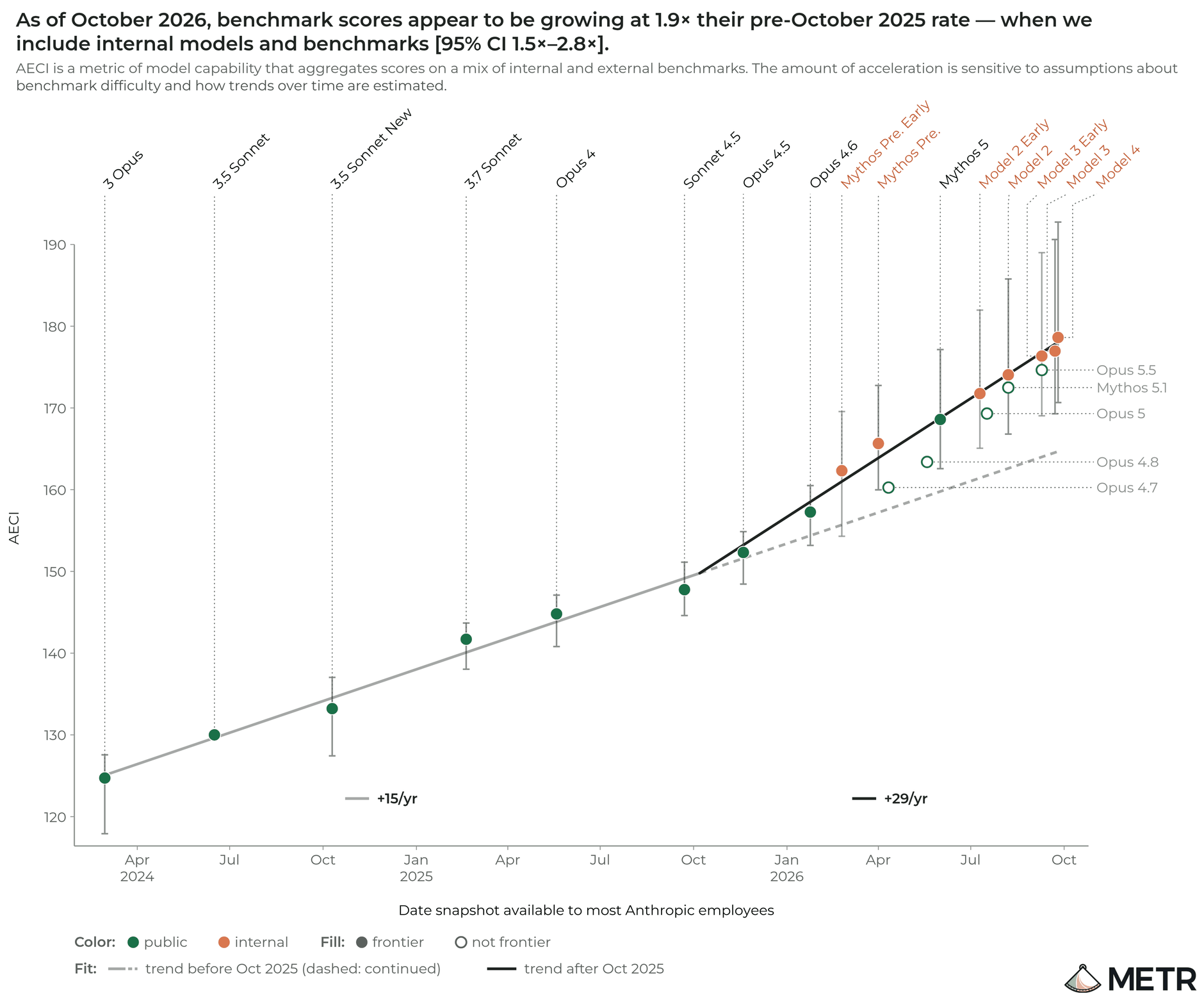
Anthropic's model scores grew about 1.9 times faster since October 2025, METR estimates

AnthropicEpoch Capabilities IndexMETR
Line chart of AECI benchmark scores for Anthropic models from 2024 to 2026, with a steeper trend line after October 2025 than before.Image: METR

METR's guess is that perhaps about 80% of the acceleration at Anthropic is due to AI, but Anthropic redacted a majority of the evidence METR found most informative.

SOURCEMETR · 1 source
CHECKED8 Nov, 05:40
Safety read
Line chart of AECI benchmark scores for Anthropic models from 2024 to 2026, with a steeper trend line after October 2025 than before. Safety / 8 NOV

Anthropic's model scores grew about 1.9 times faster since October 2025, METR estimates

  • METR estimates scores on AECI, Anthropic's version of the Epoch Capabilities Index, have grown since October 2025 at about 1.9 times the earlier rate (95% interval 1.5 to 2.8 times).
  • METR guesses a majority, perhaps about 80%, of the current acceleration is due to AI, and is confident it was not due to faster scaling of training compute.
  • Anthropic redacted a majority of the evidence METR found most informative, and METR says the public has to rely on its judgment much more than would be ideal.

METR estimates that benchmark scores for Anthropic's models have grown at about 1.9 times the rate before October 2025, with a 95% confidence interval of 1.5 to 2.8 times. It says that is roughly two years of historical progress in the last year.

The figure comes from METR's assessment of AI R&D acceleration at Anthropic, published on 5 November 2026 by Tom Cunningham, Nate Rush, Parker Whitfill and Hjalmar Wijk. They worked at Anthropic over eleven weeks, from 12 August to 29 October.

The measure is AECI, Anthropic's version of the Epoch Capabilities Index. METR's own guess is that a majority, perhaps about 80%, of the current acceleration is due to AI, with substantial uncertainty. It says it is confident the acceleration did not come from faster scaling of training compute.

Other analysis choices move the number between 1.1 and 2.9 times. METR says it would be surprised by no acceleration or by more than 3 times.

Most of the evidence is not public. Anthropic held redaction rights, and METR says Anthropic redacted a majority of the evidence METR found most informative. Anthropic described the redactions as aimed at removing confidential information that could accelerate other AI developers. METR says the public therefore has to rely on its judgment more than would be ideal.

METR also used Anthropic's self-reports. It says Anthropic staff polls put average self-reported uplift from AI at about 12 times for the most capable internal model in October 2026, and calls that very loose evidence.

The assessment drew on Anthropic's AI as well. METR says Anthropic provided free tokens that METR used mainly for AI-assisted data analysis and visualization.

On the near term, METR says it saw no evidence of significant bottlenecks in algorithmic progress, training compute, experiment compute or data over the next 12 months.

What it means for you Our view

The 1.9 times figure is an outside estimate from METR's eleven weeks at Anthropic, and METR says other analysis choices move it between 1.1 and 2.9 times. Because Anthropic redacted most of the key evidence, treat it as METR's judgment rather than a measurement anyone else can reproduce. METR also calls Anthropic staff's self-reported uplift from AI, about 12 times, very loose evidence. The practical reading is that progress at this lab is running faster than its earlier pace, on METR's estimate, and METR saw no evidence of significant bottlenecks over the next 12 months. If you depend on one Anthropic model, run your own test set against each successor when it appears.

TAGSAnthropicEpoch Capabilities IndexMETR
METR · 1 source tap to close
toned down Research 8 NOV

How METR's time horizon rates AI agents by human task length

BenchmarksMETRtime horizons
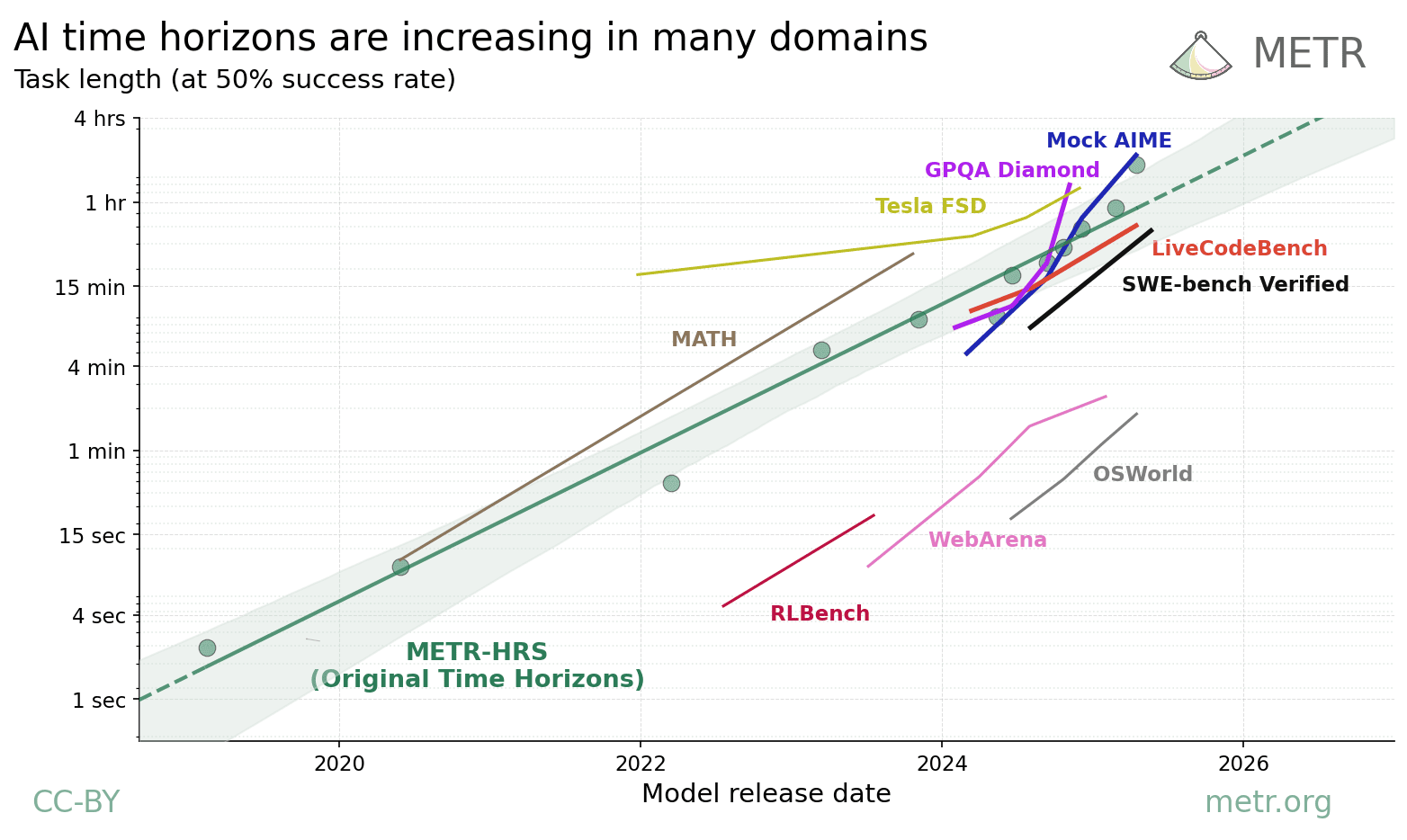
Chart of AI task length at 50% success rate by model release date, 2020 to 2026, with a rising METR trend line and benchmark lines.Image: METR

METR's 50% time horizon is the human task length at which an AI agent is predicted to succeed half the time; METR says measurements above 16 hours are unreliable with its current task suite.

SOURCEMETR · 2 sources
CHECKED8 Nov, 05:39
Research read
Chart of AI task length at 50% success rate by model release date, 2020 to 2026, with a rising METR trend line and benchmark lines. Research / 8 NOV

How METR's time horizon rates AI agents by human task length

  • METR defines the 50% time horizon as the task duration, measured by human expert completion time, at which an AI agent is predicted to succeed half the time.
  • METR says the horizon measures the difficulty of a task, not the time an AI spends on it, and 80% horizons are 4 to 6 times shorter than 50% horizons.
  • METR's time-horizons page says measurements above 16 hours are unreliable with its current task suite.

METR, the group that publishes the time-horizon measure, says measurements above 16 hours are unreliable with its current task suite. That caveat sits on the page that reports how long a task AI agents can handle.

The task-completion time horizon is the task duration, measured by how long human experts take, at which an AI agent is predicted to succeed with a given level of reliability. The 50% time horizon is the duration at which the agent is predicted to succeed half the time. METR's page stresses that it measures the difficulty of a task, not how long the AI spends on it.

The human side comes first. For most tasks, METR contracts people to attempt the task and uses the geometric mean of their successful completion times as its length; for some tasks it relies instead on expert estimates or completion times from QA tests. In the 2025 paper that introduced the measure, METR collected over 800 human baselines totalling 2,529 hours, from skilled professionals in software engineering, machine learning and cybersecurity with about five years of relevant experience.

The paper's 170 tasks came from three sets: HCAST, with 97 tasks from about one minute to 30 hours; RE-Bench, with 7 machine-learning research tasks of about 8 hours each; and SWAA, with 66 single-step tasks of 1 to 30 seconds. METR's current page describes a suite of over a hundred software, machine-learning and cybersecurity tasks, drawing on RE-Bench, HCAST and a set of shorter novel software tasks.

The AI side is a curve. For each model, METR fits a logistic curve that predicts the probability of success against task length, with length on a log scale. The 50% horizon is where the curve crosses one half. METR runs each task six times, which gives roughly 1,000 runs for the test set.

The paper's headline example is o3, with a 50% time horizon of around 110 minutes. The same method at an 80% success threshold gives horizons 4 to 6 times shorter, so a horizon is only meaningful with its reliability level beside it.

The paper also measured a trend. The paper says the frontier AI time horizon has doubled approximately every seven months since 2019; its regression gives 207 days, with a 95% bootstrapped confidence interval of 166 to 240 days. METR's page says that for models released between early 2019 and March 2025, an exponential trend is a much better fit to the data than both the linear and hyperbolic trends.

The limits are stated by METR. The paper says a time horizon is always measured relative to a domain and a task distribution, and that realistic tasks rarely have automatic scoring. It also says that, because the dataset is limited, it cannot confidently measure time horizons at very high success rates, such as 95%. The page adds the 16-hour caveat, says it is no longer actively updated, and was last updated on 8 September 2026.

What it means for you Our view

A time horizon describes how hard a task is for people, so it does not tell you how long an agent will take to run it. A figure only means something with its success level beside it, because the gap between the 50% and 80% horizons is large. METR also says its page is no longer actively updated, so the newest models may not be on it. When you see a claim that an agent can do tasks of a given length, check which success level it uses, and whether the length is inside the range METR says it can measure.

TAGSBenchmarksMETRtime horizons

METR · 2 sources tap to close
NOTHING IN THIS FILTER No story today matches. open the archive →
That's today's news: three stories. Today has one video story, not two: we found no second one we could check well enough to run.

The morning email

On the mornings we publish: the three top stories and up to four short ones. Free.

We email you a link to confirm. An issue may include one sponsor, always labelled Sponsored · Advertisement. Our emails count opens and clicks, not who made them. Unsubscribe in one click. What we keep

1 of 3
How Mozilla strengthens Firefox security with GPT-6 Cyber: a video from OpenAI on YouTubeWatch on YouTubeVideo: OpenAI on YouTube

Safety · 8 NOVnarrowed

GPT-6 Cyber found novel Firefox bugs and helped land fixes, Mozilla's Grinstead says

OpenAI says GPT-6 Cyber found 81 high-severity Firefox bugs; Mozilla's advisory credits 41 high-rated entries to reporters named as OpenAI and does not name the model.

  • Brian Grinstead of Mozilla says that in early testing GPT-6 Cyber "not only identified novel vulnerabilities, but it worked efficiently" (0:24).
  • He says the model's "reproducible test cases and fix patches helped our engineers land fixes quickly and get them out to users" (0:34).
  • He says the tools are helping Mozilla "get those fixes shipped to millions of users" (0:44).
Checked 8 Nov, 05:38 · OpenAI · 3 sources
Line chart of AECI benchmark scores for Anthropic models from 2024 to 2026, with a steeper trend line after October 2025 than before.Image: METR

Safety · 8 NOV

Anthropic's model scores grew about 1.9 times faster since October 2025, METR estimates

METR's guess is that perhaps about 80% of the acceleration at Anthropic is due to AI, but Anthropic redacted a majority of the evidence METR found most informative.

  • METR estimates scores on AECI, Anthropic's version of the Epoch Capabilities Index, have grown since October 2025 at about 1.9 times the earlier rate (95% interval 1.5 to 2.8 times).
  • METR guesses a majority, perhaps about 80%, of the current acceleration is due to AI, and is confident it was not due to faster scaling of training compute.
  • Anthropic redacted a majority of the evidence METR found most informative, and METR says the public has to rely on its judgment much more than would be ideal.
Checked 8 Nov, 05:40 · METR · 1 source
Chart of AI task length at 50% success rate by model release date, 2020 to 2026, with a rising METR trend line and benchmark lines.Image: METR

Research · 8 NOVnarrowed

How METR's time horizon rates AI agents by human task length

METR's 50% time horizon is the human task length at which an AI agent is predicted to succeed half the time; METR says measurements above 16 hours are unreliable with its current task suite.

  • METR defines the 50% time horizon as the task duration, measured by human expert completion time, at which an AI agent is predicted to succeed half the time.
  • METR says the horizon measures the difficulty of a task, not the time an AI spends on it, and 80% horizons are 4 to 6 times shorter than 50% horizons.
  • METR's time-horizons page says measurements above 16 hours are unreliable with its current task suite.
Checked 8 Nov, 05:39 · METR · 2 sources

You're all caught up

That's today's news: three stories.

You can join ai notis soon, to follow cases and keep stories on every device.

Follow us on Instagram and Threads

The morning email

On the mornings we publish: the three top stories and up to four short ones. Free.

We email you a link to confirm. An issue may include one sponsor, always labelled Sponsored · Advertisement. Our emails count opens and clicks, not who made them. Unsubscribe in one click. What we keep

No story today matches. Open the archive
Today's stories 3 STORIES

Today's stories

Sun 8 Nov · 3 STORIES
  1. Safety · 8 NOV · narrowed

    GPT-6 Cyber found novel Firefox bugs and helped land fixes, Mozilla's Grinstead says

    How Mozilla strengthens Firefox security with GPT-6 Cyber: a video from OpenAI on YouTubeVideo: OpenAI on YouTube

    OpenAI says GPT-6 Cyber found 81 high-severity Firefox bugs; Mozilla's advisory credits 41 high-rated entries to reporters named as OpenAI and does not name the model.

    Checked 8 Nov, 05:38 · OpenAI · 3 sourcesRead

  2. Safety · 8 NOV

    Anthropic's model scores grew about 1.9 times faster since October 2025, METR estimates

    Line chart of AECI benchmark scores for Anthropic models from 2024 to 2026, with a steeper trend line after October 2025 than before.Image: METR

    METR's guess is that perhaps about 80% of the acceleration at Anthropic is due to AI, but Anthropic redacted a majority of the evidence METR found most informative.

    Checked 8 Nov, 05:40 · METR · 1 sourceRead

  3. Research · 8 NOV · narrowed

    How METR's time horizon rates AI agents by human task length

    Chart of AI task length at 50% success rate by model release date, 2020 to 2026, with a rising METR trend line and benchmark lines.Image: METR

    METR's 50% time horizon is the human task length at which an AI agent is predicted to succeed half the time; METR says measurements above 16 hours are unreliable with its current task suite.

    Checked 8 Nov, 05:39 · METR · 2 sourcesRead

toned down Safety 8 NOV

GPT-6 Cyber found novel Firefox bugs and helped land fixes, Mozilla's Grinstead says

OpenAI says GPT-6 Cyber found 81 high-severity Firefox bugs; Mozilla's advisory credits 41 high-rated entries to reporters named as OpenAI and does not name the model.

OpenAI · 3 sources·checked 8 Nov, 05:38
FirefoxGPT-6 CyberMozillaOpenAI
How Mozilla strengthens Firefox security with GPT-6 Cyber: a video from OpenAI on YouTubeVideo: OpenAI on YouTube
Safety

Anthropic's model scores grew about 1.9 times faster since October 2025, METR estimates

METR's guess is that perhaps about 80% of the acceleration at Anthropic is due to AI, but Anthropic redacted a majority of the evidence METR found most informative.

8 NOV · METR · 1 source
toned down Research

How METR's time horizon rates AI agents by human task length

METR's 50% time horizon is the human task length at which an AI agent is predicted to succeed half the time; METR says measurements above 16 hours are unreliable with its current task suite.

8 NOV · METR · 2 sources
In brief 4 more today

Today has one video story, not two: we found no second one we could check well enough to run.

0 of 3 read
Drag a card to start Drag left or right · tap to read more Hover to lift a card · tap to bring it forward Tap again to put it back Tap a card to open it Tap again to close it Tap a headline to read it as a card