- Anthropic's monthly spend cap is $500 on the Start tier, $1,000 on Build and $200,000 on Scale, with no cap on Custom.
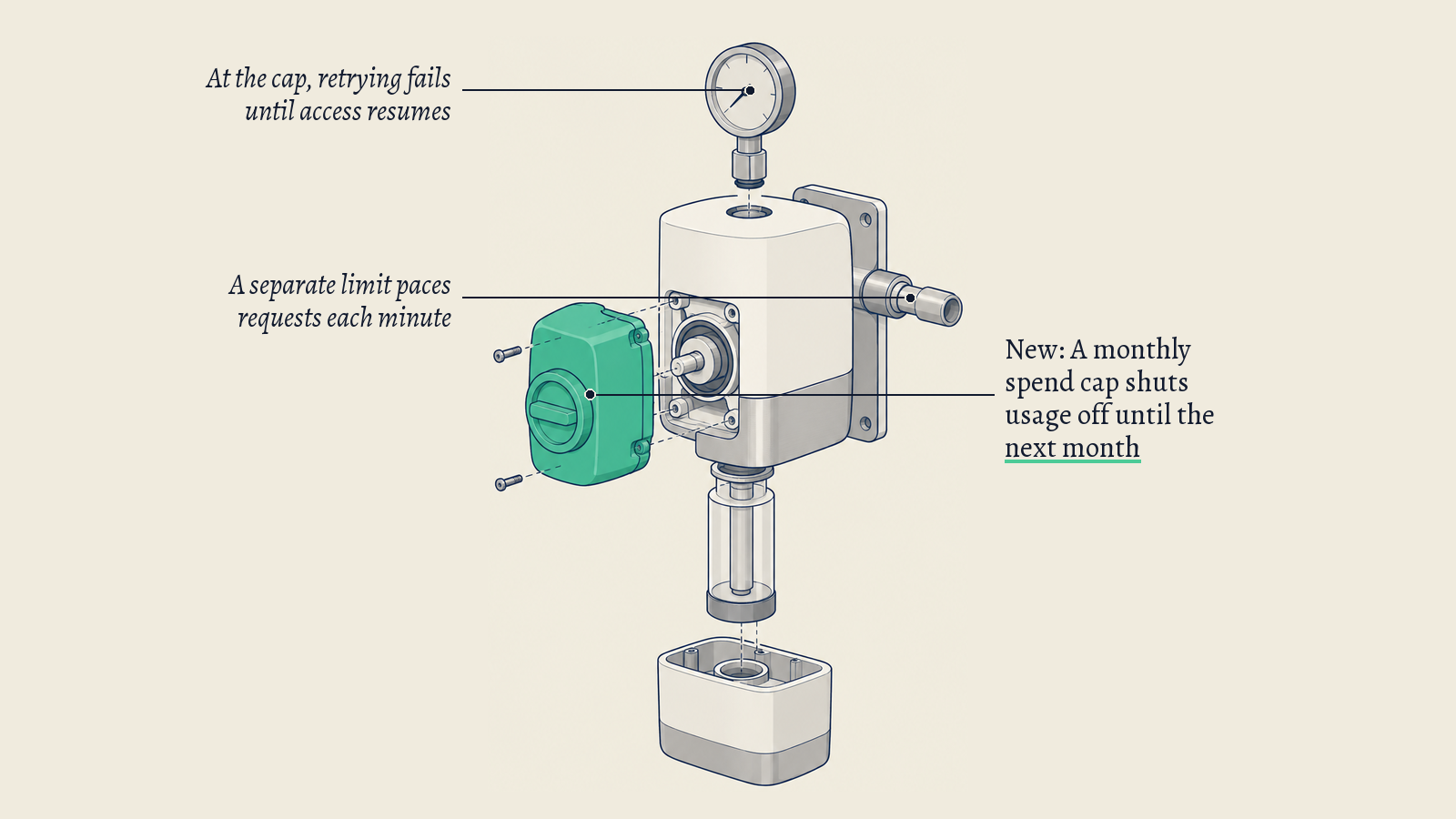
- At the cap, API usage pauses until 00:00 UTC on the first of the next month and requests return HTTP 429 without a retry-after header, so automatic retries fail.
- Anthropic says Claude Code averages around $13 per developer per active day, and agent teams use approximately 7x more tokens than standard sessions in plan mode.
This page explains spend limits and rate limits using Anthropic's own documentation for its API and for Claude Code.
A spend limit and a rate limit are different things. Anthropic's rate-limit page says spend limits set a maximum monthly cost an organization can incur for API usage, while rate limits set the maximum number of API requests an organization can make over a defined period.
Each of the Start, Build and Scale tiers carries a monthly spend cap: $500, $1,000 and $200,000 respectively. Organizations on the Custom tier have no monthly spend cap, and their limits are arranged with their account team.
When the cap is reached, API usage pauses until 00:00 UTC on the first day of the next month, unless a higher limit is requested sooner. Requests then return HTTP 429, but without a retry-after header, so retrying, including the SDK's automatic retries, fails until access resumes. The error code to look for is enforced_spend_limit_reached.
An organization can also set its own spend limit below the tier cap, and the limit cannot exceed the tier's cap. When usage reaches a limit the organization set, requests return HTTP 400 with the error type invalid_request_error instead.
Rate limits work on a shorter clock. They are measured in requests per minute, input tokens per minute and output tokens per minute, and the API uses a token bucket algorithm, so capacity is continuously replenished up to a maximum. For most Claude models, cache-read input tokens do not count toward the input-token limit.
Limits can be set lower for each workspace, so one project cannot use up the whole organization's allowance. Workspace limits are set per limiter type, the default workspace cannot be limited, and the organization-wide limits always apply.
Anthropic's Claude Code cost page says Claude Code charges by API token consumption and that, across enterprise deployments, the average cost is around $13 per developer per active day and $150-250 per developer per month. Thinking tokens are billed as output tokens, subagents' requests still draw on usage, and a scheduled task fires on its interval even while the session is idle, sending the full context each time. The page says agent teams use approximately 7x more tokens than standard sessions when teammates run in plan mode.
Where the cap lives depends on how the model is reached. For Claude Console users it is workspace spend limits. For Claude for Teams and Enterprise it is a per-seat allowance that resets on a rolling five-hour window and a weekly window, with spend limits at organization, group or individual level for usage credits. On Amazon Bedrock, Google Cloud's Agent Platform and Microsoft Foundry, the page says spend controls live in the cloud provider's billing console.
What it means for you Our view
A spend limit caps the monthly bill and a rate limit paces requests, and an agent can run into either. The spend-cap response carries no retry-after header, so an agent that retries automatically keeps failing until access resumes. Anthropic's own figures also show how agents multiply token use: a scheduled task sends the full context each time it fires, even while the session is idle. If you run agents on the API, set a workspace spend limit below the tier cap, and make sure the agent stops instead of retrying, both on the HTTP 400 from your own limit and on the 429 with enforced_spend_limit_reached at the tier cap.
TAGSAnthropicClaude CodeRate limitsSpend limits