ToolingPublished ExplainedAll news from that day
Ongoing case: Anthropic's Claude models 15 stories
How spend and rate limits cap what an AI agent costs
Anthropic's documentation separates monthly spend limits from per-minute rate limits and shows where each applies to API use and to Claude Code.
Check our sources · 25 facts from 2 sources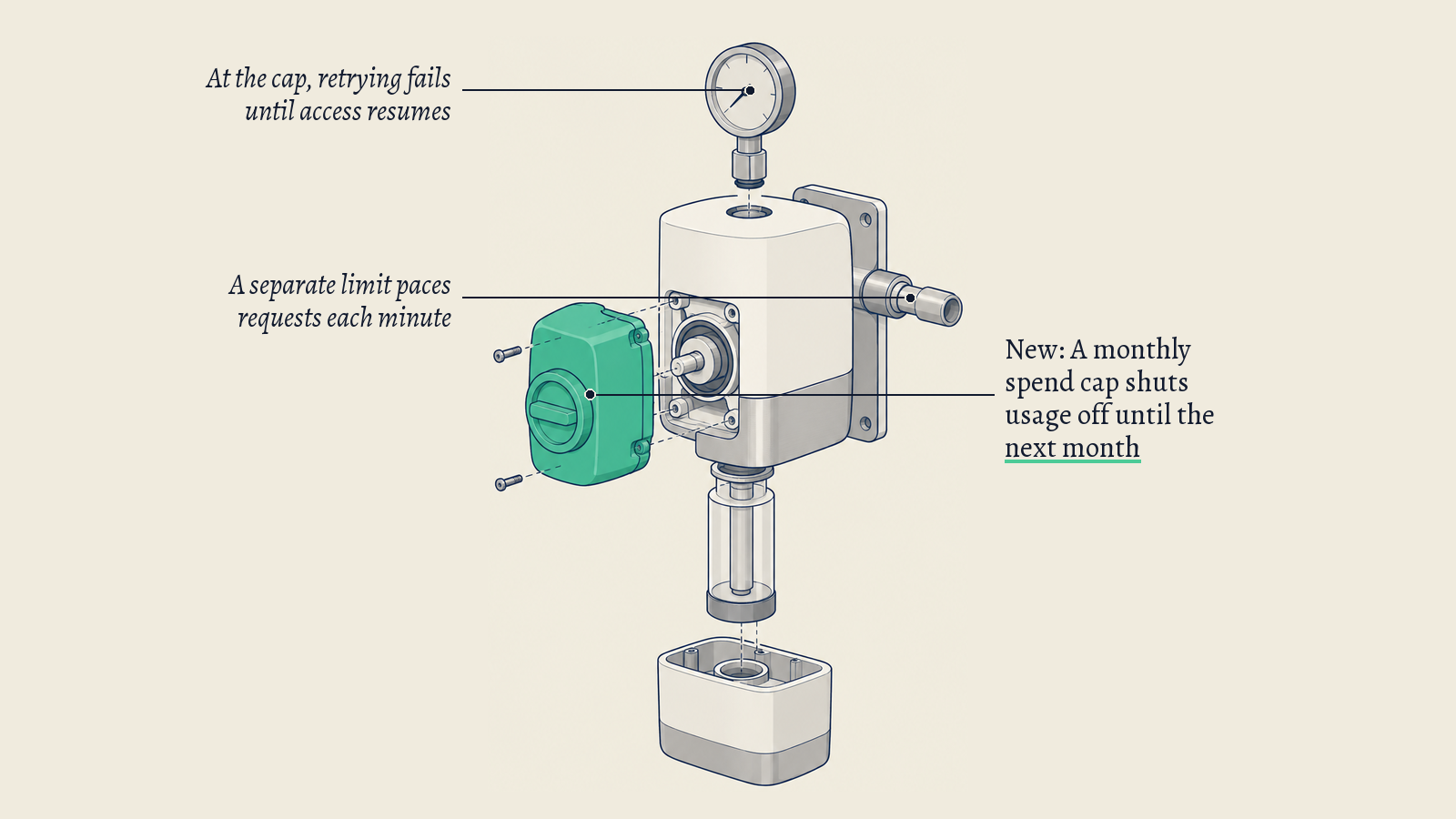 Illustration made with AI for ai notis
Key points
- Anthropic's monthly spend cap is $500 on the Start tier, $1,000 on Build and $200,000 on Scale, with no cap on Custom.
- At the cap, API usage pauses until 00:00 UTC on the first of the next month and requests return HTTP 429 without a retry-after header, so automatic retries fail.
- Anthropic says Claude Code averages around $13 per developer per active day, and agent teams use approximately 7x more tokens than standard sessions in plan mode.
What happened
This page explains spend limits and rate limits using Anthropic's own documentation for its API and for Claude Code.
A spend limit and a rate limit are different things. Anthropic's rate-limit page says spend limits set a maximum monthly cost an organization can incur for API usage, while rate limits set the maximum number of API requests an organization can make over a defined period.
Each of the Start, Build and Scale tiers carries a monthly spend cap: $500, $1,000 and $200,000 respectively. Organizations on the Custom tier have no monthly spend cap, and their limits are arranged with their account team.
When the cap is reached, API usage pauses until 00:00 UTC on the first day of the next month, unless a higher limit is requested sooner. Requests then return HTTP 429, but without a retry-after header, so retrying, including the SDK's automatic retries, fails until access resumes. The error code to look for is enforced_spend_limit_reached.
An organization can also set its own spend limit below the tier cap, and the limit cannot exceed the tier's cap. When usage reaches a limit the organization set, requests return HTTP 400 with the error type invalid_request_error instead.
Rate limits work on a shorter clock. They are measured in requests per minute, input tokens per minute and output tokens per minute, and the API uses a token bucket algorithm, so capacity is continuously replenished up to a maximum. For most Claude models, cache-read input tokens do not count toward the input-token limit.
Limits can be set lower for each workspace, so one project cannot use up the whole organization's allowance. Workspace limits are set per limiter type, the default workspace cannot be limited, and the organization-wide limits always apply.
Anthropic's Claude Code cost page says Claude Code charges by API token consumption and that, across enterprise deployments, the average cost is around $13 per developer per active day and $150-250 per developer per month.
Thinking tokens are billed as output tokens, subagents' requests still draw on usage, and a scheduled task fires on its interval even while the session is idle, sending the full context each time. The page says agent teams use approximately 7x more tokens than standard sessions when teammates run in plan mode.
Where the cap lives depends on how the model is reached. For Claude Console users it is workspace spend limits. For Claude for Teams and Enterprise it is a per-seat allowance that resets on a rolling five-hour window and a weekly window, with spend limits at organization, group or individual level for usage credits.
On Amazon Bedrock, Google Cloud's Agent Platform and Microsoft Foundry, the page says spend controls live in the cloud provider's billing console.
Underlined sentences link to the facts we checked. Dotted words open a short explainer.
Fact 2 of 25 · from Anthropic
Rate limits page: Rate limits set the maximum number of API requests an organization can make over a defined period of time.
Fact 4 of 25 · from Anthropic
Rate limits page: Organizations on the Custom tier have no monthly spend cap; limits are arranged with their account team.
Fact 5 of 25 · from Anthropic
Rate limits page: Once you reach your tier’s spend cap, API usage pauses until 00:00 UTC on the first day of the next month, unless you request a higher limit sooner.
Fact 7 of 25 · from Anthropic
Rate limits page: The error type is rate_limit_error, the same as for a rate limit, but the response has no retry-after header. Retrying, including the SDK’s automatic retries, fails until access resumes.
Fact 9 of 25 · from Anthropic
Rate limits page: You can also set your own spend limit below your tier’s cap to control costs ... Your spend limit cannot exceed your current tier’s cap.
Fact 10 of 25 · from Anthropic
Rate limits page: When usage reaches a spend limit you set, requests return HTTP 400 with error type invalid_request_error.
Fact 13 of 25 · from Anthropic
Rate limits page: For most Claude models, only uncached input tokens count toward your ITPM rate limits. ... cache_read_input_tokens (tokens read from cache) Do NOT count toward ITPM for most models
Fact 15 of 25 · from Anthropic
Rate limits page: You can’t set limits on the default Workspace. ... Workspace limits are set per limiter type ... Organization-wide limits always apply, even if Workspace limits add up to more.
Fact 17 of 25 · from Anthropic
Claude Code costs page: Across enterprise deployments, the average cost is around $13 per developer per active day and $150-250 per developer per month
What it means for you
Our viewA spend limit caps the monthly bill and a rate limit paces requests, and an agent can run into either. The spend-cap response carries no retry-after header, so an agent that retries automatically keeps failing until access resumes.
Anthropic's own figures also show how agents multiply token use: a scheduled task sends the full context each time it fires, even while the session is idle.
If you run agents on the API, set a workspace spend limit below the tier cap, and make sure the agent stops instead of retrying, both on the HTTP 400 from your own limit and on the 429 with enforced_spend_limit_reached at the tier cap.
It adds no new facts.
Your reaction
We count reactions per story and day, never who reacted. The counts help us choose what goes in the monthly issue. If you are signed in, your own page shows yours too.
We count reactions per story and day, never who reacted. They help choose what goes in the monthly issue.
Check our sources
Every sentence above is checked against these 2 sources.
1 Rate limits
Open the source archived copy-
Anthropic's rate-limits page says spend limits set a maximum monthly cost an organization can incur for API usage.
citeRate limits page: Spend limits set a maximum monthly cost an organization can incur for API usage.
-
Anthropic's rate-limits page says rate limits set the maximum number of API requests an organization can make over a defined period of time.
citeRate limits page: Rate limits set the maximum number of API requests an organization can make over a defined period of time.
-
The monthly spend cap is $500 USD on the Start tier, $1,000 USD on the Build tier and $200,000 USD on the Scale tier.
citeRate limits page: Usage tier | Monthly spend cap: Start $500 USD; Build $1,000 USD; Scale $200,000 USD
-
Organizations on the Custom tier have no monthly spend cap; limits are arranged with their account team.
citeRate limits page: Organizations on the Custom tier have no monthly spend cap; limits are arranged with their account team.
-
Once an organization reaches its tier's spend cap, API usage pauses until 00:00 UTC on the first day of the next month, unless it requests a higher limit sooner.
citeRate limits page: Once you reach your tier’s spend cap, API usage pauses until 00:00 UTC on the first day of the next month, unless you request a higher limit sooner.
-
While usage is paused at the spend cap, API requests return HTTP 429.
citeRate limits page: While usage is paused, API requests return HTTP 429
-
The spend-cap 429 response has no retry-after header, and retrying, including the SDK's automatic retries, fails until access resumes.
citeRate limits page: The error type is rate_limit_error, the same as for a rate limit, but the response has no retry-after header. Retrying, including the SDK’s automatic retries, fails until access resumes.
-
On the Messages API the error code for the spend-cap response is enforced_spend_limit_reached.
citeRate limits page: On the Messages API, error.details.error_code is enforced_spend_limit_reached. Use it to tell this response apart from a rate limit.
-
An organization can set its own spend limit below its tier's cap, and the limit cannot exceed the current tier's cap.
citeRate limits page: You can also set your own spend limit below your tier’s cap to control costs ... Your spend limit cannot exceed your current tier’s cap.
-
When usage reaches a spend limit the organization set, requests return HTTP 400 with error type invalid_request_error.
citeRate limits page: When usage reaches a spend limit you set, requests return HTTP 400 with error type invalid_request_error.
-
Messages API rate limits are measured in requests per minute (RPM), input tokens per minute (ITPM) and output tokens per minute (OTPM) for each model class.
citeRate limits page: The rate limits for the Messages API are measured in requests per minute (RPM), input tokens per minute (ITPM), and output tokens per minute (OTPM) for each model class.
-
The API uses the token bucket algorithm for rate limiting, so capacity is continuously replenished up to the maximum limit rather than reset at fixed intervals.
citeRate limits page: The API uses the token bucket algorithm to do rate limiting. This means that your capacity is continuously replenished up to your maximum limit, rather than being reset at fixed intervals.
-
For most Claude models, only uncached input tokens count toward input-tokens-per-minute limits; cache_read_input_tokens do not count for most models.
citeRate limits page: For most Claude models, only uncached input tokens count toward your ITPM rate limits. ... cache_read_input_tokens (tokens read from cache) Do NOT count toward ITPM for most models
-
Custom spend and rate limits can be set per workspace to protect other workspaces in an organization from overuse.
citeRate limits page: To protect Workspaces in your Organization from potential overuse, you can set custom spend and rate limits per Workspace.
-
Limits cannot be set on the default workspace, workspace limits are set per limiter type, and organization-wide limits always apply even if workspace limits add up to more.
citeRate limits page: You can’t set limits on the default Workspace. ... Workspace limits are set per limiter type ... Organization-wide limits always apply, even if Workspace limits add up to more.
2 Manage costs effectively
Open the source archived copy-
Anthropic's Claude Code cost page says Claude Code charges by API token consumption.
citeClaude Code costs page: Claude Code charges by API token consumption.
-
The Claude Code cost page says that across enterprise deployments the average cost is around $13 per developer per active day and $150-250 per developer per month.
citeClaude Code costs page: Across enterprise deployments, the average cost is around $13 per developer per active day and $150-250 per developer per month
-
The Claude Code cost page says thinking tokens are billed as output tokens.
citeClaude Code costs page: Thinking tokens are billed as output tokens
-
The Claude Code cost page says a subagent's own requests still draw on your usage.
citeClaude Code costs page: The subagent’s own requests still draw on your usage.
-
The Claude Code cost page says a scheduled task fires on its interval even while the session is idle, sending the full context each time.
citeClaude Code costs page: Scheduled tasks: a scheduled task fires on its interval even while the session is idle, sending your full context each time
-
The Claude Code cost page says agent teams use approximately 7x more tokens than standard sessions when teammates run in plan mode.
citeClaude Code costs page: Agent teams use approximately 7x more tokens than standard sessions when teammates run in plan mode
-
For Claude Console users the Claude Code cost page says organizations can set workspace spend limits on total Claude Code spend.
citeClaude Code costs page: API organizations manage Claude Code spend through workspaces. You can set workspace spend limits on total Claude Code spend; table row Claude Console (API): Workspace spend limits
-
On Claude for Teams and Enterprise, each member's Claude Code usage draws from a per-seat allowance that resets on a rolling five-hour window and a weekly window.
citeClaude Code costs page: On Claude for Teams and Enterprise plans, each member’s Claude Code usage draws from a per-seat allowance that resets on a rolling five-hour window and a weekly window.
-
On Claude for Teams and Enterprise, usage credits let members continue past the seat allowance, and spend limits can be set at the organization, group or individual member level.
citeClaude Code costs page: Cap spend: the seat allowance is the default ceiling. To let members continue past it, turn on usage credits and set spend limits at the organization, group, or individual member level.
-
On Amazon Bedrock, Google Cloud's Agent Platform and Microsoft Foundry, the Claude Code cost page says spend controls live in the cloud provider's billing console.
citeClaude Code costs page: On Amazon Bedrock, Google Cloud’s Agent Platform, and Microsoft Foundry, Claude Code is billed per token to your cloud account, and spend controls live in your cloud provider’s billing console.
Every sentence above is checked against these 2 sources. Each fact has its own address you can cite.
Source 1 · Anthropic
Rate limits
Anthropic's rate-limits page says spend limits set a maximum monthly cost an organization can incur for API usage.
Rate limits page: Spend limits set a maximum monthly cost an organization can incur for API usage.
Anthropic's rate-limits page says rate limits set the maximum number of API requests an organization can make over a defined period of time.
Rate limits page: Rate limits set the maximum number of API requests an organization can make over a defined period of time.
The monthly spend cap is $500 USD on the Start tier, $1,000 USD on the Build tier and $200,000 USD on the Scale tier.
Rate limits page: Usage tier | Monthly spend cap: Start $500 USD; Build $1,000 USD; Scale $200,000 USD
Show all 15 factsShow fewer facts
Organizations on the Custom tier have no monthly spend cap; limits are arranged with their account team.
Rate limits page: Organizations on the Custom tier have no monthly spend cap; limits are arranged with their account team.
Once an organization reaches its tier's spend cap, API usage pauses until 00:00 UTC on the first day of the next month, unless it requests a higher limit sooner.
Rate limits page: Once you reach your tier’s spend cap, API usage pauses until 00:00 UTC on the first day of the next month, unless you request a higher limit sooner.
While usage is paused at the spend cap, API requests return HTTP 429.
Rate limits page: While usage is paused, API requests return HTTP 429
The spend-cap 429 response has no retry-after header, and retrying, including the SDK's automatic retries, fails until access resumes.
Rate limits page: The error type is rate_limit_error, the same as for a rate limit, but the response has no retry-after header. Retrying, including the SDK’s automatic retries, fails until access resumes.
On the Messages API the error code for the spend-cap response is enforced_spend_limit_reached.
Rate limits page: On the Messages API, error.details.error_code is enforced_spend_limit_reached. Use it to tell this response apart from a rate limit.
An organization can set its own spend limit below its tier's cap, and the limit cannot exceed the current tier's cap.
Rate limits page: You can also set your own spend limit below your tier’s cap to control costs ... Your spend limit cannot exceed your current tier’s cap.
When usage reaches a spend limit the organization set, requests return HTTP 400 with error type invalid_request_error.
Rate limits page: When usage reaches a spend limit you set, requests return HTTP 400 with error type invalid_request_error.
Messages API rate limits are measured in requests per minute (RPM), input tokens per minute (ITPM) and output tokens per minute (OTPM) for each model class.
Rate limits page: The rate limits for the Messages API are measured in requests per minute (RPM), input tokens per minute (ITPM), and output tokens per minute (OTPM) for each model class.
The API uses the token bucket algorithm for rate limiting, so capacity is continuously replenished up to the maximum limit rather than reset at fixed intervals.
Rate limits page: The API uses the token bucket algorithm to do rate limiting. This means that your capacity is continuously replenished up to your maximum limit, rather than being reset at fixed intervals.
For most Claude models, only uncached input tokens count toward input-tokens-per-minute limits; cache_read_input_tokens do not count for most models.
Rate limits page: For most Claude models, only uncached input tokens count toward your ITPM rate limits. ... cache_read_input_tokens (tokens read from cache) Do NOT count toward ITPM for most models
Custom spend and rate limits can be set per workspace to protect other workspaces in an organization from overuse.
Rate limits page: To protect Workspaces in your Organization from potential overuse, you can set custom spend and rate limits per Workspace.
Limits cannot be set on the default workspace, workspace limits are set per limiter type, and organization-wide limits always apply even if workspace limits add up to more.
Rate limits page: You can’t set limits on the default Workspace. ... Workspace limits are set per limiter type ... Organization-wide limits always apply, even if Workspace limits add up to more.
Source 2 · Anthropic
Manage costs effectively
Anthropic's Claude Code cost page says Claude Code charges by API token consumption.
Claude Code costs page: Claude Code charges by API token consumption.
The Claude Code cost page says that across enterprise deployments the average cost is around $13 per developer per active day and $150-250 per developer per month.
Claude Code costs page: Across enterprise deployments, the average cost is around $13 per developer per active day and $150-250 per developer per month
The Claude Code cost page says thinking tokens are billed as output tokens.
Claude Code costs page: Thinking tokens are billed as output tokens
Show all 10 factsShow fewer facts
The Claude Code cost page says a subagent's own requests still draw on your usage.
Claude Code costs page: The subagent’s own requests still draw on your usage.
The Claude Code cost page says a scheduled task fires on its interval even while the session is idle, sending the full context each time.
Claude Code costs page: Scheduled tasks: a scheduled task fires on its interval even while the session is idle, sending your full context each time
The Claude Code cost page says agent teams use approximately 7x more tokens than standard sessions when teammates run in plan mode.
Claude Code costs page: Agent teams use approximately 7x more tokens than standard sessions when teammates run in plan mode
For Claude Console users the Claude Code cost page says organizations can set workspace spend limits on total Claude Code spend.
Claude Code costs page: API organizations manage Claude Code spend through workspaces. You can set workspace spend limits on total Claude Code spend; table row Claude Console (API): Workspace spend limits
On Claude for Teams and Enterprise, each member's Claude Code usage draws from a per-seat allowance that resets on a rolling five-hour window and a weekly window.
Claude Code costs page: On Claude for Teams and Enterprise plans, each member’s Claude Code usage draws from a per-seat allowance that resets on a rolling five-hour window and a weekly window.
On Claude for Teams and Enterprise, usage credits let members continue past the seat allowance, and spend limits can be set at the organization, group or individual member level.
Claude Code costs page: Cap spend: the seat allowance is the default ceiling. To let members continue past it, turn on usage credits and set spend limits at the organization, group, or individual member level.
On Amazon Bedrock, Google Cloud's Agent Platform and Microsoft Foundry, the Claude Code cost page says spend controls live in the cloud provider's billing console.
Claude Code costs page: On Amazon Bedrock, Google Cloud’s Agent Platform, and Microsoft Foundry, Claude Code is billed per token to your cloud account, and spend controls live in your cloud provider’s billing console.
Topics
The morning email
On the mornings we publish: the three top stories and up to four short ones. Free.
We email you a link to confirm. An issue may include one sponsor, always labelled Sponsored · Advertisement. Our emails count opens and clicks, not who made them. Unsubscribe in one click. What we keep