SafetyPublished Top storyAll news from that day
Ongoing case: Anthropic's Claude models 14 stories
Anthropic sets out its safeguards for the 2026 US midterms
In a 14 October post, Anthropic says Claude.ai will draw on Democracy Works voting information later this month, and describes new classifiers and banned accounts.
Check our sources · 13 facts from 1 source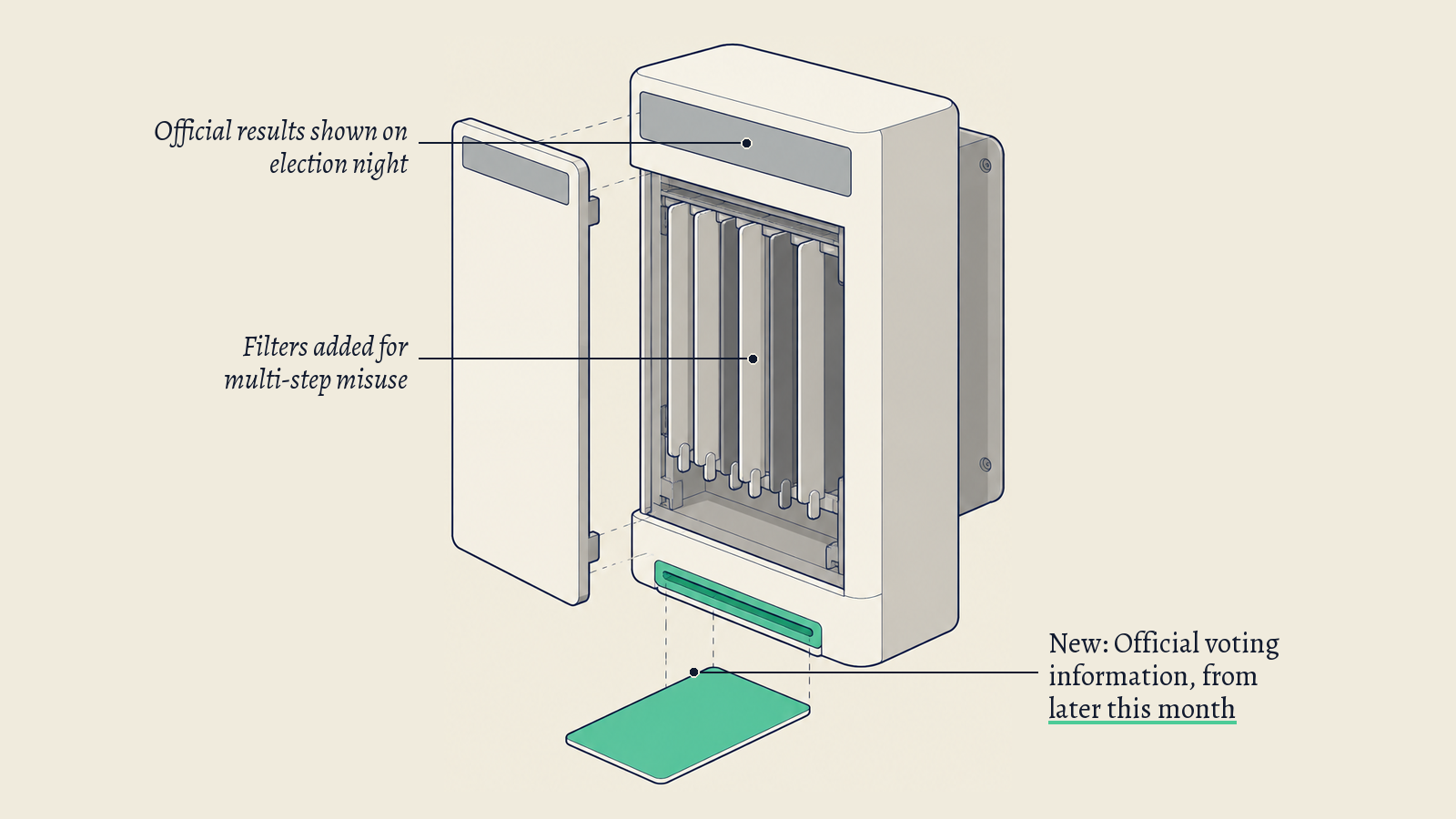 Illustration made with AI for ai notis
Key points
- Anthropic's analysis of 250,000 US Claude.ai conversations found about 0.51% were about elections or voting; a separate review put policy-breaking requests at about 0.002%.
- Anthropic says Opus 5.5, Sonnet 5.5 and Haiku 5.5 score 99% on its own evenhandedness evaluation; two outside groups found Claude rarely refused but sometimes added unsolicited caveats.
- Later this month, Anthropic says, Claude.ai will start drawing official voting information from Democracy Works for US users, and will show official results on election night and afterwards.
What happened
Anthropic published a post on 14 October 2026 on its safeguards ahead of the US midterms. It analysed a random sample of 250,000 US Claude.ai consumer conversations from 21 to 27 September 2026.
About 5.75% of US Claude.ai conversations touch on politics, public policy or social issues, and about 0.51% are about elections or voting. Requests asking whom or what to vote for appeared in about 0.01% of conversations, and requests that broke its election integrity policies in about 0.002%.
Anthropic says that later this month Claude will start drawing official voting information from Democracy Works into its responses on Claude.ai for users in the US, and it will show up-to-date official results on election night and afterwards.
Anthropic says Claude Opus 5.5, Sonnet 5.5 and Haiku 5.5 score 99% on its political evenhandedness evaluation. Anthropic says two outside groups, The Future of Free Speech and the Collective Intelligence Project, found Claude rarely refused requests but sometimes added unsolicited caveats and counterarguments.
Anthropic tested its protections with the Institute for Strategic Dialogue and the McCain Institute in the US, Israel and Brazil, and found that Claude could miss a malicious campaign split into many harmless-looking requests. It says it has added classifiers for multi-step misuse.
In one case, foreign-based operators of a fake news site used Claude to produce US midterm coverage favouring Russian, Iranian and North Korean narratives, and Anthropic banned the accounts.
Underlined sentences link to the facts we checked. Dotted words open a short explainer.
Fact 2 of 13 · from Anthropic, 14 Oct 2026
We took a random sample of 250,000 US Claude.ai consumer conversations from September 21 to 27, 2026 and analyzed them in a privacy-preserving way.
Fact 7 of 13 · from Anthropic, 14 Oct 2026
Later this month, Claude will start drawing official voting information from Democracy Works into its responses on Claude.ai for users in the US.
Fact 9 of 13 · from Anthropic, 14 Oct 2026
Claude Opus 5.5, Sonnet 5.5, and Haiku 5.5 are our most evenhanded to date, scoring 99% on our political evenhandedness evaluation.
Fact 10 of 13 · from Anthropic, 14 Oct 2026
The Future of Free Speech and the Collective Intelligence Project both found that Claude rarely refused requests, but sometimes added unsolicited caveats and counterarguments, such as inserting an opposing view into an advocacy email.
Fact 13 of 13 · from Anthropic, 14 Oct 2026
In one case, foreign-based operators of a fake news site used Claude to produce US midterm coverage favoring Russian, Iranian, and North Korean narratives. ... We banned the accounts involved in these cases
What it means for you
Our viewThe usage figures and the 99% score are Anthropic's own measurements, and the voting information and the election-night results are plans, not live features yet.
Anthropic says its outside partners found that Claude could miss a malicious campaign spread across many requests that looked harmless alone, and that it has added classifiers for this kind of misuse.
If you use Claude for communications or campaign work, check how it treats the caveats and counterarguments the outside groups noted, and ask Anthropic how its election integrity policy applies to your use. When the new features launch, test them against the official sources for your own state.
It adds no new facts.
Your reaction
We count reactions per story and day, never who reacted. The counts help us choose what goes in the monthly issue. If you are signed in, your own page shows yours too.
We count reactions per story and day, never who reacted. They help choose what goes in the monthly issue.
Check our sources
Every sentence above is checked against this source.
1 Preparing for the 2026 US midterms
Open the source archived copy-
Anthropic published a post titled "Preparing for the 2026 US midterms" dated 14 October 2026.
citePreparing for the 2026 US midterms ... Oct 14, 2026
-
Anthropic analysed a random sample of 250,000 US Claude.ai consumer conversations from 21 to 27 September 2026, in a privacy-preserving way.
citeWe took a random sample of 250,000 US Claude.ai consumer conversations from September 21 to 27, 2026 and analyzed them in a privacy-preserving way.
-
About 5.75% of US conversations on Claude.ai touch on politics, public policy or social issues, according to Anthropic.
citeconversations that touch broadly on politics, public policy, or social issues account for about 5.75% of all conversations in the United States on Claude.ai, our consumer app.
-
About 0.51% of conversations are specifically about elections or voting, according to Anthropic.
citeAbout 0.51% of all conversations are specifically about elections or voting.
-
Requests asking whom or what to vote for appeared in about 0.01% of US Claude conversations, shown as the upper end of a 95% confidence interval.
citeThese kinds of requests showed up in about 0.01% of US Claude conversations. ... Because requests for a recommendation on whom or what to vote for are so rare, we show the upper end of a 95% confidence interval for that group.
-
Requests that violated Anthropic's election integrity policies appeared in about 0.002% of conversations, from a separate analysis of 250,000 Claude.ai conversations.
citeRequests that violated our election integrity policies were even less common, appearing in about 0.002% of conversations. ... This figure was generated from a separate analysis of 250,000 Claude.ai conversations, which were reviewed against our election integrity policy.
-
Anthropic says that later this month Claude will start drawing official voting information from Democracy Works into its responses on Claude.ai for US users.
citeLater this month, Claude will start drawing official voting information from Democracy Works into its responses on Claude.ai for users in the US.
-
Anthropic says Claude will begin showing up-to-date official vote counts and results on election night and in the days that follow.
citeClaude will begin showing up-to-date results on election night and in the days that follow, so that when people ask for current vote counts or election results, they'll be shown the latest official numbers directly in their conversation.
-
Anthropic says Claude Opus 5.5, Sonnet 5.5 and Haiku 5.5 are its most evenhanded models, scoring 99% on its political evenhandedness evaluation.
citeClaude Opus 5.5, Sonnet 5.5, and Haiku 5.5 are our most evenhanded to date, scoring 99% on our political evenhandedness evaluation.
-
Anthropic says The Future of Free Speech and the Collective Intelligence Project both found that Claude rarely refused requests but sometimes added unsolicited caveats and counterarguments.
citeThe Future of Free Speech and the Collective Intelligence Project both found that Claude rarely refused requests, but sometimes added unsolicited caveats and counterarguments, such as inserting an opposing view into an advocacy email.
-
Anthropic says it partnered with the Institute for Strategic Dialogue and the McCain Institute to pressure-test its protections in the US, Israel and Brazil, and that Claude reliably refused a single harmful request but could miss a malicious campaign spread across many requests that looked harmless on their own.
citewe partnered with the Institute for Strategic Dialogue (ISD) and the McCain Institute, both independent research organizations, to pressure-test our protections in the US, Israel, and Brazil. ... They found that Claude reliably refused a single harmful request, but could miss a malicious campaign when it was spread across many individual requests that looked harmless on their own.
-
Anthropic says it has added new classifiers to identify novel and multi-step misuse, including attempts to build fake social media accounts and news sites aimed at political discussions, or to run financially motivated election schemes.
citewe've added new classifiers to better identify novel and multi-step misuse, including attempts to build fake social media accounts and news sites aimed at political discussions, or to run financially motivated election schemes.
-
Anthropic says foreign-based operators of a fake news site used Claude to produce US midterm coverage favoring Russian, Iranian and North Korean narratives, and that it banned the accounts involved.
citeIn one case, foreign-based operators of a fake news site used Claude to produce US midterm coverage favoring Russian, Iranian, and North Korean narratives. ... We banned the accounts involved in these cases
Every sentence above is checked against this source. Each fact has its own address you can cite.
Source 1 · Anthropic · 14 Oct 2026
Preparing for the 2026 US midterms
Anthropic published a post titled "Preparing for the 2026 US midterms" dated 14 October 2026.
Preparing for the 2026 US midterms ... Oct 14, 2026
Anthropic analysed a random sample of 250,000 US Claude.ai consumer conversations from 21 to 27 September 2026, in a privacy-preserving way.
We took a random sample of 250,000 US Claude.ai consumer conversations from September 21 to 27, 2026 and analyzed them in a privacy-preserving way.
About 5.75% of US conversations on Claude.ai touch on politics, public policy or social issues, according to Anthropic.
conversations that touch broadly on politics, public policy, or social issues account for about 5.75% of all conversations in the United States on Claude.ai, our consumer app.
Show all 13 factsShow fewer facts
About 0.51% of conversations are specifically about elections or voting, according to Anthropic.
About 0.51% of all conversations are specifically about elections or voting.
Requests asking whom or what to vote for appeared in about 0.01% of US Claude conversations, shown as the upper end of a 95% confidence interval.
These kinds of requests showed up in about 0.01% of US Claude conversations. ... Because requests for a recommendation on whom or what to vote for are so rare, we show the upper end of a 95% confidence interval for that group.
Requests that violated Anthropic's election integrity policies appeared in about 0.002% of conversations, from a separate analysis of 250,000 Claude.ai conversations.
Requests that violated our election integrity policies were even less common, appearing in about 0.002% of conversations. ... This figure was generated from a separate analysis of 250,000 Claude.ai conversations, which were reviewed against our election integrity policy.
Anthropic says that later this month Claude will start drawing official voting information from Democracy Works into its responses on Claude.ai for US users.
Later this month, Claude will start drawing official voting information from Democracy Works into its responses on Claude.ai for users in the US.
Anthropic says Claude will begin showing up-to-date official vote counts and results on election night and in the days that follow.
Claude will begin showing up-to-date results on election night and in the days that follow, so that when people ask for current vote counts or election results, they'll be shown the latest official numbers directly in their conversation.
Anthropic says Claude Opus 5.5, Sonnet 5.5 and Haiku 5.5 are its most evenhanded models, scoring 99% on its political evenhandedness evaluation.
Claude Opus 5.5, Sonnet 5.5, and Haiku 5.5 are our most evenhanded to date, scoring 99% on our political evenhandedness evaluation.
Anthropic says The Future of Free Speech and the Collective Intelligence Project both found that Claude rarely refused requests but sometimes added unsolicited caveats and counterarguments.
The Future of Free Speech and the Collective Intelligence Project both found that Claude rarely refused requests, but sometimes added unsolicited caveats and counterarguments, such as inserting an opposing view into an advocacy email.
Anthropic says it partnered with the Institute for Strategic Dialogue and the McCain Institute to pressure-test its protections in the US, Israel and Brazil, and that Claude reliably refused a single harmful request but could miss a malicious campaign spread across many requests that looked harmless on their own.
we partnered with the Institute for Strategic Dialogue (ISD) and the McCain Institute, both independent research organizations, to pressure-test our protections in the US, Israel, and Brazil. ... They found that Claude reliably refused a single harmful request, but could miss a malicious campaign when it was spread across many individual requests that looked harmless on their own.
Anthropic says it has added new classifiers to identify novel and multi-step misuse, including attempts to build fake social media accounts and news sites aimed at political discussions, or to run financially motivated election schemes.
we've added new classifiers to better identify novel and multi-step misuse, including attempts to build fake social media accounts and news sites aimed at political discussions, or to run financially motivated election schemes.
Anthropic says foreign-based operators of a fake news site used Claude to produce US midterm coverage favoring Russian, Iranian and North Korean narratives, and that it banned the accounts involved.
In one case, foreign-based operators of a fake news site used Claude to produce US midterm coverage favoring Russian, Iranian, and North Korean narratives. ... We banned the accounts involved in these cases
Topics
The morning email
On the mornings we publish: the three top stories and up to four short ones. Free.
We email you a link to confirm. An issue may include one sponsor, always labelled Sponsored · Advertisement. Our emails count opens and clicks, not who made them. Unsubscribe in one click. What we keep