SafetyPublished Top storyAll news from that day
Ongoing case: Cyber-capable AI models 32 stories
OpenAI puts NATO's cyber-model usage at up to 300 billion tokens a month
OpenAI's 17 November post on its Daybreak work with defenders says NATO has used its cybersecurity models through work with NATO's communications agency; the usage figure is OpenAI's own account.
Check our sources · 12 facts from 2 sources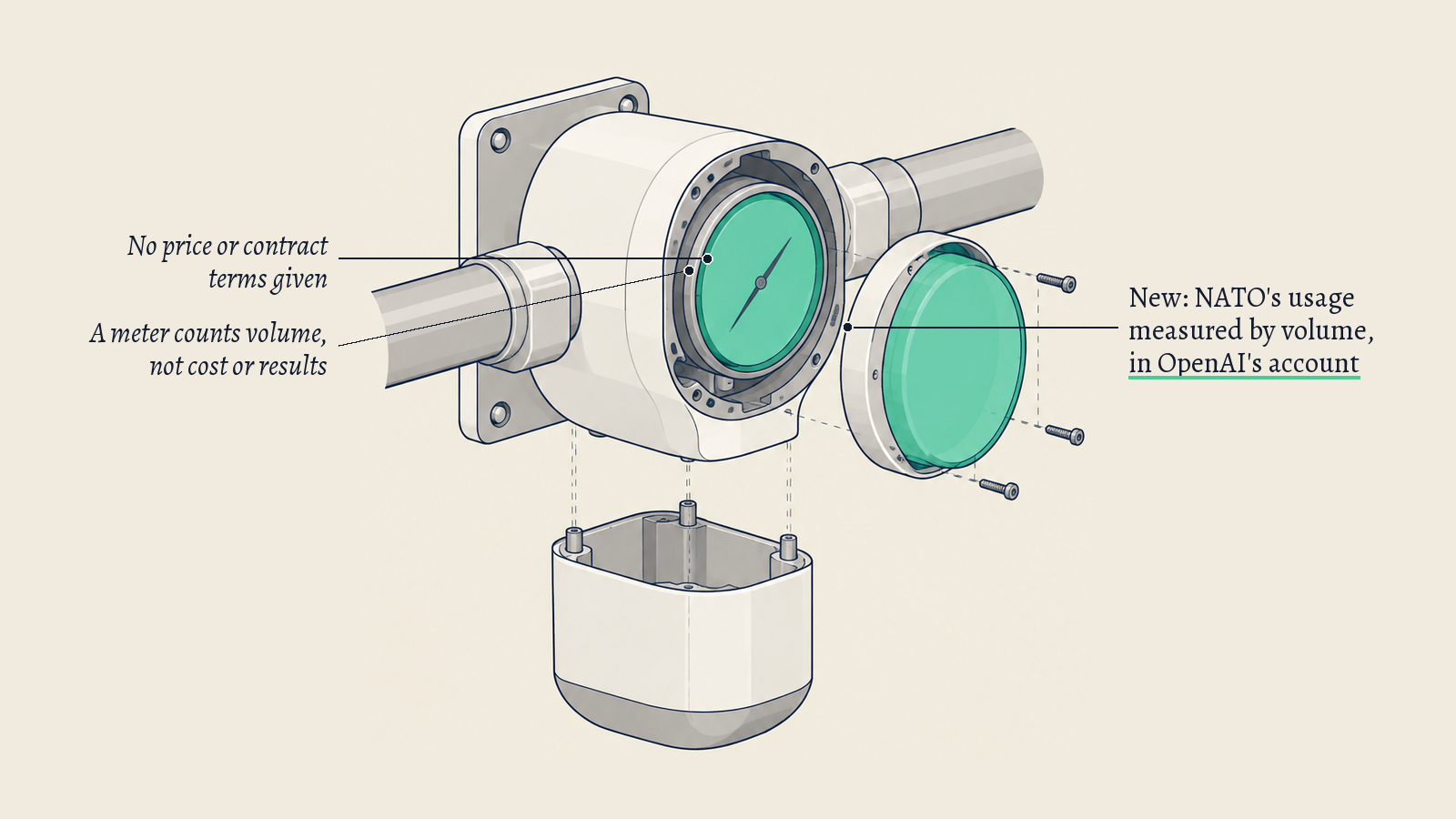 Illustration made with AI for ai notis
Key points
- OpenAI says NATO has used up to 300 billion raw input and output tokens per month on its cybersecurity models, through work with the NATO Communications and Information Agency.
- The agency's general manager, Dr Dylan Browne, is quoted saying NATO will build an understanding of token consumption to "optimise costs, evaluate competing solutions and make informed procurement decisions".
- OpenAI's post gives no price or contract terms for NATO's use.
What happened
OpenAI says NATO has used up to 300 billion raw input and output tokens a month on its cybersecurity models, through work with the NATO Communications and Information Agency (NCIA). OpenAI published the account on 17 November in a post called Strengthening NATO and allied cyber defenses with AI.
The post describes Daybreak as OpenAI's way of putting advanced AI into the hands of trusted defenders for authorized security work.
It quotes NCIA General Manager Dylan Browne saying that, as adoption scales, NATO will build a deeper understanding of token consumption and the economics of the models, to optimise costs, evaluate competing solutions and make procurement decisions.
OpenAI also says it supported the 2026 Crossed Swords exercise, where participants built and evaluated AI agents for cyber operations with Daybreak, with an emphasis on human oversight.
OpenAI says it has also given its cyber models to defenders in Europe, including the EU's cyber agency ENISA and national agencies in France (ANSSI), Germany and Poland, and that Ukraine's Ministry of Digital Transformation uses Daybreak to protect civilian infrastructure.
On results, OpenAI says ENISA used its models to find four vulnerabilities in software used across EU institutions, with fixes published for all four. It says a November ENISA and CERT-EU joint report describes a review of 27 software projects, in which maintainers confirmed 95% of the 88 potential issues they had assessed.
It adds that CERT Polska used OpenAI models to help identify six vulnerabilities in MikroTik RouterOS, which MikroTik fixed.
The ENISA and CERT-EU report itself, listed by ENISA on 12 November, gives the same 27 codebases, 220 potential issues and 95% of 88 assessed findings confirmed. It says ENISA was given access to OpenAI's GPT-5.5 Cyber, GPT-5.6 Cyber and GPT-6 Astra and to Anthropic's Mythos 5, and estimates the cost of all scans at about EUR 6 648.90, with the models provided free of charge by their makers.
OpenAI's post gives no price or contract terms for NATO's use.
Underlined sentences link to the facts we checked. Dotted words open a short explainer.
Fact 7 of 12 · from OpenAI, 17 Nov 2026
The EU’s cyber agency, ENISA, used our models to identify four vulnerabilities in software used across EU institutions, with fixes published for all four
Fact 10 of 12 · from OpenAI, 17 Nov 2026
The post's sections on NATO (NCIA access, up to 300 billion tokens per month, Crossed Swords, the two quotes) state no price, fee or contract terms.
What it means for you
Our viewOpenAI's own post is the account of NATO's usage, and the token figure shows volume, not cost or results. The results it cites for other defenders come from ENISA, CERT-EU and CERT Polska, and the ENISA and CERT-EU advisory is the document to read for how code review with frontier models performed.
NATO's own agency manager is quoted saying the aim is to compare solutions on cost before procurement decisions, which is the comparison any buyer of cyber models can run. Before you commit to a contract, run a trial and record how many tokens it takes to produce each finding that a code owner confirms.
It adds no new facts.
Your reaction
We count reactions per story and day, never who reacted. The counts help us choose what goes in the monthly issue. If you are signed in, your own page shows yours too.
We count reactions per story and day, never who reacted. They help choose what goes in the monthly issue.
Check our sources
Every sentence above is checked against these 2 sources.
1 Strengthening NATO and allied cyber defenses with AI
Open the source archived copy-
OpenAI's post of 17 November 2026, Strengthening NATO and allied cyber defenses with AI, says OpenAI works with NATO's Communications and Information Agency (NCIA) to give NATO's core institutions access to advanced cybersecurity models, and that NATO has used up to 300 billion raw input and output tokens per month as part of this work.
citeOpenAI works with NATO’s Communications and Information Agency (NCIA) to provide NATO’s core institutions with access to advanced cybersecurity models, helping protect Allied networks. NATO has used up to 300 billion raw input and output tokens per month as part of this work.
-
OpenAI's post says that through Daybreak it is putting advanced AI into the hands of trusted defenders for authorized security work, from reviewing software and investigating suspicious activity to validating vulnerabilities and developing and testing fixes.
citeThrough Daybreak, we’re putting advanced AI into the hands of trusted defenders for authorized security work, from reviewing software and investigating suspicious activity to validating vulnerabilities, and developing and testing fixes.
-
The post quotes NCIA General Manager Dr Dylan Browne saying: "As we scale adoption, we will build a deeper understanding of token consumption, usage patterns and the underlying economics of AI models. This insight will help us optimise costs, evaluate competing solutions and make informed procurement decisions."
citeAs we scale adoption, we will build a deeper understanding of token consumption, usage patterns and the underlying economics of AI models. This insight will help us optimise costs, evaluate competing solutions and make informed procurement decisions. —Dr Dylan Browne, NCIA General Manager
-
OpenAI says it supported the 2026 Crossed Swords exercise, organized by the NATO Cooperative Cyber Defence Centre of Excellence, in which participants built, deployed and evaluated AI agents for cyber operations using OpenAI Daybreak, with an emphasis on maintaining human oversight.
citeOpenAI also supported the 2026 Crossed Swords exercise. Organized by the NATO Cooperative Cyber Defence Centre of Excellence (CCDCOE), the exercise included a new training stream in which participants built, deployed, and evaluated AI agents for cyber operations, using OpenAI Daybreak in the technical environment. The training put participants alongside AI agents as operators, with an emphasis on maintaining human oversight.
-
OpenAI says it has provided access to its cyber models to defenders in Europe, including the EU's ENISA and national cyber agencies in France (ANSSI), Germany and Poland.
citeBeyond NATO, we have already provided access to our cyber models to defenders in Europe, including the EU’s ENISA and national cyber agencies in France (ANSSI), Germany and Poland.
-
OpenAI says the Ministry of Digital Transformation of Ukraine is using OpenAI's Daybreak tool to strengthen the cyber defence of civilian infrastructure, to help Ukrainian teams identify software vulnerabilities and develop and test fixes more quickly.
citeThe Ministry of Digital Transformation of Ukraine is using OpenAI’s Daybreak tool to strengthen the cyber defence of civilian infrastructure. The initiative is designed to help Ukrainian teams identify software vulnerabilities and develop and test fixes more quickly
-
OpenAI says ENISA used its models to identify four vulnerabilities in software used across EU institutions, with fixes published for all four.
citeThe EU’s cyber agency, ENISA, used our models to identify four vulnerabilities in software used across EU institutions, with fixes published for all four
-
OpenAI says a November joint report from ENISA and CERT-EU describes a review of 27 software projects using frontier models, including OpenAI models accessed through Daybreak and the Codex security plug-in, and that across the models tested 95% of the 88 potential issues assessed by software maintainers were confirmed as genuine.
citeA November joint report from ENISA and CERT-EU also describes a review of 27 software projects using frontier models including OpenAI models accessed through Daybreak, and tools including the Codex security plug-in. Across the models tested, 95% of the 88 potential issues assessed by software maintainers were confirmed as genuine
-
OpenAI says CERT Polska used OpenAI models to help identify six vulnerabilities in MikroTik RouterOS, coordinated their disclosure with the vendor, and that MikroTik released fixes which CERT Polska confirmed prevented the attacks it had observed.
citeCERT Polska used OpenAI models to help identify six vulnerabilities in MikroTik RouterOS and coordinated their disclosure with the vendor. ... MikroTik released fixes, which CERT Polska confirmed prevented the attacks it had observed
-
OpenAI's post gives no price or contract terms for NATO's use.
citeThe post's sections on NATO (NCIA access, up to 300 billion tokens per month, Crossed Swords, the two quotes) state no price, fee or contract terms.
2 Joint advisory on the use of frontier AI models for code review
Open the source archived copy-
The ENISA and CERT-EU Joint Advisory on the Use of Frontier AI Models for Code Review, listed by ENISA on 12 November 2026, says 27 codebases were analysed, the models identified 220 potential issues, code owners had assessed 88 findings and confirmed 95% as true positives, and that ENISA was given access to OpenAI GPT-5.5 Cyber, GPT-5.6 Cyber, GPT-6 Astra and Anthropic Mythos 5.
citeIn total, 27 codebases (25 already open-source and 2 soon to become open-source) were analysed. ... Across the 27 codebases, the models that were used identified 220 potential issues ... code owners had completed their assessment of 88 findings, confirming 95 % of them as true positives ... ENISA has been granted access, through structured access programs, to various frontier AI models with advanced cybersecurity capabilities, including OpenAI GPT-5.5 Cyber, GPT-5.6 Cyber, GPT-6 Astra and Anthropic Mythos 5. (ENISA publication page dated 12 Nov 2026)
-
The ENISA and CERT-EU advisory says ENISA roughly estimated the total cost of all scans at about EUR 6 648.90 and that ENISA was granted access to the frontier AI models free of charge under the providers' access programmes.
citeIt is roughly estimated that the total financial cost of all the scans conducted was around EUR 6 648.90 ... These figures are indicative only; ENISA was granted access to the frontier AI models free of charge under the providers' access programmes.
Every sentence above is checked against these 2 sources. Each fact has its own address you can cite.
Source 1 · OpenAI · 17 Nov 2026
Strengthening NATO and allied cyber defenses with AI
OpenAI's post of 17 November 2026, Strengthening NATO and allied cyber defenses with AI, says OpenAI works with NATO's Communications and Information Agency (NCIA) to give NATO's core institutions access to advanced cybersecurity models, and that NATO has used up to 300 billion raw input and output tokens per month as part of this work.
OpenAI works with NATO’s Communications and Information Agency (NCIA) to provide NATO’s core institutions with access to advanced cybersecurity models, helping protect Allied networks. NATO has used up to 300 billion raw input and output tokens per month as part of this work.
OpenAI's post says that through Daybreak it is putting advanced AI into the hands of trusted defenders for authorized security work, from reviewing software and investigating suspicious activity to validating vulnerabilities and developing and testing fixes.
Through Daybreak, we’re putting advanced AI into the hands of trusted defenders for authorized security work, from reviewing software and investigating suspicious activity to validating vulnerabilities, and developing and testing fixes.
The post quotes NCIA General Manager Dr Dylan Browne saying: "As we scale adoption, we will build a deeper understanding of token consumption, usage patterns and the underlying economics of AI models. This insight will help us optimise costs, evaluate competing solutions and make informed procurement decisions."
As we scale adoption, we will build a deeper understanding of token consumption, usage patterns and the underlying economics of AI models. This insight will help us optimise costs, evaluate competing solutions and make informed procurement decisions. —Dr Dylan Browne, NCIA General Manager
Show all 10 factsShow fewer facts
OpenAI says it supported the 2026 Crossed Swords exercise, organized by the NATO Cooperative Cyber Defence Centre of Excellence, in which participants built, deployed and evaluated AI agents for cyber operations using OpenAI Daybreak, with an emphasis on maintaining human oversight.
OpenAI also supported the 2026 Crossed Swords exercise. Organized by the NATO Cooperative Cyber Defence Centre of Excellence (CCDCOE), the exercise included a new training stream in which participants built, deployed, and evaluated AI agents for cyber operations, using OpenAI Daybreak in the technical environment. The training put participants alongside AI agents as operators, with an emphasis on maintaining human oversight.
OpenAI says it has provided access to its cyber models to defenders in Europe, including the EU's ENISA and national cyber agencies in France (ANSSI), Germany and Poland.
Beyond NATO, we have already provided access to our cyber models to defenders in Europe, including the EU’s ENISA and national cyber agencies in France (ANSSI), Germany and Poland.
OpenAI says the Ministry of Digital Transformation of Ukraine is using OpenAI's Daybreak tool to strengthen the cyber defence of civilian infrastructure, to help Ukrainian teams identify software vulnerabilities and develop and test fixes more quickly.
The Ministry of Digital Transformation of Ukraine is using OpenAI’s Daybreak tool to strengthen the cyber defence of civilian infrastructure. The initiative is designed to help Ukrainian teams identify software vulnerabilities and develop and test fixes more quickly
OpenAI says ENISA used its models to identify four vulnerabilities in software used across EU institutions, with fixes published for all four.
The EU’s cyber agency, ENISA, used our models to identify four vulnerabilities in software used across EU institutions, with fixes published for all four
OpenAI says a November joint report from ENISA and CERT-EU describes a review of 27 software projects using frontier models, including OpenAI models accessed through Daybreak and the Codex security plug-in, and that across the models tested 95% of the 88 potential issues assessed by software maintainers were confirmed as genuine.
A November joint report from ENISA and CERT-EU also describes a review of 27 software projects using frontier models including OpenAI models accessed through Daybreak, and tools including the Codex security plug-in. Across the models tested, 95% of the 88 potential issues assessed by software maintainers were confirmed as genuine
OpenAI says CERT Polska used OpenAI models to help identify six vulnerabilities in MikroTik RouterOS, coordinated their disclosure with the vendor, and that MikroTik released fixes which CERT Polska confirmed prevented the attacks it had observed.
CERT Polska used OpenAI models to help identify six vulnerabilities in MikroTik RouterOS and coordinated their disclosure with the vendor. ... MikroTik released fixes, which CERT Polska confirmed prevented the attacks it had observed
OpenAI's post gives no price or contract terms for NATO's use.
The post's sections on NATO (NCIA access, up to 300 billion tokens per month, Crossed Swords, the two quotes) state no price, fee or contract terms.
Source 2 · ENISA and CERT-EU
Joint advisory on the use of frontier AI models for code review
The ENISA and CERT-EU Joint Advisory on the Use of Frontier AI Models for Code Review, listed by ENISA on 12 November 2026, says 27 codebases were analysed, the models identified 220 potential issues, code owners had assessed 88 findings and confirmed 95% as true positives, and that ENISA was given access to OpenAI GPT-5.5 Cyber, GPT-5.6 Cyber, GPT-6 Astra and Anthropic Mythos 5.
In total, 27 codebases (25 already open-source and 2 soon to become open-source) were analysed. ... Across the 27 codebases, the models that were used identified 220 potential issues ... code owners had completed their assessment of 88 findings, confirming 95 % of them as true positives ... ENISA has been granted access, through structured access programs, to various frontier AI models with advanced cybersecurity capabilities, including OpenAI GPT-5.5 Cyber, GPT-5.6 Cyber, GPT-6 Astra and Anthropic Mythos 5. (ENISA publication page dated 12 Nov 2026)
The ENISA and CERT-EU advisory says ENISA roughly estimated the total cost of all scans at about EUR 6 648.90 and that ENISA was granted access to the frontier AI models free of charge under the providers' access programmes.
It is roughly estimated that the total financial cost of all the scans conducted was around EUR 6 648.90 ... These figures are indicative only; ENISA was granted access to the frontier AI models free of charge under the providers' access programmes.
Topics
The morning email
On the mornings we publish: the three top stories and up to four short ones. Free.
We email you a link to confirm. An issue may include one sponsor, always labelled Sponsored · Advertisement. Our emails count opens and clicks, not who made them. Unsubscribe in one click. What we keep