SafetyPublished Top storyAll news from that day
Ongoing case: Cyber-capable AI models 32 stories
CISA urges immediate patching of OpenJDK flaw on x86-64 CPUs with AVX-512 VBMI
Calif says an attacker with no credentials can reach code execution and that it directed Codex to find and weaponize the flaw; Wiz says its Wiz Atlas AI harness built an exploit.
Check our sources · 27 facts from 8 sources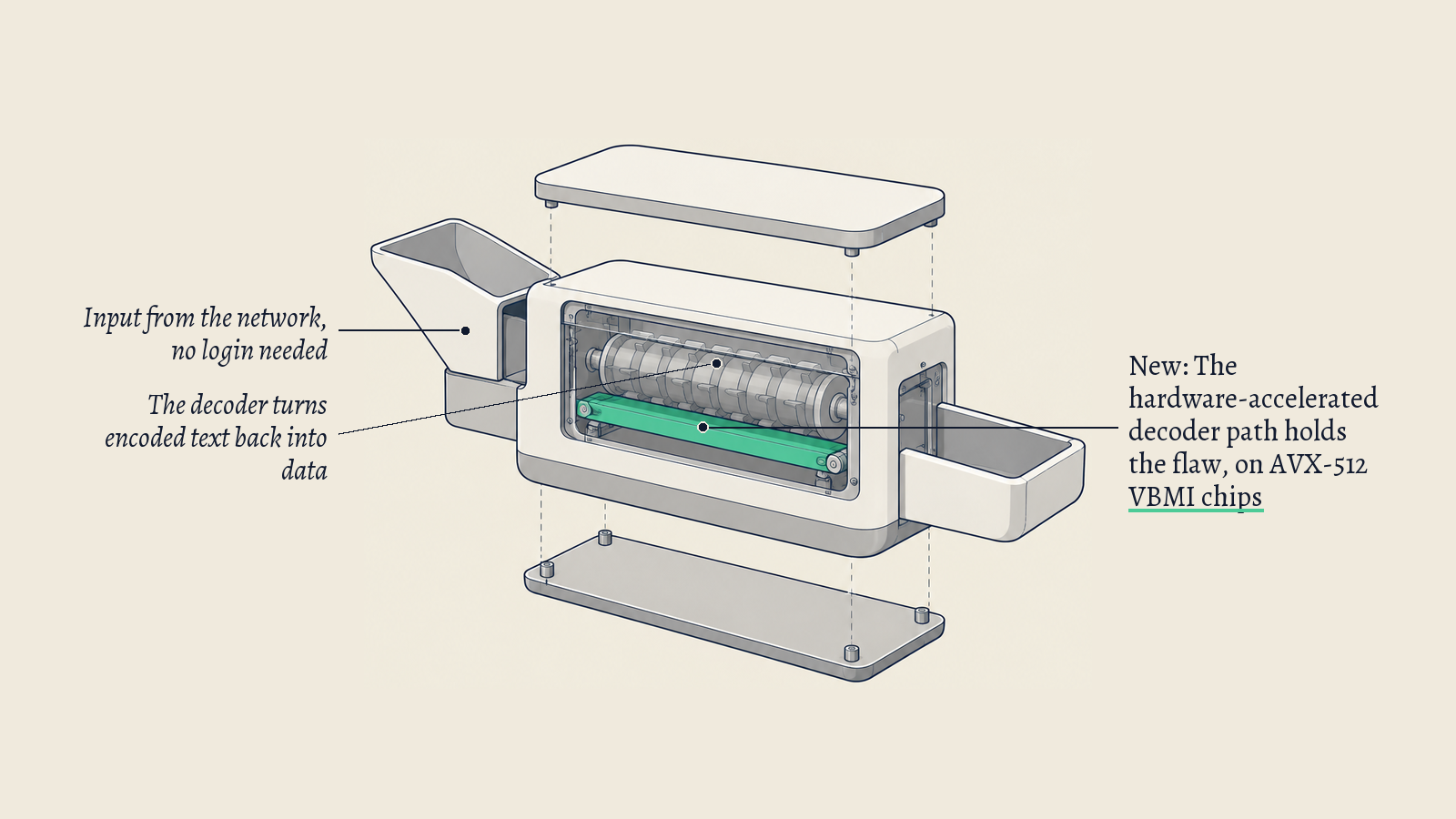 Illustration made with AI for ai notis
Key points
- CISA's alert of 17 November strongly urges immediate patching; CERT-EU rates the flaw high, with a CVSS score of 8.1, and Calif scores it 9.2, Critical.
- CERT-EU says exploitation needs an x86-64 CPU with AVX-512 VBMI, such as Intel Ice Lake or later or AMD Zen 4 or later, and attacker-controlled Base64 data reaching the decoder.
- CERT-EU lists fixes in Java SE and OpenJDK 17.0.21 patch 1, 21.0.13 patch 1 and 25.0.5 patch 1; OpenJDK-based distributions release fixes on their own schedules.
What happened
Teams that run Java on x86-64 servers with AVX-512 VBMI processors should update OpenJDK now. Calif, a security firm, disclosed a flaw it calls Java4Shell (CVE-2026-114938) on 17 November 2026: a memory-corruption bug in OpenJDK's Base64 decoder that lets a remote attacker with no credentials overwrite heap memory and reach remote code execution.
OpenJDK published its vulnerability advisory the same day, and Calif says Oracle released a patch at the same time. The advisory fixes ten OpenJDK issues in total, and it lists CVE-2026-114938 in the HotSpot compiler with a CVSS 3.1 base score of 8.1. Calif scores the flaw 9.2 out of 10, Critical, under CVSS 4.0.
CISA's alert of 17 November says it strongly urges organisations to patch immediately, and CERT-EU's advisory 2026-021 of 18 November rates the flaw high severity, CVSS 8.1. CISA's Known Exploited Vulnerabilities catalogue, in the feed released on 17 November with 1,782 entries, does not list it.
The bug affects OpenJDK 17.0.6 and newer, and the distributions built from it, but only on x86-64 processors that support AVX-512 VBMI; Wiz and CERT-EU say ARM64 is not affected.
Calif says it demonstrated remote code execution, in default configurations, against Keycloak, Atlassian Jira and Confluence, JFrog Artifactory, Jenkins and PingFederate without logging in, and against Kafka, Solr, Elasticsearch, Gerrit and Spinnaker after login.
If patching has to wait, CERT-EU says to disable the intrinsic with the JVM options -XX:+UnlockDiagnosticVMOptions -XX:-UseBASE64Intrinsics, or alternatively -XX:UseAVX=2, which can reduce performance; both need a JVM restart.
Calif says to use the second flag only on x86-64 hosts, because OpenJDK on ARM does not recognise it and will fail to start. Wiz advises patching externally facing packaged Java applications first.
Calif says there is no universal exploit; each target needs its own approach. It published a proof of concept that triggers the memory corruption safely, and says it is holding back its application-specific exploits until people have had time to upgrade.
Calif says it used AI to find and weaponize the flaw. Its researcher Quang Luong told Codex to audit HotSpot's compiler, intrinsics, widely used APIs and cryptography, and Calif says it took an hour to find the bug and two more hours to build the first working exploit, at a token cost under $200.
Calif does not name a Codex model version. Wiz says its own AI research harness, Wiz Atlas, found and built a proof-of-concept exploit within two hours, before the full details were public.
Underlined sentences link to the facts we checked. Dotted words open a short explainer.
Fact 9 of 27 · from Calif Research, 17 Nov 2026
Here is a self-contained proof of concept. ... We are holding back the application-specific exploits for now. ... The weaponized chains for individual products stay private until everyone has had a chance to upgrade.
What it means for you
Our viewIf you run OpenJDK or any Java runtime bundled in third-party software or container images, update it now, internet-facing systems first, as CISA asks.
If you cannot update at once, CERT-EU says to start the JVM with -XX:+UnlockDiagnosticVMOptions -XX:-UseBASE64Intrinsics, or with -XX:UseAVX=2, which can reduce performance; Calif says to apply that second flag only on x86-64 hosts, because OpenJDK on ARM does not recognise it and will fail to start. Both need a JVM restart.
Calif says there is no universal exploit and that it is holding back product-specific ones, which gives time to patch but not a reason to wait. Start with an inventory of which hosts have AVX-512 VBMI processors and which products carry their own Java.
It adds no new facts.
Your reaction
We count reactions per story and day, never who reacted. The counts help us choose what goes in the monthly issue. If you are signed in, your own page shows yours too.
We count reactions per story and day, never who reacted. They help choose what goes in the monthly issue.
Check our sources
Every sentence above is checked against these 8 sources.
1 Java4Shell: Write once, RCE everywhere
Open the source-
Calif disclosed Java4Shell, CVE-2026-114938, on 17 November 2026: a memory-corruption vulnerability in OpenJDK's Base64 decoder.
citeToday, we are disclosing Java4Shell (CVE-2026-114938), a memory-corruption vulnerability in OpenJDK's Base64 decoder.
-
Calif says a remote attacker with no credentials can overwrite heap memory and reach remote code execution through the flaw.
citeA remote attacker with no credentials can overwrite heap memory, read it in the style of Heartbleed, and reach remote code execution.
-
Calif scores Java4Shell 9.2 out of 10 (Critical) under CVSS 4.0.
citeUnder CVSS 4.0, this vulnerability scores 9.2 out of 10 (CRITICAL).
-
Calif says OpenJDK released a security advisory and Oracle released a patch at 1:00pm PT on 17 November 2026.
citeOpenJDK released a security advisory and Oracle released a patch at 1:00pm PT on Nov 17, 2026.
-
Calif says Java4Shell affects OpenJDK from version 17.0.6 or newer and the Java distributions built from it, including Amazon Corretto, Eclipse Temurin, Microsoft Build of OpenJDK, Azul Zulu, BellSoft Liberica, SAP SapMachine, Red Hat OpenJDK and Oracle Java SE.
citeJava4Shell affects OpenJDK from version 17.0.6 or newer. Because they are built from OpenJDK, the following Java distributions are also vulnerable: Amazon Corretto Eclipse Temurin Microsoft Build of OpenJDK Azul Zulu BellSoft Liberica SAP SapMachine Red Hat OpenJDK Oracle OpenJDK Oracle Java SE Oracle GraalVM for JDK
-
Calif says its initial testing demonstrated pre-authentication remote code execution in default configurations of Keycloak, Atlassian Jira, Atlassian Confluence, JFrog Artifactory, Jenkins and PingFederate, and post-authentication remote code execution in Apache Kafka Broker, Apache Solr, Elasticsearch, Gerrit and Spinnaker.
citeOur initial testing demonstrated remote code execution in the following widely deployed Java applications, in their default configs. Pre-auth RCE: Keycloak Atlassian Jira Atlassian Confluence JFrog Artifactory Jenkins PingFederate Post-auth RCE: Apache Kafka Broker Apache Solr Elasticsearch Gerrit Spinnaker
-
Calif recommends starting OpenJDK with -XX:-UseBASE64Intrinsics to disable hardware-accelerated Base64, or with -XX:UseAVX=2 to disable AVX-512, and says to apply the second flag only on x86-64 hosts because OpenJDK on ARM does not recognize it and will fail to start.
cite-XX:-UseBASE64Intrinsics to disable hardware-accelerated Base64 encoding and decoding, or -XX:UseAVX=2 to disable AVX-512. Apply this flag only on x86-64 hosts. OpenJDK on ARM doesn't recognize it and will fail to start.
-
Calif says there is no universal exploit and that every target needs a bespoke profile.
citeThere is no universal payload. ... Every target needs a bespoke profile. The exploit is not a universal point-and-shoot.
-
Calif published a proof of concept that triggers the memory corruption and says it is holding back application-specific exploits until everyone has had a chance to upgrade.
citeHere is a self-contained proof of concept. ... We are holding back the application-specific exploits for now. ... The weaponized chains for individual products stay private until everyone has had a chance to upgrade.
-
Calif says that as with PHP2Shell it used AI to find and weaponize Java4Shell, and that it took researcher Quang Luong an hour to discover the vulnerability and two more hours to develop the first working exploit at a total token cost of less than $200.
citeAs with PHP2Shell, Calif used AI to find and weaponize Java4Shell. ... It took our own Quang Luong an hour to discover the vulnerability, and two more hours to develop the first working exploit. The total token cost was less than $200.
-
Calif's write-up says Quang Luong told Codex to look at HotSpot's JIT compiler, intrinsics, widely accessible APIs and cryptography, and that Codex brought him the finding in the Base64 decoder; the page does not name a model version.
citeI focused the audit on the JIT compiler, intrinsics, widely accessible APIs, and cryptography. Well, more precisely, I told Codex to look at those areas ... Eventually, Codex brought me a finding for a memory corruption in the Base64 decoder itself.
-
Calif says OpenJDK is the most popular Java runtime and calls Java the world's third most popular programming language, powering 90% of Fortune 500 companies.
citeOpenJDK is the most popular Java runtime. ... Java is the world's third most popular programming language , powering 90% of Fortune 500 companies .
2 OpenJDK Vulnerability Advisory: 2026/11/17
Open the source-
OpenJDK's vulnerability advisory dated 17 November 2026 lists CVE-2026-114938 in hotspot/compiler with a CVSS 3.1 base score of 8.1.
citeOpenJDK Vulnerability Advisory: 2026/11/17 ... CVE-2026-114938 hotspot/ compiler 8.1 NHNNUHHH (column CVSSv3.1)
-
The OpenJDK advisory of 17 November 2026 lists ten OpenJDK CVEs, CVE-2026-114938 to CVE-2026-114947, and recommends upgrading as soon as possible.
citeThe following vulnerabilities in OpenJDK source code were fixed in this release. ... We recommend that you upgrade as soon as possible. (risk matrix lists CVE-2026-114938 to CVE-2026-114947)
3 CVE-2026-114938 OpenJDK RCE (Java4Shell): Everything You Need to Know
Open the source-
Wiz says the flaw is reachable only on x86-64 processors with AVX-512 VBMI support and that ARM64 processors are unaffected.
citeThe vulnerability affects OpenJDK versions 17.0.6 and later, as well as downstream distributions, provided they run on x86-64 hardware supporting AVX-512 VBMI instruction sets (ARM64 processors are unaffected).
-
Wiz recommends prioritizing externally facing, packaged Java applications for patching or restricting public access.
citePrioritize externally facing, packaged Java applications, and make sure they are either patched or restricted from public access.
-
Wiz says its AI-based vulnerability research harness, Wiz Atlas, found and built a proof-of-concept exploit for the vulnerability within 2 hours, before the full details were disclosed.
citeOur AI based vulnerability research harness, Wiz Atlas , managed to find and build a proof-of-concept exploit for this vulnerability within 2 hours, even before the full details were disclosed.
4 Change Log for Amazon Corretto 17
Open the source-
Amazon's Corretto 17 change log lists a release dated 17 November 2026 that addresses CVE-2026-114938, CVSS 8.1, in hotspot/compiler.
cite
5 CISA Known Exploited Vulnerabilities catalog (JSON feed)
Open the source archived copy-
CISA's Known Exploited Vulnerabilities catalog, in the JSON feed released 17 November 2026 at 17:53 UTC with 1,782 entries, does not list CVE-2026-114938.
cite
6 Critical Java Vulnerability Requires Immediate Patching
Open the source archived copy-
CISA's alert of 17 November 2026, "Critical Java Vulnerability Requires Immediate Patching", says CISA "strongly urges organizations to immediately patch" the Oracle Java vulnerability CVE-2026-114938, known as Java4Shell.
citeCritical Java Vulnerability Requires Immediate Patching ... Release Date November 17, 2026 ... CISA strongly urges organizations to immediately patch the recently disclosed Oracle Java vulnerability CVE-2026-114938. This critical memory-corruption vulnerability, known as Java4Shell, affects the Base64 decoder of the x86-64 HotSpot Java Virtual Machine (JVM)
-
CISA says specially crafted Base64 input could crash the JVM and allow unauthenticated remote code execution, and asks organizations to inventory Java runtimes bundled in third-party applications and container images and to patch internet-facing systems first.
citeSpecially crafted Base64 input could crash the JVM and allow for unauthenticated remote code execution. ... Review your software inventory for JDKs and Java runtimes, including those bundled with third-party applications or included in container images and appliances. ... Apply relevant Java and vendor patches as soon as they are available, prioritizing internet-facing systems.
7 High Severity Vulnerability in Java SE and OpenJDK (Security Advisory 2026-021)
Open the source archived copy-
CERT-EU's Security Advisory 2026-021, released 18 November 2026 and titled "High Severity Vulnerability in Java SE and OpenJDK", rates CVE-2026-114938 high severity with a CVSS score of 8.1, and says it can lead to denial of service and in some cases to unauthenticated remote code execution.
citeSecurity Advisory 2026-021 ... Release Date: 18-11-2026 ... High Severity Vulnerability in Java SE and OpenJDK ... The vulnerability CVE-2026-114938, with a CVSS score of 8.1, is a memory corruption vulnerability in OpenJDK which leads to Denial of Service (DoS) conditions, and in some cases to unauthenticated RCE
-
CERT-EU says exploitation needs all of: a JVM on an x86-64 CPU with avx512f, avx512bw, avx512vbmi and bmi2 (Intel Xeon Ice Lake or later, AMD Zen 4 or later); the Base64 intrinsic active, which is the default when the CPU supports these features; and attacker-controlled Base64 data reaching the decoder, for example through HTTP Basic authentication, JWT, SAML messages, cookies or TLS data.
citeExploitation requires all of the following conditions: The Java Virtual Machine (JVM) runs on an x86-64 CPU with avx512f, avx512bw, avx512vbmi and bmi2 (Intel Xeon Ice Lake or later, AMD Zen 4 or later). ARM64 systems are not affected. The intrinsic is active. This is the default when the CPU supports these features. Attacker-controlled Base64 data reaches the decoder, for example through HTTP Basic authentication, JWT, SAML messages, cookies or TLS data.
-
CERT-EU's mitigation text says: "Where it is not possible to immediately update, it is possible to disable the intrinsic feature using the JVM option -XX:+UnlockDiagnosticVMOptions -XX:-UseBASE64Intrinsics"; it adds -XX:UseAVX=2 as an alternative that can reduce performance, and says both options need a JVM restart.
citeWhere it is not possible to immediately update, it is possible to disable the intrinsic feature using the JVM option -XX:+UnlockDiagnosticVMOptions -XX:-UseBASE64Intrinsics. As an alternative, disable AVX-512 with -XX:UseAVX=2. The second option can reduce performance. Both options need a JVM restart.
-
CERT-EU lists as fixed: Oracle Java SE 8 performance builds in 8u513, Java SE and OpenJDK 17 in 17.0.21 patch 1, 21 in 21.0.13 patch 1, 25 in 25.0.5 patch 1 and 27 in 27.0.1 patch 1; it says OpenJDK-based distributions (Eclipse Temurin, Amazon Corretto, Azul Zulu, Microsoft Build of OpenJDK, BellSoft Liberica, SAP SapMachine, Red Hat build of OpenJDK) release fixes on their own schedules.
citeAffected Products ... Oracle Java SE 8 (performance builds) ... (fixed released: 8u513) ... Oracle Java SE / OpenJDK 17 ... Oracle Java SE / OpenJDK 21 ... Oracle Java SE / OpenJDK 25 ... Oracle Java SE / OpenJDK 27 ... OpenJDK-based distributions are also affected: Eclipse Temurin, Amazon Corretto, Azul Zulu, Microsoft Build of OpenJDK, BellSoft Liberica, SAP SapMachine and Red Hat build of OpenJDK. These vendors release fixes on their own schedules.
8 Oracle Critical Security Patch Update Advisory - November 2026
Open the source archived copy-
Oracle's Critical Security Patch Update Advisory for November 2026 lists CVE-2026-114938 (component: Compiler) for Oracle Java SE, Oracle GraalVM for JDK and Oracle GraalVM Enterprise Edition, remotely exploitable without authentication, with a CVSS 3.1 base score of 8.1, and credits Albert Yang and, separately, Quang Luong of Calif.io for reporting it.
Toned down to what the source says
citeCVE-2026-114938 Oracle Java SE, Oracle GraalVM for JDK, Oracle GraalVM Enterprise Edition Compiler Multiple Yes 8.1 ... Albert Yang: CVE-2026-114938 ... Quang Luong of Calif.io: CVE-2026-114938
-
Oracle's advisory lists the supported versions affected by CVE-2026-114938 as the Oracle Java SE 8u511b33-perf build and the listed Java SE 17, 21, 25 and 27 releases, Oracle GraalVM for JDK 17 and 21, and Oracle GraalVM Enterprise Edition 21; Oracle says it strongly recommends applying Critical Security Patch Update patches as soon as possible.
Toned down to what the source says
citeWorkarounds Due to the threat posed by a successful attack, Oracle strongly recommends that customers apply Critical Security Patch Update security patches as soon as possible.
Every sentence above is checked against these 8 sources. Each fact has its own address you can cite.
Source 1 · Calif Research · 17 Nov 2026
Java4Shell: Write once, RCE everywhere
Calif disclosed Java4Shell, CVE-2026-114938, on 17 November 2026: a memory-corruption vulnerability in OpenJDK's Base64 decoder.
Today, we are disclosing Java4Shell (CVE-2026-114938), a memory-corruption vulnerability in OpenJDK's Base64 decoder.
Calif says a remote attacker with no credentials can overwrite heap memory and reach remote code execution through the flaw.
A remote attacker with no credentials can overwrite heap memory, read it in the style of Heartbleed, and reach remote code execution.
Calif scores Java4Shell 9.2 out of 10 (Critical) under CVSS 4.0.
Under CVSS 4.0, this vulnerability scores 9.2 out of 10 (CRITICAL).
Show all 12 factsShow fewer facts
Calif says OpenJDK released a security advisory and Oracle released a patch at 1:00pm PT on 17 November 2026.
OpenJDK released a security advisory and Oracle released a patch at 1:00pm PT on Nov 17, 2026.
Calif says Java4Shell affects OpenJDK from version 17.0.6 or newer and the Java distributions built from it, including Amazon Corretto, Eclipse Temurin, Microsoft Build of OpenJDK, Azul Zulu, BellSoft Liberica, SAP SapMachine, Red Hat OpenJDK and Oracle Java SE.
Java4Shell affects OpenJDK from version 17.0.6 or newer. Because they are built from OpenJDK, the following Java distributions are also vulnerable: Amazon Corretto Eclipse Temurin Microsoft Build of OpenJDK Azul Zulu BellSoft Liberica SAP SapMachine Red Hat OpenJDK Oracle OpenJDK Oracle Java SE Oracle GraalVM for JDK
Calif says its initial testing demonstrated pre-authentication remote code execution in default configurations of Keycloak, Atlassian Jira, Atlassian Confluence, JFrog Artifactory, Jenkins and PingFederate, and post-authentication remote code execution in Apache Kafka Broker, Apache Solr, Elasticsearch, Gerrit and Spinnaker.
Our initial testing demonstrated remote code execution in the following widely deployed Java applications, in their default configs. Pre-auth RCE: Keycloak Atlassian Jira Atlassian Confluence JFrog Artifactory Jenkins PingFederate Post-auth RCE: Apache Kafka Broker Apache Solr Elasticsearch Gerrit Spinnaker
Calif recommends starting OpenJDK with -XX:-UseBASE64Intrinsics to disable hardware-accelerated Base64, or with -XX:UseAVX=2 to disable AVX-512, and says to apply the second flag only on x86-64 hosts because OpenJDK on ARM does not recognize it and will fail to start.
-XX:-UseBASE64Intrinsics to disable hardware-accelerated Base64 encoding and decoding, or -XX:UseAVX=2 to disable AVX-512. Apply this flag only on x86-64 hosts. OpenJDK on ARM doesn't recognize it and will fail to start.
Calif says there is no universal exploit and that every target needs a bespoke profile.
There is no universal payload. ... Every target needs a bespoke profile. The exploit is not a universal point-and-shoot.
Calif published a proof of concept that triggers the memory corruption and says it is holding back application-specific exploits until everyone has had a chance to upgrade.
Here is a self-contained proof of concept. ... We are holding back the application-specific exploits for now. ... The weaponized chains for individual products stay private until everyone has had a chance to upgrade.
Calif says that as with PHP2Shell it used AI to find and weaponize Java4Shell, and that it took researcher Quang Luong an hour to discover the vulnerability and two more hours to develop the first working exploit at a total token cost of less than $200.
As with PHP2Shell, Calif used AI to find and weaponize Java4Shell. ... It took our own Quang Luong an hour to discover the vulnerability, and two more hours to develop the first working exploit. The total token cost was less than $200.
Calif's write-up says Quang Luong told Codex to look at HotSpot's JIT compiler, intrinsics, widely accessible APIs and cryptography, and that Codex brought him the finding in the Base64 decoder; the page does not name a model version.
I focused the audit on the JIT compiler, intrinsics, widely accessible APIs, and cryptography. Well, more precisely, I told Codex to look at those areas ... Eventually, Codex brought me a finding for a memory corruption in the Base64 decoder itself.
Calif says OpenJDK is the most popular Java runtime and calls Java the world's third most popular programming language, powering 90% of Fortune 500 companies.
OpenJDK is the most popular Java runtime. ... Java is the world's third most popular programming language , powering 90% of Fortune 500 companies .
Source 2 · OpenJDK · 17 Nov 2026
OpenJDK Vulnerability Advisory: 2026/11/17
OpenJDK's vulnerability advisory dated 17 November 2026 lists CVE-2026-114938 in hotspot/compiler with a CVSS 3.1 base score of 8.1.
OpenJDK Vulnerability Advisory: 2026/11/17 ... CVE-2026-114938 hotspot/ compiler 8.1 NHNNUHHH (column CVSSv3.1)
The OpenJDK advisory of 17 November 2026 lists ten OpenJDK CVEs, CVE-2026-114938 to CVE-2026-114947, and recommends upgrading as soon as possible.
The following vulnerabilities in OpenJDK source code were fixed in this release. ... We recommend that you upgrade as soon as possible. (risk matrix lists CVE-2026-114938 to CVE-2026-114947)
Source 3 · Wiz · 17 Nov 2026
CVE-2026-114938 OpenJDK RCE (Java4Shell): Everything You Need to Know
Wiz says the flaw is reachable only on x86-64 processors with AVX-512 VBMI support and that ARM64 processors are unaffected.
The vulnerability affects OpenJDK versions 17.0.6 and later, as well as downstream distributions, provided they run on x86-64 hardware supporting AVX-512 VBMI instruction sets (ARM64 processors are unaffected).
Wiz recommends prioritizing externally facing, packaged Java applications for patching or restricting public access.
Prioritize externally facing, packaged Java applications, and make sure they are either patched or restricted from public access.
Wiz says its AI-based vulnerability research harness, Wiz Atlas, found and built a proof-of-concept exploit for the vulnerability within 2 hours, before the full details were disclosed.
Our AI based vulnerability research harness, Wiz Atlas , managed to find and build a proof-of-concept exploit for this vulnerability within 2 hours, even before the full details were disclosed.
Source 4 · Amazon Corretto (GitHub) · 17 Nov 2026
Change Log for Amazon Corretto 17
Amazon's Corretto 17 change log lists a release dated 17 November 2026 that addresses CVE-2026-114938, CVSS 8.1, in hotspot/compiler.
Source 5 · CISA · 21 Oct 2026
CISA Known Exploited Vulnerabilities catalog (JSON feed)
CISA's Known Exploited Vulnerabilities catalog, in the JSON feed released 17 November 2026 at 17:53 UTC with 1,782 entries, does not list CVE-2026-114938.
Source 6 · CISA · 17 Nov 2026
Critical Java Vulnerability Requires Immediate Patching
CISA's alert of 17 November 2026, "Critical Java Vulnerability Requires Immediate Patching", says CISA "strongly urges organizations to immediately patch" the Oracle Java vulnerability CVE-2026-114938, known as Java4Shell.
Critical Java Vulnerability Requires Immediate Patching ... Release Date November 17, 2026 ... CISA strongly urges organizations to immediately patch the recently disclosed Oracle Java vulnerability CVE-2026-114938. This critical memory-corruption vulnerability, known as Java4Shell, affects the Base64 decoder of the x86-64 HotSpot Java Virtual Machine (JVM)
CISA says specially crafted Base64 input could crash the JVM and allow unauthenticated remote code execution, and asks organizations to inventory Java runtimes bundled in third-party applications and container images and to patch internet-facing systems first.
Specially crafted Base64 input could crash the JVM and allow for unauthenticated remote code execution. ... Review your software inventory for JDKs and Java runtimes, including those bundled with third-party applications or included in container images and appliances. ... Apply relevant Java and vendor patches as soon as they are available, prioritizing internet-facing systems.
Source 7 · CERT-EU · 18 Nov 2026
High Severity Vulnerability in Java SE and OpenJDK (Security Advisory 2026-021)
CERT-EU's Security Advisory 2026-021, released 18 November 2026 and titled "High Severity Vulnerability in Java SE and OpenJDK", rates CVE-2026-114938 high severity with a CVSS score of 8.1, and says it can lead to denial of service and in some cases to unauthenticated remote code execution.
Security Advisory 2026-021 ... Release Date: 18-11-2026 ... High Severity Vulnerability in Java SE and OpenJDK ... The vulnerability CVE-2026-114938, with a CVSS score of 8.1, is a memory corruption vulnerability in OpenJDK which leads to Denial of Service (DoS) conditions, and in some cases to unauthenticated RCE
CERT-EU says exploitation needs all of: a JVM on an x86-64 CPU with avx512f, avx512bw, avx512vbmi and bmi2 (Intel Xeon Ice Lake or later, AMD Zen 4 or later); the Base64 intrinsic active, which is the default when the CPU supports these features; and attacker-controlled Base64 data reaching the decoder, for example through HTTP Basic authentication, JWT, SAML messages, cookies or TLS data.
Exploitation requires all of the following conditions: The Java Virtual Machine (JVM) runs on an x86-64 CPU with avx512f, avx512bw, avx512vbmi and bmi2 (Intel Xeon Ice Lake or later, AMD Zen 4 or later). ARM64 systems are not affected. The intrinsic is active. This is the default when the CPU supports these features. Attacker-controlled Base64 data reaches the decoder, for example through HTTP Basic authentication, JWT, SAML messages, cookies or TLS data.
CERT-EU's mitigation text says: "Where it is not possible to immediately update, it is possible to disable the intrinsic feature using the JVM option -XX:+UnlockDiagnosticVMOptions -XX:-UseBASE64Intrinsics"; it adds -XX:UseAVX=2 as an alternative that can reduce performance, and says both options need a JVM restart.
Where it is not possible to immediately update, it is possible to disable the intrinsic feature using the JVM option -XX:+UnlockDiagnosticVMOptions -XX:-UseBASE64Intrinsics. As an alternative, disable AVX-512 with -XX:UseAVX=2. The second option can reduce performance. Both options need a JVM restart.
Show all 4 factsShow fewer facts
CERT-EU lists as fixed: Oracle Java SE 8 performance builds in 8u513, Java SE and OpenJDK 17 in 17.0.21 patch 1, 21 in 21.0.13 patch 1, 25 in 25.0.5 patch 1 and 27 in 27.0.1 patch 1; it says OpenJDK-based distributions (Eclipse Temurin, Amazon Corretto, Azul Zulu, Microsoft Build of OpenJDK, BellSoft Liberica, SAP SapMachine, Red Hat build of OpenJDK) release fixes on their own schedules.
Affected Products ... Oracle Java SE 8 (performance builds) ... (fixed released: 8u513) ... Oracle Java SE / OpenJDK 17 ... Oracle Java SE / OpenJDK 21 ... Oracle Java SE / OpenJDK 25 ... Oracle Java SE / OpenJDK 27 ... OpenJDK-based distributions are also affected: Eclipse Temurin, Amazon Corretto, Azul Zulu, Microsoft Build of OpenJDK, BellSoft Liberica, SAP SapMachine and Red Hat build of OpenJDK. These vendors release fixes on their own schedules.
Source 8 · Oracle
Oracle Critical Security Patch Update Advisory - November 2026
Oracle's Critical Security Patch Update Advisory for November 2026 lists CVE-2026-114938 (component: Compiler) for Oracle Java SE, Oracle GraalVM for JDK and Oracle GraalVM Enterprise Edition, remotely exploitable without authentication, with a CVSS 3.1 base score of 8.1, and credits Albert Yang and, separately, Quang Luong of Calif.io for reporting it.
Toned down to what the source saysCVE-2026-114938 Oracle Java SE, Oracle GraalVM for JDK, Oracle GraalVM Enterprise Edition Compiler Multiple Yes 8.1 ... Albert Yang: CVE-2026-114938 ... Quang Luong of Calif.io: CVE-2026-114938
Oracle's advisory lists the supported versions affected by CVE-2026-114938 as the Oracle Java SE 8u511b33-perf build and the listed Java SE 17, 21, 25 and 27 releases, Oracle GraalVM for JDK 17 and 21, and Oracle GraalVM Enterprise Edition 21; Oracle says it strongly recommends applying Critical Security Patch Update patches as soon as possible.
Toned down to what the source saysWorkarounds Due to the threat posed by a successful attack, Oracle strongly recommends that customers apply Critical Security Patch Update security patches as soon as possible.
Topics
The morning email
On the mornings we publish: the three top stories and up to four short ones. Free.
We email you a link to confirm. An issue may include one sponsor, always labelled Sponsored · Advertisement. Our emails count opens and clicks, not who made them. Unsubscribe in one click. What we keep