ComputePublished ExplainedAll news from that day
Ongoing case: What the AI buildout costs and needs 4 storiesHow a gigawatt of power relates to the size of AI data centres
A gigawatt is a billion watts; the IEA's Energy and AI report sizes data centres in megawatts, while AI labs now announce plans in gigawatts.
Check our sources · 12 facts from 6 sources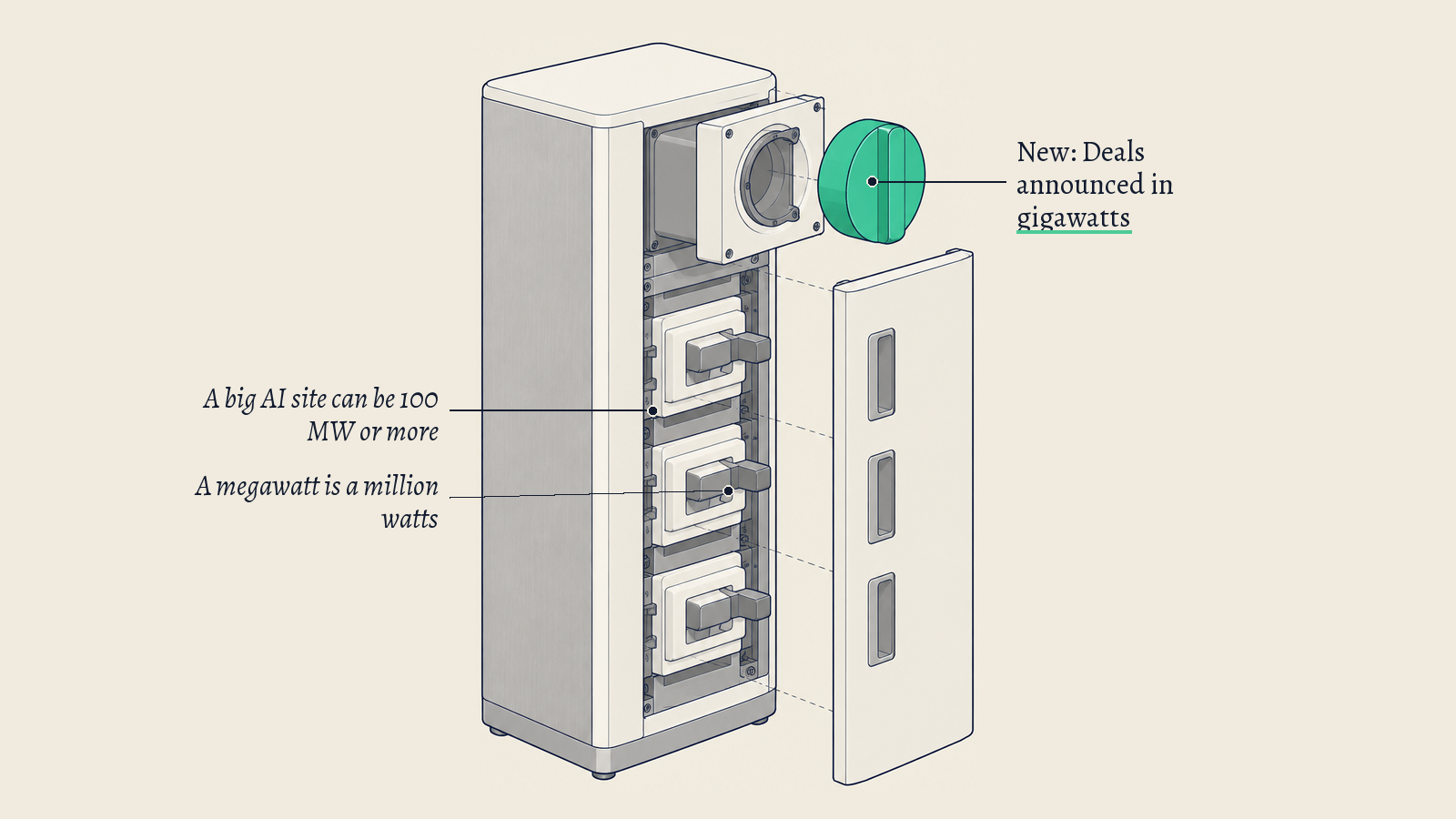 Illustration made with AI for ai notis
Key points
- A gigawatt is a billion watts and a megawatt a million, according to NIST's table of metric prefixes.
- The IEA says a conventional data centre may draw 10 to 25 megawatts and a hyperscale AI-focused one 100 or more, as much electricity yearly as 100 000 households.
- Nvidia and OpenAI announced a letter of intent for at least 10 gigawatts, and Anthropic an agreement with Google and Broadcom for multiple gigawatts from 2027. Both are announced plans.
What happened
A gigawatt is a unit of electrical power. In the metric system the prefix giga stands for a billion and mega for a million, so a gigawatt is a billion watts and a megawatt is a million.
The International Energy Agency sizes data centres by their power draw in megawatts. In its Energy and AI report it says a conventional data centre may be around 10 to 25 megawatts, and that a hyperscale, AI-focused data centre can have a capacity of 100 megawatts or more. It says such a site consumes as much electricity annually as 100,000 households.
The report's chart of data centre sizes takes about 2,000 megawatts as the largest data centre under construction and 5,000 megawatts as the largest planned. Its executive summary says the largest ones under construction will consume 20 times as much as a typical AI-focused data centre.
The IEA reports totals in terawatt hours: it estimates data centres used around 415 terawatt hours in 2024, about 1.5% of global electricity consumption.
Two announcements state deals in gigawatts. In September 2025 NVIDIA and OpenAI announced a letter of intent to deploy at least 10 gigawatts of NVIDIA systems, representing millions of GPUs, and said the first gigawatt would be deployed in the second half of 2026.
In April 2026 Anthropic said it had signed an agreement with Google and Broadcom for multiple gigawatts of TPU capacity that it expects to come online starting in 2027. Both are plans the companies announced.
The IEA says data centres tend to be highly concentrated, which poses significant challenges to local grids given their substantial power draw. In Ireland it says data centres consume around 20% of the metered electricity supply.
Underlined sentences link to the facts we checked. Dotted words open a short explainer.
Fact 5 of 12 · from International Energy Agency, 10 Apr 2025
Data centres tend to be highly concentrated in spatial terms, posing significant challenges to local grids given their substantial power draw.
What it means for you
Our viewGigawatts describe the electrical power a site draws, and the two deals are plans the companies announced, not capacity running today. When a vendor quotes gigawatts, ask how many chips it assumes and when each stage is due: Nvidia said in September 2025 that the first gigawatt would be deployed in the second half of 2026.
The IEA also says data centres tend to be concentrated, which strains local grids, and that in Ireland they use around 20% of metered electricity. Ask your provider where the capacity for your workloads sits and what happens to your service if power there runs short.
It adds no new facts.
Your reaction
We count reactions per story and day, never who reacted. The counts help us choose what goes in the monthly issue. If you are signed in, your own page shows yours too.
We count reactions per story and day, never who reacted. They help choose what goes in the monthly issue.
Check our sources
Every sentence above is checked against these 6 sources.
1 Metric (SI) Prefixes
Open the source archived copy-
NIST's table of metric prefixes lists giga as 10 to the power 9, a billion, with gigawatt as its example, and mega as 10 to the power 6, a million.
citegiga Example: gigawatt G 10 9 billion mega M 10 6 million
2 Understanding the energy-AI nexus - Energy and AI
Open the source archived copy-
The IEA says that in terms of power draw a conventional data centre may be around 10-25 megawatts (MW) in size.
citeIn terms of power draw, a conventional data centre may be around 10-25 megawatts (MW) in size.
-
The IEA says a hyperscale, AI-focused data centre can have a capacity of 100 MW or more, consuming as much electricity annually as 100 000 households.
citeA hyperscale, AI-focused data centre can have a capacity of 100 MW or more, consuming as much electricity annually as 100 000 households.
-
The notes to the IEA's chart of data centre electricity consumption in household equivalents say the largest under-construction data centre capacity considered is around 2 000 MW and the largest planned data centre capacity considered is 5 000 MW.
citeThe conventional data centre capacity considered is 25 MW. The hyperscale data centre capacity considered is 100 MW. The largest under-construction data centre capacity considered is around 2 000 MW. The largest planned data centre capacity considered is 5 000 MW.
-
The IEA says data centres tend to be highly concentrated in spatial terms, posing significant challenges to local grids given their substantial power draw.
citeData centres tend to be highly concentrated in spatial terms, posing significant challenges to local grids given their substantial power draw.
-
The IEA says that in Ireland data centres consume around 20% of the metered electricity supply.
citeIn Ireland, for example, data centres consume around 20% of the metered electricity supply.
3 Executive summary - Energy and AI
Open the source archived copy-
The IEA's executive summary says a typical AI-focused data centre consumes as much electricity as 100 000 households, but the largest ones under construction today will consume 20 times as much.
citeA typical AI-focused data centre consumes as much electricity as 100 000 households, but the largest ones under construction today will consume 20 times as much.
4 Energy demand from AI - Energy and AI
Open the source archived copy-
The IEA estimates that electricity consumption from data centres amounts to around 415 terawatt hours (TWh), or about 1.5% of global electricity consumption in 2024.
citeToday, electricity consumption from data centres is estimated to amount to around 415 terawatt hours (TWh), or about 1.5% of global electricity consumption in 2024.
5 OpenAI and NVIDIA Announce Strategic Partnership to Deploy 10 Gigawatts of NVIDIA Systems
Open the source archived copy-
On 22 September 2025 NVIDIA and OpenAI announced a letter of intent to deploy at least 10 gigawatts of NVIDIA systems for OpenAI's next-generation AI infrastructure.
citeSeptember 22, 2025 ... OpenAI and NVIDIA today announced a letter of intent for a landmark strategic partnership to deploy at least 10 gigawatts of NVIDIA systems for OpenAI's next-generation AI infrastructure
-
NVIDIA's announcement says the partnership enables OpenAI to build and deploy at least 10 gigawatts of AI data centers with NVIDIA systems representing millions of GPUs.
citeStrategic partnership enables OpenAI to build and deploy at least 10 gigawatts of AI data centers with NVIDIA systems representing millions of GPUs for OpenAI's next-generation AI infrastructure.
-
NVIDIA's announcement says the first gigawatt of NVIDIA systems will be deployed in the second half of 2026 on the NVIDIA Vera Rubin platform.
citeThe first gigawatt of NVIDIA systems will be deployed in the second half of 2026 on the NVIDIA Vera Rubin platform.
6 Anthropic expands partnership with Google and Broadcom for multiple gigawatts of next-generation compute
Open the source archived copy-
Anthropic said on 6 April 2026 that it had signed a new agreement with Google and Broadcom for multiple gigawatts of next-generation TPU capacity that it expects to come online starting in 2027.
citeWe have signed a new agreement with Google and Broadcom for multiple gigawatts of next-generation TPU capacity that we expect to come online starting in 2027.
Every sentence above is checked against these 6 sources. Each fact has its own address you can cite.
Source 1 · NIST
Metric (SI) Prefixes
NIST's table of metric prefixes lists giga as 10 to the power 9, a billion, with gigawatt as its example, and mega as 10 to the power 6, a million.
giga Example: gigawatt G 10 9 billion mega M 10 6 million
Source 2 · International Energy Agency · 10 Apr 2025
Understanding the energy-AI nexus - Energy and AI
The IEA says that in terms of power draw a conventional data centre may be around 10-25 megawatts (MW) in size.
In terms of power draw, a conventional data centre may be around 10-25 megawatts (MW) in size.
The IEA says a hyperscale, AI-focused data centre can have a capacity of 100 MW or more, consuming as much electricity annually as 100 000 households.
A hyperscale, AI-focused data centre can have a capacity of 100 MW or more, consuming as much electricity annually as 100 000 households.
The notes to the IEA's chart of data centre electricity consumption in household equivalents say the largest under-construction data centre capacity considered is around 2 000 MW and the largest planned data centre capacity considered is 5 000 MW.
The conventional data centre capacity considered is 25 MW. The hyperscale data centre capacity considered is 100 MW. The largest under-construction data centre capacity considered is around 2 000 MW. The largest planned data centre capacity considered is 5 000 MW.
Show all 5 factsShow fewer facts
The IEA says data centres tend to be highly concentrated in spatial terms, posing significant challenges to local grids given their substantial power draw.
Data centres tend to be highly concentrated in spatial terms, posing significant challenges to local grids given their substantial power draw.
The IEA says that in Ireland data centres consume around 20% of the metered electricity supply.
In Ireland, for example, data centres consume around 20% of the metered electricity supply.
Source 3 · International Energy Agency · 10 Apr 2025
Executive summary - Energy and AI
The IEA's executive summary says a typical AI-focused data centre consumes as much electricity as 100 000 households, but the largest ones under construction today will consume 20 times as much.
A typical AI-focused data centre consumes as much electricity as 100 000 households, but the largest ones under construction today will consume 20 times as much.
Source 4 · International Energy Agency · 10 Apr 2025
Energy demand from AI - Energy and AI
The IEA estimates that electricity consumption from data centres amounts to around 415 terawatt hours (TWh), or about 1.5% of global electricity consumption in 2024.
Today, electricity consumption from data centres is estimated to amount to around 415 terawatt hours (TWh), or about 1.5% of global electricity consumption in 2024.
Source 5 · NVIDIA · 22 Sep 2025
OpenAI and NVIDIA Announce Strategic Partnership to Deploy 10 Gigawatts of NVIDIA Systems
On 22 September 2025 NVIDIA and OpenAI announced a letter of intent to deploy at least 10 gigawatts of NVIDIA systems for OpenAI's next-generation AI infrastructure.
September 22, 2025 ... OpenAI and NVIDIA today announced a letter of intent for a landmark strategic partnership to deploy at least 10 gigawatts of NVIDIA systems for OpenAI's next-generation AI infrastructure
NVIDIA's announcement says the partnership enables OpenAI to build and deploy at least 10 gigawatts of AI data centers with NVIDIA systems representing millions of GPUs.
Strategic partnership enables OpenAI to build and deploy at least 10 gigawatts of AI data centers with NVIDIA systems representing millions of GPUs for OpenAI's next-generation AI infrastructure.
NVIDIA's announcement says the first gigawatt of NVIDIA systems will be deployed in the second half of 2026 on the NVIDIA Vera Rubin platform.
The first gigawatt of NVIDIA systems will be deployed in the second half of 2026 on the NVIDIA Vera Rubin platform.
Source 6 · Anthropic · 6 Apr 2026
Anthropic expands partnership with Google and Broadcom for multiple gigawatts of next-generation compute
Anthropic said on 6 April 2026 that it had signed a new agreement with Google and Broadcom for multiple gigawatts of next-generation TPU capacity that it expects to come online starting in 2027.
We have signed a new agreement with Google and Broadcom for multiple gigawatts of next-generation TPU capacity that we expect to come online starting in 2027.
Topics
The morning email
On the mornings we publish: the three top stories and up to four short ones. Free.
We email you a link to confirm. An issue may include one sponsor, always labelled Sponsored · Advertisement. Our emails count opens and clicks, not who made them. Unsubscribe in one click. What we keep