ModelsPublished ExplainedAll news from that day
Ongoing case: Google's Gemini models 21 stories
What a thinking level sets, and how Gemini 4 Neon's four levels differ
A thinking level sets how much a model reasons before it answers, and Gemini 4 Neon offers four of them, with high as the default.
Check our sources · 22 facts from 3 sources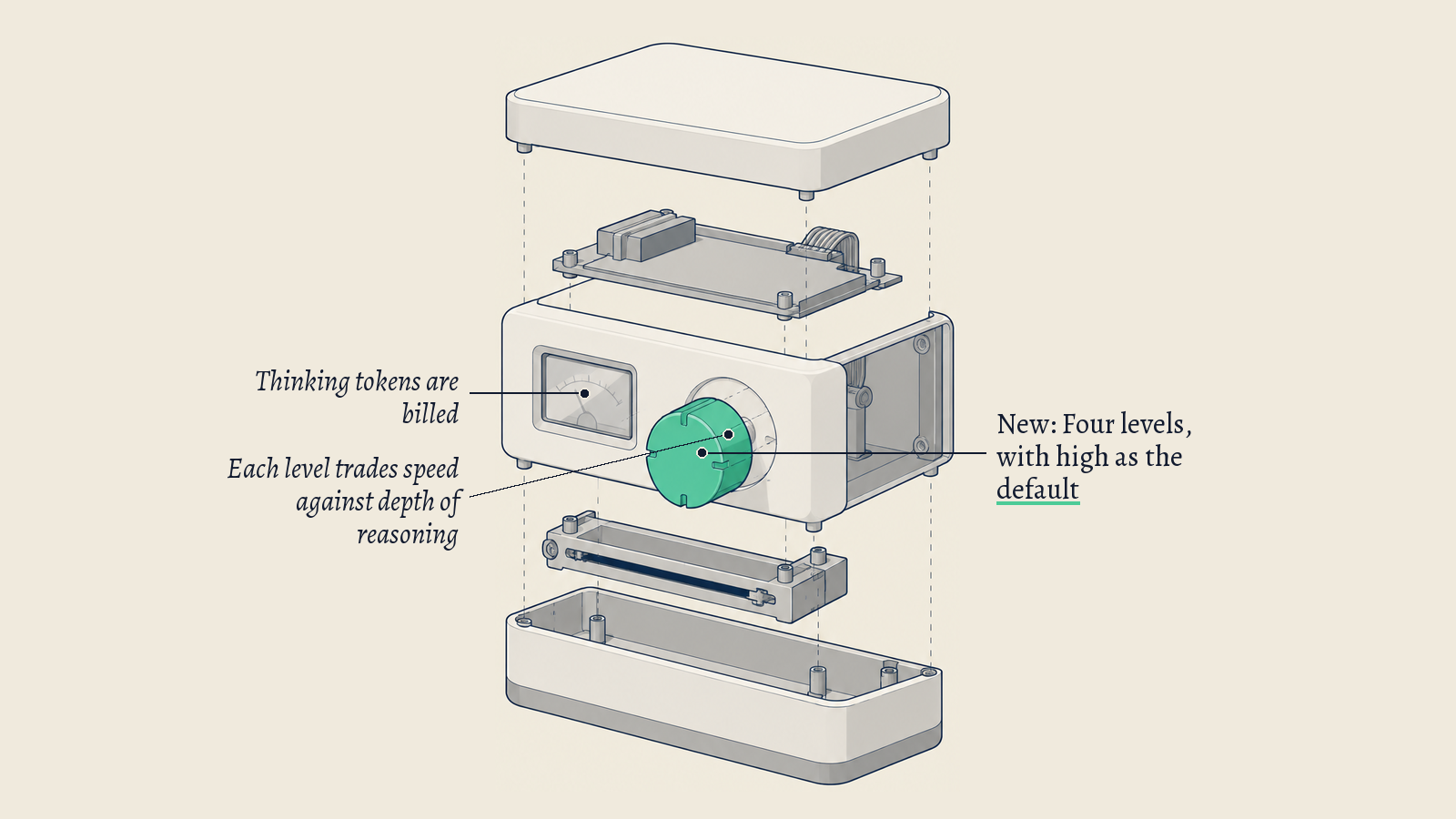 Illustration made with AI for ai notis
Key points
- Google's thinking guide says the thinking_level setting sets discrete reasoning tiers that trade latency against reasoning depth, and that you are billed for tokens generated during thinking.
- Neon and Hydrogen support LOW, MEDIUM, HIGH and XHIGH with HIGH as default; Carbon and Argon stop at HIGH with MEDIUM as default; no Gemini 4 model supports MINIMAL.
- On Neon, reasoning tokens at HIGH and XHIGH count toward max_output_tokens, so set it high enough for thinking and the answer, or use MEDIUM on latency-sensitive tool turns.
What happened
Google's new Gemini 4 Neon comes with four thinking levels, and the level you pick decides how much the model reasons before it answers. Google says the default, high, costs 32% less per task than its Carbon model, and that the top level, xhigh, gives Neon its highest intelligence score.
A thinking level is a setting on a thinking model. Thinking models generate an internal "thinking" process before returning a response, which Google says helps with multi-step planning, mathematics and code. The level sets discrete reasoning tiers, so you can trade speed against depth of reasoning.
On Google's models the setting is called thinking_level, and it takes up to five values. MINIMAL uses the fewest tokens for thinking, LOW uses fewer for faster responses, MEDIUM balances quality and latency, HIGH uses a high thinking budget for complex prompts, and XHIGH allocates the maximum thinking capacity for the hardest maths, science and software engineering tasks.
For Neon, Google's developer guide matches a level to work. LOW is for high-throughput classification, routing, summarization and structured metadata extraction. MEDIUM is for general coding, tool use, document Q&A and video understanding with balanced latency.
HIGH, the default, is for multi-step agentic tool loops, code generation and architectural refactoring. XHIGH is for deep reasoning, mathematical proofs, scientific analysis and the most complex multi-file software engineering tasks.
Thinking costs money and room. Google bills the tokens generated during the thinking process. On Neon, reasoning tokens at HIGH and XHIGH count toward the output cap, so the guide says to set that cap high enough for both thinking and the final answer, or to use MEDIUM on latency-sensitive tool turns.
Not every model offers every level. Neon and Gemini 4 Hydrogen support LOW, MEDIUM, HIGH and XHIGH with HIGH as the default, while Carbon and Argon support LOW, MEDIUM and HIGH with MEDIUM as the default, and MINIMAL is not supported on any Gemini 4 model.
Gemini 2.5 and earlier models work differently: they take a thinking_budget, a soft limit on thinking tokens, and Gemini 4 models return an error if a request sets one.
Google's guide says that even when thinking is enabled and a level is set, the model might answer some requests without thinking and return no thought parts, so an application has to handle that case. Where a model does return thought summaries, they can also be missing, for example on low-complexity requests.
When you compare models, check which level a published result used. Google's Neon claims name the level, such as the xhigh score of 61 on the Artificial Analysis Intelligence Index and the default-high cost per task, and those figures are Google's own.
Underlined sentences link to the facts we checked. Dotted words open a short explainer.
Fact 5 of 22 · from Google Cloud, 19 Nov 2026
Thinking models generate an internal "thinking" process before returning a response. This capability helps the model perform complex multi-step planning, solve mathematical problems, and generate accurate code.
Fact 16 of 22 · from Google Cloud, 19 Nov 2026
Because model behavior is non-deterministic, thinking isn't guaranteed for every request. Even when thinking is enabled and you set a thinking level, a thinking budget, or include_thoughts, the model might respond to some requests without thinking and return no thought parts. Your application must handle responses that don't contain thought parts.
Fact 22 of 22 · from Google Cloud, 19 Nov 2026
Reasoning tokens generated at HIGH (default) and XHIGH count toward max_output_tokens and accumulate in multi-turn context when you preserve thought signatures across turns. Set max_output_tokens high enough for both thinking and final output, avoid overly low context-compaction thresholds in multi-turn coding harnesses, or set thinking_level="MEDIUM" on latency-sensitive tool turns.
What it means for you
Our viewBefore you compare models, check which level each published result used: Google's cost claim of 32% less per task than Carbon is at high, and its Artificial Analysis score of 61 for Neon is at xhigh, and both are Google's own figures.
Because Google says a model might answer some requests without thinking, an application has to handle a response with no thought parts. Review the thinking_level and max_output_tokens settings in your Gemini 4 calls, and add a handler for responses that return no thought parts.
It adds no new facts.
Your reaction
We count reactions per story and day, never who reacted. The counts help us choose what goes in the monthly issue. If you are signed in, your own page shows yours too.
We count reactions per story and day, never who reacted. They help choose what goes in the monthly issue.
Check our sources
Every sentence above is checked against these 3 sources.
1 Introducing Gemini 4 Neon
Open the source archived copy-
Google says Gemini 4 Neon's four thinking levels scale steadily, letting teams dial intelligence and token spend to what each workload needs.
citeWe’re refining thinking levels with each new model release to give teams finer control and a smoother progression from one tier to the next. Neon’s four levels scale steadily, letting teams dial intelligence and token spend to what each workload needs.
-
Google says that at its default high thinking level Gemini 4 Neon pairs a high Artificial Analysis Intelligence Index score with a 32% lower cost per task than Carbon.
citeAt its default high thinking level, it pairs a high Artificial Analysis Intelligence Index score with a 32% lower cost per task than Carbon.
-
Google says xhigh thinking adds deeper, multi-step reasoning for the hardest engineering, analytical and scientific workloads, and that Neon shows its highest intelligence score at that level.
citexhigh thinking adds deeper, multi-step reasoning for the hardest engineering, analytical, and scientific workloads. Neon shows its highest intelligence score here
-
Google says Gemini 4 Neon ranks #3 overall with a score of 61 on the Artificial Analysis Intelligence Index at its xhigh thinking level.
citeNeon ranks ahead of comparable models and #3 overall with a score of 61 on the Artificial Analysis Intelligence Index at its xhigh thinking level
2 Thinking (Gemini Enterprise Agent Platform)
Open the source archived copy-
Google's thinking guide says thinking models generate an internal "thinking" process before returning a response, which helps the model perform complex multi-step planning, solve mathematical problems and generate accurate code.
citeThinking models generate an internal "thinking" process before returning a response. This capability helps the model perform complex multi-step planning, solve mathematical problems, and generate accurate code.
-
Google's thinking guide says the thinking_level parameter sets discrete reasoning tiers so you can optimize between latency and reasoning depth.
citeGemini 3 models use the thinking_level parameter. This parameter sets discrete reasoning tiers so you can optimize between latency and reasoning depth.
-
Google's thinking guide describes MINIMAL as using the fewest possible tokens for thinking, and LOW as using fewer thinking tokens for faster responses.
citeMINIMAL: Uses the fewest possible tokens for thinking. ... LOW: Uses fewer thinking tokens for faster responses.
-
Google's thinking guide describes MEDIUM as balancing reasoning quality and latency, and HIGH as using a high thinking budget for complex prompts requiring deep reasoning, multi-step problem solving, formal code verification or multi-turn tool execution.
citeMEDIUM: Balances reasoning quality and latency. ... HIGH: Uses a high thinking budget for complex prompts requiring deep reasoning, multi-step problem solving, formal code verification, or multi-turn tool execution.
-
Google's thinking guide says XHIGH allocates the maximum thinking capacity for the hardest math, science, formal verification and long-horizon software engineering tasks, and is supported on Gemini 4 Neon and Gemini 4 Hydrogen.
citeXHIGH: Allocates the maximum thinking capacity for the hardest math, science, formal verification, and long-horizon software engineering tasks. Supported on Gemini 4 Neon and Gemini 4 Hydrogen.
-
Google's thinking guide says you are billed for tokens generated during the thinking process.
citeYou are billed for tokens generated during the thinking process.
-
Google's thinking guide lists Gemini 4 Neon and Gemini 4 Hydrogen as supporting LOW, MEDIUM, HIGH and XHIGH with a default of HIGH.
citeGemini 4 Neon LOW, MEDIUM, HIGH, XHIGH HIGH Gemini 4 Hydrogen LOW, MEDIUM, HIGH, XHIGH HIGH
-
Google's thinking guide lists Gemini 4 Carbon and Gemini 4 Argon as supporting LOW, MEDIUM and HIGH with a default of MEDIUM.
citeGemini 4 Carbon LOW, MEDIUM, HIGH MEDIUM ... Gemini 4 Argon LOW, MEDIUM, HIGH MEDIUM
-
Google's thinking guide says the MINIMAL level is not supported on Gemini 4 models.
citeMINIMAL: Uses the fewest possible tokens for thinking. ... Not supported on Gemini 4 models.
-
Google's thinking guide says that for Gemini 2.5 and earlier models, thinking is configured with the thinking_budget parameter, which sets a soft limit on the number of tokens the model can use during internal reasoning.
citeFor Gemini 2.5 and earlier models, configure thinking using the thinking_budget parameter. This parameter sets a soft limit on the number of tokens the model can use during internal reasoning.
-
Google's thinking guide says setting thinking_budget on Gemini 4 models returns a 400: INVALID_ARGUMENT error.
citeSetting thinking_budget on Gemini 4 models returns a 400: INVALID_ARGUMENT error
-
Google's thinking guide says that because model behavior is non-deterministic, thinking is not guaranteed for every request: even when thinking is enabled and a thinking level is set, the model might respond to some requests without thinking and return no thought parts, and an application must handle such responses.
citeBecause model behavior is non-deterministic, thinking isn't guaranteed for every request. Even when thinking is enabled and you set a thinking level, a thinking budget, or include_thoughts, the model might respond to some requests without thinking and return no thought parts. Your application must handle responses that don't contain thought parts.
-
Google's thinking guide says a response might return a thought signature without thought summary text in some situations, including low-complexity requests, when summaries were not requested or were turned off, and when reasoning over certain modalities such as image analysis.
citeA response might return a thought signature without thought summary text in the following situations: Low-complexity requests: The request required minimal reasoning steps. Disabled summaries: Thought summaries were not requested or were turned off. Non-text modalities: Reasoning over certain modalities (such as image analysis) might not produce text summaries.
3 Developer's guide to Gemini 4 Neon (Gemini Enterprise Agent Platform)
Open the source archived copy-
Google's Neon developer guide lists LOW as recommended for high-throughput classification, routing, summarization and structured metadata extraction.
citeLOW High-throughput classification, routing, summarization, and structured metadata extraction.
-
Google's Neon developer guide lists MEDIUM as recommended for general coding, tool use, document Q&A and video understanding with balanced latency.
citeMEDIUM General coding, tool use, document Q&A, and video understanding with balanced latency.
-
Google's Neon developer guide lists HIGH, the default on gemini-4-neon, as recommended for multi-step agentic tool loops, code generation, architectural refactoring and complex multimodal analysis.
citeHIGH (default on gemini-4-neon) Multi-step agentic tool loops, code generation, architectural refactoring, and complex multimodal analysis.
-
Google's Neon developer guide lists XHIGH as recommended for deep reasoning, mathematical proofs, scientific analysis and the most complex multi-file software engineering tasks.
citeXHIGH Deep reasoning, mathematical proofs, scientific analysis, and the most complex multi-file software engineering tasks.
-
Google's Neon developer guide says reasoning tokens generated at HIGH (default) and XHIGH count toward max_output_tokens, and advises setting max_output_tokens high enough for both thinking and final output, or setting thinking_level="MEDIUM" on latency-sensitive tool turns.
citeReasoning tokens generated at HIGH (default) and XHIGH count toward max_output_tokens and accumulate in multi-turn context when you preserve thought signatures across turns. Set max_output_tokens high enough for both thinking and final output, avoid overly low context-compaction thresholds in multi-turn coding harnesses, or set thinking_level="MEDIUM" on latency-sensitive tool turns.
Every sentence above is checked against these 3 sources. Each fact has its own address you can cite.
Source 1 · Google · 18 Nov 2026
Introducing Gemini 4 Neon
Google says Gemini 4 Neon's four thinking levels scale steadily, letting teams dial intelligence and token spend to what each workload needs.
We’re refining thinking levels with each new model release to give teams finer control and a smoother progression from one tier to the next. Neon’s four levels scale steadily, letting teams dial intelligence and token spend to what each workload needs.
Google says that at its default high thinking level Gemini 4 Neon pairs a high Artificial Analysis Intelligence Index score with a 32% lower cost per task than Carbon.
At its default high thinking level, it pairs a high Artificial Analysis Intelligence Index score with a 32% lower cost per task than Carbon.
Google says xhigh thinking adds deeper, multi-step reasoning for the hardest engineering, analytical and scientific workloads, and that Neon shows its highest intelligence score at that level.
xhigh thinking adds deeper, multi-step reasoning for the hardest engineering, analytical, and scientific workloads. Neon shows its highest intelligence score here
Show all 4 factsShow fewer facts
Google says Gemini 4 Neon ranks #3 overall with a score of 61 on the Artificial Analysis Intelligence Index at its xhigh thinking level.
Neon ranks ahead of comparable models and #3 overall with a score of 61 on the Artificial Analysis Intelligence Index at its xhigh thinking level
Source 2 · Google Cloud · 19 Nov 2026
Thinking (Gemini Enterprise Agent Platform)
Google's thinking guide says thinking models generate an internal "thinking" process before returning a response, which helps the model perform complex multi-step planning, solve mathematical problems and generate accurate code.
Thinking models generate an internal "thinking" process before returning a response. This capability helps the model perform complex multi-step planning, solve mathematical problems, and generate accurate code.
Google's thinking guide says the thinking_level parameter sets discrete reasoning tiers so you can optimize between latency and reasoning depth.
Gemini 3 models use the thinking_level parameter. This parameter sets discrete reasoning tiers so you can optimize between latency and reasoning depth.
Google's thinking guide describes MINIMAL as using the fewest possible tokens for thinking, and LOW as using fewer thinking tokens for faster responses.
MINIMAL: Uses the fewest possible tokens for thinking. ... LOW: Uses fewer thinking tokens for faster responses.
Show all 13 factsShow fewer facts
Google's thinking guide describes MEDIUM as balancing reasoning quality and latency, and HIGH as using a high thinking budget for complex prompts requiring deep reasoning, multi-step problem solving, formal code verification or multi-turn tool execution.
MEDIUM: Balances reasoning quality and latency. ... HIGH: Uses a high thinking budget for complex prompts requiring deep reasoning, multi-step problem solving, formal code verification, or multi-turn tool execution.
Google's thinking guide says XHIGH allocates the maximum thinking capacity for the hardest math, science, formal verification and long-horizon software engineering tasks, and is supported on Gemini 4 Neon and Gemini 4 Hydrogen.
XHIGH: Allocates the maximum thinking capacity for the hardest math, science, formal verification, and long-horizon software engineering tasks. Supported on Gemini 4 Neon and Gemini 4 Hydrogen.
Google's thinking guide says you are billed for tokens generated during the thinking process.
You are billed for tokens generated during the thinking process.
Google's thinking guide lists Gemini 4 Neon and Gemini 4 Hydrogen as supporting LOW, MEDIUM, HIGH and XHIGH with a default of HIGH.
Gemini 4 Neon LOW, MEDIUM, HIGH, XHIGH HIGH Gemini 4 Hydrogen LOW, MEDIUM, HIGH, XHIGH HIGH
Google's thinking guide lists Gemini 4 Carbon and Gemini 4 Argon as supporting LOW, MEDIUM and HIGH with a default of MEDIUM.
Gemini 4 Carbon LOW, MEDIUM, HIGH MEDIUM ... Gemini 4 Argon LOW, MEDIUM, HIGH MEDIUM
Google's thinking guide says the MINIMAL level is not supported on Gemini 4 models.
MINIMAL: Uses the fewest possible tokens for thinking. ... Not supported on Gemini 4 models.
Google's thinking guide says that for Gemini 2.5 and earlier models, thinking is configured with the thinking_budget parameter, which sets a soft limit on the number of tokens the model can use during internal reasoning.
For Gemini 2.5 and earlier models, configure thinking using the thinking_budget parameter. This parameter sets a soft limit on the number of tokens the model can use during internal reasoning.
Google's thinking guide says setting thinking_budget on Gemini 4 models returns a 400: INVALID_ARGUMENT error.
Setting thinking_budget on Gemini 4 models returns a 400: INVALID_ARGUMENT error
Google's thinking guide says that because model behavior is non-deterministic, thinking is not guaranteed for every request: even when thinking is enabled and a thinking level is set, the model might respond to some requests without thinking and return no thought parts, and an application must handle such responses.
Because model behavior is non-deterministic, thinking isn't guaranteed for every request. Even when thinking is enabled and you set a thinking level, a thinking budget, or include_thoughts, the model might respond to some requests without thinking and return no thought parts. Your application must handle responses that don't contain thought parts.
Google's thinking guide says a response might return a thought signature without thought summary text in some situations, including low-complexity requests, when summaries were not requested or were turned off, and when reasoning over certain modalities such as image analysis.
A response might return a thought signature without thought summary text in the following situations: Low-complexity requests: The request required minimal reasoning steps. Disabled summaries: Thought summaries were not requested or were turned off. Non-text modalities: Reasoning over certain modalities (such as image analysis) might not produce text summaries.
Source 3 · Google Cloud · 19 Nov 2026
Developer's guide to Gemini 4 Neon (Gemini Enterprise Agent Platform)
Google's Neon developer guide lists LOW as recommended for high-throughput classification, routing, summarization and structured metadata extraction.
LOW High-throughput classification, routing, summarization, and structured metadata extraction.
Google's Neon developer guide lists MEDIUM as recommended for general coding, tool use, document Q&A and video understanding with balanced latency.
MEDIUM General coding, tool use, document Q&A, and video understanding with balanced latency.
Google's Neon developer guide lists HIGH, the default on gemini-4-neon, as recommended for multi-step agentic tool loops, code generation, architectural refactoring and complex multimodal analysis.
HIGH (default on gemini-4-neon) Multi-step agentic tool loops, code generation, architectural refactoring, and complex multimodal analysis.
Show all 5 factsShow fewer facts
Google's Neon developer guide lists XHIGH as recommended for deep reasoning, mathematical proofs, scientific analysis and the most complex multi-file software engineering tasks.
XHIGH Deep reasoning, mathematical proofs, scientific analysis, and the most complex multi-file software engineering tasks.
Google's Neon developer guide says reasoning tokens generated at HIGH (default) and XHIGH count toward max_output_tokens, and advises setting max_output_tokens high enough for both thinking and final output, or setting thinking_level="MEDIUM" on latency-sensitive tool turns.
Reasoning tokens generated at HIGH (default) and XHIGH count toward max_output_tokens and accumulate in multi-turn context when you preserve thought signatures across turns. Set max_output_tokens high enough for both thinking and final output, avoid overly low context-compaction thresholds in multi-turn coding harnesses, or set thinking_level="MEDIUM" on latency-sensitive tool turns.
Topics
The morning email
On the mornings we publish: the three top stories and up to four short ones. Free.
We email you a link to confirm. An issue may include one sponsor, always labelled Sponsored · Advertisement. Our emails count opens and clicks, not who made them. Unsubscribe in one click. What we keep