ModelsPublished Top storyAll news from that day
Ongoing case: GitHub Copilot's agent features 7 stories
MAI Code 2 arrives in GitHub Copilot, with Flash on the Free plan
Microsoft says MAI Code 2 gives 98% of GPT-6.1 Sol's performance at 40% of the cost on four benchmarks it chose; GitHub lists both models for eligible annual-plan subscribers.
Check our sources · 16 facts from 3 sources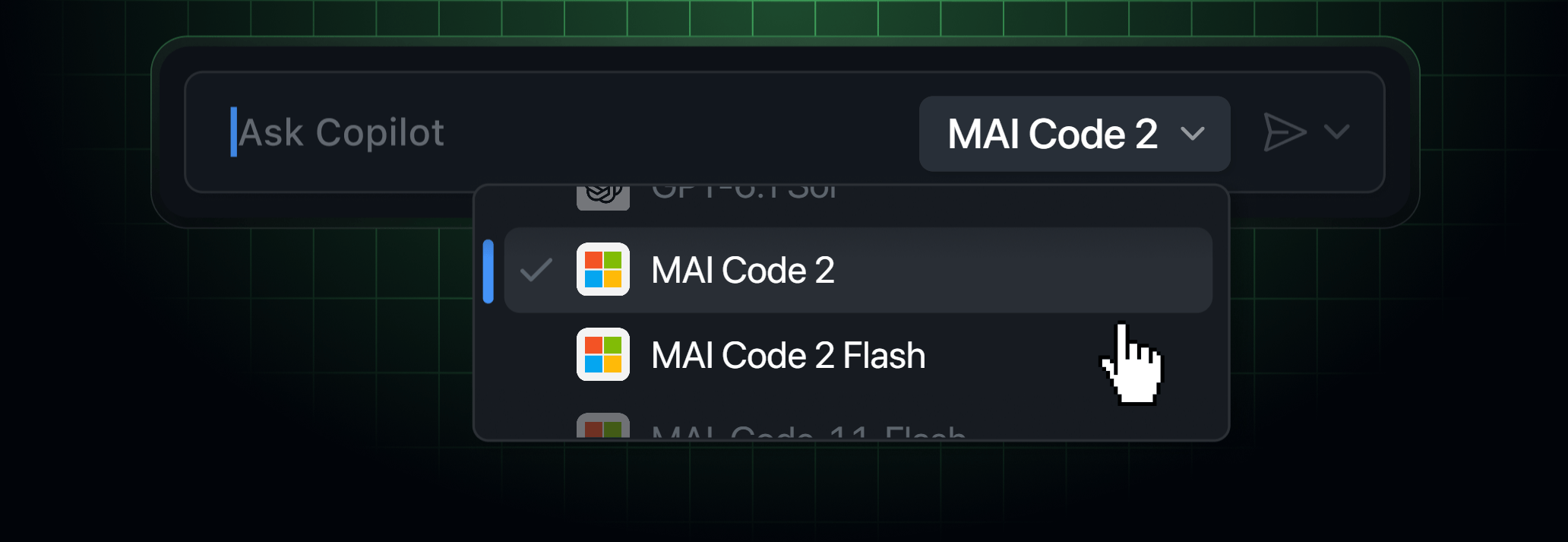 Image: GitHub
Key points
- GitHub's changelog of 17 November lists MAI Code 2 for Copilot Pro, Pro+, Max, Business and Enterprise, and MAI Code 2 Flash also for Copilot Free and Student.
- GitHub says both models are for eligible Copilot subscribers on annual plans and are billed under usage-based billing; Microsoft's announcement gives no per-token price for either.
- Microsoft says, averaged over four benchmarks it picked, MAI Code 2 gives 98% of GPT-6.1 Sol's performance at 40% of the cost, shown at a 50% promotional price.
What happened
Microsoft released MAI Code 2 and MAI Code 2 Flash, two coding models it says are built for everyday enterprise coding rather than the hardest problems. Microsoft says they are explicitly not yet tuned for fundamental science research or very long-horizon agentic work. Both are in GitHub Copilot, according to GitHub's changelog and Microsoft AI's announcement, both dated 17 November.
Microsoft says MAI Code 2 is for taking code to production, deep debugging, multi-file implementation, repo-wide reasoning and user interfaces, and that Code 2 Flash is for high-volume work such as code explanations, targeted edits and routine fixes.
The comparisons are Microsoft's own. Averaged over four benchmarks it picked (DeepSWE 1.1, Terminal Bench 2.1, SWE-Atlas and FrontierCode v1.1), Microsoft says MAI Code 2 gives 98% of GPT-6.1 Sol's performance at 40% of the cost, and 96% of Claude Opus 5.5's at 5% of the cost.
Microsoft ran the first three on its own evaluation platform at maximum reasoning effort, and shows MAI Code 2's cost at its 50% promotional price. In blind front-end evaluations, Microsoft says developers preferred MAI Code 2's results over GPT-6 Sol 64% of the time.
For Code 2 Flash, Microsoft says performance is comparable to GPT-6 Luna and Claude Haiku 5.5 at 65% and 20% of the cost across three benchmarks. Its announcement gives no per-token price for either model.
GitHub's changelog makes both models available to eligible Copilot subscribers on annual plans. MAI Code 2 is available on Copilot Pro, Pro+, Max, Business and Enterprise, and Code 2 Flash also on Copilot Free and Student, both billed under usage-based billing.
Microsoft says Code 2 Flash is in limited-access preview on Microsoft Foundry and that it will soon release both models on OpenRouter, Vercel, Hermes, OpenCode and Kilo.
Microsoft also said a security model is coming. It says MAI Cyber 2 Flash will come exclusively to Microsoft security products, replacing the existing model in the MAI profile in Codename MDASH for eligible customers from mid-December. Microsoft reports 92.3% on CyberGym-E2E against 91.5% for GPT-6 Astra, after excluding 92 of the benchmark's 905 tasks that overlap its training data.
Underlined sentences link to the facts we checked. Dotted words open a short explainer.
Fact 7 of 16 · from Microsoft AI, 17 Nov 2026
In blind frontend app evaluations, developers preferred its results over GPT-6 Sol 64% of the time.
What it means for you
Our viewThe comparison is Microsoft's own: it picked the benchmarks, ran most of them on its own evaluation platform and shows MAI Code 2's cost at a promotional price, so the cost figure reflects that discount.
Microsoft also says the models are not yet tuned for fundamental science research or very long-horizon agentic work, which makes them a fit for everyday enterprise coding.
If you manage Copilot seats, check whether your plan is an annual one, then run a week of real tasks on both models and compare what usage-based billing charges against your current default before you change it.
It adds no new facts.
Your reaction
We count reactions per story and day, never who reacted. The counts help us choose what goes in the monthly issue. If you are signed in, your own page shows yours too.
We count reactions per story and day, never who reacted. They help choose what goes in the monthly issue.
Check our sources
Every sentence above is checked against these 3 sources.
1 MAI Code 2 and Code 2 Flash: Everyday coding at scalable prices
Open the source archived copy-
Microsoft AI's announcement of 17 November 2026 introduces MAI Code 2 and MAI Code 2 Flash as two new coding models built for everyday enterprise coding tasks.
citeNov 17, 2026 ... MAI Code 2 and MAI Code 2 Flash: two new coding models built for everyday enterprise coding tasks, delivering leading performance at a fraction of the cost of competing models.
-
Microsoft says the MAI Code 2 models are explicitly not yet tuned for harder problems, like fundamental science research and very long-horizon agentic work.
citeThey’re explicitly not yet tuned for harder problems, like fundamental science research and very long-horizon agentic work.
-
Microsoft says MAI Code 2 excels in taking code to production, deep debugging, multi-file implementation, repo-wide reasoning and UI.
citeMAI Code 2 is at the frontier of price-performance for common enterprise coding tasks and excels in taking code to production, deep debugging, multi-file implementation, repo-wide reasoning, and UI.
-
Microsoft says MAI Code 2 Flash is designed for high-volume work such as code explanations, targeted edits, routine fixes and rapid iterations.
citeMeanwhile, MAI Code 2 Flash is designed for high-volume work such as code explanations, targeted edits, routine fixes, and rapid iterations
-
Microsoft says that, averaged over four benchmarks (DeepSWE 1.1, Terminal Bench 2.1, SWE-Atlas and FrontierCode v1.1), MAI Code 2 gives 98% of the performance of GPT-6.1 Sol at 40% of the cost, and 96% of Claude Opus 5.5's performance at 5% of the cost.
citeAveraged over four widely used benchmarks that target the everyday enterprise coding tasks we see in GitHub Copilot (DeepSWE 1.1, Terminal Bench 2.1, SWE-Atlas and FrontierCode v1.1), MAI Code 2 gives you 98% of the performance of GPT-6.1 Sol at 40% of the cost, and 96% of Claude Opus 5.5’s performance at just 5% of the cost.
-
Microsoft's footnote says all models were run at max reasoning effort, that DeepSWE 1.1, TerminalBench 2.1 and SWE Atlas were run on MSBench, Microsoft's internal eval platform, and that MAI Code 2's cost is shown at its 50% promotional price.
citeMAI Code 2 performance and price: All models were run at max reasoning effort. DeepSWE 1.1, TerminalBench 2.1, and SWE Atlas were run on MSBench (Microsoft’s internal eval platform) with the GitHub Copilot CLI without subagents. FrontierCode 1.1 scores and costs are from Artificial Analysis; MAI Code 2 cost is shown at its 50% promotional price
-
Microsoft says that in blind front-end app evaluations developers preferred MAI Code 2's results over GPT-6 Sol 64% of the time.
citeIn blind frontend app evaluations, developers preferred its results over GPT-6 Sol 64% of the time.
-
Microsoft says MAI Code 2 Flash offers comparable performance to GPT-6 Luna and Claude Haiku 5.5 at 65% and 20% of the cost, across three coding benchmarks.
citeIn addition, MAI Code 2 Flash offers comparable performance to GPT-6 Luna and Claude Haiku 5.5 at 65% and 20% of the cost, across three coding benchmarks measuring day-to-day, high-volume routine coding tasks.
-
Microsoft AI's announcement gives no per-token price for MAI Code 2 or MAI Code 2 Flash.
citeMAI Code 2 gives you 98% of the performance of GPT-6.1 Sol at 40% of the cost (the page states cost only as ratios to other models and its 50% promotional price; it gives no price per token for MAI Code 2 or MAI Code 2 Flash)
-
Microsoft says MAI Code 2 Flash is in limited-access preview in Microsoft Foundry, and that it will soon release the models on OpenRouter, Vercel, Hermes, OpenCode and Kilo.
citeMAI Code 2 and Code 2 Flash are available in GitHub Copilot, and Code 2 Flash is in limited-access preview in Microsoft Foundry. Soon, we’ll be releasing them on OpenRouter, Vercel, Hermes, OpenCode, and Kilo.
2 MAI Code 2 and MAI Code 2 Flash in GitHub Copilot
Open the source archived copy-
GitHub's changelog of 17 November 2026 says MAI Code 2 and MAI Code 2 Flash have arrived in GitHub Copilot.
citeNovember 17, 2026 ... The next generation of Microsoft AI (MAI) coding models has arrived in GitHub Copilot. Introducing MAI Code 2 and MAI Code 2 Flash
-
GitHub's changelog lists MAI Code 2 for Copilot Pro, Pro+, Max, Business and Enterprise, and MAI Code 2 Flash for Copilot Free, Student, Pro, Pro+, Max, Business and Enterprise, and says both are available to eligible Copilot subscribers on annual plans.
Toned down to what the source says
citeMAI Code 2: Copilot Pro, Pro+, Max, Business, and Enterprise MAI Code 2 Flash: Copilot Free, Student, Pro, Pro+, Max, Business, and Enterprise Both models are available to eligible GitHub Copilot subscribers on annual plans.
-
GitHub's changelog says both models are billed under usage-based billing.
citeThese models are billed under usage-based billing.
3 MAI Cyber 2 Flash: Leading security. Lower cost
Open the source archived copy-
Microsoft says MAI Cyber 2 Flash is coming exclusively to Microsoft security products, including Codename MDASH, where it will automatically replace the existing model in the MAI profile for eligible customers starting mid-December.
citeMAI Cyber 2 Flash is coming exclusively to Microsoft security products, including Codename MDASH, where it will automatically replace the existing model in the MAI profile for eligible customers starting mid-December.
-
Microsoft says MAI Cyber 2 Flash achieved 92.3% task success on CyberGym-E2E versus 91.5% for GPT-6 Astra, using half the reasoning budget.
citeCyberGym‑E2E: MAI Cyber 2 Flash achieved 92.3% task success versus 91.5% for GPT‑6 Astra, using half the reasoning budget.
-
Microsoft says that 92 of CyberGym-E2E's 905 tasks are based on the same open source projects and vulnerability reports as some of its training data, so it excluded them for every model and reports results on the remaining 813 tasks.
citeBenchmark integrity: While reviewing our CyberGym‑E2E results, we found that 92 of the benchmark’s 905 tasks are based on the same open source projects and vulnerability reports as some of our training data. The benchmark’s reference solutions were never used in training. To be conservative, we excluded these 92 tasks for every model and report CyberGym‑E2E results on the remaining 813 tasks.
Every sentence above is checked against these 3 sources. Each fact has its own address you can cite.
Source 1 · Microsoft AI · 17 Nov 2026
MAI Code 2 and Code 2 Flash: Everyday coding at scalable prices
Microsoft AI's announcement of 17 November 2026 introduces MAI Code 2 and MAI Code 2 Flash as two new coding models built for everyday enterprise coding tasks.
Nov 17, 2026 ... MAI Code 2 and MAI Code 2 Flash: two new coding models built for everyday enterprise coding tasks, delivering leading performance at a fraction of the cost of competing models.
Microsoft says the MAI Code 2 models are explicitly not yet tuned for harder problems, like fundamental science research and very long-horizon agentic work.
They’re explicitly not yet tuned for harder problems, like fundamental science research and very long-horizon agentic work.
Microsoft says MAI Code 2 excels in taking code to production, deep debugging, multi-file implementation, repo-wide reasoning and UI.
MAI Code 2 is at the frontier of price-performance for common enterprise coding tasks and excels in taking code to production, deep debugging, multi-file implementation, repo-wide reasoning, and UI.
Show all 10 factsShow fewer facts
Microsoft says MAI Code 2 Flash is designed for high-volume work such as code explanations, targeted edits, routine fixes and rapid iterations.
Meanwhile, MAI Code 2 Flash is designed for high-volume work such as code explanations, targeted edits, routine fixes, and rapid iterations
Microsoft says that, averaged over four benchmarks (DeepSWE 1.1, Terminal Bench 2.1, SWE-Atlas and FrontierCode v1.1), MAI Code 2 gives 98% of the performance of GPT-6.1 Sol at 40% of the cost, and 96% of Claude Opus 5.5's performance at 5% of the cost.
Averaged over four widely used benchmarks that target the everyday enterprise coding tasks we see in GitHub Copilot (DeepSWE 1.1, Terminal Bench 2.1, SWE-Atlas and FrontierCode v1.1), MAI Code 2 gives you 98% of the performance of GPT-6.1 Sol at 40% of the cost, and 96% of Claude Opus 5.5’s performance at just 5% of the cost.
Microsoft's footnote says all models were run at max reasoning effort, that DeepSWE 1.1, TerminalBench 2.1 and SWE Atlas were run on MSBench, Microsoft's internal eval platform, and that MAI Code 2's cost is shown at its 50% promotional price.
MAI Code 2 performance and price: All models were run at max reasoning effort. DeepSWE 1.1, TerminalBench 2.1, and SWE Atlas were run on MSBench (Microsoft’s internal eval platform) with the GitHub Copilot CLI without subagents. FrontierCode 1.1 scores and costs are from Artificial Analysis; MAI Code 2 cost is shown at its 50% promotional price
Microsoft says that in blind front-end app evaluations developers preferred MAI Code 2's results over GPT-6 Sol 64% of the time.
In blind frontend app evaluations, developers preferred its results over GPT-6 Sol 64% of the time.
Microsoft says MAI Code 2 Flash offers comparable performance to GPT-6 Luna and Claude Haiku 5.5 at 65% and 20% of the cost, across three coding benchmarks.
In addition, MAI Code 2 Flash offers comparable performance to GPT-6 Luna and Claude Haiku 5.5 at 65% and 20% of the cost, across three coding benchmarks measuring day-to-day, high-volume routine coding tasks.
Microsoft AI's announcement gives no per-token price for MAI Code 2 or MAI Code 2 Flash.
MAI Code 2 gives you 98% of the performance of GPT-6.1 Sol at 40% of the cost (the page states cost only as ratios to other models and its 50% promotional price; it gives no price per token for MAI Code 2 or MAI Code 2 Flash)
Microsoft says MAI Code 2 Flash is in limited-access preview in Microsoft Foundry, and that it will soon release the models on OpenRouter, Vercel, Hermes, OpenCode and Kilo.
MAI Code 2 and Code 2 Flash are available in GitHub Copilot, and Code 2 Flash is in limited-access preview in Microsoft Foundry. Soon, we’ll be releasing them on OpenRouter, Vercel, Hermes, OpenCode, and Kilo.
Source 2 · GitHub · 17 Nov 2026
MAI Code 2 and MAI Code 2 Flash in GitHub Copilot
GitHub's changelog of 17 November 2026 says MAI Code 2 and MAI Code 2 Flash have arrived in GitHub Copilot.
November 17, 2026 ... The next generation of Microsoft AI (MAI) coding models has arrived in GitHub Copilot. Introducing MAI Code 2 and MAI Code 2 Flash
GitHub's changelog lists MAI Code 2 for Copilot Pro, Pro+, Max, Business and Enterprise, and MAI Code 2 Flash for Copilot Free, Student, Pro, Pro+, Max, Business and Enterprise, and says both are available to eligible Copilot subscribers on annual plans.
Toned down to what the source saysMAI Code 2: Copilot Pro, Pro+, Max, Business, and Enterprise MAI Code 2 Flash: Copilot Free, Student, Pro, Pro+, Max, Business, and Enterprise Both models are available to eligible GitHub Copilot subscribers on annual plans.
GitHub's changelog says both models are billed under usage-based billing.
These models are billed under usage-based billing.
Source 3 · Microsoft AI · 17 Nov 2026
MAI Cyber 2 Flash: Leading security. Lower cost
Microsoft says MAI Cyber 2 Flash is coming exclusively to Microsoft security products, including Codename MDASH, where it will automatically replace the existing model in the MAI profile for eligible customers starting mid-December.
MAI Cyber 2 Flash is coming exclusively to Microsoft security products, including Codename MDASH, where it will automatically replace the existing model in the MAI profile for eligible customers starting mid-December.
Microsoft says MAI Cyber 2 Flash achieved 92.3% task success on CyberGym-E2E versus 91.5% for GPT-6 Astra, using half the reasoning budget.
CyberGym‑E2E: MAI Cyber 2 Flash achieved 92.3% task success versus 91.5% for GPT‑6 Astra, using half the reasoning budget.
Microsoft says that 92 of CyberGym-E2E's 905 tasks are based on the same open source projects and vulnerability reports as some of its training data, so it excluded them for every model and reports results on the remaining 813 tasks.
Benchmark integrity: While reviewing our CyberGym‑E2E results, we found that 92 of the benchmark’s 905 tasks are based on the same open source projects and vulnerability reports as some of our training data. The benchmark’s reference solutions were never used in training. To be conservative, we excluded these 92 tasks for every model and report CyberGym‑E2E results on the remaining 813 tasks.
Topics
The morning email
On the mornings we publish: the three top stories and up to four short ones. Free.
We email you a link to confirm. An issue may include one sponsor, always labelled Sponsored · Advertisement. Our emails count opens and clicks, not who made them. Unsubscribe in one click. What we keep