LawsPublished ExplainedAll news from that day
Ongoing case: US chip export rules and China 2 storiesHow US AI-chip export rules use a performance score and buyer headquarters
The US grades AI chips by a performance score and ties the licence to where the buyer's parent company is headquartered, as BIS guidance dated 31 May 2026 restates.
Check our sources · 23 facts from 4 sources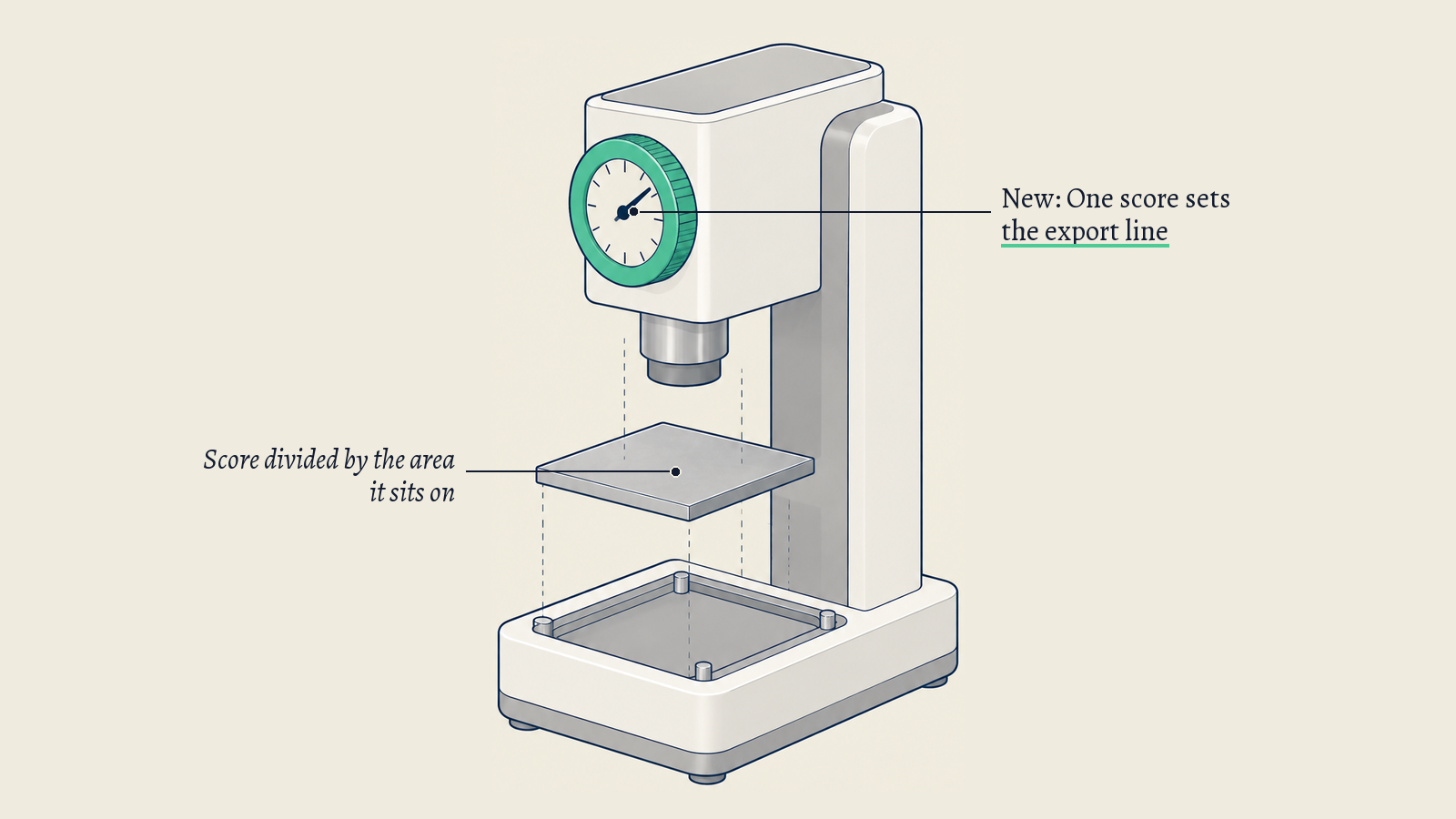 Illustration made with AI for ai notis
Key points
- BIS guidance dated 31 May 2026 requires a licence to export advanced computing items to entities headquartered in Country Group D:5 or Macau, or with a parent that is.
- BIS defines total processing performance (TPP) as 2 x MacTOPS x the bit length of the operation, added over all processing units on the chip.
- The October 2023 rule's revised ECCN 3A090.a controls chips with a TPP of 4800 or more, or 1600 or more with a performance density of 5.92 or more.
What happened
A US licence is needed to ship advanced AI chips to a company headquartered in Macau or a Country Group D:5 country, or owned by a parent that is, even when the company itself sits in another country. The Commerce Department's Bureau of Industry and Security (BIS) restated this in guidance dated 31 May 2026. The controls turn on a performance score rather than a product name.
That score is called total processing performance, or TPP. BIS defines it as 2 x MacTOPS x the bit length of the operation, added up over all the processing units on the chip. MacTOPS is the theoretical peak number of trillions of multiply-accumulate operations per second.
The rules work in tiers. In the October 2023 rule, the top tier, ECCN 3A090.a, covered chips with a TPP of 4800 or more, or a TPP of 1600 or more together with a performance density of 5.92 or more. Performance density is TPP divided by the chip's die area. BIS added it so that buyers could not get round the rule by buying many smaller chips that together are as powerful as a restricted one.
The second tier, 3A090.b, covered chips with a TPP of 2400 to under 4800 and a performance density of 1.6 to under 5.92, or a TPP of 1600 or more and a density of 3.2 to under 5.92. BIS treated the tiers differently.
The most powerful chips needed a licence for any destination in Country Groups D:1, D:4 or D:5 that is not also in A:5 or A:6. For the less powerful tier BIS offered licence exception NAC, but using it requires pre-notification of an export or reexport to Macau or a D:5 destination.
In a final rule effective 15 January 2026, BIS moved licence review for chips below set TPP and DRAM-bandwidth limits, such as Nvidia's H200, from a presumption of denial to case by case for China and Macau end users.
The headquarters test answers a concern about diversion. When BIS widened its end-use controls in 2023 it cited "ongoing national security concerns related to diversion and misuse of items subject to the EAR", and it said it was acting against "transshipment and diversion" by PRC operations.
The May 2026 guidance says the headquarters-based licence requirement dates from 17 November 2023, and that it continues to apply even though BIS said in May 2025 that it would not enforce the new compliance requirements of the AI Diffusion Rule.
There are limits. BIS says bona fide data-centre operators need not stop using, storing or servicing chips they already run because of the guidance, until BIS says otherwise. A BIS FAQ updated on 17 June 2026 adds that the guidance covers 3A090.a chips and every other advanced computing item that contains one, including 4A090.a systems and related .z items.
Underlined sentences link to the facts we checked. Dotted words open a short explainer.
Fact 11 of 23 · from Bureau of Industry and Security (Federal Register), 25 Oct 2023
`Performance density' is `TPP' divided by `applicable die area'.
What it means for you
Our viewThe score decides which tier a chip falls in, and the headquarters test decides whether the buyer's own location matters at all: the guidance applies when the entity or its ultimate parent is headquartered in a listed place, even if the entity sits elsewhere.
BIS says bona fide data-centre operators need not stop using, storing or servicing chips they already run because of the guidance, until further notice, so watch for that notice.
Before your next purchase or hosting contract involving advanced accelerators, write down each chip's TPP and each buyer's ultimate parent headquarters, and ask your export-compliance adviser to confirm both.
It adds no new facts.
Your reaction
We count reactions per story and day, never who reacted. The counts help us choose what goes in the monthly issue. If you are signed in, your own page shows yours too.
We count reactions per story and day, never who reacted. They help choose what goes in the monthly issue.
Check our sources
Every sentence above is checked against these 4 sources.
1 Guidance Regarding Enforcement of License Requirements for Advanced Computing Items for Entities Headquartered in Country Group D:5 and Macau
Open the source archived copy-
BIS's guidance dated 31 May 2026 says a licence is required to export advanced computing items to entities headquartered in Country Group D:5 or Macau, or with an ultimate parent company headquartered in Country Group D:5 or Macau, even if the entities themselves are located outside Country Group D:5 or Macau.
citea license is required to export advanced computing items to entities headquartered in Country Group D:5 (see supplement no. 1 to part 740 of the Export Administration Regulations (EAR) (15 CFR parts 730-774)) or Macau or with an ultimate parent company headquartered in Country Group D:5 or Macau - even if the entities themselves are located outside Country Group D:5 or Macau.
-
The guidance says advanced computing items are those specified in ECCNs 3A090.a and .b, 4A090.a and .b, and related .z paragraph items.
citeall advanced computing items (e.g., those specified in Export Control Classification Numbers (ECCNs) 3A090.a and .b, 4A090.a and .b, and related .z paragraph items)
-
The guidance says the license requirement for entities headquartered in Country Group D:5 or Macau was first introduced on 17 November 2023 through an end-user control in section 744.23(a)(3) of the EAR.
citeThis license requirement was first introduced on November 17, 2023. It was implemented via an end-user control in 744.23(a)(3) of the EAR
-
The guidance says that in May 2025 BIS announced it would not be enforcing the AI Diffusion Rule's new compliance requirements, and that this non-enforcement policy applies only to the extent the items are not for entities headquartered in, or with ultimate parent companies headquartered in, Country Group D:5 or Macau.
citeIn May 2025, BIS announced that it would not be enforcing the AI Diffusion Rule's new compliance requirements. ... BIS's non-enforcement policy ... applies only to the extent such items are not for entities headquartered in or that have ultimate parent companies headquartered in Country Group D:5 or Macau.
-
The guidance says the license requirement continues to apply under section 742.6(a)(6)(iii)(A) of the EAR to all destinations outside the United States for these advanced computing items when they are for entities headquartered in, or whose ultimate parent company is headquartered in, Country Group D:5 or Macau.
citea license requirement continues to apply under 742.6(a)(6)(iii)(A) of the EAR to all destinations outside the United States for these advanced computing items when such items are for entities headquartered in, or whose ultimate parent company is headquartered in, Country Group D:5 or Macau.
-
The guidance says bona fide operators of data centers who are otherwise engaged in activities consistent with the EAR are not required to cease the ongoing use, storage, disposal, or servicing of advanced computing items because of the guidance, until further notice from BIS.
citeBona fide operators of data centers who are otherwise engaged in activities consistent with the EAR are not required to cease the ongoing use, storage, disposal, or servicing of advanced computing items because of this guidance, until further notice from BIS.
-
BIS's guidance dated 31 May 2026 says: "Exporters should continue to seek BIS licenses for such transactions, unless a license exception specified in § 740.2(a)(9)(ii) is available."
citeExporters should continue to seek BIS licenses for such transactions, unless a license exception specified in § 740.2(a)(9)(ii) is available.
2 Implementation of Additional Export Controls: Certain Advanced Computing Items (interim final rule, 88 FR 73458)
Open the source archived copy-
The October 2023 BIS rule (88 FR 73458) defines 'total processing performance' (TPP) as 2 x 'MacTOPS' x 'bit length of the operation', aggregated over all processing units on the integrated circuit.
cite`Total processing performance' (`TPP') is 2 x `MacTOPS' x `bit length of the operation', aggregated over all processing units on the integrated circuit.
-
The rule says 'MacTOPS' is the theoretical peak number of Tera (10^12) operations per second for multiply-accumulate computation (D = A x B + C).
cite`MacTOPS' is the theoretical peak number of Tera (10^12) operations per second for multiply- accumulate computation (D = A x B + C).
-
The October 2023 rule's revised ECCN 3A090.a controls integrated circuits with a TPP of 4800 or more, or a TPP of 1600 or more and a performance density of 5.92 or more.
citeThe revised 3A090.a control parameter will control ICs with one or more digital processing units having either: (1) a `total processing performance' of 4800 or more, or (2) a `total processing performance' of 1600 or more and a `performance density' of 5.92 or more.
-
The rule says 'performance density' is TPP divided by 'applicable die area'.
cite`Performance density' is `TPP' divided by `applicable die area'.
-
The rule says a performance density parameter prevents the workaround of simply purchasing a larger number of smaller datacenter AI chips which, if combined, would be equally powerful as restricted chips.
citeA performance density parameter prevents the workaround of simply purchasing a larger number of smaller datacenter AI chips which, if combined, would be equally powerful as restricted chips.
-
The October 2023 rule's ECCN 3A090.b controls integrated circuits with a TPP of 2400 or more and less than 4800 and a performance density of 1.6 or more and less than 5.92, or a TPP of 1600 or more and a performance density of 3.2 or more and less than 5.92.
citeThe new ECCN 3A090.b will control ICs with one or more digital processing units having either: (1) a `total processing performance' of 2400 or more and less than 4800 and a `performance density' of 1.6 or more and less than 5.92, or (2) a `total processing performance' of 1600 or more and a `performance density' of 3.2 or more and less than 5.92.
-
The rule says BIS is controlling a wider scope of advanced ICs through a tiered approach: for the most powerful data-center ICs (ECCN 3A090.a) it imposes a license requirement to any destination in Country Groups D:1, D:4 or D:5 that are not also in A:5 or A:6.
citeBIS is controlling a wider scope of advanced- ICs through adoption of a tiered approach. Thus, first, for the most powerful data-center ICs (as described in ECCN 3A090.a), which are of the greatest national security and foreign policy concern, BIS is imposing a license requirement to any destination specified in Country Groups D:1, D:4, or D:5 that are not also in Country Groups A:5 or A:6.
-
The rule says for less powerful ICs (ECCN 3A090.b, as well as certain 3A090.a commodities) BIS provides license exception NAC for destinations in D:1, D:4 or D:5, with use requiring pre-notification of the export or reexport to Macau or a D:5 destination.
cite(as described in ECCN 3A090.b, as well as certain 3A090.a commodities) BIS is providing license exception NAC for destinations in Country Groups D:1, D:4, or D:5, but use of such license exception will require pre-notification of the export or reexport to Macau or a destination specified in Country Group D:5.
-
The October 2023 rule says section 744.23 is expanded to capture PRC operations outside of China in light of ongoing national security concerns related to diversion and misuse of items subject to the EAR.
citeSection 744.23 is expanded to capture PRC operations outside of China in light of ongoing national security concerns related to diversion and misuse of items subject to the EAR
-
The October 2023 rule says it expands controls to destinations in Country Groups D:1, D:4 and D:5 not also in A:5 or A:6 to address PRC operations inside and outside of China and Macau seeking to acquire advanced ICs through transshipment and diversion, and accessing datacenters with advanced ICs.
citeto address PRC operations inside and outside of China and Macau seeking to acquire advanced ICs through transshipment and diversion, and accessing datacenters with advanced ICs, the rule expands controls to destinations in country groups D:1, D:4, and D:5 that are not also in Country Groups A:5 or A:6.
3 Revision to License Review Policy for Advanced Computing Commodities (final rule, Federal Register 2026-00789)
Open the source archived copy-
BIS's final rule effective 15 January 2026 (Federal Register 2026-00789) adjusts the license review policy to case-by-case for exports of certain commercially available advanced computing commodities to end-users located in China and Macau.
citeThe Bureau of Industry and Security (BIS) is revising its license review policy for exports of certain semiconductors to China and Macau--changing it from a presumption of denial to a case-by-case review. ... The effective date of this rule is January 15, 2026.
-
The rule applies to advanced computing commodities with a TPP less than 21,000 and a total DRAM bandwidth less than 6,500 GB/s, such as the NVIDIA H200 or AMD MI325X, and moves them from a presumption of denial to a case-by-case license review policy if conditions are satisfied.
citefor advanced computing commodities with a TPP less than 21,000 ... and a `total DRAM bandwidth' less than 6,500 GB/s ..., such as the NVIDIA H200 or AMD MI325X, this final rule specifies certain conditions that, if satisfied, allow for license applicants to move from a presumption of denial to a case-by-case license review policy
-
The rule requires the applicant to certify that aggregate shipments of the product to China and Macau will be no more than 50% of the total product shipped to customers for end use in the United States.
citethe aggregate shipments of the product to China and Macau will be no more than 50% of the total product shipped to customers for end use in the United States of that product
-
The rule requires that a qualified third-party testing lab review the AI commodities described in the license application to confirm their technical capabilities and functions before export from the United States.
citeBIS will require, prior to export from the United States, that an exporter confirm as part of the license application process that the AI commodities described in their license application will be reviewed by a qualified third-party testing lab to confirm the technical capabilities and functions of the AI commodities
-
The rule says all other applications for exports, reexports or transfers (in-country) will be reviewed under a presumption of denial to or within Macau or destinations in Country Group D:5, or to an entity headquartered in, or whose ultimate parent company is headquartered in, Macau or a D:5 destination.
citeAll other applications for exports, reexports, or transfers (in-country) will be reviewed under a presumption of denial to or within Macau or destinations specified in Country Group D:5 or to an entity headquartered in, or whose ultimate parent company is headquartered in, either Macau or a destination specified in Country Group D:5.
4 Frequently Asked Questions about the May 31, 2026 guidance (updated June 17, 2026)
Open the source archived copy-
BIS's FAQ, updated 17 June 2026, says the May 2026 guidance applies to 3A090.a ICs and all other advanced computing items containing such .a ICs, including 4A090.a and related .z items such as 5A002.z.1.a.
cite
Every sentence above is checked against these 4 sources. Each fact has its own address you can cite.
Source 1 · Bureau of Industry and Security · 31 May 2026
Guidance Regarding Enforcement of License Requirements for Advanced Computing Items for Entities Headquartered in Country Group D:5 and Macau
BIS's guidance dated 31 May 2026 says a licence is required to export advanced computing items to entities headquartered in Country Group D:5 or Macau, or with an ultimate parent company headquartered in Country Group D:5 or Macau, even if the entities themselves are located outside Country Group D:5 or Macau.
a license is required to export advanced computing items to entities headquartered in Country Group D:5 (see supplement no. 1 to part 740 of the Export Administration Regulations (EAR) (15 CFR parts 730-774)) or Macau or with an ultimate parent company headquartered in Country Group D:5 or Macau - even if the entities themselves are located outside Country Group D:5 or Macau.
The guidance says advanced computing items are those specified in ECCNs 3A090.a and .b, 4A090.a and .b, and related .z paragraph items.
all advanced computing items (e.g., those specified in Export Control Classification Numbers (ECCNs) 3A090.a and .b, 4A090.a and .b, and related .z paragraph items)
The guidance says the license requirement for entities headquartered in Country Group D:5 or Macau was first introduced on 17 November 2023 through an end-user control in section 744.23(a)(3) of the EAR.
This license requirement was first introduced on November 17, 2023. It was implemented via an end-user control in 744.23(a)(3) of the EAR
Show all 7 factsShow fewer facts
The guidance says that in May 2025 BIS announced it would not be enforcing the AI Diffusion Rule's new compliance requirements, and that this non-enforcement policy applies only to the extent the items are not for entities headquartered in, or with ultimate parent companies headquartered in, Country Group D:5 or Macau.
In May 2025, BIS announced that it would not be enforcing the AI Diffusion Rule's new compliance requirements. ... BIS's non-enforcement policy ... applies only to the extent such items are not for entities headquartered in or that have ultimate parent companies headquartered in Country Group D:5 or Macau.
The guidance says the license requirement continues to apply under section 742.6(a)(6)(iii)(A) of the EAR to all destinations outside the United States for these advanced computing items when they are for entities headquartered in, or whose ultimate parent company is headquartered in, Country Group D:5 or Macau.
a license requirement continues to apply under 742.6(a)(6)(iii)(A) of the EAR to all destinations outside the United States for these advanced computing items when such items are for entities headquartered in, or whose ultimate parent company is headquartered in, Country Group D:5 or Macau.
The guidance says bona fide operators of data centers who are otherwise engaged in activities consistent with the EAR are not required to cease the ongoing use, storage, disposal, or servicing of advanced computing items because of the guidance, until further notice from BIS.
Bona fide operators of data centers who are otherwise engaged in activities consistent with the EAR are not required to cease the ongoing use, storage, disposal, or servicing of advanced computing items because of this guidance, until further notice from BIS.
BIS's guidance dated 31 May 2026 says: "Exporters should continue to seek BIS licenses for such transactions, unless a license exception specified in § 740.2(a)(9)(ii) is available."
Exporters should continue to seek BIS licenses for such transactions, unless a license exception specified in § 740.2(a)(9)(ii) is available.
Source 2 · Bureau of Industry and Security (Federal Register) · 25 Oct 2023
Implementation of Additional Export Controls: Certain Advanced Computing Items (interim final rule, 88 FR 73458)
The October 2023 BIS rule (88 FR 73458) defines 'total processing performance' (TPP) as 2 x 'MacTOPS' x 'bit length of the operation', aggregated over all processing units on the integrated circuit.
`Total processing performance' (`TPP') is 2 x `MacTOPS' x `bit length of the operation', aggregated over all processing units on the integrated circuit.
The rule says 'MacTOPS' is the theoretical peak number of Tera (10^12) operations per second for multiply-accumulate computation (D = A x B + C).
`MacTOPS' is the theoretical peak number of Tera (10^12) operations per second for multiply- accumulate computation (D = A x B + C).
The October 2023 rule's revised ECCN 3A090.a controls integrated circuits with a TPP of 4800 or more, or a TPP of 1600 or more and a performance density of 5.92 or more.
The revised 3A090.a control parameter will control ICs with one or more digital processing units having either: (1) a `total processing performance' of 4800 or more, or (2) a `total processing performance' of 1600 or more and a `performance density' of 5.92 or more.
Show all 10 factsShow fewer facts
The rule says 'performance density' is TPP divided by 'applicable die area'.
`Performance density' is `TPP' divided by `applicable die area'.
The rule says a performance density parameter prevents the workaround of simply purchasing a larger number of smaller datacenter AI chips which, if combined, would be equally powerful as restricted chips.
A performance density parameter prevents the workaround of simply purchasing a larger number of smaller datacenter AI chips which, if combined, would be equally powerful as restricted chips.
The October 2023 rule's ECCN 3A090.b controls integrated circuits with a TPP of 2400 or more and less than 4800 and a performance density of 1.6 or more and less than 5.92, or a TPP of 1600 or more and a performance density of 3.2 or more and less than 5.92.
The new ECCN 3A090.b will control ICs with one or more digital processing units having either: (1) a `total processing performance' of 2400 or more and less than 4800 and a `performance density' of 1.6 or more and less than 5.92, or (2) a `total processing performance' of 1600 or more and a `performance density' of 3.2 or more and less than 5.92.
The rule says BIS is controlling a wider scope of advanced ICs through a tiered approach: for the most powerful data-center ICs (ECCN 3A090.a) it imposes a license requirement to any destination in Country Groups D:1, D:4 or D:5 that are not also in A:5 or A:6.
BIS is controlling a wider scope of advanced- ICs through adoption of a tiered approach. Thus, first, for the most powerful data-center ICs (as described in ECCN 3A090.a), which are of the greatest national security and foreign policy concern, BIS is imposing a license requirement to any destination specified in Country Groups D:1, D:4, or D:5 that are not also in Country Groups A:5 or A:6.
The rule says for less powerful ICs (ECCN 3A090.b, as well as certain 3A090.a commodities) BIS provides license exception NAC for destinations in D:1, D:4 or D:5, with use requiring pre-notification of the export or reexport to Macau or a D:5 destination.
(as described in ECCN 3A090.b, as well as certain 3A090.a commodities) BIS is providing license exception NAC for destinations in Country Groups D:1, D:4, or D:5, but use of such license exception will require pre-notification of the export or reexport to Macau or a destination specified in Country Group D:5.
The October 2023 rule says section 744.23 is expanded to capture PRC operations outside of China in light of ongoing national security concerns related to diversion and misuse of items subject to the EAR.
Section 744.23 is expanded to capture PRC operations outside of China in light of ongoing national security concerns related to diversion and misuse of items subject to the EAR
The October 2023 rule says it expands controls to destinations in Country Groups D:1, D:4 and D:5 not also in A:5 or A:6 to address PRC operations inside and outside of China and Macau seeking to acquire advanced ICs through transshipment and diversion, and accessing datacenters with advanced ICs.
to address PRC operations inside and outside of China and Macau seeking to acquire advanced ICs through transshipment and diversion, and accessing datacenters with advanced ICs, the rule expands controls to destinations in country groups D:1, D:4, and D:5 that are not also in Country Groups A:5 or A:6.
Source 3 · Bureau of Industry and Security (Federal Register) · 15 Jan 2026
Revision to License Review Policy for Advanced Computing Commodities (final rule, Federal Register 2026-00789)
BIS's final rule effective 15 January 2026 (Federal Register 2026-00789) adjusts the license review policy to case-by-case for exports of certain commercially available advanced computing commodities to end-users located in China and Macau.
The Bureau of Industry and Security (BIS) is revising its license review policy for exports of certain semiconductors to China and Macau--changing it from a presumption of denial to a case-by-case review. ... The effective date of this rule is January 15, 2026.
The rule applies to advanced computing commodities with a TPP less than 21,000 and a total DRAM bandwidth less than 6,500 GB/s, such as the NVIDIA H200 or AMD MI325X, and moves them from a presumption of denial to a case-by-case license review policy if conditions are satisfied.
for advanced computing commodities with a TPP less than 21,000 ... and a `total DRAM bandwidth' less than 6,500 GB/s ..., such as the NVIDIA H200 or AMD MI325X, this final rule specifies certain conditions that, if satisfied, allow for license applicants to move from a presumption of denial to a case-by-case license review policy
The rule requires the applicant to certify that aggregate shipments of the product to China and Macau will be no more than 50% of the total product shipped to customers for end use in the United States.
the aggregate shipments of the product to China and Macau will be no more than 50% of the total product shipped to customers for end use in the United States of that product
Show all 5 factsShow fewer facts
The rule requires that a qualified third-party testing lab review the AI commodities described in the license application to confirm their technical capabilities and functions before export from the United States.
BIS will require, prior to export from the United States, that an exporter confirm as part of the license application process that the AI commodities described in their license application will be reviewed by a qualified third-party testing lab to confirm the technical capabilities and functions of the AI commodities
The rule says all other applications for exports, reexports or transfers (in-country) will be reviewed under a presumption of denial to or within Macau or destinations in Country Group D:5, or to an entity headquartered in, or whose ultimate parent company is headquartered in, Macau or a D:5 destination.
All other applications for exports, reexports, or transfers (in-country) will be reviewed under a presumption of denial to or within Macau or destinations specified in Country Group D:5 or to an entity headquartered in, or whose ultimate parent company is headquartered in, either Macau or a destination specified in Country Group D:5.
Source 4 · Bureau of Industry and Security · 17 Jun 2026
Frequently Asked Questions about the May 31, 2026 guidance (updated June 17, 2026)
BIS's FAQ, updated 17 June 2026, says the May 2026 guidance applies to 3A090.a ICs and all other advanced computing items containing such .a ICs, including 4A090.a and related .z items such as 5A002.z.1.a.
Topics
The morning email
On the mornings we publish: the three top stories and up to four short ones. Free.
We email you a link to confirm. An issue may include one sponsor, always labelled Sponsored · Advertisement. Our emails count opens and clicks, not who made them. Unsubscribe in one click. What we keep