ResearchPublished Top storyAll news from that day
Anthropic says junior technical hires fell as agent work grew
Anthropic's own report, published on 16 October 2026, says the junior share of its technical hires fell from 27% to 9% while agents took on more of the work.
Check our sources · 10 facts from 1 source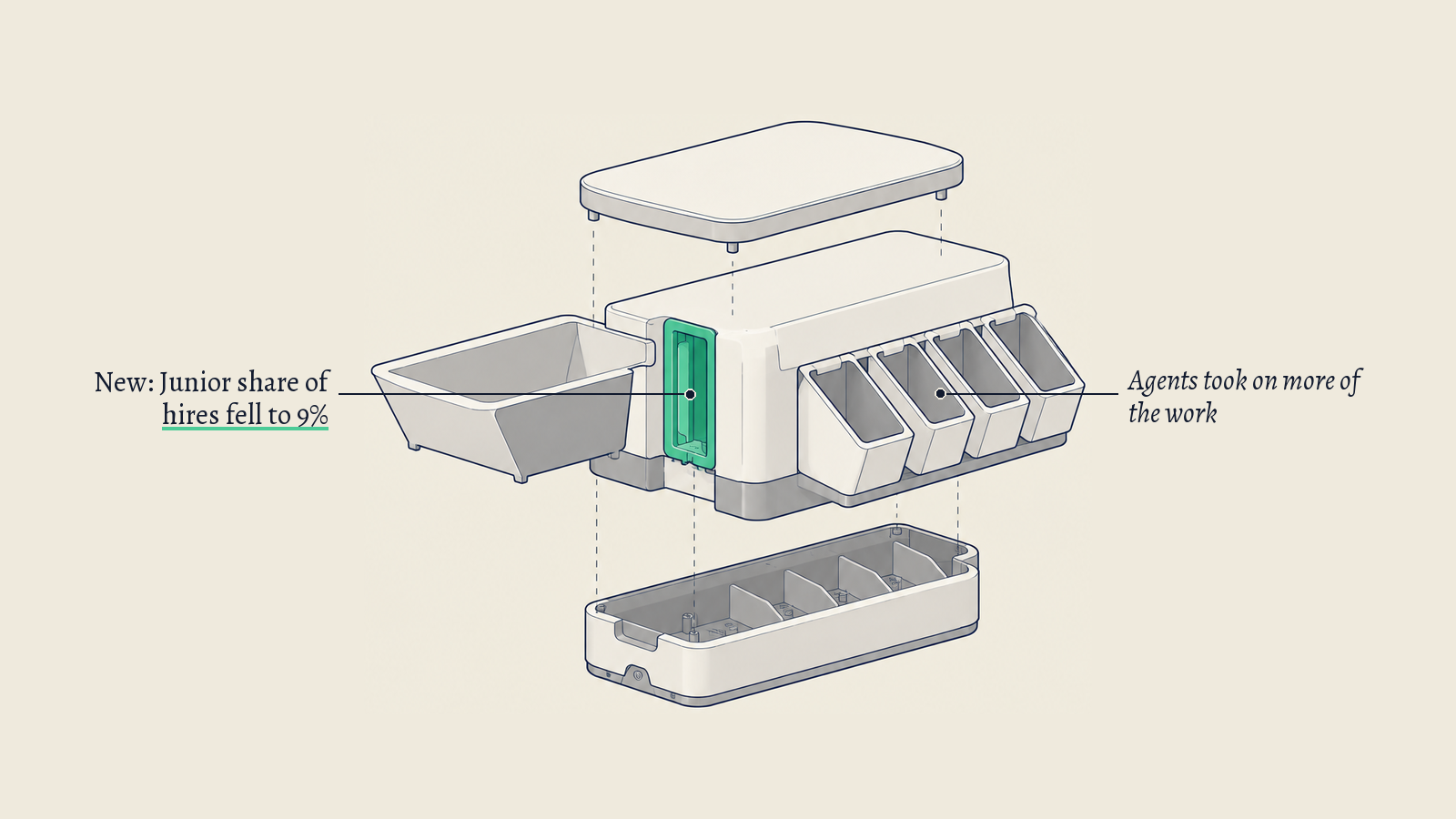 Illustration made with AI for ai notis
Key points
- The Anthropic Institute report, published 16 October 2026, says the junior share of Anthropic's technical employees fell from 21% to 14% since early 2025.
- The report says the junior share of technical hires fell from 27% to 9%, and that by August interactive agent hours were about six times employee hours.
- The authors compared 192 engineers who adopted coding agents with 74 who did not, and say adoption was not random, so their estimates may be biased.
What happened
The report, "How employment is changing at Anthropic", is by Nathan Wilmers, Regina Catipon, Maxim Massenkoff and Peter McCrory. It says the junior share of Anthropic's technical employees fell from 21% to 14% since early 2025, and the junior share of technical hires fell from 27% to 9%. Agent work passed human work hours in March 2026, and by August interactive agent hours were about six times employee hours.
The authors report that code commits per engineer rose to about five times their level six months earlier. They compared 192 engineers who adopted coding agents with 74 who did not, and note that adoption was not random, so the estimates may be biased.
Roughly 80% of interactive Claude session time is idle waiting for human input, and the share of sessions spent on work that builds tools and monitors agents rose from 10% to 22%.
The data are Anthropic's own: internal data covering employment, AI use, output metrics, employee surveys, internal communication patterns, employee calendar data and hiring decision records, plus 17 employee interviews. The figures describe one company, not the labour market.
Underlined sentences link to the facts we checked. Dotted words open a short explainer.
Fact 2 of 10 · from Anthropic, 16 Oct 2026
Nathan Wilmers, Regina Catipon, Maxim Massenkoff, Peter McCrory
Fact 3 of 10 · from Anthropic, 16 Oct 2026
the share of junior-level employees in technical departments at Anthropic slipped from 21% to 14% since early 2025.
Fact 5 of 10 · from Anthropic, 16 Oct 2026
in March 2026, the sum of autonomous and interactive agent work hours leapt past human work hours for the first time. ... By August interactive AI agent hours outnumbered employees' six to one.
Fact 6 of 10 · from Anthropic, 16 Oct 2026
code commits per engineer have risen the fastest, coming in at 5x their velocity as six months ago.
Fact 7 of 10 · from Anthropic, 16 Oct 2026
Note, however, that tool adoption is not random: if employees on the cusp of driving some big new project decide to tool up for it, for example, this would bias our estimates. We follow 192 engineers over time as they adopt coding agents, compared to 74 engineers who do not adopt agents during the period studied.
What it means for you
Our viewThis is one company's account of itself, written from its own internal records, so it describes Anthropic and not the labour market. The authors themselves warn that adoption of coding agents was not random, which limits what the comparison can show.
Still, it gives a concrete picture of what an agent-heavy team looks like, including a rise in sessions spent on building tools and monitoring agents from 10% to 22%.
If you manage engineers, check how your own junior hiring and review workload have changed over the past year before you set targets based on these ratios, and ask who reviews agent output on your team.
It adds no new facts.
Your reaction
We count reactions per story and day, never who reacted. The counts help us choose what goes in the monthly issue. If you are signed in, your own page shows yours too.
We count reactions per story and day, never who reacted. They help choose what goes in the monthly issue.
Check our sources
Every sentence above is checked against this source.
1 How employment is changing at Anthropic
Open the source archived copy-
The report "How employment is changing at Anthropic" was published on 16 October 2026 as a technical report from The Anthropic Institute.
citeHow employment is changing at Anthropic ... Oct 16, 2026 ... @techreport{wilmers2026employment, ... institution = {The Anthropic Institute}, type = {Technical Report}
-
The authors are Nathan Wilmers, Regina Catipon, Maxim Massenkoff and Peter McCrory.
citeNathan Wilmers, Regina Catipon, Maxim Massenkoff, Peter McCrory
-
The report says the junior share of Anthropic's technical employees fell from 21% to 14% since early 2025.
citethe share of junior-level employees in technical departments at Anthropic slipped from 21% to 14% since early 2025.
-
The report says the junior share of technical hires fell from 27% to 9%.
citeThe proportion of junior technical hires fell even faster, from 27% to 9%.
-
The report says agent work passed human work hours in March 2026 and that by August interactive agent hours were about six times employee hours.
citein March 2026, the sum of autonomous and interactive agent work hours leapt past human work hours for the first time. ... By August interactive AI agent hours outnumbered employees' six to one.
-
The report says code commits per engineer rose to about five times their level six months earlier.
citecode commits per engineer have risen the fastest, coming in at 5x their velocity as six months ago.
-
The report compares 192 engineers who adopted coding agents with 74 who did not, and says tool adoption was not random, so the estimates may be biased.
citeNote, however, that tool adoption is not random: if employees on the cusp of driving some big new project decide to tool up for it, for example, this would bias our estimates. We follow 192 engineers over time as they adopt coding agents, compared to 74 engineers who do not adopt agents during the period studied.
-
The report says roughly 80% of interactive Claude session time is idle, waiting for human input.
citeClaude sessions amount to around 80% idly waiting for human input.
-
The report says the share of interactive sessions devoted to meta-work, building tools and monitoring agents, rose from 10% in fall 2025 to 22% in spring 2026.
citethis kind of meta-work leapt from 10% of the average employee's interactive Claude sessions in fall 2025 to 22% in spring 2026.
-
The report draws on internal Anthropic data covering employment, AI use, output metrics, employee surveys, internal communication patterns, employee calendar data and hiring decision records, and on 17 employee interviews.
Toned down to what the source says
citeThis report draws on comprehensive internal Anthropic data covering employment, AI use, output metrics, employee surveys, internal communication patterns, employee calendar data, and hiring decision records. It contextualizes these quantitative data with 17 employee interviews.
Every sentence above is checked against this source. Each fact has its own address you can cite.
Source 1 · Anthropic · 16 Oct 2026
How employment is changing at Anthropic
The report "How employment is changing at Anthropic" was published on 16 October 2026 as a technical report from The Anthropic Institute.
How employment is changing at Anthropic ... Oct 16, 2026 ... @techreport{wilmers2026employment, ... institution = {The Anthropic Institute}, type = {Technical Report}
The authors are Nathan Wilmers, Regina Catipon, Maxim Massenkoff and Peter McCrory.
Nathan Wilmers, Regina Catipon, Maxim Massenkoff, Peter McCrory
The report says the junior share of Anthropic's technical employees fell from 21% to 14% since early 2025.
the share of junior-level employees in technical departments at Anthropic slipped from 21% to 14% since early 2025.
Show all 10 factsShow fewer facts
The report says the junior share of technical hires fell from 27% to 9%.
The proportion of junior technical hires fell even faster, from 27% to 9%.
The report says agent work passed human work hours in March 2026 and that by August interactive agent hours were about six times employee hours.
in March 2026, the sum of autonomous and interactive agent work hours leapt past human work hours for the first time. ... By August interactive AI agent hours outnumbered employees' six to one.
The report says code commits per engineer rose to about five times their level six months earlier.
code commits per engineer have risen the fastest, coming in at 5x their velocity as six months ago.
The report compares 192 engineers who adopted coding agents with 74 who did not, and says tool adoption was not random, so the estimates may be biased.
Note, however, that tool adoption is not random: if employees on the cusp of driving some big new project decide to tool up for it, for example, this would bias our estimates. We follow 192 engineers over time as they adopt coding agents, compared to 74 engineers who do not adopt agents during the period studied.
The report says roughly 80% of interactive Claude session time is idle, waiting for human input.
Claude sessions amount to around 80% idly waiting for human input.
The report says the share of interactive sessions devoted to meta-work, building tools and monitoring agents, rose from 10% in fall 2025 to 22% in spring 2026.
this kind of meta-work leapt from 10% of the average employee's interactive Claude sessions in fall 2025 to 22% in spring 2026.
The report draws on internal Anthropic data covering employment, AI use, output metrics, employee surveys, internal communication patterns, employee calendar data and hiring decision records, and on 17 employee interviews.
Toned down to what the source saysThis report draws on comprehensive internal Anthropic data covering employment, AI use, output metrics, employee surveys, internal communication patterns, employee calendar data, and hiring decision records. It contextualizes these quantitative data with 17 employee interviews.
Topics
The morning email
On the mornings we publish: the three top stories and up to four short ones. Free.
We email you a link to confirm. An issue may include one sponsor, always labelled Sponsored · Advertisement. Our emails count opens and clicks, not who made them. Unsubscribe in one click. What we keep