LawsPublished Top storyAll news from that day
Ongoing case: US chip export rules and China Rules and courts · 5 storiesAPK / Herbert C. Hoover Building Washington, D.C. / CC BY-SA 4.0, croppedData centres will need licences to rent large AI compute to China-headquartered companies
Not yet in force, the US Commerce Department rule covers access above 12,000,000 TPP of compute for companies headquartered in China, Macau or other D:5 countries, plus chip exports to five countries.
Check our sources · 22 facts from 6 sources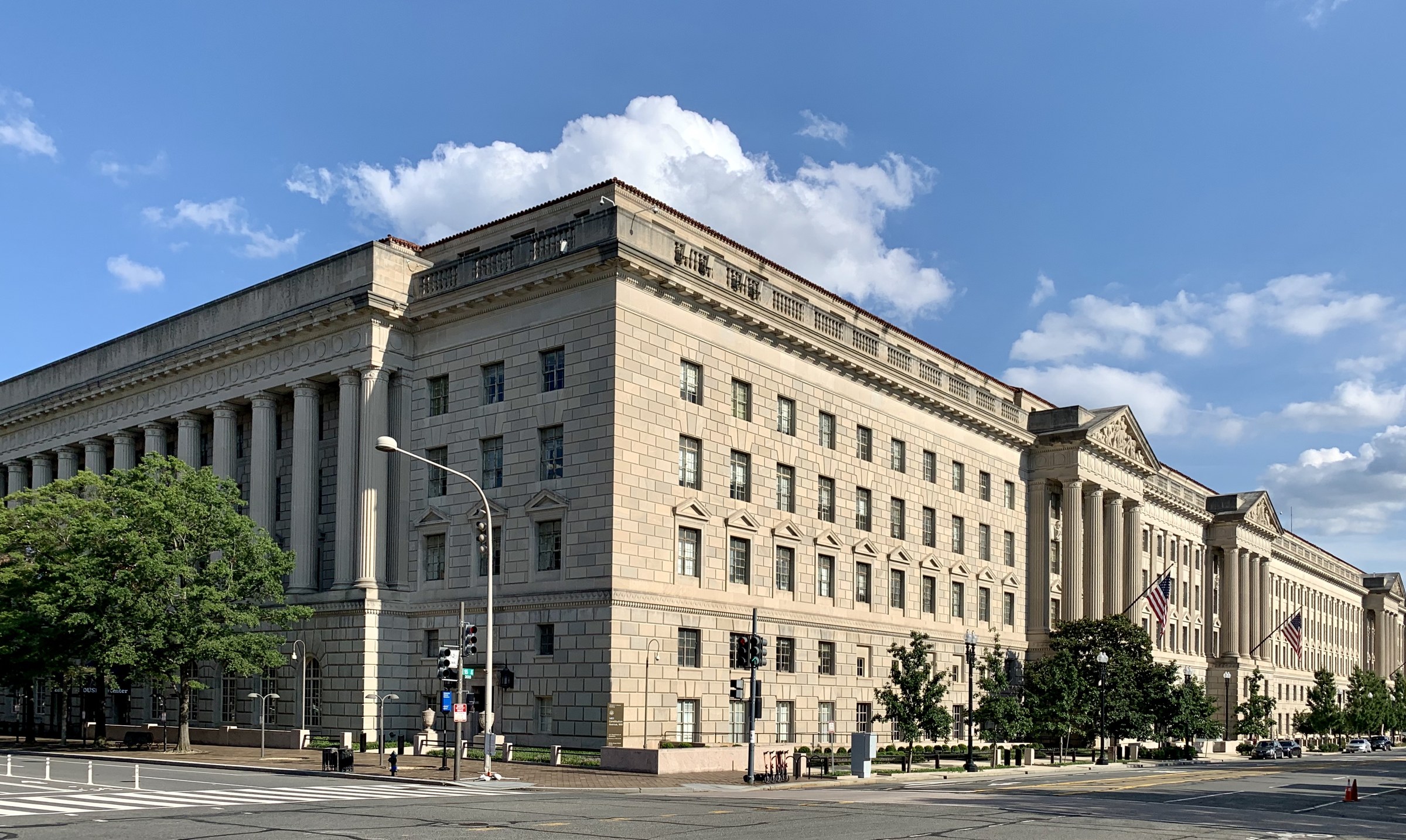 APK / Herbert C. Hoover Building Washington, D.C. / CC BY-SA 4.0, cropped

Key points
- A licence will be needed for a data centre giving companies headquartered in Macau or a Country Group D:5 country access above 12,000,000 aggregate TPP, counted across linked sites.
- A data centre already serving such companies must get a licence within 90 days of the effective date; compute used only for commercial recommender systems is exempt.
- Licences will also be needed to export advanced chips to Indonesia, Malaysia, Singapore, Thailand and Brazil; the rule takes effect on Federal Register publication, a date not yet set.
What happened
Once it takes effect, a US licence will be required to supply advanced AI chips to a data centre anywhere in the world when the supplier knows it will give more than 12,000,000 aggregate TPP of computing power to companies headquartered in Macau or in a Country Group D:5 destination.
That is the central new control in an interim final rule from the Bureau of Industry and Security, published on its website on 16 November 2026 under RIN 0694-AK50.
BIS says the rule was written by and at the direction of the Department of the Treasury and the National Security Council, and is meant to ensure that existing restrictions on sensitive American technology cannot be circumvented through remote computing arrangements, including data centres in third countries.
CNBC reported that it is the first US policy response to the scandal at Nvidia that led its chief executive, Jensen Huang, to resign, and that it follows criticism of Commerce Secretary Howard Lutnick for not doing enough to prevent chip diversion to China.
Semafor reported that the rule aims to close a remote access loophole through which Chinese AI firms used US-made chips in third-country data centres, a practice it says was most intensely applied in Indonesia, Malaysia, Singapore and Thailand.
The 12,000,000 aggregate TPP will be counted either at one data centre or across linked data centres, which the rule defines to include digitally linked sites and not only physically linked ones. Licence applications will be reviewed case by case. The rule's reach extends to a customer that is not itself headquartered in D:5 but is training models for, or supplying models to, a D:5 company.
A data centre that was already supplying significant volumes of compute to such companies before the rule is published, and wants to keep doing so, will have to obtain a licence within 90 days of the effective date.
The licence requirement will not apply when the compute is used only for commercial recommender systems, which the rule defines narrowly and which exclude any system that generates text, images, audio, video or software.
Separately, a licence will be required to export advanced semiconductors to Indonesia, Malaysia, Singapore, Thailand and Brazil, which the rule calls destinations with a higher risk of diversion.
That requirement will not apply to a buyer headquartered in the United States, or whose ultimate parent is, provided reporting requirements are met. Commerce says it will watch for countries that tolerate evasion and may respond with import restrictions, new licence requirements or Entity List designations.
The rule text says "SI", for Super Intelligence, in place of "AI", citing Executive Order 14434 in its footnote 1; the items it covers are what this article calls AI chips.
The rule takes effect on the date it is published in the Federal Register, and comments are due 60 days after that. The rule text has these dates as blanks, so no date is fixed yet and the rule is not in force. BIS's press release gives no thresholds, country list or deadline; they are in the rule text. The same rule formally rescinds the AI Diffusion Rule's regulations, which BIS says were never enforced.
Underlined sentences link to the facts we checked. Dotted words open a short explainer.
Fact 2 of 22 · from https://www.bis.gov/media/documents/rin-0694-ak50.pdf, 16 Nov 2026
(either at one data center or through ... linked data centers' (including digitally-linked infrastructure, not just physically-linked infrastructure)
Fact 12 of 22 · from https://www.bis.gov/media/documents/rin-0694-ak50.pdf, 16 Nov 2026
Finally, the IFR formally rescinds the regulations implementing the Biden-era AI Diffusion Rule. The AI Diffusion Rule has never been enforced.
Fact 21 of 22 · from Semafor, 16 Nov 2026
Semafor reported that the rule aims to close a remote access loophole through which Chinese AI firms used US-made chips in third-country data centres, a practice Semafor says was most intensely applied in Indonesia, Malaysia, Singapore and Thailand.
What it means for you
Our viewIf you run or rent AI compute through a data centre outside the US, find out now whether any customer, or any customer's customer, is headquartered in Macau or a D:5 country.
The rule will reach a customer that trains models for, or supplies models to, such a company, and linked sites count together, so the threshold may be met across several facilities. Nothing is in force: the effective date depends on Federal Register publication, and comments will be due 60 days after it.
Watch for that notice, because it will fix the date and start the clock for existing arrangements.
It adds no new facts.
Your reaction
We count reactions per story and day, never who reacted. The counts help us choose what goes in the monthly issue. If you are signed in, your own page shows yours too.
We count reactions per story and day, never who reacted. They help choose what goes in the monthly issue.
Check our sources
Every sentence above is checked against these 6 sources.
1 https://www.bis.gov/media/documents/rin-0694-ak50.pdf
Open the source archived copy-
BIS's interim final rule, RIN 0694-AK50, adds a licence requirement for exports, reexports or transfers of advanced SI items when there is knowledge that they are destined for a data centre, wherever located, that will provide access to more than 12,000,000 aggregate TPP to companies headquartered in, or whose ultimate parent is headquartered in, Macau or a Country Group D:5 destination (new section 744.24(a)(1)).
citeYou may not knowingly export, reexport, or transfer (in-county) items specified in paragraph (a) ... for use in a data center to or within any destination worldwide that will provide access to more than 12,000,000 "aggregate TPP" ... to companies headquartered in, or whose ultimate parent company is headquartered in, Macau or a destination specified in Country Group D:5 ... These changes are contained in new
-
The 12,000,000 aggregate TPP is counted either at one data centre or through linked data centres, which the rule says includes digitally linked infrastructure, not just physically linked infrastructure.
cite(either at one data center or through ... linked data centers' (including digitally-linked infrastructure, not just physically-linked infrastructure)
-
License applications under the new data-centre control are reviewed case by case.
citeLicense applications will be reviewed on a case-by-case basis.
-
The rule says the control applies where there is knowledge that a non-D:5 customer of a data centre is in turn training SI models for, participating in the training of SI models for, or providing SI models to a D:5 company.
citeapplies to instances in which there is "knowledge" that a data center is providing remote access to a non-D:5 customer that is in turn training SI models for, or participating in the training of SI models for, or providing SI models to a D:5 company.
-
A data centre that was providing significant volumes of compute to companies headquartered in Macau or Country Group D:5 before the rule's publication date and wants to continue must obtain a license within 90 days of the effective date, or face future export restrictions.
citeAny data center providing significant volume of compute power to companies headquartered, or with an ultimate parent headquartered, in Macau or Country Group D:5 prior to the publication date of this rule that wishes to continue providing these services must obtain a license with 90 days of the effective date of this IFR or face future export restrictions.
-
The rule defines a commercial recommender system as an SI tool exclusively designed and exclusively used to rank, filter or suggest commercial products, services or content, and says the term does not include any SI system designed or used to generate novel text, image, audio, video, software or other content.
citecommercial recommender system' means a Super Intelligence (SI) tool exclusively designed and exclusively used to rank, filter, or suggest commercial products, services, or content to users based on user behavior, transaction history, or item attributes. This term does not include any SI system designed or used to generate novel text, image, audio, video, software, or other content in response to user inputs
-
The license requirement does not apply to compute used exclusively for commercial recommender systems, provided the reporting requirements are followed.
citedo not apply when the computing power access is being provided exclusively for a ... commercial recommender system' under the (b)(2) exception provided the reporting requirements described therein are followed.
-
The rule adds a licence requirement for exports, reexports or transfers of advanced semiconductors to or within Indonesia, Malaysia, Singapore, Brazil and Thailand, which the rule describes as countries presenting a higher-than-normal risk of diversion.
citea license will be required to export, reexport, or transfer (in-country) advanced semiconductors to Indonesia, Malaysia, Singapore, Thailand, or Brazil (and any additional country designated by the Secretary of Commerce, in consultation with the Secretary of State or the Assistant to the President for National Security Affairs)
-
That five-country licence requirement does not apply to an ultimate consignee or end user headquartered in, or whose ultimate parent is headquartered in, the United States, provided the reporting requirements of new section 743.10 are met.
citedo not apply to exports, reexports, and transfers (in-country) to an ultimate consignee or end user headquartered in, or whose ultimate parent company is headquartered in, the United States, provided the reporting requirements of new ... 743.10, described in section VI of this preamble, are met
-
The rule says Commerce will monitor for countries that tolerate evasion and will consider consequences including import restrictions, new license requirements, downgrading the country's status in the export control regime, and Entity List designations.
citeCommerce will be actively monitoring for countries that tolerate evasion of this IFR and will consider a range of consequences for such countries, such as import restrictions, new license requirements on advanced semiconductor exports, downgrading the country's status in the U.S. export control regime, and Entity List designations
-
The rule states it is effective on the date of publication in the Federal Register, and comments must be received no later than 60 days after that date; the text opened has both dates as placeholders.
citeDATES: This rule is effective [INSERT DATE OF PUBLICATION IN THE FEDERAL REGISTER]. Comment due date: Comments on the revisions and additions in this rule must be received by BIS no later than [INSERT DATE 60 DAYS AFTER DATE OF PUBLICATION IN THE FEDERAL REGISTER].
-
The rule formally rescinds the regulations implementing the AI Diffusion Rule, which the rule says was never enforced.
citeFinally, the IFR formally rescinds the regulations implementing the Biden-era AI Diffusion Rule. The AI Diffusion Rule has never been enforced.
-
The rule's footnote 1 says that, pursuant to Executive Order 14434, Inaugurating the Era of Super Intelligence, the terms "Super Intelligence" and "SI" are used in place of "Artificial Intelligence" or "AI".
citePursuant to Executive Order 14434, Inaugurating the Era of Super Intelligence, the terms "Super Intelligence" and "SI" is used in place of "Artificial Intelligence" or "AI".
2 https://www.bis.gov/press-release/bis-issues-rule-addressing-remote-access-american-super-intelligence-technology
Open the source archived copy-
BIS published a press release on 16 November 2026 announcing the interim final rule on remote access to advanced semiconductors, and links the rule text (RIN 0694-AK50).
citeNovember 16, 2026 ... BIS Issues Rule Addressing Remote Access to American Super Intelligence Technology ... Today, the U.S. Commerce Department’s Bureau of Industry and Security (BIS) released an interim final rule (IFR) ... The IFR is on display HERE.
-
The press release for the rule does not state thresholds, a country list or a deadline.
citeThe rule is designed to ensure that existing restrictions on access to sensitive American technology cannot be circumvented through remote computing arrangements involving data centers in third countries. ... This IFR addresses this evolving technological landscape by further aligning protections governing remote access to advanced computing capabilities with existing controls on the physical shipment of sensitive American technology. The IFR is on display HERE.
-
BIS's press release of 16 November 2026 says the rule was written by and at the direction of the Department of the Treasury and the National Security Council, and that it aims to ensure existing restrictions on sensitive American technology cannot be circumvented through remote computing arrangements, including data centres in third countries.
citereleased an interim final rule (IFR)—written by and at the direction of the Department of Treasury and the National Security Council—to address remote access to advanced super intelligence (SI) chips and servers. The rule is designed to ensure that existing restrictions on access to sensitive American technology cannot be circumvented through remote computing arrangements involving data centers in third countries.
3 Guidance Regarding Enforcement of License Requirements for Advanced Computing Items for Entities Headquartered in Country Group D:5 and Macau, 31 May 2026
Open the source archived copy-
BIS's guidance of 31 May 2026 says a licence is required to export advanced computing items to entities headquartered in Country Group D:5 or Macau, or whose ultimate parent is, even when the entities are located outside those places; it says this requirement was first introduced on 17 November 2023.
citea license is required to export advanced computing items to entities headquartered in Country Group D:5 ... or Macau or with an ultimate parent company headquartered in Country Group D:5 or Macau ... even if the entities themselves are located outside Country Group D:5 or Macau. This license requirement was first introduced on November 17, 2023.
-
BIS's 31 May 2026 guidance says its May 2025 non-enforcement policy for the AI Diffusion Rule applies to these advanced computing items only to the extent they are not for entities headquartered in, or with an ultimate parent headquartered in, Country Group D:5 or Macau.
citenon-enforcement policy with respect to the destination-based license requirements for these advanced computing items under ... 742.6(a)(6)(iii)(A) applies only to the extent such items are not for entities headquartered in or that have ultimate parent companies headquartered in Country Group D:5 or Macau.
-
BIS's 31 May 2026 guidance says bona fide operators of data centres otherwise engaged in activities consistent with the EAR are not required to cease ongoing use, storage, disposal or servicing of such items because of the guidance, until further notice from BIS.
citeBona fide operators of data centers who are otherwise engaged in activities consistent with the EAR are not required to cease the ongoing use, storage, disposal, or servicing of advanced computing items because of this guidance, until further notice from BIS.
4 Nvidia fallout: Commerce targets loophole for China's data center use
Open the source archived copy-
CNBC reported that the rule is the first US policy response to the scandal at Nvidia that led its chief executive, Jensen Huang, to resign, and that it follows criticism that Commerce Secretary Howard Lutnick had not done enough to prevent chip diversion to China; CNBC's page quotes BIS as saying the rule was written by and at the direction of the Treasury Department and the National Security Council. reported by CNBC
cite
5 US moves to close remote access chip loophole
Open the source archived copy-
Semafor reported that the rule aims to close a remote access loophole through which Chinese AI firms used US-made chips in third-country data centres, a practice Semafor says was most intensely applied in Indonesia, Malaysia, Singapore and Thailand. reported by Semafor
cite
6 15 CFR Part 740, Supplement No. 1: Country Groups
Open the source archived copy-
In the Country Groups table in Supplement No. 1 to 15 CFR part 740, column D:5 is headed "U.S. Arms Embargoed Countries", and the row for China (PRC) is marked X in it, so Country Group D:5 includes China.
citeChina (PRC)
Every sentence above is checked against these 6 sources. Each fact has its own address you can cite.
Source 1 · 16 Nov 2026
https://www.bis.gov/media/documents/rin-0694-ak50.pdf
BIS's interim final rule, RIN 0694-AK50, adds a licence requirement for exports, reexports or transfers of advanced SI items when there is knowledge that they are destined for a data centre, wherever located, that will provide access to more than 12,000,000 aggregate TPP to companies headquartered in, or whose ultimate parent is headquartered in, Macau or a Country Group D:5 destination (new section 744.24(a)(1)).
You may not knowingly export, reexport, or transfer (in-county) items specified in paragraph (a) ... for use in a data center to or within any destination worldwide that will provide access to more than 12,000,000 "aggregate TPP" ... to companies headquartered in, or whose ultimate parent company is headquartered in, Macau or a destination specified in Country Group D:5 ... These changes are contained in new
The 12,000,000 aggregate TPP is counted either at one data centre or through linked data centres, which the rule says includes digitally linked infrastructure, not just physically linked infrastructure.
(either at one data center or through ... linked data centers' (including digitally-linked infrastructure, not just physically-linked infrastructure)
License applications under the new data-centre control are reviewed case by case.
License applications will be reviewed on a case-by-case basis.
Show all 13 factsShow fewer facts
The rule says the control applies where there is knowledge that a non-D:5 customer of a data centre is in turn training SI models for, participating in the training of SI models for, or providing SI models to a D:5 company.
applies to instances in which there is "knowledge" that a data center is providing remote access to a non-D:5 customer that is in turn training SI models for, or participating in the training of SI models for, or providing SI models to a D:5 company.
A data centre that was providing significant volumes of compute to companies headquartered in Macau or Country Group D:5 before the rule's publication date and wants to continue must obtain a license within 90 days of the effective date, or face future export restrictions.
Any data center providing significant volume of compute power to companies headquartered, or with an ultimate parent headquartered, in Macau or Country Group D:5 prior to the publication date of this rule that wishes to continue providing these services must obtain a license with 90 days of the effective date of this IFR or face future export restrictions.
The rule defines a commercial recommender system as an SI tool exclusively designed and exclusively used to rank, filter or suggest commercial products, services or content, and says the term does not include any SI system designed or used to generate novel text, image, audio, video, software or other content.
commercial recommender system' means a Super Intelligence (SI) tool exclusively designed and exclusively used to rank, filter, or suggest commercial products, services, or content to users based on user behavior, transaction history, or item attributes. This term does not include any SI system designed or used to generate novel text, image, audio, video, software, or other content in response to user inputs
The license requirement does not apply to compute used exclusively for commercial recommender systems, provided the reporting requirements are followed.
do not apply when the computing power access is being provided exclusively for a ... commercial recommender system' under the (b)(2) exception provided the reporting requirements described therein are followed.
The rule adds a licence requirement for exports, reexports or transfers of advanced semiconductors to or within Indonesia, Malaysia, Singapore, Brazil and Thailand, which the rule describes as countries presenting a higher-than-normal risk of diversion.
a license will be required to export, reexport, or transfer (in-country) advanced semiconductors to Indonesia, Malaysia, Singapore, Thailand, or Brazil (and any additional country designated by the Secretary of Commerce, in consultation with the Secretary of State or the Assistant to the President for National Security Affairs)
That five-country licence requirement does not apply to an ultimate consignee or end user headquartered in, or whose ultimate parent is headquartered in, the United States, provided the reporting requirements of new section 743.10 are met.
do not apply to exports, reexports, and transfers (in-country) to an ultimate consignee or end user headquartered in, or whose ultimate parent company is headquartered in, the United States, provided the reporting requirements of new ... 743.10, described in section VI of this preamble, are met
The rule says Commerce will monitor for countries that tolerate evasion and will consider consequences including import restrictions, new license requirements, downgrading the country's status in the export control regime, and Entity List designations.
Commerce will be actively monitoring for countries that tolerate evasion of this IFR and will consider a range of consequences for such countries, such as import restrictions, new license requirements on advanced semiconductor exports, downgrading the country's status in the U.S. export control regime, and Entity List designations
The rule states it is effective on the date of publication in the Federal Register, and comments must be received no later than 60 days after that date; the text opened has both dates as placeholders.
DATES: This rule is effective [INSERT DATE OF PUBLICATION IN THE FEDERAL REGISTER]. Comment due date: Comments on the revisions and additions in this rule must be received by BIS no later than [INSERT DATE 60 DAYS AFTER DATE OF PUBLICATION IN THE FEDERAL REGISTER].
The rule formally rescinds the regulations implementing the AI Diffusion Rule, which the rule says was never enforced.
Finally, the IFR formally rescinds the regulations implementing the Biden-era AI Diffusion Rule. The AI Diffusion Rule has never been enforced.
The rule's footnote 1 says that, pursuant to Executive Order 14434, Inaugurating the Era of Super Intelligence, the terms "Super Intelligence" and "SI" are used in place of "Artificial Intelligence" or "AI".
Pursuant to Executive Order 14434, Inaugurating the Era of Super Intelligence, the terms "Super Intelligence" and "SI" is used in place of "Artificial Intelligence" or "AI".
Source 2 · 16 Nov 2026
https://www.bis.gov/press-release/bis-issues-rule-addressing-remote-access-american-super-intelligence-technology
BIS published a press release on 16 November 2026 announcing the interim final rule on remote access to advanced semiconductors, and links the rule text (RIN 0694-AK50).
November 16, 2026 ... BIS Issues Rule Addressing Remote Access to American Super Intelligence Technology ... Today, the U.S. Commerce Department’s Bureau of Industry and Security (BIS) released an interim final rule (IFR) ... The IFR is on display HERE.
The press release for the rule does not state thresholds, a country list or a deadline.
The rule is designed to ensure that existing restrictions on access to sensitive American technology cannot be circumvented through remote computing arrangements involving data centers in third countries. ... This IFR addresses this evolving technological landscape by further aligning protections governing remote access to advanced computing capabilities with existing controls on the physical shipment of sensitive American technology. The IFR is on display HERE.
BIS's press release of 16 November 2026 says the rule was written by and at the direction of the Department of the Treasury and the National Security Council, and that it aims to ensure existing restrictions on sensitive American technology cannot be circumvented through remote computing arrangements, including data centres in third countries.
released an interim final rule (IFR)—written by and at the direction of the Department of Treasury and the National Security Council—to address remote access to advanced super intelligence (SI) chips and servers. The rule is designed to ensure that existing restrictions on access to sensitive American technology cannot be circumvented through remote computing arrangements involving data centers in third countries.
Source 3 · Bureau of Industry and Security, US Department of Commerce · 31 May 2026
Guidance Regarding Enforcement of License Requirements for Advanced Computing Items for Entities Headquartered in Country Group D:5 and Macau, 31 May 2026
BIS's guidance of 31 May 2026 says a licence is required to export advanced computing items to entities headquartered in Country Group D:5 or Macau, or whose ultimate parent is, even when the entities are located outside those places; it says this requirement was first introduced on 17 November 2023.
a license is required to export advanced computing items to entities headquartered in Country Group D:5 ... or Macau or with an ultimate parent company headquartered in Country Group D:5 or Macau ... even if the entities themselves are located outside Country Group D:5 or Macau. This license requirement was first introduced on November 17, 2023.
BIS's 31 May 2026 guidance says its May 2025 non-enforcement policy for the AI Diffusion Rule applies to these advanced computing items only to the extent they are not for entities headquartered in, or with an ultimate parent headquartered in, Country Group D:5 or Macau.
non-enforcement policy with respect to the destination-based license requirements for these advanced computing items under ... 742.6(a)(6)(iii)(A) applies only to the extent such items are not for entities headquartered in or that have ultimate parent companies headquartered in Country Group D:5 or Macau.
BIS's 31 May 2026 guidance says bona fide operators of data centres otherwise engaged in activities consistent with the EAR are not required to cease ongoing use, storage, disposal or servicing of such items because of the guidance, until further notice from BIS.
Bona fide operators of data centers who are otherwise engaged in activities consistent with the EAR are not required to cease the ongoing use, storage, disposal, or servicing of advanced computing items because of this guidance, until further notice from BIS.
Source 4 · CNBC · 16 Nov 2026 · second-hand source
Nvidia fallout: Commerce targets loophole for China's data center use
CNBC reported that the rule is the first US policy response to the scandal at Nvidia that led its chief executive, Jensen Huang, to resign, and that it follows criticism that Commerce Secretary Howard Lutnick had not done enough to prevent chip diversion to China; CNBC's page quotes BIS as saying the rule was written by and at the direction of the Treasury Department and the National Security Council. reported by CNBC
Source 5 · Semafor · 16 Nov 2026 · second-hand source
US moves to close remote access chip loophole
Semafor reported that the rule aims to close a remote access loophole through which Chinese AI firms used US-made chips in third-country data centres, a practice Semafor says was most intensely applied in Indonesia, Malaysia, Singapore and Thailand. reported by Semafor
Source 6 · eCFR (Office of the Federal Register)
15 CFR Part 740, Supplement No. 1: Country Groups
In the Country Groups table in Supplement No. 1 to 15 CFR part 740, column D:5 is headed "U.S. Arms Embargoed Countries", and the row for China (PRC) is marked X in it, so Country Group D:5 includes China.
China (PRC)
Topics
The morning email
On the mornings we publish: the three top stories and up to four short ones. Free.
We email you a link to confirm. An issue may include one sponsor, always labelled Sponsored · Advertisement. Our emails count opens and clicks, not who made them. Unsubscribe in one click. What we keep