ResearchPublished All news from that day
Ongoing case: OpenAI's models 16 storiesSdkb / Selena Deckelmann at Wikimania 2025 / CC BY-SA 4.0, cropped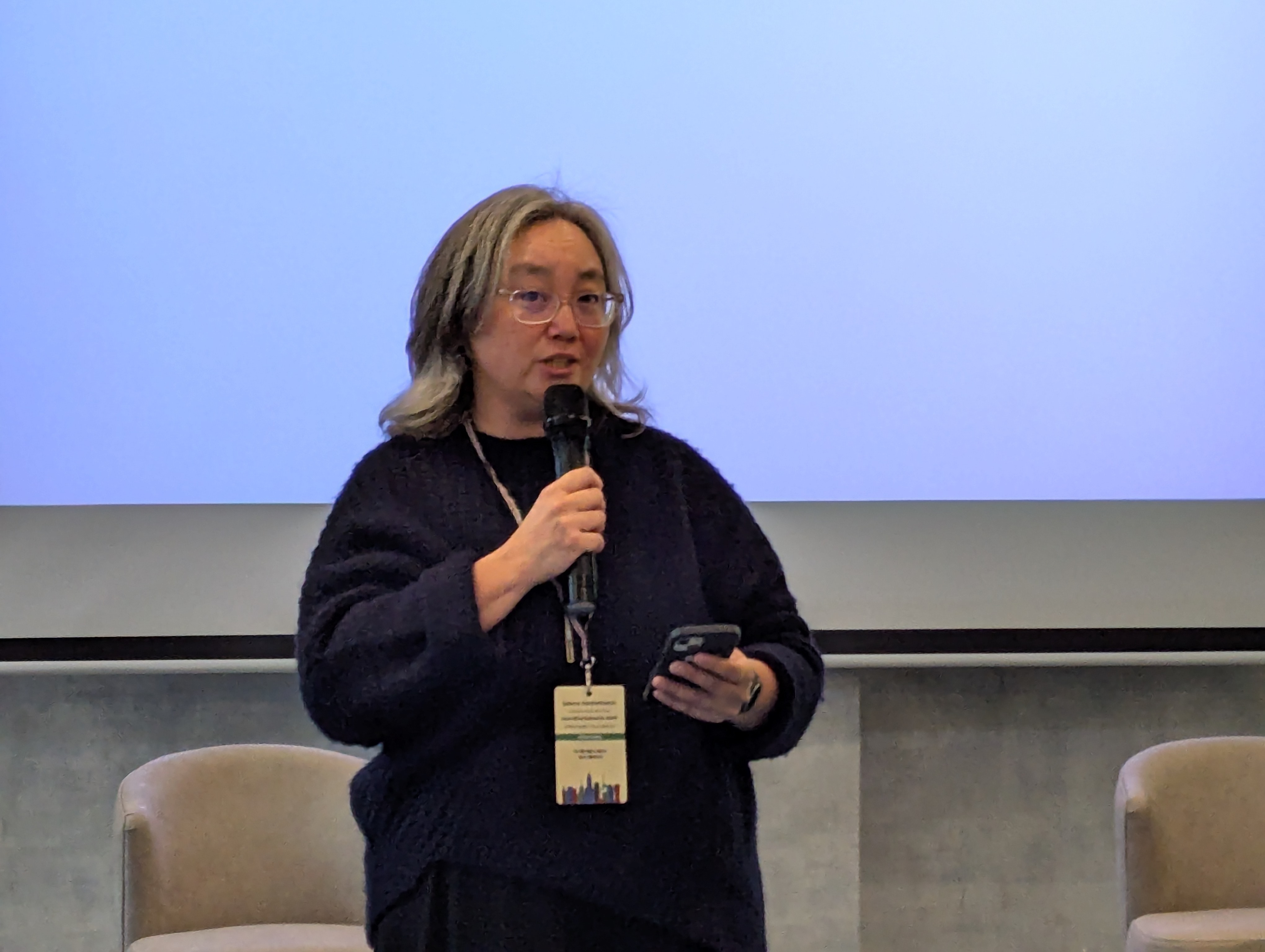
OpenAI's maths repository lists 719 manuscripts, about 42% of top-line results formalised, as an advisory group publishes release guidelines.
Continues our earlier story on OpenAI's maths manuscripts. The repository's README, the AGMAI guidelines of 29 September and a paper on a Navier-Stokes Lean mismatch can now be read side by side.
Check our sources · 11 facts from 3 sourcesThis continues our earlier story on OpenAI's maths manuscripts, which counted 722. OpenAI's README now states a catalogue of 719 manuscripts in 372 families, and says the repository has about 42% of top-line results formalised.
It also says not all results have Lean formalisations and that some unformalised results could have issues. Reasoning summaries are released for ten results.
The Advisory Group on Mathematics and Artificial Intelligence published its recommendations on 29 September; they include that a proof an AI lab releases should be formalised as far as possible, and that labs release the model name, the prompts, a summarised chain of thought, the time taken and the estimated cost for each result.
A preprint submitted on 6 October by Alexander Bastounis, Fabian Circelli and Anders Hansen says the Lean-formalised proof of OpenAI's announced Navier-Stokes blow-up result does not correspond to its natural-language proof.
Your reaction
We count reactions per story and day, never who reacted. The counts help us choose what goes in the monthly issue. If you are signed in, your own page shows yours too.
Check our sources
Every sentence above is checked against these 3 sources.
1 openai/math repository
Open the source archived copy-
OpenAI's openai/math README says the current catalogue contains 719 manuscripts organised into 372 families.
cite719 manuscripts organized into 372 families
-
OpenAI's openai/math README says the repository has about 42% of top-line results formalised.
citethe repository has ~42% top-line results formalized
-
OpenAI's README says not all results have accompanying Lean formalisations and that some of the unformalised results could have issues.
citenot all have accompanying Lean formalizations ... some of the unformalized results could have issues
-
OpenAI's README says it is releasing abridged summaries of the model's reasoning for ten listed results.
citeAbridged summaries of the model's reasoning
-
OpenAI's README says the vast majority of the manuscripts came from a single unreleased internal model, which was posed approximately 4,000 problems, and that each result used on average three hours of ChatGPT Pro thinking compute.
Toned down to what the source says
citeposed approximately 4,000 problems ... each result used three hours of ChatGPT Pro thinking compute
2 Responsible Release of AI-Generated Mathematics
Open the source archived copy-
The Advisory Group on Mathematics and Artificial Intelligence (AGMAI) published "Responsible Release of AI-Generated Mathematics" dated 29 September 2026, based on feedback from over 600 replies from the mathematical community.
citeResponsible Release of AI-Generated Mathematics (September 29, 2026); received over 600 replies
-
AGMAI says it does not endorse the practice of testing advanced mathematical problems on proprietary models inaccessible to the broader scientific community, and asks labs to stop doing so.
citedo not endorse this practice
-
AGMAI recommends that, for each result released, an AI lab make public the name of the model, the prompts used, a summarised chain of thought, the time taken and the estimated cost of computation.
citethe name of the model, the prompts used, a (summarized) chain of thought, the time taken, and the estimated cost of computation
-
AGMAI recommends that, as far as possible, a proof released by an AI lab be formalised, and that where formalisation would lead to unacceptable delays the formalisation status be clearly stated.
citea proof released by an AI lab should be formalized
3 Navier-Stokes lost in translation: Why Lean verification of AI autoformalisation does not guarantee correct natural language proofs
Open the source archived copy-
Alexander Bastounis, Fabian Circelli and Anders C. Hansen submitted the arXiv paper "Navier-Stokes lost in translation" on 6 October 2026.
citeAlexander Bastounis, Fabian Circelli, and Anders C. Hansen; submitted October 6, 2026
-
The paper's abstract says the authors show that the formalised Lean proof does not correspond to the natural-language proof of blow-up of solutions to the Navier-Stokes equations that OpenAI announced.
citewe show that the formalised Lean proof does not correspond to the NL proof of blow-up of solutions to the Navier-Stokes equations
Topics
The morning email
On the mornings we publish: the three top stories and up to four short ones. Free.
We email you a link to confirm. An issue may include one sponsor, always labelled Sponsored · Advertisement. Our emails count opens and clicks, not who made them. Unsubscribe in one click. What we keep