SafetyPublished ExplainedAll news from that day
Case: Anthropic's IPO 6 stories
How Anthropic's RSP decides a capability threshold is met, and what follows
Anthropic's Responsible Scaling Policy v3.4 counts its automated AI R&D threshold as met in two ways, and ties reports, external review and a conditional delay to it.
Check our sources · 17 facts from 3 sources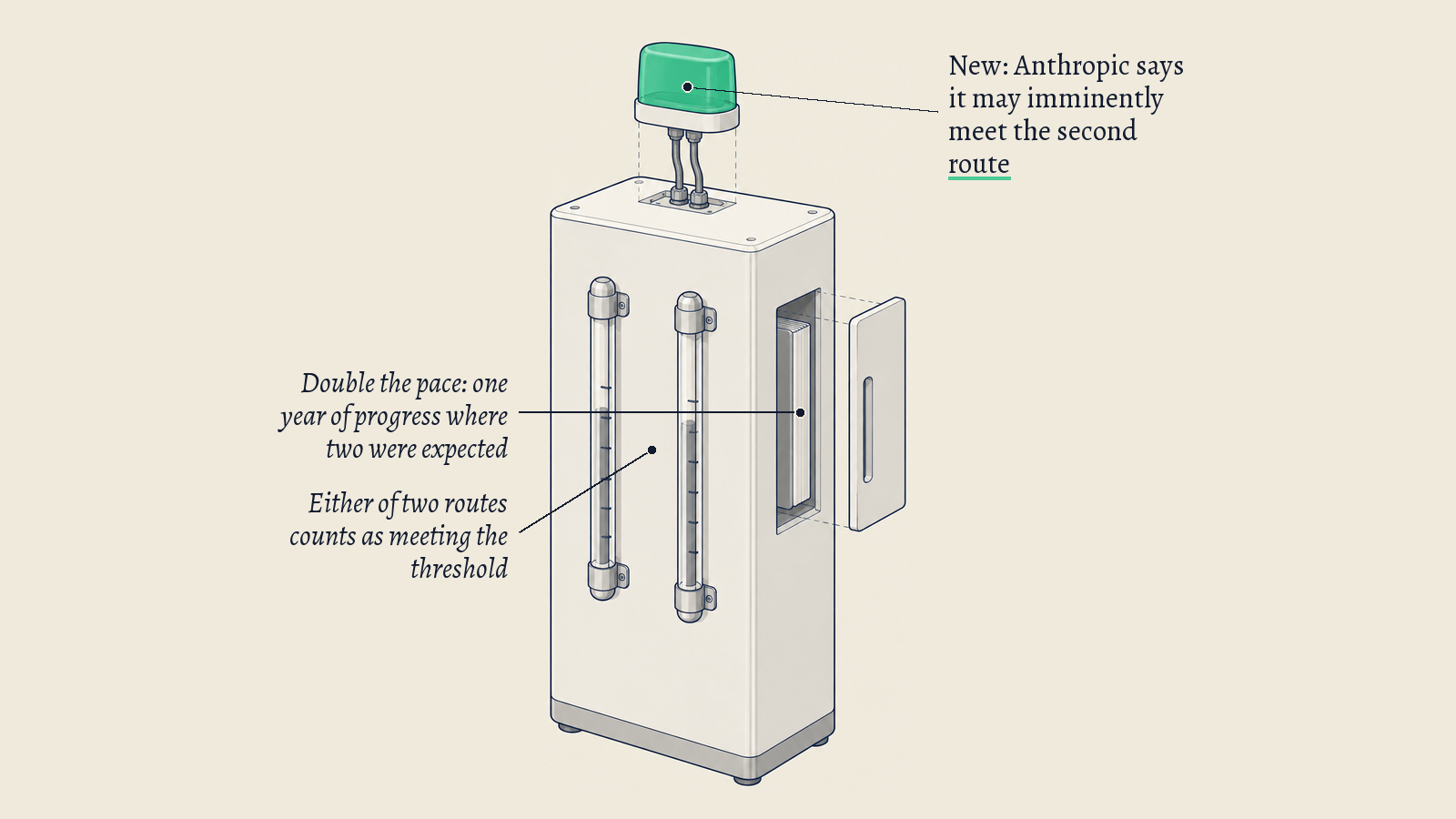 Illustration made with AI for ai notis
Key points
- Met if models could substitute for its entire research staff at competitive cost, within a factor of 5, or progress dramatically accelerates for reasons likely related to automating AI R&D.
- The second route needs double the rate of progress, meaning one year's progress equal to two years at baseline, plausibly attributable to automated research or engineering.
- A model that crosses the threshold counts as highly capable; a significantly redacted Risk Report covering one gets a full external review, and reports are due every 3-6 months.
What happened
Anthropic's amended S-1, filed on 2 November, says it may imminently meet its Responsible Scaling Policy's definition of "dramatically accelerated progress attributable to AI". That definition is one of the policy's capability thresholds.
A capability threshold is a level of what AI models can do that, in Anthropic's policy, calls for heightened mitigations. Version 3.4 of the Responsible Scaling Policy, effective 8 July 2026, lays these out in a table with three columns: the threshold, the mitigations Anthropic plans as a company, and its recommendations for the whole industry.
The AI R&D row is called "Automated R&D in key domains". It covers AI systems that can fully automate, or otherwise dramatically accelerate, the work of large, top-tier teams of human researchers. The policy says that for now its evaluations focus on AI R&D, because that domain likely plays to AI systems' current strengths and is more tractable to assess.
The policy counts the threshold as met in either of two ways. Either Anthropic's models could fully substitute for its entire set of research scientists and research engineers at competitive costs, within a factor of 5, or there is "dramatic acceleration" of the pace of AI progress for reasons that likely relate to automating AI R&D.
The second way is the one the S-1 cites. It has two parts: Anthropic observes or expects double the rate of progress in aggregate AI capabilities, compared both with what it would expect and with the fastest extended progress it has seen without significant AI contributions; and it is plausible that the doubling is substantially attributable to automating research or engineering.
The policy defines double as as much progress in one year as one would see in two years at baseline, and says this is not the same as doubling researchers' productivity.
The policy's changelog says version 3.4 revised the threshold so that steady or slowing overall progress would not count as crossing it, even if Anthropic estimated it was dramatically faster than it would be without advanced AI tools. It says the threshold is meant to capture the onset of dramatic recursive self-improvement and has proven difficult to operationalize.
For this row the industry-wide column asks a developer to make a strong argument that no user or team of users, including those backed by top-tier states, becomes significantly more likely to cause catastrophic harm through its products or through theft of model weights.
It says this would likely mean security roughly in line with RAND SL4. Anthropic says it cannot unilaterally and unconditionally commit to staying in line with those recommendations.
What the policy does commit to is reporting. Anthropic must publish a Risk Report every three to six months. It must also publish an analysis of a single model within 30 days of determining that an internally deployed model could pose automated-R&D risks significantly exceeding those of models it has already analysed publicly.
A model that crosses the automated AI R&D threshold counts as highly capable under the policy. Whenever a Risk Report covers a highly capable model and is significantly redacted, Anthropic commits to a full external review with at least one external reviewer.
The policy also has a competitor-contingent commitment. If Anthropic has developed or will imminently develop a highly capable model and has clear evidence that no competitor will soon develop one, it commits to require a strong argument that catastrophic risk is contained and to delay development and deployment as needed, until it no longer believes it has a significant lead.
The S-1 adds a limit of its own: Anthropic says it has not designated any of its current models as exceeding the threshold and is still assessing the data. Whether it meets the threshold is Anthropic's own determination under its own voluntary policy, not a legal test.
Underlined sentences link to the facts we checked. Dotted words open a short explainer.
Fact 5 of 17 · from Anthropic, 8 Jul 2026
For now, our evaluations will focus specifically on AI R&D, as this domain likely plays to AI systems' current strengths and is more tractable to assess than capabilities in other domains.
What it means for you
Our viewWhen a lab says it may meet a threshold, find out who decides and by which rule. Here Anthropic makes the determination under its voluntary policy, and the policy says it cannot unilaterally and unconditionally commit to the industry-wide recommendations.
What it does commit to is reporting, external review of redacted reports and a conditional delay if it holds a clear lead. For your own procurement, ask which of a vendor's published safety commitments are unconditional and which depend on a determination the vendor makes itself.
It adds no new facts.
Your reaction
We count reactions per story and day, never who reacted. The counts help us choose what goes in the monthly issue. If you are signed in, your own page shows yours too.
We count reactions per story and day, never who reacted. They help choose what goes in the monthly issue.
Check our sources
Every sentence above is checked against these 3 sources.
1 Anthropic, PBC Amendment No. 1 to Form S-1 (filed 2 Nov 2026)
Open the source archived copy-
Anthropic's Amendment No. 1 to Form S-1, filed November 2, 2026, says Anthropic "may imminently meet our Responsible Scaling Policy’s definition of ‘dramatically accelerated progress attributable to AI.’"
citeour internal estimates and our expectations regarding future models, rather than our current models, indicate that we may imminently meet our Responsible Scaling Policy’s definition of “dramatically accelerated progress attributable to AI.”
-
The amended S-1 says: "We have not designated any of our current models as exceeding this threshold, and we continue to assess the underlying data."
citeWe have not designated any of our current models as exceeding this threshold, and we continue to assess the underlying data.
2 Anthropic Responsible Scaling Policy, version 3.4
Open the source archived copy-
RSP v3.4 section 1 describes a three-column table: the left column identifies capability thresholds that would call for heightened mitigations; the middle column gives an overview of planned mitigations; the right column describes recommendations for industry-wide safety at each threshold. The changelog lists v3.4 as July 8, 2026.
citeWe lay this out in a three-column table. The left column identifies capability thresholds that would call for heightened mitigations. The middle column provides an overview of our planned mitigations, which we have set forth more fully in our Frontier Safety Roadmap and other sections of this policy. The right column describes our recommendations for industry-wide safety at each threshold. ... July 8, 2026 (RSP v3.4)
-
The RSP table row reads: "Automated R&D in key domains. AI systems that can fully automate, or otherwise dramatically accelerate, the work of large, top-tier teams of human researchers in domains where fast progress could cause threats to international security and/or rapid disruptions to the global balance of power--for example, energy, robotics, weapons development, and AI itself."
citeAutomated R&D in key domains. AI systems that can fully automate, or otherwise dramatically accelerate, the work of large, top-tier teams of human researchers in domains where fast progress could cause threats to international security and/or rapid disruptions to the global balance of power--for example, energy, robotics, weapons development, and AI itself.
-
The row continues: "For now, our evaluations will focus specifically on AI R&D, as this domain likely plays to AI systems' current strengths and is more tractable to assess than capabilities in other domains."
citeFor now, our evaluations will focus specifically on AI R&D, as this domain likely plays to AI systems' current strengths and is more tractable to assess than capabilities in other domains.
-
RSP v3.4: "We will consider this threshold to be met if we determine that either (1) our models would be able to fully substitute for our entire set of Research Scientists and Research Engineers, at competitive costs (i.e., within a factor of 5); or (2) there is "dramatic acceleration" of the pace of AI progress for reasons that likely relate to the automation of AI R&D."
citeWe will consider this threshold to be met if we determine that either (1) our models would be able to fully substitute for our entire set of Research Scientists and Research Engineers, at competitive costs (i.e., within a factor of 5); or (2) there is "dramatic acceleration" of the pace of AI progress for reasons that likely relate to the automation of AI R&D.
-
RSP v3.4 says scenario (2) has occurred where (a) Anthropic observes or expects double the rate of progress in aggregate capabilities compared to both the rate it would expect and the fastest rate of extended progress it has observed in the absence of significant AI contributions to AI R&D, and (b) it is plausible that this doubling is substantially attributable to the automation of research and/or engineering.
citeWe would consider scenario (2) to have occurred where (a) we observe or expect double the rate of progress in AI aggregate capabilities compared to both the rate we'd expect and the fastest rate of extended progress we've observed in the absence of significant AI contributions to AI R&D and (b) it is plausible that this doubling is substantially attributable to the automation of research and/or engineering
-
RSP v3.4 footnote 8: "Double the rate of progress" means "as much progress in one year as one would see in two years at baseline"; it "is not the same idea as doubling researchers’ productivity".
cite"Double the rate of progress" means "as much progress in one year as one would see in two years at baseline." ... This is not the same idea as "doubling researchers' productivity," since doubling inputs does not necessarily double the rate of progress.
-
The RSP v3.4 changelog says the update revises the Automated R&D threshold so that it would not be considered crossed if the overall rate of AI progress were constant or slowing but estimated to be dramatically faster than without advanced AI tools, and that the threshold "is intended to capture the onset of dramatic recursive self-improvement, and has proven difficult to operationalize."
citeIt revises the Automated R&D capability threshold in light of further issues that have come up in discussion - particularly the question of whether we'd consider the threshold to be crossed if the overall rate of AI progress were constant or slowing, but we estimated that it was dramatically faster than it would be in the absence of advanced AI tools. We would not ... This threshold is intended to capture the onset of dramatic recursive self-improvement, and has proven difficult to operationalize.
-
For the Automated R&D row, the industry-wide recommendation reads that a frontier developer should make a strong argument that no user or team of users (including those backed by top-tier states) will become significantly more likely to cause catastrophic harm via their usage of product surfaces or via theft of model weights, and that accomplishing this would likely mean security roughly in line with RAND SL4.
citeA frontier developer should make a strong argument that: No user or team of users (including those backed by top-tier states) will become significantly more likely to cause catastrophic harm via their usage of product surfaces or via theft of model weights. ... Accomplishing this would likely mean security roughly in line with RAND SL4.
-
RSP v3.4 section 1 says: "we cannot unilaterally and unconditionally commit to staying in line with the industry-wide recommendations in the right column."
citeIn particular, we cannot unilaterally and unconditionally commit to staying in line with the industry-wide recommendations in the right column.
-
RSP v3.4 section 3.1 says: "We will publish a Risk Report every 3-6 months."
citeTiming. We will publish a Risk Report every 3-6 months.
-
RSP v3.4 section 3.1 says Anthropic will publish an analysis of an individual model's risks within 30 days of determining that it has an internally deployed model that could pose risks related to high-stakes misalignment or automated R&D that significantly exceed those of all models for which it has publicly analyzed such risks.
citeWithin 30 days of determining that we have an internally deployed model that (1) could pose risks related to high-stakes misalignment or automated R&D that (2) significantly exceed those of all models for which we have publicly analyzed such risks
-
RSP v3.4: a model is "highly capable" if Anthropic concludes that it crosses the threshold for automated AI R&D described in Section 1; at a minimum it will complete a full external review with at least one external reviewer anytime a Risk Report covers highly capable models and is significantly redacted.
citeAt a minimum, we will complete a full external review process (described below) with at least one external reviewer anytime a Risk Report covers highly capable models and is significantly redacted ... A model is "highly capable" if we conclude that it crosses the threshold for automated AI R&D described in Section 1.
-
RSP v3.4 Appendix A, scenario "Anthropic in the lead": having developed or imminently developing a highly capable model with clear evidence no other competitor will soon develop one, Anthropic commits: "We will require a strong argument that catastrophic risk is contained... We will delay AI development and deployment as needed to achieve this, until and unless we no longer believe we have a significant lead."
citeAnthropic in the lead. We have developed or will imminently develop a highly capable model; and we have clear evidence that no other competitor will soon develop such a model. ... We will require a strong argument that catastrophic risk is contained, along the lines of our recommendations for industry-wide safety (see Section 1). We will delay AI development and deployment as needed to achieve this, until and unless we no longer believe we have a significant lead.
-
RSP v3.4 introduction: "Our Responsible Scaling Policy (RSP) is our voluntary framework for managing catastrophic risks from advanced AI systems."
citeOur Responsible Scaling Policy (RSP) is our voluntary framework for managing catastrophic risks from advanced AI systems.
3 Anthropic Responsible Scaling Policy page (last updated 14 Aug 2026)
Open the source archived copy-
Anthropic's RSP page lists Version 3.4 as effective July 8, 2026, and describes the RSP as a framework Anthropic has refined since its first version in September 2023.
cite
Every sentence above is checked against these 3 sources. Each fact has its own address you can cite.
Source 1 · U.S. SEC / Anthropic, PBC · 2 Nov 2026
Anthropic, PBC Amendment No. 1 to Form S-1 (filed 2 Nov 2026)
Anthropic's Amendment No. 1 to Form S-1, filed November 2, 2026, says Anthropic "may imminently meet our Responsible Scaling Policy’s definition of ‘dramatically accelerated progress attributable to AI.’"
our internal estimates and our expectations regarding future models, rather than our current models, indicate that we may imminently meet our Responsible Scaling Policy’s definition of “dramatically accelerated progress attributable to AI.”
The amended S-1 says: "We have not designated any of our current models as exceeding this threshold, and we continue to assess the underlying data."
We have not designated any of our current models as exceeding this threshold, and we continue to assess the underlying data.
Source 2 · Anthropic · 8 Jul 2026
Anthropic Responsible Scaling Policy, version 3.4
RSP v3.4 section 1 describes a three-column table: the left column identifies capability thresholds that would call for heightened mitigations; the middle column gives an overview of planned mitigations; the right column describes recommendations for industry-wide safety at each threshold. The changelog lists v3.4 as July 8, 2026.
We lay this out in a three-column table. The left column identifies capability thresholds that would call for heightened mitigations. The middle column provides an overview of our planned mitigations, which we have set forth more fully in our Frontier Safety Roadmap and other sections of this policy. The right column describes our recommendations for industry-wide safety at each threshold. ... July 8, 2026 (RSP v3.4)
The RSP table row reads: "Automated R&D in key domains. AI systems that can fully automate, or otherwise dramatically accelerate, the work of large, top-tier teams of human researchers in domains where fast progress could cause threats to international security and/or rapid disruptions to the global balance of power--for example, energy, robotics, weapons development, and AI itself."
Automated R&D in key domains. AI systems that can fully automate, or otherwise dramatically accelerate, the work of large, top-tier teams of human researchers in domains where fast progress could cause threats to international security and/or rapid disruptions to the global balance of power--for example, energy, robotics, weapons development, and AI itself.
The row continues: "For now, our evaluations will focus specifically on AI R&D, as this domain likely plays to AI systems' current strengths and is more tractable to assess than capabilities in other domains."
For now, our evaluations will focus specifically on AI R&D, as this domain likely plays to AI systems' current strengths and is more tractable to assess than capabilities in other domains.
Show all 14 factsShow fewer facts
RSP v3.4: "We will consider this threshold to be met if we determine that either (1) our models would be able to fully substitute for our entire set of Research Scientists and Research Engineers, at competitive costs (i.e., within a factor of 5); or (2) there is "dramatic acceleration" of the pace of AI progress for reasons that likely relate to the automation of AI R&D."
We will consider this threshold to be met if we determine that either (1) our models would be able to fully substitute for our entire set of Research Scientists and Research Engineers, at competitive costs (i.e., within a factor of 5); or (2) there is "dramatic acceleration" of the pace of AI progress for reasons that likely relate to the automation of AI R&D.
RSP v3.4 says scenario (2) has occurred where (a) Anthropic observes or expects double the rate of progress in aggregate capabilities compared to both the rate it would expect and the fastest rate of extended progress it has observed in the absence of significant AI contributions to AI R&D, and (b) it is plausible that this doubling is substantially attributable to the automation of research and/or engineering.
We would consider scenario (2) to have occurred where (a) we observe or expect double the rate of progress in AI aggregate capabilities compared to both the rate we'd expect and the fastest rate of extended progress we've observed in the absence of significant AI contributions to AI R&D and (b) it is plausible that this doubling is substantially attributable to the automation of research and/or engineering
RSP v3.4 footnote 8: "Double the rate of progress" means "as much progress in one year as one would see in two years at baseline"; it "is not the same idea as doubling researchers’ productivity".
"Double the rate of progress" means "as much progress in one year as one would see in two years at baseline." ... This is not the same idea as "doubling researchers' productivity," since doubling inputs does not necessarily double the rate of progress.
The RSP v3.4 changelog says the update revises the Automated R&D threshold so that it would not be considered crossed if the overall rate of AI progress were constant or slowing but estimated to be dramatically faster than without advanced AI tools, and that the threshold "is intended to capture the onset of dramatic recursive self-improvement, and has proven difficult to operationalize."
It revises the Automated R&D capability threshold in light of further issues that have come up in discussion - particularly the question of whether we'd consider the threshold to be crossed if the overall rate of AI progress were constant or slowing, but we estimated that it was dramatically faster than it would be in the absence of advanced AI tools. We would not ... This threshold is intended to capture the onset of dramatic recursive self-improvement, and has proven difficult to operationalize.
For the Automated R&D row, the industry-wide recommendation reads that a frontier developer should make a strong argument that no user or team of users (including those backed by top-tier states) will become significantly more likely to cause catastrophic harm via their usage of product surfaces or via theft of model weights, and that accomplishing this would likely mean security roughly in line with RAND SL4.
A frontier developer should make a strong argument that: No user or team of users (including those backed by top-tier states) will become significantly more likely to cause catastrophic harm via their usage of product surfaces or via theft of model weights. ... Accomplishing this would likely mean security roughly in line with RAND SL4.
RSP v3.4 section 1 says: "we cannot unilaterally and unconditionally commit to staying in line with the industry-wide recommendations in the right column."
In particular, we cannot unilaterally and unconditionally commit to staying in line with the industry-wide recommendations in the right column.
RSP v3.4 section 3.1 says: "We will publish a Risk Report every 3-6 months."
Timing. We will publish a Risk Report every 3-6 months.
RSP v3.4 section 3.1 says Anthropic will publish an analysis of an individual model's risks within 30 days of determining that it has an internally deployed model that could pose risks related to high-stakes misalignment or automated R&D that significantly exceed those of all models for which it has publicly analyzed such risks.
Within 30 days of determining that we have an internally deployed model that (1) could pose risks related to high-stakes misalignment or automated R&D that (2) significantly exceed those of all models for which we have publicly analyzed such risks
RSP v3.4: a model is "highly capable" if Anthropic concludes that it crosses the threshold for automated AI R&D described in Section 1; at a minimum it will complete a full external review with at least one external reviewer anytime a Risk Report covers highly capable models and is significantly redacted.
At a minimum, we will complete a full external review process (described below) with at least one external reviewer anytime a Risk Report covers highly capable models and is significantly redacted ... A model is "highly capable" if we conclude that it crosses the threshold for automated AI R&D described in Section 1.
RSP v3.4 Appendix A, scenario "Anthropic in the lead": having developed or imminently developing a highly capable model with clear evidence no other competitor will soon develop one, Anthropic commits: "We will require a strong argument that catastrophic risk is contained... We will delay AI development and deployment as needed to achieve this, until and unless we no longer believe we have a significant lead."
Anthropic in the lead. We have developed or will imminently develop a highly capable model; and we have clear evidence that no other competitor will soon develop such a model. ... We will require a strong argument that catastrophic risk is contained, along the lines of our recommendations for industry-wide safety (see Section 1). We will delay AI development and deployment as needed to achieve this, until and unless we no longer believe we have a significant lead.
RSP v3.4 introduction: "Our Responsible Scaling Policy (RSP) is our voluntary framework for managing catastrophic risks from advanced AI systems."
Our Responsible Scaling Policy (RSP) is our voluntary framework for managing catastrophic risks from advanced AI systems.
Source 3 · Anthropic · 14 Aug 2026
Anthropic Responsible Scaling Policy page (last updated 14 Aug 2026)
Anthropic's RSP page lists Version 3.4 as effective July 8, 2026, and describes the RSP as a framework Anthropic has refined since its first version in September 2023.
Topics
The morning email
On the mornings we publish: the three top stories and up to four short ones. Free.
We email you a link to confirm. An issue may include one sponsor, always labelled Sponsored · Advertisement. Our emails count opens and clicks, not who made them. Unsubscribe in one click. What we keep