ResearchPublished Top storyAll news from that day
Anthropic says 17 of 211 designed proteins bound scorpion toxins in tests
Anthropic's research post of 20 October 2026 says Claude selected 180 designs and the team added 31; 17 of the 211 met its binding criteria in lab tests, and it does not claim an antivenom.
Check our sources · 12 facts from 1 source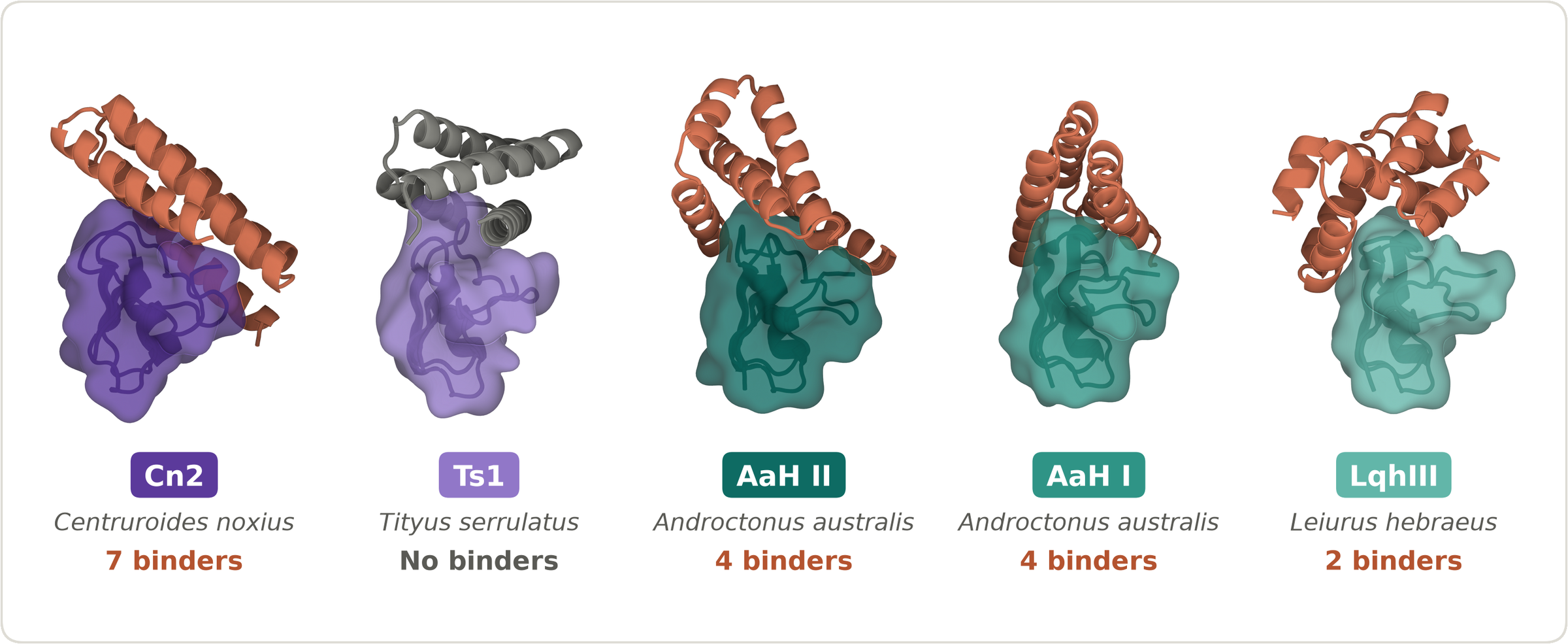 Image: Anthropic
Key points
- Claude selected 180 designs and the team added 31 more, 211 in total, aimed at five scorpion toxins: Cn2, Ts1, AaH I, AaH II and LqhIII.
- 17 of the 211 designs met the criteria: 7 against Cn2, 4 against AaH II, 4 against AaH I and 2 against LqhIII, which was tested only at Adaptyv Bio.
- Binding was tested only against recombinant toxins. No design was tested for neutralisation in cells or efficacy in living animals, and Anthropic does not claim an antivenom.
What happened
Anthropic asked an internal research model to design small proteins that bind scorpion neurotoxins. It selected 180 designs and the team added 31, 211 in all, and 17 met its binding criteria in lab tests at Adaptyv Bio and Twist Bioscience (LqhIII was tested only at Adaptyv Bio).
Anthropic does not claim to have produced an antivenom, because it has not confirmed the binders neutralise venom in cells, and it has released all 211 designs with their data on Hugging Face.
What it means for you
Our viewAnthropic describes a model-driven design process whose output was tested only for binding to recombinant toxins, at Adaptyv Bio and Twist Bioscience, with 17 of 211 designs meeting its criteria.
Nothing was tested for neutralisation in cells or in animals, and Anthropic does not claim an antivenom, so the result shows a design workflow and not a treatment. Anthropic has released all 211 designs and their data on Hugging Face, which lets others examine the binding results.
If your organisation works in protein design or biosecurity, download the dataset and check whether your own assays reproduce the hit rate before drawing conclusions.
It adds no new facts.
Your reaction
We count reactions per story and day, never who reacted. The counts help us choose what goes in the monthly issue. If you are signed in, your own page shows yours too.
We count reactions per story and day, never who reacted. They help choose what goes in the monthly issue.
Check our sources
Every sentence above is checked against this source.
1 How Claude designed protein binders against scorpion neurotoxins
Open the source archived copy-
Anthropic's research post of 20 October 2026 says it asked an internal research model to design minibinders, small proteins that attach tightly to a target, against scorpion neurotoxins.
citePublished Oct 20, 2026 ... we asked an internal research model to design minibinders (small proteins that attach tightly to a target) against scorpion neurotoxins.
-
The post says the hope is that the binders could one day be used to develop a scorpion antivenom, and that Anthropic does not claim to have produced one, because it has not confirmed that they neutralize venom in cells.
Toned down to what the source says
citewith the hope that they could one day be used to develop a scorpion antivenom ... We have not confirmed whether these binders neutralize scorpion venom in a cellular environment, so we do not claim to have produced an antivenom.
-
The post says scorpions sting 1.2 million people or more every year, causing more than 3,250 deaths, mostly among children.
citeScorpions sting 1.2 million people or more every year, resulting in more than 3,250 deaths, mostly among children in parts of the world with limited access to medical care.
-
The model ran for 64 hours, mostly autonomously, and worked alone for the first 24 hours after the initial prompt.
citeOver the next 64 hours, an internal research model, operating within Claude Science, worked mainly autonomously, although we directed its work with four follow-ups. ... Claude worked autonomously for 24 hours following our first prompt.
-
The model used 12 design tools to generate 318,484 designs, and co-folded and screened 553,052 design-toxin pairs using about 10,000 GPU hours.
citeClaude used 12 design tools to generate 318,484 designs ... Claude co-folded and screened 553,052 design-toxin pairs ... The campaign used on the order of 10,000 GPU hours.
-
Claude selected 180 designs and the team added 31 more, 211 designs in total, aimed at five toxins: Cn2, Ts1, AaH I, AaH II and LqhIII.
citeit produced its final list of 180 designs ... We later worked with Claude to add another 31 designs, increasing the total to 211 designs ... five scorpion-venom neurotoxins ... (Cn2, Ts1, AaH I, AaH II, and LqhIII)
-
Adaptyv Bio and Twist Bioscience tested the designs by surface plasmon resonance; a binder had to be a hit at both labs (LqhIII was tested only at Adaptyv Bio), with every dissociation constant at 1 micromolar or tighter and no signal against the human protein CLEC12A.
Toned down to what the source says
citeBoth labs measured binding by surface plasmon resonance (SPR) ... The design needed to be a hit at both labs 3 ... every KD needed to be 1 µM or tighter. We also required that the design show no signal against CLEC12A ... Footnote 3: LqhIII was assessed only by Adaptyv Bio.
-
17 of the 211 designs met the criteria: 7 against Cn2, 4 against AaH II, 4 against AaH I and 2 against LqhIII.
citeOf the 211 designs our teams assessed, 17 met our criteria for a binder, each against a single toxin. ... Seven designs were binders against Cn2, four against AaH II, four against AaH I, and two against LqhIII.
-
Among the 60 single-toxin designs, 11 (18%) were binders, and none of the multitoxin designs met the criteria for more than one toxin.
citeAmong the 60 single-toxin designs, 11 were binders (18%). ... None of the designs made against multiple toxins met our criteria for more than one.
-
The strongest binders, Cn2-B1 and Cn2-B2, had single-digit nanomolar affinities.
citeOur two strongest binders, which we call Cn2-B1 and Cn2-B2, target Cn2 ... with affinities (KD) in the single-digit nanomolar range.
-
Binding was tested only against recombinant toxins; no designs were tested for neutralization in cells or for efficacy in living animals.
citeOur results show binding only against recombinant toxins ... we didn't test any design for neutralization in vitro (against cells grown in the lab) or for efficacy in vivo (in living animals, such as mice).
-
All 211 designs and their data are released on Hugging Face at huggingface.co/datasets/Anthropic/scorpion-toxin-binder-design.
citeWe are releasing all 211 designs and their binding data; the post's data link is https://huggingface.co/datasets/Anthropic/scorpion-toxin-binder-design, which opens (HTTP 200).
Every sentence above is checked against this source. Each fact has its own address you can cite.
Source 1 · Anthropic · 20 Oct 2026
How Claude designed protein binders against scorpion neurotoxins
Anthropic's research post of 20 October 2026 says it asked an internal research model to design minibinders, small proteins that attach tightly to a target, against scorpion neurotoxins.
Published Oct 20, 2026 ... we asked an internal research model to design minibinders (small proteins that attach tightly to a target) against scorpion neurotoxins.
The post says the hope is that the binders could one day be used to develop a scorpion antivenom, and that Anthropic does not claim to have produced one, because it has not confirmed that they neutralize venom in cells.
Toned down to what the source sayswith the hope that they could one day be used to develop a scorpion antivenom ... We have not confirmed whether these binders neutralize scorpion venom in a cellular environment, so we do not claim to have produced an antivenom.
The post says scorpions sting 1.2 million people or more every year, causing more than 3,250 deaths, mostly among children.
Scorpions sting 1.2 million people or more every year, resulting in more than 3,250 deaths, mostly among children in parts of the world with limited access to medical care.
Show all 12 factsShow fewer facts
The model ran for 64 hours, mostly autonomously, and worked alone for the first 24 hours after the initial prompt.
Over the next 64 hours, an internal research model, operating within Claude Science, worked mainly autonomously, although we directed its work with four follow-ups. ... Claude worked autonomously for 24 hours following our first prompt.
The model used 12 design tools to generate 318,484 designs, and co-folded and screened 553,052 design-toxin pairs using about 10,000 GPU hours.
Claude used 12 design tools to generate 318,484 designs ... Claude co-folded and screened 553,052 design-toxin pairs ... The campaign used on the order of 10,000 GPU hours.
Claude selected 180 designs and the team added 31 more, 211 designs in total, aimed at five toxins: Cn2, Ts1, AaH I, AaH II and LqhIII.
it produced its final list of 180 designs ... We later worked with Claude to add another 31 designs, increasing the total to 211 designs ... five scorpion-venom neurotoxins ... (Cn2, Ts1, AaH I, AaH II, and LqhIII)
Adaptyv Bio and Twist Bioscience tested the designs by surface plasmon resonance; a binder had to be a hit at both labs (LqhIII was tested only at Adaptyv Bio), with every dissociation constant at 1 micromolar or tighter and no signal against the human protein CLEC12A.
Toned down to what the source saysBoth labs measured binding by surface plasmon resonance (SPR) ... The design needed to be a hit at both labs 3 ... every KD needed to be 1 µM or tighter. We also required that the design show no signal against CLEC12A ... Footnote 3: LqhIII was assessed only by Adaptyv Bio.
17 of the 211 designs met the criteria: 7 against Cn2, 4 against AaH II, 4 against AaH I and 2 against LqhIII.
Of the 211 designs our teams assessed, 17 met our criteria for a binder, each against a single toxin. ... Seven designs were binders against Cn2, four against AaH II, four against AaH I, and two against LqhIII.
Among the 60 single-toxin designs, 11 (18%) were binders, and none of the multitoxin designs met the criteria for more than one toxin.
Among the 60 single-toxin designs, 11 were binders (18%). ... None of the designs made against multiple toxins met our criteria for more than one.
The strongest binders, Cn2-B1 and Cn2-B2, had single-digit nanomolar affinities.
Our two strongest binders, which we call Cn2-B1 and Cn2-B2, target Cn2 ... with affinities (KD) in the single-digit nanomolar range.
Binding was tested only against recombinant toxins; no designs were tested for neutralization in cells or for efficacy in living animals.
Our results show binding only against recombinant toxins ... we didn't test any design for neutralization in vitro (against cells grown in the lab) or for efficacy in vivo (in living animals, such as mice).
All 211 designs and their data are released on Hugging Face at huggingface.co/datasets/Anthropic/scorpion-toxin-binder-design.
We are releasing all 211 designs and their binding data; the post's data link is https://huggingface.co/datasets/Anthropic/scorpion-toxin-binder-design, which opens (HTTP 200).
Topics
The morning email
On the mornings we publish: the three top stories and up to four short ones. Free.
We email you a link to confirm. An issue may include one sponsor, always labelled Sponsored · Advertisement. Our emails count opens and clicks, not who made them. Unsubscribe in one click. What we keep