LawsPublished Top storyAll news from that day
Ongoing case: Watermarks on AI-made content Rules and courts · 8 stories
Existing generative AI systems in the EU must mark output by 2 December
Fines can reach up to 15 million euros or 3% of worldwide turnover; the Commission says Article 50 applies from 2 August, with only marking by earlier systems delayed to 2 December.
Check our sources · 11 facts from 5 sources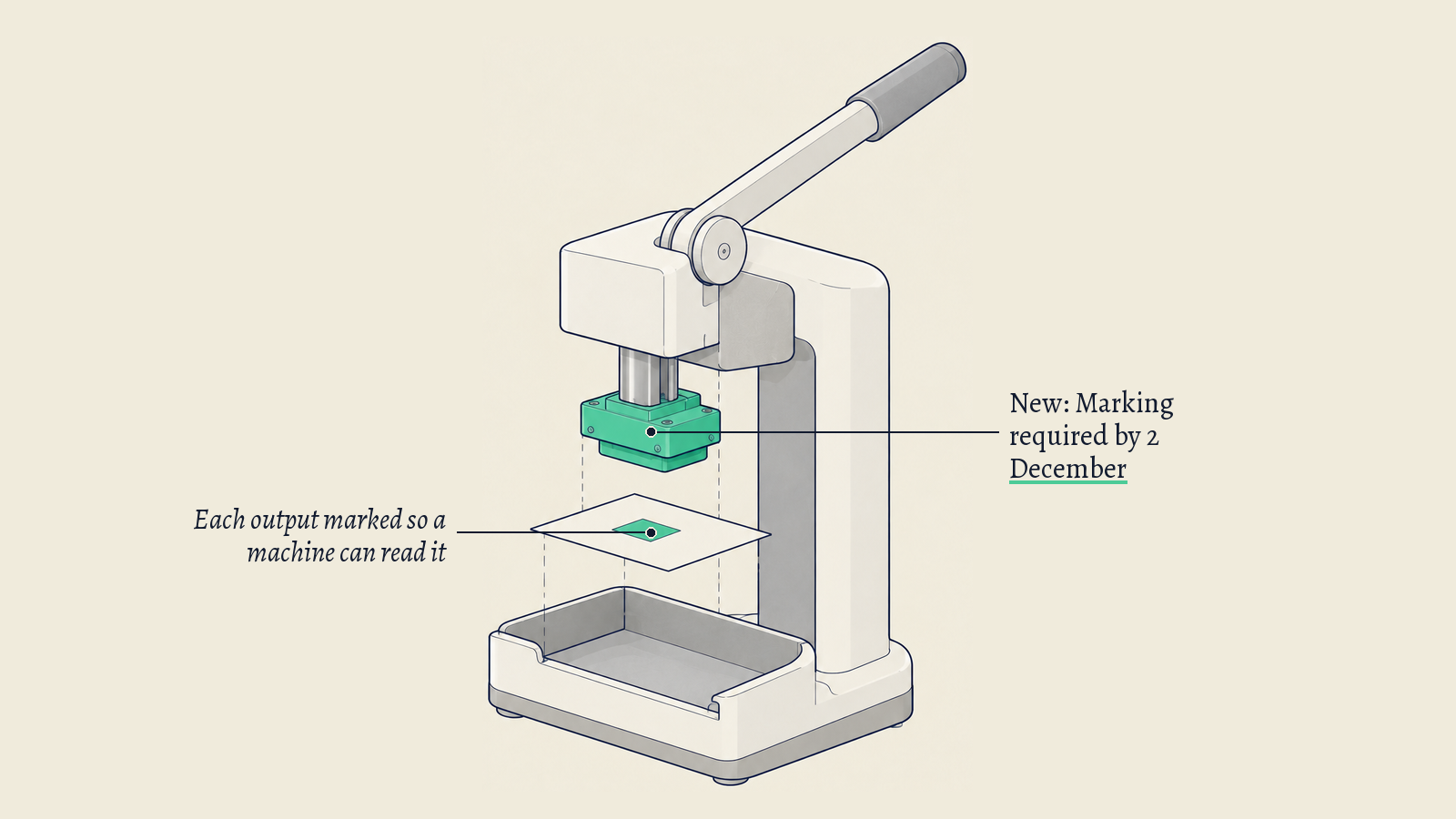 Illustration made with AI for ai notis
Key points
- The Commission's FAQ says Article 50 applies from 2 August 2026; systems placed on the market before then must meet the marking duty only from 2 December 2026.
- Article 50(2) requires outputs of systems that generate audio, image, video or text to be marked machine-readably; the Commission lists watermarks, metadata and fingerprints.
- The FAQ says providers outside the EU are covered if their output is used in the EU; fines can reach up to 15 million euros or 3% of worldwide turnover.
What happened
Providers of generative AI systems that were already on the EU market before 2 August 2026 have until 2 December 2026 to mark their outputs in a machine-readable way, according to the European Commission's FAQ on Article 50 of the AI Act. Everything else in Article 50 has applied since 2 August. This is a European rule: it covers providers outside the EU if the output of their system is used in the EU.
The grace period is narrow. The Commission says it covers only the marking and detection duty in Article 50(2), and only for systems placed on the market before 2 August 2026; content generated before that date does not need to be labelled retroactively.
The grace period comes from Regulation (EU) 2026/1744, the Digital Omnibus on AI, published in the Official Journal on 24 July 2026; its recital 38 refers to a four-month transitional period for providers already on the market.
Article 50(2) requires providers of systems that generate synthetic audio, image, video or text to ensure outputs are marked in a machine-readable format and detectable as artificially generated or manipulated. The Commission lists watermarks, metadata, cryptographic methods, logging and fingerprints as possible techniques.
Fines can reach up to 15 million euros or 3% of total worldwide turnover for the preceding financial year, according to the same FAQ. The Commission published a final voluntary Code of Practice on marking and labelling on 10 June 2026, and says signatories can rely on it to show compliance.
What it means for you
Our viewIf your system generates audio, image, video or text and was on the EU market before 2 August 2026, plan for machine-readable marking to be in place by 2 December 2026; a system placed on the market since then is already covered.
The grace period covers marking only, so the other Article 50 duties already apply, and a provider outside the EU is covered when its output is used in the EU. The Commission says signatories of its voluntary Code of Practice can rely on it for legal certainty.
Check which of your systems were on the market before 2 August, and whether your marking method is among the techniques the Commission lists.
It adds no new facts.
Your reaction
We count reactions per story and day, never who reacted. The counts help us choose what goes in the monthly issue. If you are signed in, your own page shows yours too.
We count reactions per story and day, never who reacted. They help choose what goes in the monthly issue.
Check our sources
Every sentence above is checked against these 5 sources.
1 Transparency obligations under Article 50 of the AI Act (Commission FAQ)
Open the source archived copy-
The Commission's Article 50 FAQ says Article 50 of the AI Act applies from 2 August 2026, and that a limited grace period is envisaged only for AI systems placed on the market before 2 August 2026 and only for the marking and detection obligation for AI-generated content (Article 50(2)).
citeArticle 50 of the AI Act applies as from 2 August 2026. ... A limited grace period is envisaged only for AI systems placed on the market before 2 August 2026 and only as regards the marking and detection obligation for AI-generated content (Article 50(2) of the AI Act).
-
The FAQ says providers of such systems must comply with the Article 50(2) obligations only from 2 December 2026.
citeProviders of such systems must comply with those obligations only as from 2 December 2026.
-
The FAQ says content generated prior to 2 August 2026 does not need to be labelled retroactively, though the Commission encourages relevant deployers to do so where possible.
citeContent generated prior to 2 August 2026 does not need to be labelled retroactively. Nonetheless, the Commission encourages relevant deployers to do so, where possible
-
The FAQ says providers of AI systems established outside the EU are also subject to the AI Act if the output of their AI system is used in the EU.
citeProviders of AI systems established or located outside the EU are also subject to the provisions of the AI Act if the output of their AI system is used in the EU.
-
The FAQ says fines can reach up to 15 million euros or 3% of total worldwide turnover for the preceding financial year.
citeFines can reach up to 15 million euros or 3% of total worldwide turnover for the preceding financial year
-
The FAQ says the Code of Practice on transparency of AI-generated content has been assessed as adequate by the Commission and the AI Board, and that signatories may rely on an approved code they have signed for legal certainty.
citeThe code has been assessed as adequate by both the Commission and the AI Board. It allows signatories to benefit from legal certainty, predictability, and trust as they may rely on an approved code that they have signed
2 Article 50: Transparency obligations for providers and deployers of certain AI systems (AI Act Service Desk)
Open the source archived copy-
Article 50(2) of the AI Act requires providers of AI systems, including general-purpose AI systems, generating synthetic audio, image, video or text content to ensure that outputs are marked in a machine-readable format and detectable as artificially generated or manipulated.
cite
3 Guidelines and Code of Practice on transparent AI systems (Commission Q&A)
Open the source archived copy-
The Commission's Q&A says techniques for marking and detecting AI-generated content include watermarks, metadata identifications, cryptographic methods for proving origin and authenticity, logging methods, fingerprints or other techniques.
cite
4 Commission publishes Code of Practice on marking and labelling AI-generated content
Open the source archived copy-
The European Commission published the final Code of Practice on marking and labelling of AI-generated content on 10 June 2026, and describes it as voluntary.
cite
5 Regulation (EU) 2026/1744 (Digital Omnibus on AI), Official Journal 24.7.2026
Open the source archived copy-
Regulation (EU) 2026/1744 of the European Parliament and of the Council, the Digital Omnibus on AI, amends Regulation (EU) 2024/1689 and was published in the Official Journal on 24 July 2026 (signed 8 July 2026).
citeRegulation (EU) 2026/1744 of the European Parliament and of the Council of 8 July 2026 amending Regulations (EU) 2024/1689, (EU) 2018/1139 and (EU) 2023/1230 ... (Digital Omnibus on AI) ... OJ L, 2026/1744, 24.7.2026
-
Recital 38 of Regulation (EU) 2026/1744 refers to a transitional period of four months for providers who have already placed their systems on the market, in connection with the Article 50(2) marking obligation.
cite(38) To allow sufficient time for providers of generative AI systems subject to the marking obligations laid down in Article 50(2) of Regulation (EU) 2024/1689 to adapt their practices ... it is appropriate to introduce a transitional period of four months for providers who have already placed their systems on the market before the 2 August 2026.
Every sentence above is checked against these 5 sources. Each fact has its own address you can cite.
Source 1 · European Commission · 24 Jul 2026
Transparency obligations under Article 50 of the AI Act (Commission FAQ)
The Commission's Article 50 FAQ says Article 50 of the AI Act applies from 2 August 2026, and that a limited grace period is envisaged only for AI systems placed on the market before 2 August 2026 and only for the marking and detection obligation for AI-generated content (Article 50(2)).
Article 50 of the AI Act applies as from 2 August 2026. ... A limited grace period is envisaged only for AI systems placed on the market before 2 August 2026 and only as regards the marking and detection obligation for AI-generated content (Article 50(2) of the AI Act).
The FAQ says providers of such systems must comply with the Article 50(2) obligations only from 2 December 2026.
Providers of such systems must comply with those obligations only as from 2 December 2026.
The FAQ says content generated prior to 2 August 2026 does not need to be labelled retroactively, though the Commission encourages relevant deployers to do so where possible.
Content generated prior to 2 August 2026 does not need to be labelled retroactively. Nonetheless, the Commission encourages relevant deployers to do so, where possible
Show all 6 factsShow fewer facts
The FAQ says providers of AI systems established outside the EU are also subject to the AI Act if the output of their AI system is used in the EU.
Providers of AI systems established or located outside the EU are also subject to the provisions of the AI Act if the output of their AI system is used in the EU.
The FAQ says fines can reach up to 15 million euros or 3% of total worldwide turnover for the preceding financial year.
Fines can reach up to 15 million euros or 3% of total worldwide turnover for the preceding financial year
The FAQ says the Code of Practice on transparency of AI-generated content has been assessed as adequate by the Commission and the AI Board, and that signatories may rely on an approved code they have signed for legal certainty.
The code has been assessed as adequate by both the Commission and the AI Board. It allows signatories to benefit from legal certainty, predictability, and trust as they may rely on an approved code that they have signed
Source 2 · European Commission · 27 Jul 2026
Article 50: Transparency obligations for providers and deployers of certain AI systems (AI Act Service Desk)
Article 50(2) of the AI Act requires providers of AI systems, including general-purpose AI systems, generating synthetic audio, image, video or text content to ensure that outputs are marked in a machine-readable format and detectable as artificially generated or manipulated.
Source 3 · European Commission
Guidelines and Code of Practice on transparent AI systems (Commission Q&A)
The Commission's Q&A says techniques for marking and detecting AI-generated content include watermarks, metadata identifications, cryptographic methods for proving origin and authenticity, logging methods, fingerprints or other techniques.
Source 4 · European Commission · 10 Jun 2026
Commission publishes Code of Practice on marking and labelling AI-generated content
The European Commission published the final Code of Practice on marking and labelling of AI-generated content on 10 June 2026, and describes it as voluntary.
Source 5 · EUR-Lex · 24 Jul 2026
Regulation (EU) 2026/1744 (Digital Omnibus on AI), Official Journal 24.7.2026
Regulation (EU) 2026/1744 of the European Parliament and of the Council, the Digital Omnibus on AI, amends Regulation (EU) 2024/1689 and was published in the Official Journal on 24 July 2026 (signed 8 July 2026).
Regulation (EU) 2026/1744 of the European Parliament and of the Council of 8 July 2026 amending Regulations (EU) 2024/1689, (EU) 2018/1139 and (EU) 2023/1230 ... (Digital Omnibus on AI) ... OJ L, 2026/1744, 24.7.2026
Recital 38 of Regulation (EU) 2026/1744 refers to a transitional period of four months for providers who have already placed their systems on the market, in connection with the Article 50(2) marking obligation.
(38) To allow sufficient time for providers of generative AI systems subject to the marking obligations laid down in Article 50(2) of Regulation (EU) 2024/1689 to adapt their practices ... it is appropriate to introduce a transitional period of four months for providers who have already placed their systems on the market before the 2 August 2026.
Topics
The morning email
On the mornings we publish: the three top stories and up to four short ones. Free.
We email you a link to confirm. An issue may include one sponsor, always labelled Sponsored · Advertisement. Our emails count opens and clicks, not who made them. Unsubscribe in one click. What we keep