LawsPublished ExplainedAll news from that day
Ongoing case: Watermarks on AI-made content 8 stories
EU AI Act Article 50 sets four duties for AI providers and deployers
Four duties sit under one article: say when someone is talking to AI, mark what AI generates, tell people about emotion recognition, and label deepfakes and AI text on public matters.
Check our sources · 16 facts from 4 sources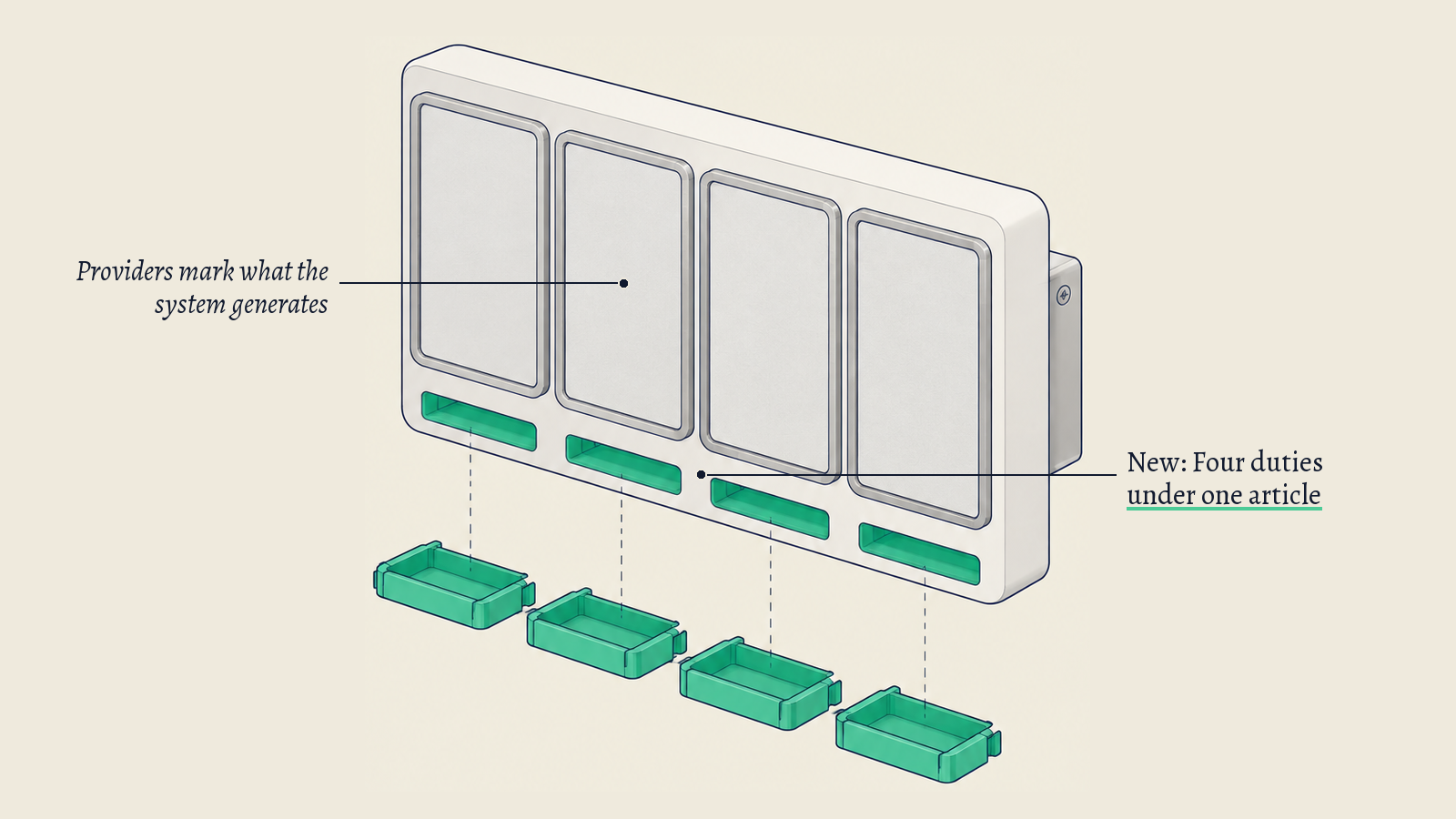 Illustration made with AI for ai notis
Key points
- Providers of systems that interact directly with people must ensure people are told they are dealing with AI, unless that is obvious; background and machine-to-machine systems fall outside.
- Providers of systems that generate audio, image, video or text must mark outputs in a machine-readable format; systems already on the market have until 2 December 2026.
- Deployers must tell people about emotion recognition and deepfakes, and label AI text on public-interest matters, unless it had human review or editorial control and a person holds editorial responsibility.
What happened
Article 50 of the EU AI Act sets four duties: tell people when they are talking to a machine, mark what AI generates, disclose emotion recognition and biometric categorisation, and label deepfakes and AI-written text on matters of public interest.
The article applies from 2 August 2026, and the European Commission's FAQ says it covers providers outside the EU whenever the output of their system is used in the EU. Providers of generative AI already on the EU market have until 2 December 2026 to mark what their systems produce.
The first duty is to say it is a machine. Providers of systems that interact directly with people must design them so people are informed they are interacting with an AI system, unless that is obvious to a reasonably well-informed, observant person. The Commission says the duty needs a genuine two-way exchange with a natural person, so systems working only in the background or machine to machine fall outside it.
The second duty is to mark what is generated. Providers of systems that generate synthetic audio, image, video or text must ensure outputs are marked in a machine-readable format and detectable as artificially generated or manipulated.
The Commission lists watermarks, metadata, cryptographic proof of origin, logging and fingerprints as techniques. The duty does not apply to assistive standard editing, and the Commission says short strings of symbols and source code are outside its scope.
The third and fourth duties fall on deployers, the organisations that use such systems under their own authority. Those running emotion recognition or biometric categorisation must inform the people exposed to them.
Those who generate a deepfake must disclose it, and the Commission says it must be shown in a way people can see or hear, so the provider's machine-readable mark is not enough.
Deployers who publish AI-generated text to inform the public on matters of public interest must label it, unless the text has had human review or editorial control and someone holds editorial responsibility for it.
The Commission says a deepfake must resemble something that exists or could plausibly exist and falsely appear authentic, so background scenes and special effects in a normal film production are not likely to count. It also says spell-checking is not editorial control.
There is a way to show compliance. The Commission published a voluntary Code of Practice on marking and labelling on 10 June 2026 and says signatories can rely on it for legal certainty; those who do not sign must show compliance by other means and may face more requests for information. Fines can reach up to 15 million euros or 3% of total worldwide turnover for the preceding financial year.
To check where your own product stands, ask who the provider is, who the deployer is, and whether your system was on the EU market before 2 August 2026, since only that last case has until 2 December to add the mark.
What it means for you
Our viewSort each AI system you build or use into provider or deployer, because the duties differ: providers handle telling people they are dealing with AI and the machine-readable mark, deployers handle emotion recognition notices, deepfake disclosure and public-interest text.
A provider's mark does not satisfy a deployer's deepfake duty, since the Commission says deployers cannot rely only on it. Spell-checking does not count as human review or editorial control.
For each AI output your organisation publishes, write down who owns which duty, and whether a named person reviews AI-written text before it goes out.
It adds no new facts.
Your reaction
We count reactions per story and day, never who reacted. The counts help us choose what goes in the monthly issue. If you are signed in, your own page shows yours too.
We count reactions per story and day, never who reacted. They help choose what goes in the monthly issue.
Check our sources
Every sentence above is checked against these 4 sources.
1 Transparency obligations under Article 50 of the AI Act (Commission FAQ)
Open the source archived copy-
The Commission's FAQ says Article 50 of the AI Act applies from 2 August 2026, with a limited grace period only for the Article 50(2) marking and detection obligation for AI systems placed on the market before that date, which must comply only from 2 December 2026.
citeArticle 50 of the AI Act applies as from 2 August 2026. ... A limited grace period is envisaged only for AI systems placed on the market before 2 August 2026 and only as regards the marking and detection obligation ... (Article 50(2) of the AI Act). Providers of such systems must comply with those obligations only as from 2 December 2026.
-
The FAQ says providers of AI systems established or located outside the EU are also subject to the AI Act if the output of their AI system is used in the EU.
citeProviders of AI systems established or located outside the EU are also subject to the provisions of the AI Act if the output of their AI system is used in the EU.
-
Under Article 50(1), providers of AI systems that directly interact with people must ensure people are informed they are interacting with an AI system, unless this is obvious; the FAQ says the obligation requires a system designed for a genuine two-way exchange with natural persons, and that systems operating solely in the background or through machine-to-machine communication fall outside it.
citeProviders of AI systems that directly interact with people must design and develop those systems in such a way that the individuals concerned are informed that they are interacting with an AI system, unless this is obvious. ... it must be designed for a genuine two-way exchange with people ... AI systems operating solely in the background, through machine-to-machine communication, or without direct contact with people, fall outside the scope of this obligation.
-
The FAQ says the Article 50(2) marking duty does not apply when the AI system performs an assistive function for standard editing, and that the guidelines place outside its scope a short sequence of numbers, symbols or letters, and source code.
citecertain outputs fall outside the scope of the obligations, such as: a short sequence of numbers, symbols or letters, source code ... The obligation to mark AI-generated or manipulated synthetic content does not apply when the AI system performs an assistive function for standard editing.
-
The FAQ says deployers must disclose deepfake content to a natural person upon first exposure at the latest, in a clear and distinguishable manner that is perceivable without specific technical tools, so deployers cannot rely only on the machine-readable marking embedded by the provider.
citeDeployers must disclose deepfake content to a natural person upon first exposure at the latest. This disclosure should happen in a clear and distinguishable manner. It should be understandable and perceivable by natural persons (e.g. with visible or audible labels), without need for any specific technical tools ... Therefore, deployers cannot simply rely on the machine-readable marking embedded in the content by the provider under Article 50(2)
-
The FAQ says a deepfake must resemble existing persons, objects, places, entities or events, or ones that could plausibly exist, and would falsely appear to a person to be authentic or truthful; it says AI-generated background scenes, special effects, or technical pre- and post-processing in standard movie production are not likely to make content falsely appear authentic.
citeDeepfakes are defined in Article 3(60) of the AI Act as AI-generated or manipulated image, audio or video content that resembles existing persons, objects, places, entities or events and would falsely appear to a person to be authentic or truthful. ... can plausibly exist or could have plausibly existed in reality ... the AI-generation or manipulation of background scenes, special effects, or technical pre- and post-processing as part of standard movie production processes are not likely to make content falsely appear to the audience to be authentic or truthful.
-
The FAQ says superficial, solely formal or procedural checks such as spell-checking or grammatical correction are not considered human review or editorial control.
citeSuperficial, solely formal, or procedural checks (e.g. spell-checking or grammatical correction) are not considered to be human review or editorial control.
-
The FAQ says signatories of the Code of Practice on transparency of AI-generated content can rely on it for legal certainty, and that providers and deployers who do not adhere must demonstrate compliance through alternative adequate means and may be subject to more requests for information.
citethey may rely on an approved code that they have signed ... Providers and deployers of generative AI systems that decide not to adhere to the code will have to demonstrate compliance through alternative adequate means. They may be subject to more requests for information
-
The FAQ says fines can reach up to 15 million euros or 3% of total worldwide turnover for the preceding financial year.
citeFines can reach up to 15 million euros or 3% of total worldwide turnover for the preceding financial year
-
The FAQ says that where the deployer is a legal person, its employees acting under its instructions and control are not separate deployers, and that a natural person using an AI system in a personal capacity is outside the AI Act unless it is an activity from which they gain an economic benefit on a regular basis.
Toned down to what the source says
citeWhere the deployer of an AI system is a legal person under whose authority the system is used, the individual employees that act under the instructions and under the control of that legal person should not be considered as separate deployers of that system. ... When a natural person uses an AI system in their personal capacity, this is considered a personal activity. Such use is excluded from the scope of the AI Act. However, if it is an activity through which they gain an economic benefit on a regular basis, this is considered a professional activity.
2 Article 50: Transparency obligations for providers and deployers of certain AI systems (AI Act Service Desk)
Open the source archived copy-
Article 50(1) says the information duty applies unless it is obvious from the point of view of a natural person who is reasonably well-informed, observant and circumspect, taking into account the circumstances and the context of use.
citeunless this is obvious from the point of view of a natural person who is reasonably well-informed, observant and circumspect, taking into account the circumstances and the context of use.
-
Article 50(2) requires providers of AI systems generating synthetic audio, image, video or text content to ensure that outputs are marked in a machine-readable format and detectable as artificially generated or manipulated.
citeProviders of AI systems, including general-purpose AI systems, generating synthetic audio, image, video or text content, shall ensure that the outputs of the AI system are marked in a machine-readable format and detectable as artificially generated or manipulated.
-
Article 50(3) requires deployers of an emotion recognition system or a biometric categorisation system to inform the natural persons exposed to it of the operation of the system.
cite3. Deployers of an emotion recognition system or a biometric categorisation system shall inform the natural persons exposed thereto of the operation of the system
-
Article 50(4) requires deployers of an AI system that generates or manipulates text published to inform the public on matters of public interest to disclose that the text has been artificially generated or manipulated, unless it has undergone human review or editorial control and a natural or legal person holds editorial responsibility for the publication.
citeDeployers of an AI system that generates or manipulates text which is published with the purpose of informing the public on matters of public interest shall disclose that the text has been artificially generated or manipulated. This obligation shall not apply ... where the AI-generated content has undergone a process of human review or editorial control and where a natural or legal person holds editorial responsibility for the publication of the content.
3 Guidelines and Code of Practice on transparent AI systems (Commission Q&A)
Open the source archived copy-
The Commission's Q&A says techniques for marking and detecting AI-generated content include watermarks, metadata identifications, cryptographic methods for proving origin and authenticity, logging methods, fingerprints or other techniques.
cite
4 Commission publishes Code of Practice on marking and labelling AI-generated content
Open the source archived copy-
The Commission published the final voluntary Code of Practice on marking and labelling of AI-generated content on 10 June 2026.
cite
Every sentence above is checked against these 4 sources. Each fact has its own address you can cite.
Source 1 · European Commission · 24 Jul 2026
Transparency obligations under Article 50 of the AI Act (Commission FAQ)
The Commission's FAQ says Article 50 of the AI Act applies from 2 August 2026, with a limited grace period only for the Article 50(2) marking and detection obligation for AI systems placed on the market before that date, which must comply only from 2 December 2026.
Article 50 of the AI Act applies as from 2 August 2026. ... A limited grace period is envisaged only for AI systems placed on the market before 2 August 2026 and only as regards the marking and detection obligation ... (Article 50(2) of the AI Act). Providers of such systems must comply with those obligations only as from 2 December 2026.
The FAQ says providers of AI systems established or located outside the EU are also subject to the AI Act if the output of their AI system is used in the EU.
Providers of AI systems established or located outside the EU are also subject to the provisions of the AI Act if the output of their AI system is used in the EU.
Under Article 50(1), providers of AI systems that directly interact with people must ensure people are informed they are interacting with an AI system, unless this is obvious; the FAQ says the obligation requires a system designed for a genuine two-way exchange with natural persons, and that systems operating solely in the background or through machine-to-machine communication fall outside it.
Providers of AI systems that directly interact with people must design and develop those systems in such a way that the individuals concerned are informed that they are interacting with an AI system, unless this is obvious. ... it must be designed for a genuine two-way exchange with people ... AI systems operating solely in the background, through machine-to-machine communication, or without direct contact with people, fall outside the scope of this obligation.
Show all 10 factsShow fewer facts
The FAQ says the Article 50(2) marking duty does not apply when the AI system performs an assistive function for standard editing, and that the guidelines place outside its scope a short sequence of numbers, symbols or letters, and source code.
certain outputs fall outside the scope of the obligations, such as: a short sequence of numbers, symbols or letters, source code ... The obligation to mark AI-generated or manipulated synthetic content does not apply when the AI system performs an assistive function for standard editing.
The FAQ says deployers must disclose deepfake content to a natural person upon first exposure at the latest, in a clear and distinguishable manner that is perceivable without specific technical tools, so deployers cannot rely only on the machine-readable marking embedded by the provider.
Deployers must disclose deepfake content to a natural person upon first exposure at the latest. This disclosure should happen in a clear and distinguishable manner. It should be understandable and perceivable by natural persons (e.g. with visible or audible labels), without need for any specific technical tools ... Therefore, deployers cannot simply rely on the machine-readable marking embedded in the content by the provider under Article 50(2)
The FAQ says a deepfake must resemble existing persons, objects, places, entities or events, or ones that could plausibly exist, and would falsely appear to a person to be authentic or truthful; it says AI-generated background scenes, special effects, or technical pre- and post-processing in standard movie production are not likely to make content falsely appear authentic.
Deepfakes are defined in Article 3(60) of the AI Act as AI-generated or manipulated image, audio or video content that resembles existing persons, objects, places, entities or events and would falsely appear to a person to be authentic or truthful. ... can plausibly exist or could have plausibly existed in reality ... the AI-generation or manipulation of background scenes, special effects, or technical pre- and post-processing as part of standard movie production processes are not likely to make content falsely appear to the audience to be authentic or truthful.
The FAQ says superficial, solely formal or procedural checks such as spell-checking or grammatical correction are not considered human review or editorial control.
Superficial, solely formal, or procedural checks (e.g. spell-checking or grammatical correction) are not considered to be human review or editorial control.
The FAQ says signatories of the Code of Practice on transparency of AI-generated content can rely on it for legal certainty, and that providers and deployers who do not adhere must demonstrate compliance through alternative adequate means and may be subject to more requests for information.
they may rely on an approved code that they have signed ... Providers and deployers of generative AI systems that decide not to adhere to the code will have to demonstrate compliance through alternative adequate means. They may be subject to more requests for information
The FAQ says fines can reach up to 15 million euros or 3% of total worldwide turnover for the preceding financial year.
Fines can reach up to 15 million euros or 3% of total worldwide turnover for the preceding financial year
The FAQ says that where the deployer is a legal person, its employees acting under its instructions and control are not separate deployers, and that a natural person using an AI system in a personal capacity is outside the AI Act unless it is an activity from which they gain an economic benefit on a regular basis.
Toned down to what the source saysWhere the deployer of an AI system is a legal person under whose authority the system is used, the individual employees that act under the instructions and under the control of that legal person should not be considered as separate deployers of that system. ... When a natural person uses an AI system in their personal capacity, this is considered a personal activity. Such use is excluded from the scope of the AI Act. However, if it is an activity through which they gain an economic benefit on a regular basis, this is considered a professional activity.
Source 2 · European Commission · 27 Jul 2026
Article 50: Transparency obligations for providers and deployers of certain AI systems (AI Act Service Desk)
Article 50(1) says the information duty applies unless it is obvious from the point of view of a natural person who is reasonably well-informed, observant and circumspect, taking into account the circumstances and the context of use.
unless this is obvious from the point of view of a natural person who is reasonably well-informed, observant and circumspect, taking into account the circumstances and the context of use.
Article 50(2) requires providers of AI systems generating synthetic audio, image, video or text content to ensure that outputs are marked in a machine-readable format and detectable as artificially generated or manipulated.
Providers of AI systems, including general-purpose AI systems, generating synthetic audio, image, video or text content, shall ensure that the outputs of the AI system are marked in a machine-readable format and detectable as artificially generated or manipulated.
Article 50(3) requires deployers of an emotion recognition system or a biometric categorisation system to inform the natural persons exposed to it of the operation of the system.
3. Deployers of an emotion recognition system or a biometric categorisation system shall inform the natural persons exposed thereto of the operation of the system
Show all 4 factsShow fewer facts
Article 50(4) requires deployers of an AI system that generates or manipulates text published to inform the public on matters of public interest to disclose that the text has been artificially generated or manipulated, unless it has undergone human review or editorial control and a natural or legal person holds editorial responsibility for the publication.
Deployers of an AI system that generates or manipulates text which is published with the purpose of informing the public on matters of public interest shall disclose that the text has been artificially generated or manipulated. This obligation shall not apply ... where the AI-generated content has undergone a process of human review or editorial control and where a natural or legal person holds editorial responsibility for the publication of the content.
Source 3 · European Commission
Guidelines and Code of Practice on transparent AI systems (Commission Q&A)
The Commission's Q&A says techniques for marking and detecting AI-generated content include watermarks, metadata identifications, cryptographic methods for proving origin and authenticity, logging methods, fingerprints or other techniques.
Source 4 · European Commission · 10 Jun 2026
Commission publishes Code of Practice on marking and labelling AI-generated content
The Commission published the final voluntary Code of Practice on marking and labelling of AI-generated content on 10 June 2026.
Topics
The morning email
On the mornings we publish: the three top stories and up to four short ones. Free.
We email you a link to confirm. An issue may include one sponsor, always labelled Sponsored · Advertisement. Our emails count opens and clicks, not who made them. Unsubscribe in one click. What we keep