2026-10-11 notis CATEGORY Join
Show Read as Find Sections Models and releasesAgents and appsResearchMoney and computeLaws and rulingsSafety and securityAI at work More ArchiveModelsAboutCorrectionsThe numbersRSS
My notis
TODAY'S NEWS
October 2026 3 STORIES
MTWTFSS
1 2 3 4 5 6 7 8 9 10 11 12 13 14 15 16 17 18 19 20 21 22 23 24 25 26 27 28 29 30 31

Days with a dot have news. See the archive.

The whole week ›
09:03
0/3
WEATHER THEME CARD SPACING

Today's news

today

My page

Kept in this browser only.

SAVED FOLLOWING COLLECTIONS READING SINCE
Nothing saved yet. Tap the bookmark on a card to keep it here. read today
all cases

No case followed yet.

Price changes Stories where a published price went up or down.
Models being retired Models being withdrawn, and gaps before a replacement is ready.
The day's top stories. Sign up
toned down Models 11 OCT

Reflection AI's Laskin says open models will take most token demand

BeamOpen weightsReflection AIreinforcement learning
Beam: The Great American Open Model with ReflectionAI Co-Founder and CEO Misha Laskin: a video from No Priors: AI, Machine Learning, Tech, & Startups on YouTubeVideo: No Priors: AI, Machine Learning, Tech, & Startups on YouTube

On the No Priors podcast, published on YouTube on 9 October, Misha Laskin of Reflection AI gave his account of Beam's training run and his forecast for open models.

SOURCENo Priors (YouTube) · 1 source
CHECKED11 Oct, 04:38
Models watch read
Beam: The Great American Open Model with ReflectionAI Co-Founder and CEO Misha Laskin: a video from No Priors: AI, Machine Learning, Tech, & Startups on YouTube Models / 11 OCT

Reflection AI's Laskin says open models will take most token demand

  • Laskin says Beam's reinforcement-learning stage used a little over 10,000 GB300s for four weeks (12:47).
  • He says Beam tends to be three to four times more efficient than models of the same capability class, his own claim (20:27).
  • He says gateway token use flipped from about 70/30 closed to 70/30 open over roughly six months (25:27), and expects most token demand to go to open models (26:03).

Misha Laskin, introduced by the host as co-founder and chief executive of Reflection AI, spoke on the No Priors podcast, which published the interview on YouTube on 9 October. Asked for an update, he said Reflection is now at around 300 people. Of Beam's training, he said the run used 6,000 GB300 chips for a few weeks, and that with infrastructure efficiencies it could now be done in about 12 days or less. He put the reinforcement-learning stage at a little over 10,000 GB300s for four weeks. He said Beam tends to be three to four times more efficient than models of the same capability class. On the market, he said token use on model gateways has flipped from roughly 70 per cent closed to 70 per cent open, and that he expects most token demand to go to open models. Asked what it costs to catch up to the frontier, he gave a range of single-digit billions of dollars. On safety, he said closed labs have a few hundred safety researchers and argued that more eyeballs make vulnerabilities shallow.

What it means for you Our view

Laskin's figures are his own account on a podcast, and he cited no published figure for the shift in gateway token use. He speaks for a company that is building its own model, Beam, so the efficiency comparison and the forecast are best read as his view, not as measurements. For a team choosing models, three to four times better efficiency matters only on your own tasks. Test it: if you get access to Beam, run the same set of real tasks on it and on your current model, and compare the cost of each completed task, not the list price.

TAGSBeamOpen weightsReflection AIreinforcement learning
toned down Compute 11 OCT

SemiAnalysis's Patel: a trillion in AI capex needs $250 billion of revenue a year

AnthropicBig Technology PodcastOpenAISemiAnalysiscapex
Can AI Keep Growing Exponentially? Let’s Ask SemiAnalysis — With Dylan Patel and Jordan Nanos: a video from Alex Kantrowitz on YouTubeVideo: Alex Kantrowitz on YouTube

On the Big Technology Podcast, published 9 October, Dylan Patel of SemiAnalysis said AI-related capex, supply chain included, will be about $2 trillion next year, and set out his payback arithmetic.

SOURCEAlex Kantrowitz (Big Technology) · 1 source
CHECKED11 Oct, 04:26
Compute watch read
Can AI Keep Growing Exponentially? Let’s Ask SemiAnalysis — With Dylan Patel and Jordan Nanos: a video from Alex Kantrowitz on YouTube Compute / 11 OCT

SemiAnalysis's Patel: a trillion in AI capex needs $250 billion of revenue a year

  • Patel says next year's AI-related capex, supply chain included, will be on the order of $2 trillion, which he puts at five or 6% of US GDP (01:58).
  • By his straight-line arithmetic over six years, a trillion dollars of capex needs about $1.5 trillion of revenue, or $250 billion a year (09:55).
  • He says Anthropic is now profitable on revenue minus compute cost, training and inference combined, and OpenAI within two or three quarters, an estimate from SemiAnalysis's model (12:07).

Dylan Patel, founder and chief executive of SemiAnalysis, spoke with Alex Kantrowitz and SemiAnalysis's Jordan Nanos on the Big Technology Podcast, published on 9 October 2026. Asked about a chart that compared the AI buildout with railroads as a share of GDP, Patel said capex across the US next year will be on the order of $2 trillion, which he put at five or 6% of GDP.

On what revenue the spending needs, Patel said these assets are depreciated over six years on an accounting basis, and that on a straight line a trillion dollars of capex needs about $1.5 trillion of revenue over those six years, or $250 billion a year. He said he expects AI revenue to be much higher by 2031, and that if it is only $3 trillion then, "we'll have big problems". He also said Anthropic is now profitable on revenue minus compute cost, training and inference combined, and that OpenAI gets there within two or three quarters, based on SemiAnalysis's model.

Nanos said SemiAnalysis tracks $588 billion of off-balance-sheet backstops that Nvidia is supporting.

What it means for you Our view

These are one analyst's estimates given in conversation. The profitability of two labs rests on SemiAnalysis's own model, and the straight line is one of two cases he gave. Patel says he expects AI revenue to be much higher by 2031, and that if it is only $3 trillion then, there will be big problems. For a buyer, the point is that the labs you rely on are spending against a payback that needs revenue to keep growing. If you sign a multi-year commitment with an AI vendor, ask what happens to your price and your service terms if its revenue grows more slowly than planned.

TAGSAnthropicBig Technology PodcastOpenAISemiAnalysiscapex
Compute 11 OCT

How a gigawatt of power relates to the size of AI data centres

AnthropicDatacentreIEANvidiaOpenAI
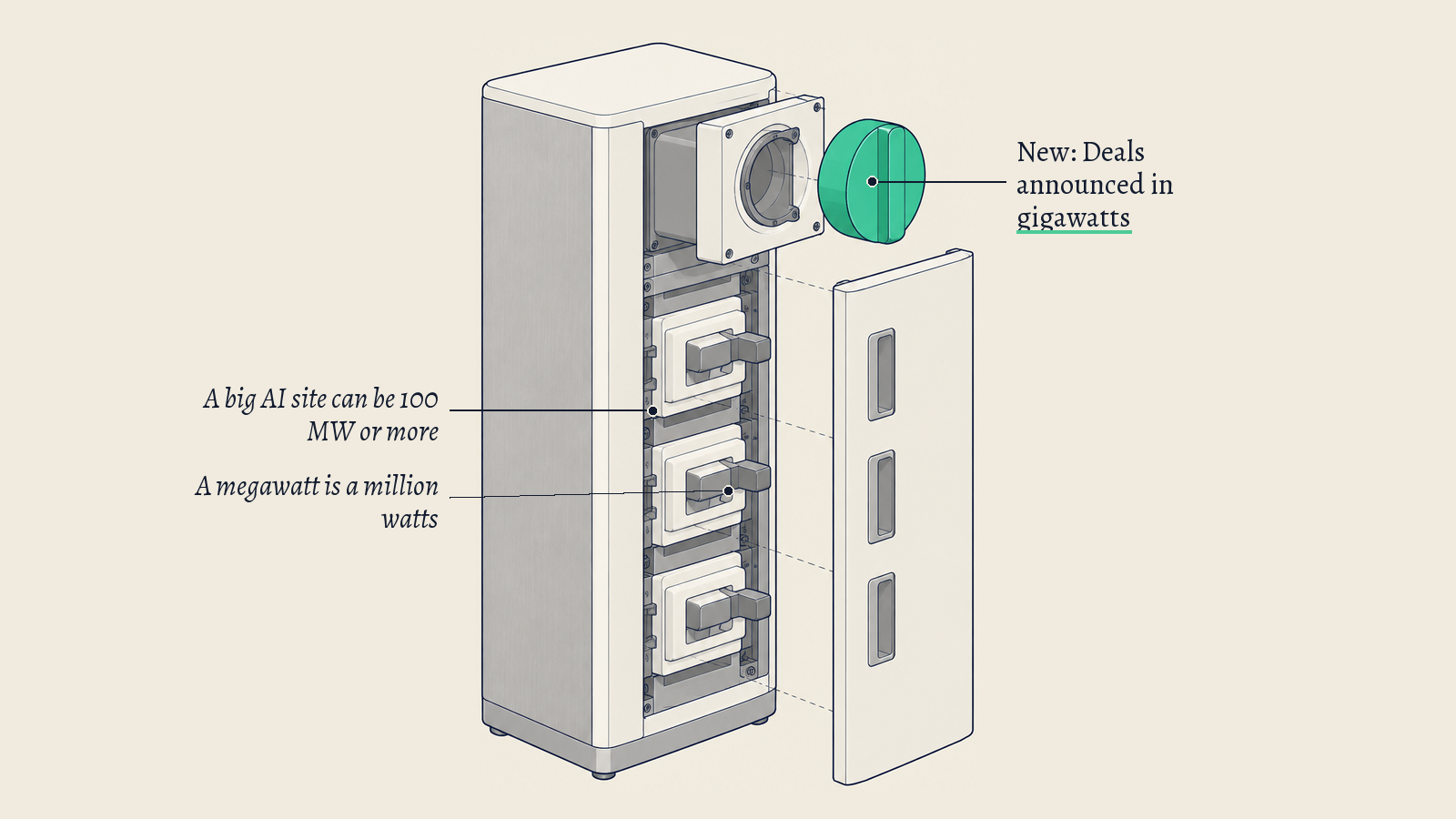
Illustration: A white switchgear cabinet with a row of breaker handles and a large round power dial; the green dial stands for power measured in gigawatts.Illustration made with AI for ai notis

A gigawatt is a billion watts; the IEA's Energy and AI report sizes data centres in megawatts, while AI labs now announce plans in gigawatts.

SOURCENIST · 6 sources
CHECKED11 Oct, 04:27
Compute read
Illustration: A white switchgear cabinet with a row of breaker handles and a large round power dial; the green dial stands for power measured in gigawatts. Compute / 11 OCT

How a gigawatt of power relates to the size of AI data centres

  • A gigawatt is a billion watts and a megawatt a million, according to NIST's table of metric prefixes.
  • The IEA says a conventional data centre may draw 10 to 25 megawatts and a hyperscale AI-focused one 100 or more, as much electricity yearly as 100 000 households.
  • Nvidia and OpenAI announced a letter of intent for at least 10 gigawatts, and Anthropic an agreement with Google and Broadcom for multiple gigawatts from 2027. Both are announced plans.

A gigawatt is a unit of electrical power. In the metric system the prefix giga stands for a billion and mega for a million, so a gigawatt is a billion watts and a megawatt is a million.

The International Energy Agency sizes data centres by their power draw in megawatts. In its Energy and AI report it says a conventional data centre may be around 10 to 25 megawatts, and that a hyperscale, AI-focused data centre can have a capacity of 100 megawatts or more. It says such a site consumes as much electricity annually as 100,000 households.

The report's chart of data centre sizes takes about 2,000 megawatts as the largest data centre under construction and 5,000 megawatts as the largest planned. Its executive summary says the largest ones under construction will consume 20 times as much as a typical AI-focused data centre.

The IEA reports totals in terawatt hours: it estimates data centres used around 415 terawatt hours in 2024, about 1.5% of global electricity consumption.

Two announcements state deals in gigawatts. In September 2025 NVIDIA and OpenAI announced a letter of intent to deploy at least 10 gigawatts of NVIDIA systems, representing millions of GPUs, and said the first gigawatt would be deployed in the second half of 2026. In April 2026 Anthropic said it had signed an agreement with Google and Broadcom for multiple gigawatts of TPU capacity that it expects to come online starting in 2027. Both are plans the companies announced.

The IEA says data centres tend to be highly concentrated, which poses significant challenges to local grids given their substantial power draw. In Ireland it says data centres consume around 20% of the metered electricity supply.

What it means for you Our view

Gigawatts describe the electrical power a site draws, and the two deals are plans the companies announced, not capacity running today. When a vendor quotes gigawatts, ask how many chips it assumes and when each stage is due: Nvidia said in September 2025 that the first gigawatt would be deployed in the second half of 2026. The IEA also says data centres tend to be concentrated, which strains local grids, and that in Ireland they use around 20% of metered electricity. Ask your provider where the capacity for your workloads sits and what happens to your service if power there runs short.

TAGSAnthropicDatacentreIEANvidiaOpenAI

NIST · 6 sources tap to close
NOTHING IN THIS FILTER No story today matches. open the archive →
That's today's news: three stories.

The morning email

On the mornings we publish: the three top stories and up to four short ones. Free.

We email you a link to confirm. An issue may include one sponsor, always labelled Sponsored · Advertisement. Our emails count opens and clicks, not who made them. Unsubscribe in one click. What we keep

1 of 3
Beam: The Great American Open Model with ReflectionAI Co-Founder and CEO Misha Laskin: a video from No Priors: AI, Machine Learning, Tech, & Startups on YouTube Watch on YouTubeVideo: No Priors: AI, Machine Learning, Tech, & Startups on YouTube

Models · 11 OCTnarrowed

Reflection AI's Laskin says open models will take most token demand

On the No Priors podcast, published on YouTube on 9 October, Misha Laskin of Reflection AI gave his account of Beam's training run and his forecast for open models.

  • Laskin says Beam's reinforcement-learning stage used a little over 10,000 GB300s for four weeks (12:47).
  • He says Beam tends to be three to four times more efficient than models of the same capability class, his own claim (20:27).
  • He says gateway token use flipped from about 70/30 closed to 70/30 open over roughly six months (25:27), and expects most token demand to go to open models (26:03).
Checked 11 Oct, 04:38 · No Priors (YouTube) · 1 source
Can AI Keep Growing Exponentially? Let’s Ask SemiAnalysis — With Dylan Patel and Jordan Nanos: a video from Alex Kantrowitz on YouTube Watch on YouTubeVideo: Alex Kantrowitz on YouTube

Compute · 11 OCTnarrowed

SemiAnalysis's Patel: a trillion in AI capex needs $250 billion of revenue a year

On the Big Technology Podcast, published 9 October, Dylan Patel of SemiAnalysis said AI-related capex, supply chain included, will be about $2 trillion next year, and set out his payback arithmetic.

  • Patel says next year's AI-related capex, supply chain included, will be on the order of $2 trillion, which he puts at five or 6% of US GDP (01:58).
  • By his straight-line arithmetic over six years, a trillion dollars of capex needs about $1.5 trillion of revenue, or $250 billion a year (09:55).
  • He says Anthropic is now profitable on revenue minus compute cost, training and inference combined, and OpenAI within two or three quarters, an estimate from SemiAnalysis's model (12:07).
Checked 11 Oct, 04:26 · Alex Kantrowitz (Big Technology) · 1 source
Illustration: A white switchgear cabinet with a row of breaker handles and a large round power dial; the green dial stands for power measured in gigawatts. Illustration made with AI for ai notis

Compute · 11 OCT

How a gigawatt of power relates to the size of AI data centres

A gigawatt is a billion watts; the IEA's Energy and AI report sizes data centres in megawatts, while AI labs now announce plans in gigawatts.

  • A gigawatt is a billion watts and a megawatt a million, according to NIST's table of metric prefixes.
  • The IEA says a conventional data centre may draw 10 to 25 megawatts and a hyperscale AI-focused one 100 or more, as much electricity yearly as 100 000 households.
  • Nvidia and OpenAI announced a letter of intent for at least 10 gigawatts, and Anthropic an agreement with Google and Broadcom for multiple gigawatts from 2027. Both are announced plans.
Checked 11 Oct, 04:27 · NIST · 6 sources

You're all caught up

That's today's news: three stories.

You can join ai notis soon, to follow cases and keep stories on every device.

Follow us on Instagram and Threads

The morning email

On the mornings we publish: the three top stories and up to four short ones. Free.

We email you a link to confirm. An issue may include one sponsor, always labelled Sponsored · Advertisement. Our emails count opens and clicks, not who made them. Unsubscribe in one click. What we keep

No story today matches. Open the archive
Today's stories 3 STORIES

Today's stories

Sun 11 Oct · 3 STORIES
  1. Models · 11 OCT · narrowed

    Reflection AI's Laskin says open models will take most token demand

    Beam: The Great American Open Model with ReflectionAI Co-Founder and CEO Misha Laskin: a video from No Priors: AI, Machine Learning, Tech, & Startups on YouTubeVideo: No Priors: AI, Machine Learning, Tech, & Startups on YouTube

    On the No Priors podcast, published on YouTube on 9 October, Misha Laskin of Reflection AI gave his account of Beam's training run and his forecast for open models.

    Checked 11 Oct, 04:38 · No Priors (YouTube) · 1 sourceRead

  2. Compute · 11 OCT · narrowed

    SemiAnalysis's Patel: a trillion in AI capex needs $250 billion of revenue a year

    Can AI Keep Growing Exponentially? Let’s Ask SemiAnalysis — With Dylan Patel and Jordan Nanos: a video from Alex Kantrowitz on YouTubeVideo: Alex Kantrowitz on YouTube

    On the Big Technology Podcast, published 9 October, Dylan Patel of SemiAnalysis said AI-related capex, supply chain included, will be about $2 trillion next year, and set out his payback arithmetic.

    Checked 11 Oct, 04:26 · Alex Kantrowitz (Big Technology) · 1 sourceRead

  3. Compute · 11 OCT

    How a gigawatt of power relates to the size of AI data centres

    Illustration: A white switchgear cabinet with a row of breaker handles and a large round power dial; the green dial stands for power measured in gigawatts.Illustration made with AI for ai notis

    A gigawatt is a billion watts; the IEA's Energy and AI report sizes data centres in megawatts, while AI labs now announce plans in gigawatts.

    Checked 11 Oct, 04:27 · NIST · 6 sourcesRead

toned down Models 11 OCT

Reflection AI's Laskin says open models will take most token demand

On the No Priors podcast, published on YouTube on 9 October, Misha Laskin of Reflection AI gave his account of Beam's training run and his forecast for open models.

No Priors (YouTube) · 1 source·checked 11 Oct, 04:38
BeamOpen weightsReflection AIreinforcement learning
Beam: The Great American Open Model with ReflectionAI Co-Founder and CEO Misha Laskin: a video from No Priors: AI, Machine Learning, Tech, & Startups on YouTubeVideo: No Priors: AI, Machine Learning, Tech, & Startups on YouTube
toned down Compute

SemiAnalysis's Patel: a trillion in AI capex needs $250 billion of revenue a year

On the Big Technology Podcast, published 9 October, Dylan Patel of SemiAnalysis said AI-related capex, supply chain included, will be about $2 trillion next year, and set out his payback arithmetic.

11 OCT · Alex Kantrowitz (Big Technology) · 1 source
Compute

How a gigawatt of power relates to the size of AI data centres

A gigawatt is a billion watts; the IEA's Energy and AI report sizes data centres in megawatts, while AI labs now announce plans in gigawatts.

11 OCT · NIST · 6 sources
In brief 2 more today
0 of 3 read
Drag a card to start Drag left or right · tap to read more Hover to lift a card · tap to bring it forward Tap again to put it back Tap a card to open it Tap again to close it Tap a headline to read it as a card