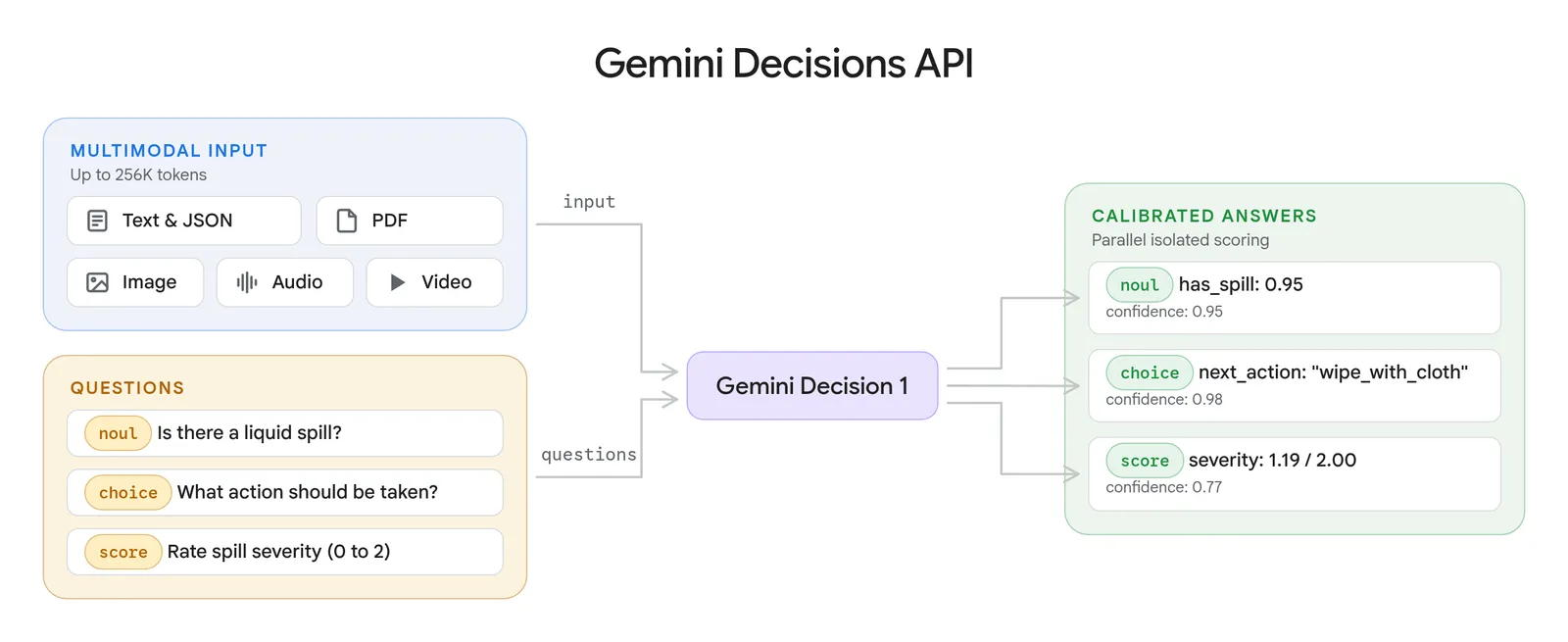
- A request takes shared input up to 262,144 tokens and up to 1,000 independent questions; a yes/no answer returns a probability from 0.01 to 0.99.
- Google says median latency is 150-250 ms up to 16K tokens, and it is nearly 5x cheaper than Gemini 3.5 Flash-Lite with the Interactions API across the shared benchmark suite.
- The paid tier costs $0.10 per million input tokens and $0 for output; context caching, the Batch API, and Flex or Priority inference are not supported.
Google released the Gemini Decisions API on 11 November, an endpoint that answers yes/no, multiple-choice and rubric questions about one shared input and returns probabilities instead of text. It runs on a new model, gemini-decision-1, in the Gemini API's v1beta version. Google DeepMind's Min Choi and Felix Yu announced it in a blog post.
Google says it is meant for bounded choices such as tool selection, policy checks, model routing and context grading. One request can carry text, images, audio, video or PDFs up to 262,144 tokens and up to 1,000 independent questions. A yes/no answer comes back with a probability and a confidence score, a choice question takes 2 to 255 options, and a rubric question takes 2 to 255 ordered levels.
Google says the model leads on benchmarks spanning agent routing, reasoning, ranking and multimodal understanding, with the lowest calibration error. The post's text does not name those benchmarks, and the comparison is Google's own. It also says the model scores options without token-by-token decoding, a median of 150 to 250 milliseconds for contexts up to 16K tokens, and that it is nearly 5 times cheaper across the shared benchmark suite than Gemini 3.5 Flash-Lite with the Interactions API.
Google says one of its own products, Gemini Notebook, uses it as a router. Google says Gemini Notebook uses the API to send each query to the right model tier and thinking level, which it says serves everyday queries with up to 40% lower latency.
The paid tier costs $0.10 per million input tokens, with no charge for output because the model generates none. The shared input is billed once per request however many questions are asked, and each question adds only its own instructions and criteria. There is a free tier in Google AI Studio for prototyping.
The docs list limits: no context caching, no Batch API, and no Flex or Priority inference. They also tell developers to treat input as untrusted, because user-supplied text can argue for its own classification. Google says integrations are rolling out across OpenRouter, LangChain, Vercel, LiteLLM, Pydantic AI, Pipecat, LiveKit and OpenCode, with support for Gemini in Google Cloud coming soon.
This note continues the case on typed decision models and APIs.
What it means for you Our view
The API is built for bounded choices such as routing, policy checks and context grading, so it suits a different job from a general model. Google's latency and cost comparisons are its own, and the post's text does not name the benchmarks behind them. The docs also warn that user-supplied text can argue for its own classification, which matters when an answer gates an action. Compare the listed limits with your own request volume before you build a routing layer on it.
TAGSGeminiGemini Decisions APIGoogle