- BIS guidance dated 31 May 2026 requires a licence to export advanced computing items to entities headquartered in Country Group D:5 or Macau, or with a parent that is.
- BIS defines total processing performance (TPP) as 2 x MacTOPS x the bit length of the operation, added over all processing units on the chip.
- The October 2023 rule's revised ECCN 3A090.a controls chips with a TPP of 4800 or more, or 1600 or more with a performance density of 5.92 or more.
A US licence is needed to ship advanced AI chips to a company headquartered in Macau or a Country Group D:5 country, or owned by a parent that is, even when the company itself sits in another country. The Commerce Department's Bureau of Industry and Security (BIS) restated this in guidance dated 31 May 2026. The controls turn on a performance score rather than a product name.
That score is called total processing performance, or TPP. BIS defines it as 2 x MacTOPS x the bit length of the operation, added up over all the processing units on the chip. MacTOPS is the theoretical peak number of trillions of multiply-accumulate operations per second.
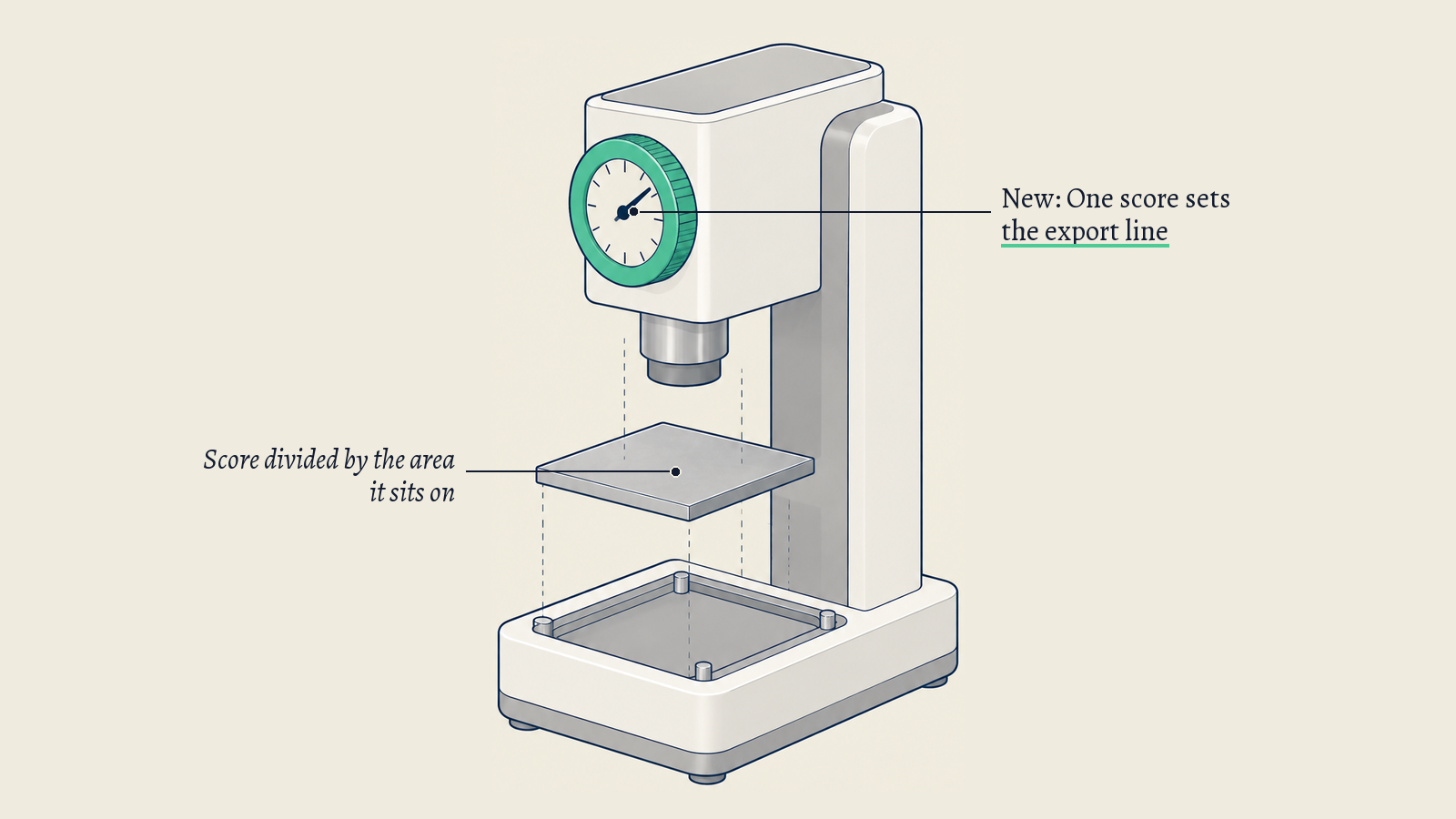
The rules work in tiers. In the October 2023 rule, the top tier, ECCN 3A090.a, covered chips with a TPP of 4800 or more, or a TPP of 1600 or more together with a performance density of 5.92 or more. Performance density is TPP divided by the chip's die area. BIS added it so that buyers could not get round the rule by buying many smaller chips that together are as powerful as a restricted one.
The second tier, 3A090.b, covered chips with a TPP of 2400 to under 4800 and a performance density of 1.6 to under 5.92, or a TPP of 1600 or more and a density of 3.2 to under 5.92. BIS treated the tiers differently. The most powerful chips needed a licence for any destination in Country Groups D:1, D:4 or D:5 that is not also in A:5 or A:6. For the less powerful tier BIS offered licence exception NAC, but using it requires pre-notification of an export or reexport to Macau or a D:5 destination.
In a final rule effective 15 January 2026, BIS moved licence review for chips below set TPP and DRAM-bandwidth limits, such as Nvidia's H200, from a presumption of denial to case by case for China and Macau end users.
The headquarters test answers a concern about diversion. When BIS widened its end-use controls in 2023 it cited "ongoing national security concerns related to diversion and misuse of items subject to the EAR", and it said it was acting against "transshipment and diversion" by PRC operations. The May 2026 guidance says the headquarters-based licence requirement dates from 17 November 2023, and that it continues to apply even though BIS said in May 2025 that it would not enforce the new compliance requirements of the AI Diffusion Rule.
There are limits. BIS says bona fide data-centre operators need not stop using, storing or servicing chips they already run because of the guidance, until BIS says otherwise. A BIS FAQ updated on 17 June 2026 adds that the guidance covers 3A090.a chips and every other advanced computing item that contains one, including 4A090.a systems and related .z items.
What it means for you Our view
The score decides which tier a chip falls in, and the headquarters test decides whether the buyer's own location matters at all: the guidance applies when the entity or its ultimate parent is headquartered in a listed place, even if the entity sits elsewhere. BIS says bona fide data-centre operators need not stop using, storing or servicing chips they already run because of the guidance, until further notice, so watch for that notice. Before your next purchase or hosting contract involving advanced accelerators, write down each chip's TPP and each buyer's ultimate parent headquarters, and ask your export-compliance adviser to confirm both.
TAGSAMDBISExport controlsNvidia