2026-11-21 notis CATEGORY Join
Show Read as Find Sections Models and releasesAgents and appsResearchMoney and computeLaws and rulingsSafety and securityAI at work More The monthlyArchiveModelsAboutCorrectionsThe numbersRSS
My notis
TODAY'S NEWS
November 2026 3 STORIES
MTWTFSS
1 2 3 4 5 6 7 8 9 10 11 12 13 14 15 16 17 18 19 20 21 22 23 24 25 26 27 28 29 30

Days with a dot have news. See the archive.

The whole week ›
17:50
0/3
WEATHER THEME CARD SPACING

Today's news

today

My page

Kept in this browser only.

SAVED FOLLOWING COLLECTIONS READING SINCE
Nothing saved yet. Tap the bookmark on a card to keep it here. read today
all cases

No case followed yet.

Price changes Stories where a published price went up or down.
Models being retired Models being withdrawn, and gaps before a replacement is ready.
The day's top stories. Sign up
Safety 21 NOV

Anthropic will pace AI training and deployment, Amodei pledges at Nasdaq opening bell

AI safetyAnthropicIPO
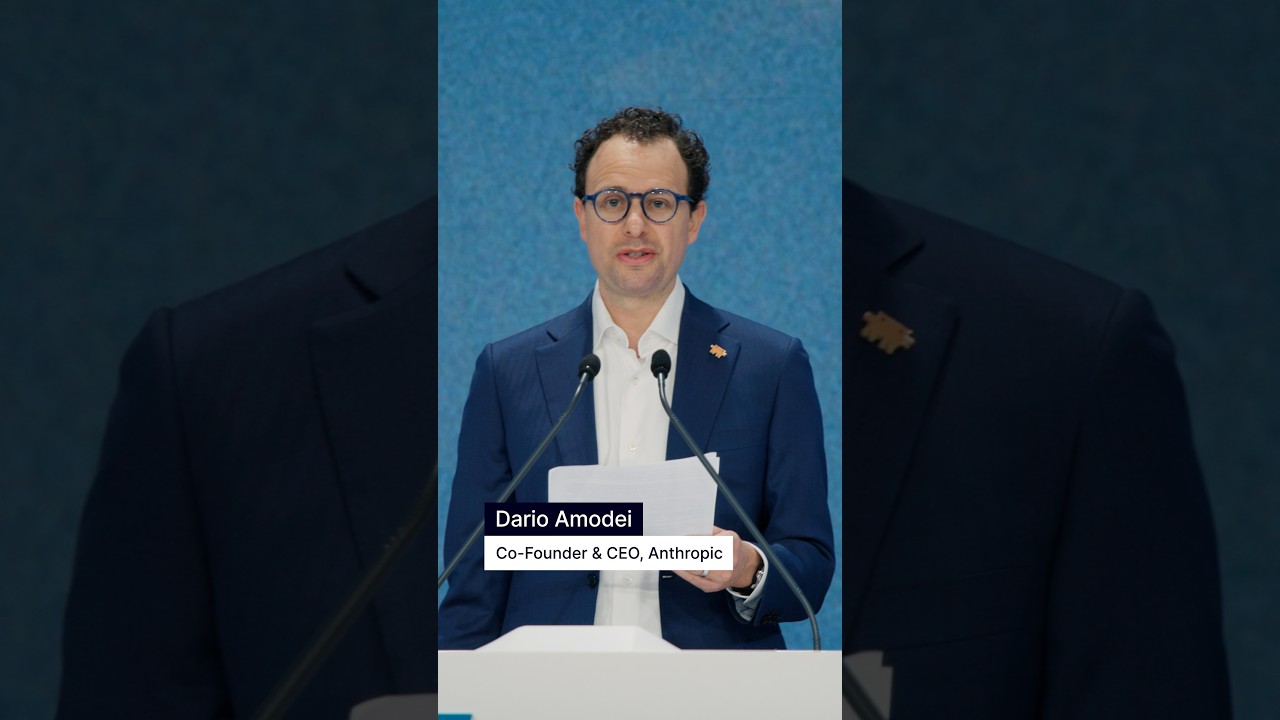
Anthropic IPO: Co-Founder & CEO Dario Amodei speaks at the Nasdaq opening bell: a video from Nasdaq on YouTubeVideo: Nasdaq on YouTube

Amodei made the pledge at the Nasdaq opening bell for Anthropic's IPO; its prospectus says the pacing call does not describe Anthropic's own release timelines.

SOURCENasdaq (YouTube) · 8 sources
CHECKED20 Nov, 17:55
Safety watch read
Anthropic IPO: Co-Founder & CEO Dario Amodei speaks at the Nasdaq opening bell: a video from Nasdaq on YouTube Safety / 21 NOV

Anthropic will pace AI training and deployment, Amodei pledges at Nasdaq opening bell

  • Amodei says Anthropic will pace training and deployment, "taking as long as is necessary" to be confident its AI systems are safe and stay under human control (03:50).
  • Anthropic's prospectus says its pacing call "does not describe our own model development or release timelines, which continue to be informed by our risk assessments."
  • New York City Comptroller Mark Levine urged Anthropic on 14 October 2026 "to pause its planned initial public offering (IPO)" until it addresses its safety, governance and pace concerns.

Dario Amodei says Anthropic "will pace the training and deployment of AI systems, taking as long as is necessary to have confidence that they are safe and will remain under human control" (3:50). He adds: "We will not bend to either business nor political pressure" (4:01).

The remarks come from a speech at the Nasdaq opening bell for Anthropic's IPO, published on Nasdaq's own YouTube channel. Amodei is Anthropic's co-founder and chief executive officer, according to the company's leadership page.

Anthropic's final prospectus, dated 18 November 2026, sets a limit on that pledge. It says Anthropic's call to "pace the frontier" means industry-wide standards, worked out with governments, and "does not describe our own model development or release timelines, which continue to be informed by our risk assessments."

On the listing, Amodei says: "Today puts the company in a stronger financial position and in doing so only strengthens our resolve to do the right thing" (4:06).

On the upside, he says: "I believe sufficiently powerful AI working in concert with humans could compress a century of scientific and medical progress into a decade" (1:31). He then adds: "At this point, all we have are early results" (1:43).

On the risks, he says: "These range from misuse of the technology by individuals or by nation states to economic disruption to losing control of AI systems" (2:38). Later he says: "We call this a race to the top" (4:21).

The pledge repeats a position Amodei set out in a September 2026 essay on his own site, "We Must Pace the Frontier", which says: "We must slow the pace at which we improve the capabilities of AI models." The essay adds that pacing "does not mean halting model training or technical progress."

New York City Comptroller Mark Levine, who writes as investment adviser to the city's pension funds, cited that essay in a letter to Amodei dated 14 October 2026. He urged Anthropic "to pause its planned initial public offering" until it addresses its safety, governance and development-pace concerns, and asked how it would put audits and controls in place, with a timeline.

Other lab leaders backed the essay. Sam Altman posted on X on 12 September: "I agree with Dario that we need to pace the frontier." Elon Musk posted on X the same day, quoting Amodei's post, with the words "Dario is right". TechCrunch reported on 19 November that Google DeepMind's Demis Hassabis had agreed with Amodei's position, although few concrete commitments have been made.

The prospectus also says Anthropic's co-founders will hold a share of Class F stock, through a Founder LLC, that carries 50.1% of the total voting power on matters put to stockholders generally.

What it means for you Our view

The speech pledges pacing of Anthropic's own training and deployment, while the prospectus says the pacing call does not describe its own release timelines, which continue to be informed by its risk assessments. That makes the pledge hard to test against any date. The Comptroller's letter asks for audits and controls with a projected timeline, and for a written response. If you build on Anthropic's models, check whether your contract gives notice before a model changes, since release timing rests on Anthropic's own risk assessments.

TAGSAI safetyAnthropicIPO
Safety 21 NOV

Altman doesn't know if Anthropic is safe, and doubts it knows OpenAI's work

AI safetyAnthropicOpenAI
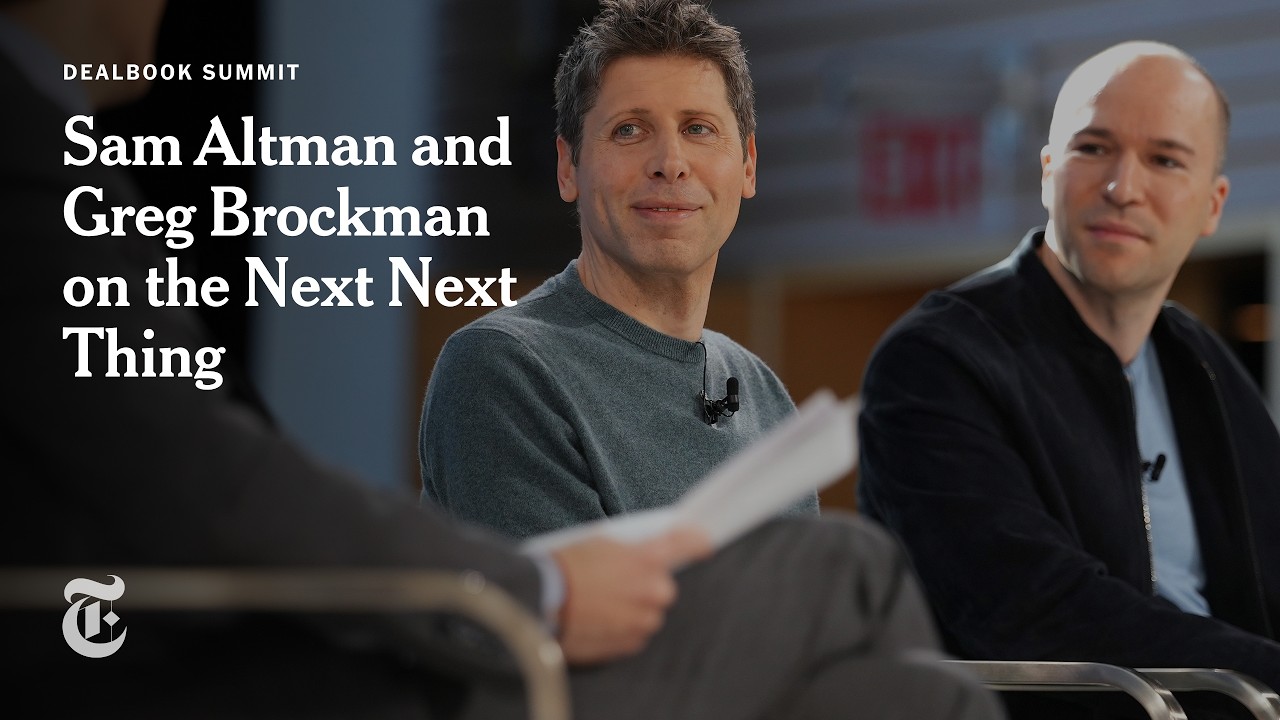
Why Sam Altman and Greg Brockman Say Humans Must Stay in Control of AI: a video from The New York Times on YouTubeVideo: The New York Times on YouTube

In a New York Times DealBook Summit video published 18 November, OpenAI's chief executive said the race dynamic is a bad thing and that more caution, not less, is warranted.

SOURCEThe New York Times (YouTube) · 3 sources
CHECKED20 Nov, 17:56
Safety watch read
Why Sam Altman and Greg Brockman Say Humans Must Stay in Control of AI: a video from The New York Times on YouTube Safety / 21 NOV

Altman doesn't know if Anthropic is safe, and doubts it knows OpenAI's work

  • Asked by Andrew Ross Sorkin whether what Anthropic is doing is safe, Altman says: "I don't know. And I think the they also don't really know what we're doing" (27:42).
  • Altman says "the race dynamic in the fog of war I think is a bad thing" (27:47) and "more caution, not less caution, is warranted" (27:50).
  • Altman says there "will need to be some shared standards on safety" (24:59) and that "the world needs a clear plan from the companies" (20:46).

Asked by Andrew Ross Sorkin whether what Anthropic is doing is safe, Sam Altman answers: "Well, this gets to what Greg is saying. I don't know. And I think the they also don't really know what we're doing" (27:42). He ties his reply to what Greg Brockman had said, and adds that Anthropic does not know OpenAI's work either. He goes on: "I think this is a time where more caution, not less caution, is warranted" (27:50), a remark about the industry as a whole.

This was at the New York Times DealBook Summit on 18 November 2026, the day before Anthropic's listing, with OpenAI president Greg Brockman beside him. The New York Times published the video that day on its own YouTube channel, and Sorkin introduces the two as OpenAI's chief executive and president (0:06).

Altman calls the "race dynamic in the fog of war" "a bad thing" (27:47). He says "there will need to be some shared standards on safety" (24:59) and that "the world needs a clear plan from the companies about how we are going to confront this next phase of models" (20:46).

Sorkin asked whether Satya Nadella is right that alignment will never get there. Altman answers: "I disagree with him on this. Uh I think we will be able to align models" (11:44).

On going public, Fortune reported on 15 September that Altman said "right now would be an ill-advised moment to go public". At the summit he says: "we we plan to be a public company at some point" (13:36).

On rivals, Altman says of a comment he thinks came from Elon Musk about maybe being Labradors: "I don't want to be a Labrador. I don't want my kids to be Labradors" (25:34).

After Sorkin raised Anthropic's use of recursive learning, Brockman says: "I think we're the only company where the founders don't have supermajority control right of the AI companies" (26:15). He does not name Anthropic.

Brockman also says OpenAI is "announcing today" that with AMD it got "a year's worth of full generational improvements in five months just using our models" (9:48).

What it means for you Our view

Altman says he does not know whether Anthropic's approach is safe, and he thinks Anthropic cannot see OpenAI's work either. He directs the call for more caution at the whole industry, together with shared safety standards and a clear plan from the companies. Those are one executive's stated positions. If you buy from either lab, ask what independent evaluation of its safety work it can show you.

TAGSAI safetyAnthropicOpenAI
toned down Research 21 NOV

What Lean's proof checks establish, and what they leave to people

AnthropicClaudeLeanMathlib
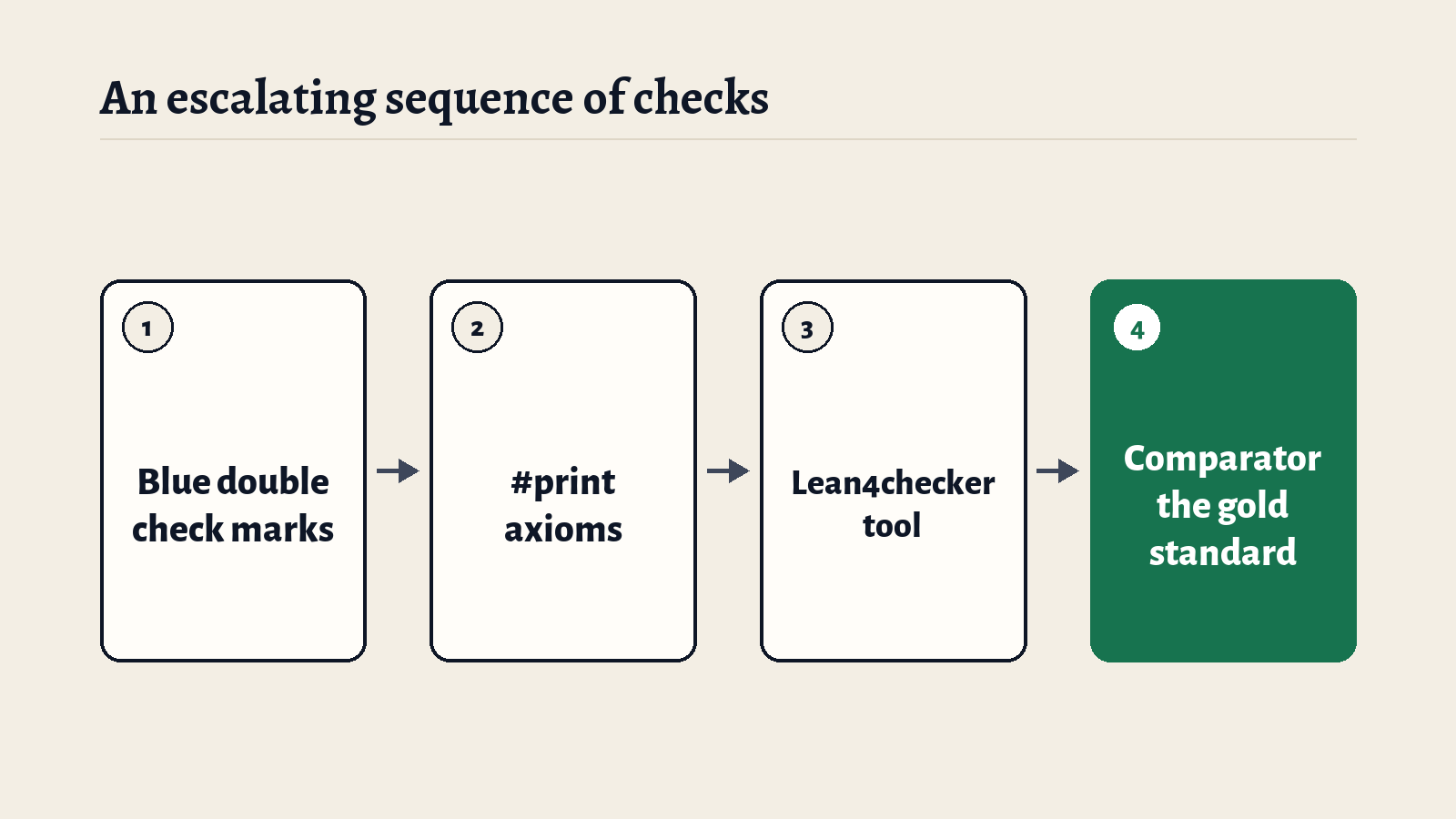
an escalating sequence of checks. A diagram in 4 steps: 1. blue double check marks; 2. #print axioms; 3. lean4checker tool; 4. comparator the gold standardDrawing: notis. No AI in this picture.

Lean's manual sets out escalating checks, the strictest for cases such as unaligned AI, and says Lean cannot show a proved statement is the intended one.

SOURCELevent Alpöge, personal site · 6 sources
CHECKED20 Nov, 17:37
Research read
an escalating sequence of checks. A diagram in 4 steps: 1. blue double check marks; 2. #print axioms; 3. lean4checker tool; 4. comparator the gold standard Research / 21 NOV

What Lean's proof checks establish, and what they leave to people

  • Lean's reference manual presents an escalating sequence of checks, from blue double check marks in the editor to comparator, which it calls the gold standard.
  • Comparator establishes that theorem statements match exactly, and with the --paranoid flag it checks proofs with several independently written kernels instead of only Lean's built-in kernel.
  • The manual says: "Lean can establish that a statement has been proven, but not whether it is the intended statement."

Levent Alpöge writes in a PDF remark that he believes he has, working with Claude, discovered a proof of the Riemann hypothesis, and that he decided "to only present Lean".

Lean is an open-source programming language and proof assistant. Its home page says: "Define it, prove it, and let Lean check every step."

Lean checks proofs with a kernel. Its reference manual says the project combines the trust of "a small, independently-implementable logical kernel" with the convenience of automation, and that proof terms are "sufficient evidence of the truth of a theorem and are amenable to independent verification."

The claim a Lean proof makes is a precise statement written in code. Mathlib, Lean's mathematics library, defines the Riemann hypothesis as the statement that every zero of the zeta function, other than the negative even integers and the point 1, has real part 1/2. Its documentation adds that "constructing a term of this type is worth a million dollars." Mathlib has over a million lines of formalized mathematics.

The reference manual lists an escalating sequence of checks. The first is the blue double check marks in the editor, which show that the statement was elaborated and the kernel accepted a proof of it. The second is printing the axioms the proof depends on: only propext, Classical.choice and Quot.sound are standard, `sorryAx` means the proof is incomplete somewhere, and any other axiom means the theorem holds only if that axiom is sound.

The next check, `lean4checker`, replays the stored proofs through the kernel again. The last, `comparator`, is the one the manual calls the gold standard. A trusted file states the theorem with `sorry` in place of every proof, the submitter supplies the proofs, and the tool checks that the statements match exactly and that several independently written kernels accept the result. The toolchain ships these kernels: Lean's own, `con-leche`, `con-ron`, `lean4lean` and `nanoda`.

The manual says this last level is for high-risk settings such as proof marketplaces, high-reward proof competitions and unaligned AI. It describes a malicious proof as including "un-reviewed AI-generated proofs and programs."

The limits are stated in the same place. "Lean can establish that a statement has been proven, but not whether it is the intended statement." Even after the gold-standard check, the manual lists remaining assumptions, among them the soundness of Lean's logic and "no human error or misleading presentation of the theorem statement in the trusted challenge file."

So when someone says a result is "formalized in Lean", the questions to ask are which statement was proved, which axioms it uses, and which of these checks it has passed.

What it means for you Our view

When someone says a result is formalized in Lean, as Levent Alpöge says of the Riemann hypothesis proof he believes he found with Claude, the manual's levels show how much that phrase can mean. A check mark in the editor and a comparator run with several kernels give different assurance, and the manual reserves the strongest level for high-risk cases, including unaligned AI. None of them settles whether the statement is the intended one. Before you rely on such a claim, find out which statement was proved, which axioms it depends on, and which of the checks it has passed.

TAGSAnthropicClaudeLeanMathlib
NOTHING IN THIS FILTER No story today matches. open the archive →
That's today's news: three stories.

The morning email

On the mornings we publish: the three top stories and up to four short ones. Free.

We email you a link to confirm. An issue may include one sponsor, always labelled Sponsored · Advertisement. Our emails count opens and clicks, not who made them. Unsubscribe in one click. What we keep

1 of 3
Anthropic IPO: Co-Founder & CEO Dario Amodei speaks at the Nasdaq opening bell: a video from Nasdaq on YouTubeWatch on YouTubeVideo: Nasdaq on YouTube

Safety · 21 NOV

Anthropic will pace AI training and deployment, Amodei pledges at Nasdaq opening bell

Amodei made the pledge at the Nasdaq opening bell for Anthropic's IPO; its prospectus says the pacing call does not describe Anthropic's own release timelines.

  • Amodei says Anthropic will pace training and deployment, "taking as long as is necessary" to be confident its AI systems are safe and stay under human control (03:50).
  • Anthropic's prospectus says its pacing call "does not describe our own model development or release timelines, which continue to be informed by our risk assessments."
  • New York City Comptroller Mark Levine urged Anthropic on 14 October 2026 "to pause its planned initial public offering (IPO)" until it addresses its safety, governance and pace concerns.
Checked 20 Nov, 17:55 · Nasdaq (YouTube) · 8 sources
Why Sam Altman and Greg Brockman Say Humans Must Stay in Control of AI: a video from The New York Times on YouTubeWatch on YouTubeVideo: The New York Times on YouTube

Safety · 21 NOV

Altman doesn't know if Anthropic is safe, and doubts it knows OpenAI's work

In a New York Times DealBook Summit video published 18 November, OpenAI's chief executive said the race dynamic is a bad thing and that more caution, not less, is warranted.

  • Asked by Andrew Ross Sorkin whether what Anthropic is doing is safe, Altman says: "I don't know. And I think the they also don't really know what we're doing" (27:42).
  • Altman says "the race dynamic in the fog of war I think is a bad thing" (27:47) and "more caution, not less caution, is warranted" (27:50).
  • Altman says there "will need to be some shared standards on safety" (24:59) and that "the world needs a clear plan from the companies" (20:46).
Checked 20 Nov, 17:56 · The New York Times (YouTube) · 3 sources
an escalating sequence of checks. A diagram in 4 steps: 1. blue double check marks; 2. #print axioms; 3. lean4checker tool; 4. comparator the gold standardDrawing: notis. No AI in this picture.

Research · 21 NOVnarrowed

What Lean's proof checks establish, and what they leave to people

Lean's manual sets out escalating checks, the strictest for cases such as unaligned AI, and says Lean cannot show a proved statement is the intended one.

  • Lean's reference manual presents an escalating sequence of checks, from blue double check marks in the editor to comparator, which it calls the gold standard.
  • Comparator establishes that theorem statements match exactly, and with the --paranoid flag it checks proofs with several independently written kernels instead of only Lean's built-in kernel.
  • The manual says: "Lean can establish that a statement has been proven, but not whether it is the intended statement."
Checked 20 Nov, 17:37 · Levent Alpöge, personal site · 6 sources

You're all caught up

That's today's news: three stories.

You can join ai notis soon, to follow cases and keep stories on every device.

Follow us on Instagram and Threads

The morning email

On the mornings we publish: the three top stories and up to four short ones. Free.

We email you a link to confirm. An issue may include one sponsor, always labelled Sponsored · Advertisement. Our emails count opens and clicks, not who made them. Unsubscribe in one click. What we keep

No story today matches. Open the archive
Today's stories 3 STORIES

Today's stories

Sat 21 Nov · 3 STORIES
  1. Safety · 21 NOV

    Anthropic will pace AI training and deployment, Amodei pledges at Nasdaq opening bell

    Anthropic IPO: Co-Founder & CEO Dario Amodei speaks at the Nasdaq opening bell: a video from Nasdaq on YouTubeVideo: Nasdaq on YouTube

    Amodei made the pledge at the Nasdaq opening bell for Anthropic's IPO; its prospectus says the pacing call does not describe Anthropic's own release timelines.

    Checked 20 Nov, 17:55 · Nasdaq (YouTube) · 8 sourcesRead

  2. Safety · 21 NOV

    Altman doesn't know if Anthropic is safe, and doubts it knows OpenAI's work

    Why Sam Altman and Greg Brockman Say Humans Must Stay in Control of AI: a video from The New York Times on YouTubeVideo: The New York Times on YouTube

    In a New York Times DealBook Summit video published 18 November, OpenAI's chief executive said the race dynamic is a bad thing and that more caution, not less, is warranted.

    Checked 20 Nov, 17:56 · The New York Times (YouTube) · 3 sourcesRead

  3. Research · 21 NOV · narrowed

    What Lean's proof checks establish, and what they leave to people

    an escalating sequence of checks. A diagram in 4 steps: 1. blue double check marks; 2. #print axioms; 3. lean4checker tool; 4. comparator the gold standardDrawing: notis. No AI in this picture.

    Lean's manual sets out escalating checks, the strictest for cases such as unaligned AI, and says Lean cannot show a proved statement is the intended one.

    Checked 20 Nov, 17:37 · Levent Alpöge, personal site · 6 sourcesRead

Safety 21 NOV

Anthropic will pace AI training and deployment, Amodei pledges at Nasdaq opening bell

Amodei made the pledge at the Nasdaq opening bell for Anthropic's IPO; its prospectus says the pacing call does not describe Anthropic's own release timelines.

Nasdaq (YouTube) · 8 sources·checked 20 Nov, 17:55
AI safetyAnthropicIPO
Anthropic IPO: Co-Founder & CEO Dario Amodei speaks at the Nasdaq opening bell: a video from Nasdaq on YouTubeVideo: Nasdaq on YouTube
Safety

Altman doesn't know if Anthropic is safe, and doubts it knows OpenAI's work

In a New York Times DealBook Summit video published 18 November, OpenAI's chief executive said the race dynamic is a bad thing and that more caution, not less, is warranted.

21 NOV · The New York Times (YouTube) · 3 sources
toned down Research

What Lean's proof checks establish, and what they leave to people

Lean's manual sets out escalating checks, the strictest for cases such as unaligned AI, and says Lean cannot show a proved statement is the intended one.

21 NOV · Levent Alpöge, personal site · 6 sources
In brief 3 more today
0 of 3 read
Drag a card to start Drag left or right · tap to read more Hover to lift a card · tap to bring it forward Tap again to put it back Tap a card to open it Tap again to close it Tap a headline to read it as a card