2026-11-16 notis CATEGORY Join
Show Read as Find Sections Models and releasesAgents and appsResearchMoney and computeLaws and rulingsSafety and securityAI at work More The monthlyArchiveModelsAboutCorrectionsThe numbersRSS
My notis
TODAY'S NEWS
November 2026 3 STORIES
MTWTFSS
1 2 3 4 5 6 7 8 9 10 11 12 13 14 15 16 17 18 19 20 21 22 23 24 25 26 27 28 29 30

Days with a dot have news. See the archive.

The whole week ›
08:09
0/3
WEATHER THEME CARD SPACING

Today's news

today

My page

Kept in this browser only.

SAVED FOLLOWING COLLECTIONS READING SINCE
Nothing saved yet. Tap the bookmark on a card to keep it here. read today
all cases

No case followed yet.

Price changes Stories where a published price went up or down.
Models being retired Models being withdrawn, and gaps before a replacement is ready.
The day's top stories. Sign up
toned down Compute 16 NOV

Claude maker Anthropic expects IPO pricing on 18 November, trading 19 November

AnthropicIPONasdaqSEC
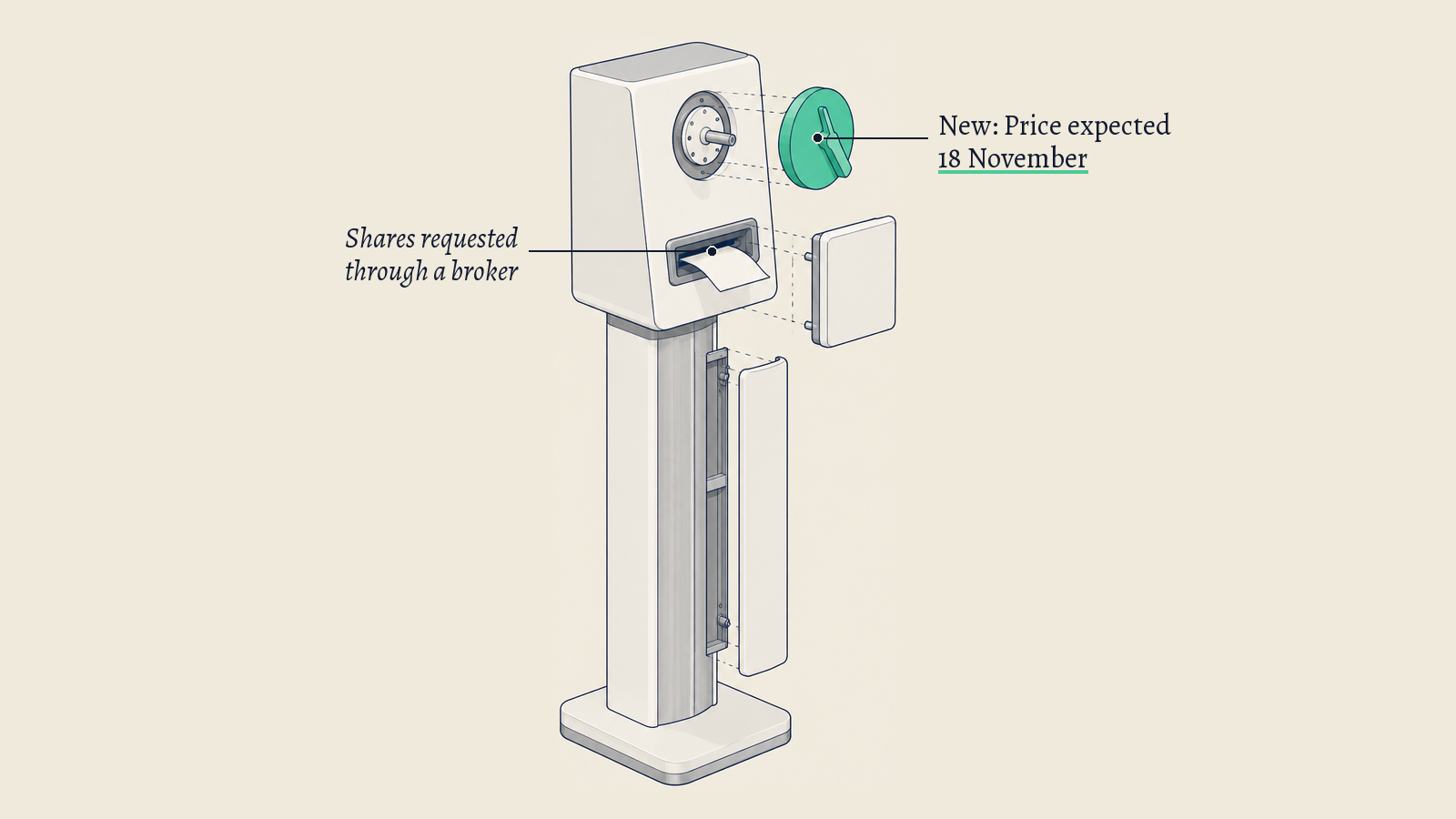
Illustration: A freestanding white booking kiosk with a ticket slot; its green round dial stands for the date the IPO price is set.Illustration made with AI for ai notis

Anthropic's S-1/A says it delivers Claude through its models, platform and applications, among them Claude Code and Claude Cowork; UK retail applications close on 18 November.

SOURCESEC · 7 sources
CHECKED15 Nov, 18:02
Compute read
Illustration: A freestanding white booking kiosk with a ticket slot; its green round dial stands for the date the IPO price is set. Compute / 16 NOV

Claude maker Anthropic expects IPO pricing on 18 November, trading 19 November

  • Anthropic's IPO website FAQ says the final price is expected to be set on 18 November and trading to begin on 19 November, subject to regulatory clearance.
  • The 10 November S-1/A estimates $70.00 to $78.00 a share for 825,000,000 Class A shares, to be listed on Nasdaq as ANT.
  • UK retail applications close on 18 November, with each intermediary setting its own closing time; the Australian offer closes at 5:00pm on 17 November (AEDT).

Anthropic expects to set its final IPO share price on 18 November 2026 (US Eastern time) and to start trading on Nasdaq on 19 November, according to the FAQ on its own IPO website. The site's screenshots are part of a free writing prospectus Anthropic filed with the SEC on 12 November.

The price range itself is in the S-1/A that Anthropic filed on 10 November: between $70.00 and $78.00 a share for 825 million Class A shares, 801,351,354 of them sold by Anthropic and 23,648,646 by selling stockholders, with the stock to be listed on Nasdaq as ANT. The filing says Anthropic expects retail investors to receive up to 20% of the shares offered, depending on demand. CNBC reported, citing people familiar with the deal, that the order book was already covered at the $70 to $78 range.

The same FAQ says the price depends on regulatory clearance, investor demand and market conditions. It says people can request shares through a participating brokerage platform, that no one is guaranteed to receive all or any of the shares they apply for, and that the brokerage account or app confirms eligibility and, on the first day of trading, the allocation.

Retail investors outside the US have their own windows. In the UK, the offer runs through RetailBook and applications close on 18 November, with each broker setting its own closing time. In Australia, the offer closes at 5:00pm on 17 November Sydney time. In Japan, Anthropic's filing gives the amount of the offering there as US$3.0 billion to US$3.5 billion.

The website's financial highlights give Q3 2026 revenue of $17.0 billion and a net loss of $23.3 billion, which Anthropic says includes a $21.9 billion non-cash charge from a change in the fair value of convertible notes, derivative liabilities and SAFEs.

EDGAR's filing list for Anthropic shows no final prospectus yet, and the registration statement is still not effective.

What it means for you Our view

If you want to apply for shares, request them through a participating brokerage platform before your window closes: the Australian offer closes first, then the UK one. The FAQ says no investor is guaranteed any of the shares applied for, and the broker confirms eligibility and, on the first trading day, the allocation. Until the price is set it remains a range, and Anthropic says the final price depends on regulatory clearance, investor demand and market conditions. CNBC reported, citing people familiar with the deal, that the book was already covered at that range; the filings do not say so. EDGAR showed no final prospectus when we looked on 15 November. Find your broker's own closing time and the date it will confirm your allocation.

TAGSAnthropicIPONasdaqSEC
SEC · 7 sources tap to close
Laws 16 NOV

Existing generative AI systems in the EU must mark output by 2 December

EU AI ActEuropean CommissionMarking and labelling code
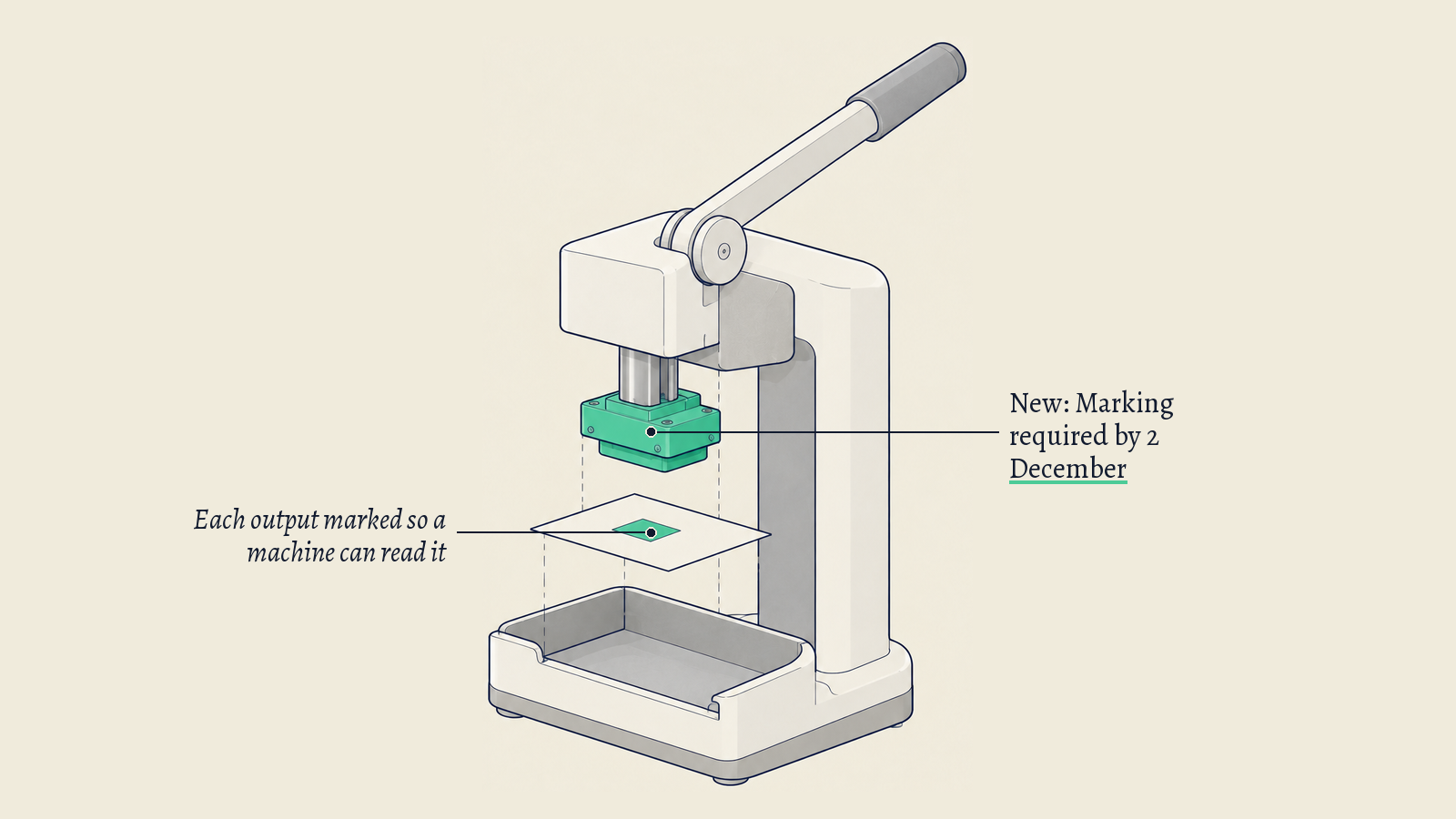
Illustration: A white bench-top stamping press with a tray of finished sheets; its green stamping head stands for the duty to mark generated output.Illustration made with AI for ai notis

Fines can reach up to 15 million euros or 3% of worldwide turnover; the Commission says Article 50 applies from 2 August, with only marking by earlier systems delayed to 2 December.

SOURCEEuropean Commission · 5 sources
CHECKED15 Nov, 17:35
Laws read
Illustration: A white bench-top stamping press with a tray of finished sheets; its green stamping head stands for the duty to mark generated output. Laws / 16 NOV

Existing generative AI systems in the EU must mark output by 2 December

  • The Commission's FAQ says Article 50 applies from 2 August 2026; systems placed on the market before then must meet the marking duty only from 2 December 2026.
  • Article 50(2) requires outputs of systems that generate audio, image, video or text to be marked machine-readably; the Commission lists watermarks, metadata and fingerprints.
  • The FAQ says providers outside the EU are covered if their output is used in the EU; fines can reach up to 15 million euros or 3% of worldwide turnover.

Providers of generative AI systems that were already on the EU market before 2 August 2026 have until 2 December 2026 to mark their outputs in a machine-readable way, according to the European Commission's FAQ on Article 50 of the AI Act. Everything else in Article 50 has applied since 2 August. This is a European rule: it covers providers outside the EU if the output of their system is used in the EU.

The grace period is narrow. The Commission says it covers only the marking and detection duty in Article 50(2), and only for systems placed on the market before 2 August 2026; content generated before that date does not need to be labelled retroactively.

The grace period comes from Regulation (EU) 2026/1744, the Digital Omnibus on AI, published in the Official Journal on 24 July 2026; its recital 38 refers to a four-month transitional period for providers already on the market.

Article 50(2) requires providers of systems that generate synthetic audio, image, video or text to ensure outputs are marked in a machine-readable format and detectable as artificially generated or manipulated. The Commission lists watermarks, metadata, cryptographic methods, logging and fingerprints as possible techniques.

Fines can reach up to 15 million euros or 3% of total worldwide turnover for the preceding financial year, according to the same FAQ. The Commission published a final voluntary Code of Practice on marking and labelling on 10 June 2026, and says signatories can rely on it to show compliance.

What it means for you Our view

If your system generates audio, image, video or text and was on the EU market before 2 August 2026, plan for machine-readable marking to be in place by 2 December 2026; a system placed on the market since then is already covered. The grace period covers marking only, so the other Article 50 duties already apply, and a provider outside the EU is covered when its output is used in the EU. The Commission says signatories of its voluntary Code of Practice can rely on it for legal certainty. Check which of your systems were on the market before 2 August, and whether your marking method is among the techniques the Commission lists.

TAGSEU AI ActEuropean CommissionMarking and labelling code
toned down Research 16 NOV

AI could match the best human AI researchers around 2028, Dwarkesh Patel estimates

Automated researchDwarkesh PodcastRecursive self-improvement
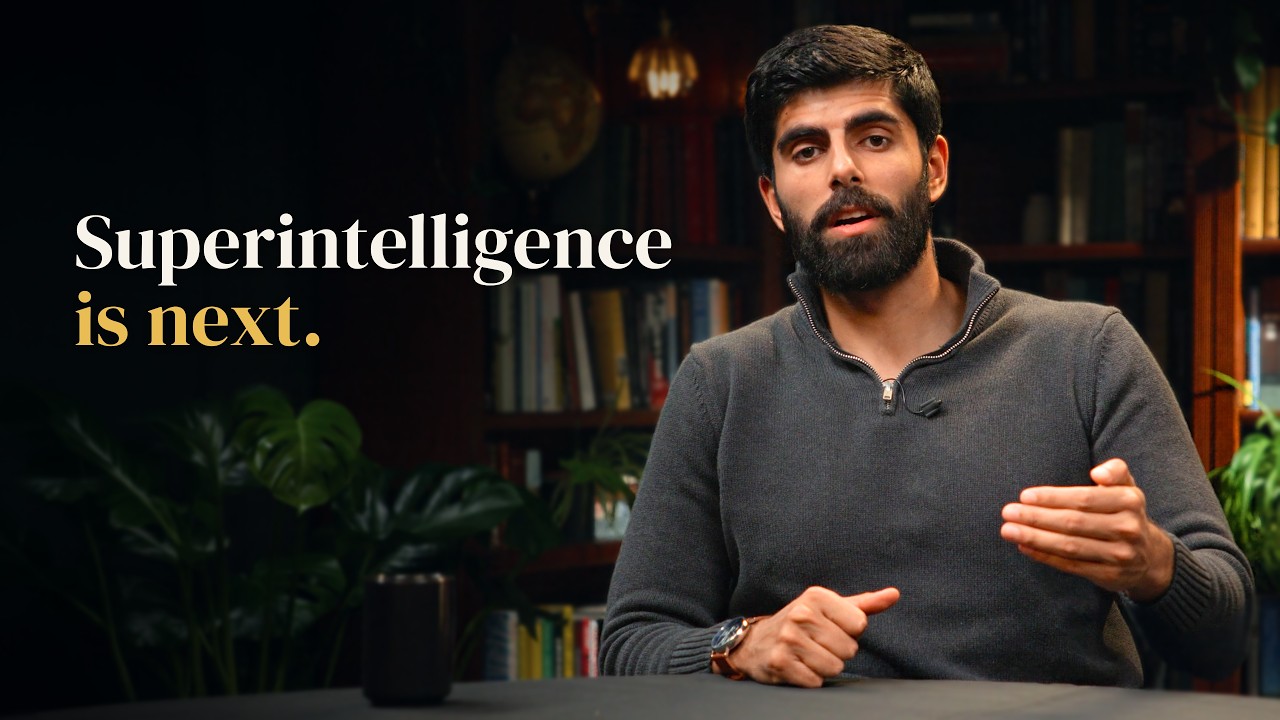
Recursive self-improvement has started: a video from Dwarkesh Patel on YouTubeVideo: Dwarkesh Patel on YouTube

In a solo video published on 13 November, the Dwarkesh Podcast host puts at least a 25% chance on a date after 2032; these are his own estimates, not findings.

SOURCEDwarkesh Patel (YouTube) · 3 sources
CHECKED15 Nov, 17:31
Research watch read
Recursive self-improvement has started: a video from Dwarkesh Patel on YouTube Research / 16 NOV

AI could match the best human AI researchers around 2028, Dwarkesh Patel estimates

  • Patel's median year for automated researchers to match the very best human AI researchers is 2028, assuming labs do not slow down or get slowed by a government (8:18).
  • He puts at least a 25% chance on it not happening until after 2032 (10:03).
  • At the early end, he says it is "possibly only a couple months away" (0:22), a view he did not hold a couple of months ago (0:47).

Dwarkesh Patel says AI that is as good as the best humans at AI research is "only a couple years away and possibly only a couple months away". He says that automating that research will compress so much progress into a single year that AI as good as the best human experts in every field could follow "by 2030 and plausibly as early as next year".

Patel, who hosts the Dwarkesh Podcast, made the argument in a solo video titled "Recursive self-improvement has started", published on his YouTube channel on 13 November 2026. The quotes below are from the video's automatic captions.

His median guess is later and more cautious than the headline. "If I had to pick my median year for when automated researchers will be as good as the very best human AI researchers at doing AI research, I'd guess 2028", he says, and he adds that this assumes the AI labs do not slow themselves down and are not slowed by a government (8:18).

He also puts a number on the other side. "I guess that there's at least a 25% chance that it doesn't happen until after 2032" (10:03).

Patel presents all of this as his own judgement, formed over the last three months, and says he did not believe it himself a couple of months ago.

The video narrates a written essay Patel published on his own site the same day, "The avalanche that hit math is coming for AI development"; the essay gives the same 2028 median and a 25% chance of a date after 2032.

What it means for you Our view

Treat this as one informed person's forecast. Patel presents it as his own judgement, formed over the last three months, and his 2028 median depends on the labs not slowing themselves down and not being slowed by a government. His 25% chance of a date after 2032 shows how wide his own range is, and "a couple of months" is its early edge, not his central estimate. The video gives his argument, not a measurement. If you set multi-year plans that assume a pace for AI research automation, write down where your assumptions sit against his 2028 median and his later tail, and revisit them when labs report results.

TAGSAutomated researchDwarkesh PodcastRecursive self-improvement
NOTHING IN THIS FILTER No story today matches. open the archive →
That's today's news: three stories. ExplainedEU AI Act Article 50 sets four duties for AI providers and deployers

The morning email

On the mornings we publish: the three top stories and up to four short ones. Free.

We email you a link to confirm. An issue may include one sponsor, always labelled Sponsored · Advertisement. Our emails count opens and clicks, not who made them. Unsubscribe in one click. What we keep

1 of 3
Illustration: A freestanding white booking kiosk with a ticket slot; its green round dial stands for the date the IPO price is set.Illustration made with AI for ai notis

Compute · 16 NOVnarrowed

Claude maker Anthropic expects IPO pricing on 18 November, trading 19 November

Anthropic's S-1/A says it delivers Claude through its models, platform and applications, among them Claude Code and Claude Cowork; UK retail applications close on 18 November.

  • Anthropic's IPO website FAQ says the final price is expected to be set on 18 November and trading to begin on 19 November, subject to regulatory clearance.
  • The 10 November S-1/A estimates $70.00 to $78.00 a share for 825,000,000 Class A shares, to be listed on Nasdaq as ANT.
  • UK retail applications close on 18 November, with each intermediary setting its own closing time; the Australian offer closes at 5:00pm on 17 November (AEDT).
Checked 15 Nov, 18:02 · SEC · 7 sources
Illustration: A white bench-top stamping press with a tray of finished sheets; its green stamping head stands for the duty to mark generated output.Illustration made with AI for ai notis

Laws · 16 NOV

Existing generative AI systems in the EU must mark output by 2 December

Fines can reach up to 15 million euros or 3% of worldwide turnover; the Commission says Article 50 applies from 2 August, with only marking by earlier systems delayed to 2 December.

  • The Commission's FAQ says Article 50 applies from 2 August 2026; systems placed on the market before then must meet the marking duty only from 2 December 2026.
  • Article 50(2) requires outputs of systems that generate audio, image, video or text to be marked machine-readably; the Commission lists watermarks, metadata and fingerprints.
  • The FAQ says providers outside the EU are covered if their output is used in the EU; fines can reach up to 15 million euros or 3% of worldwide turnover.
Checked 15 Nov, 17:35 · European Commission · 5 sources
Recursive self-improvement has started: a video from Dwarkesh Patel on YouTubeWatch on YouTubeVideo: Dwarkesh Patel on YouTube

Research · 16 NOVnarrowed

AI could match the best human AI researchers around 2028, Dwarkesh Patel estimates

In a solo video published on 13 November, the Dwarkesh Podcast host puts at least a 25% chance on a date after 2032; these are his own estimates, not findings.

  • Patel's median year for automated researchers to match the very best human AI researchers is 2028, assuming labs do not slow down or get slowed by a government (8:18).
  • He puts at least a 25% chance on it not happening until after 2032 (10:03).
  • At the early end, he says it is "possibly only a couple months away" (0:22), a view he did not hold a couple of months ago (0:47).
Checked 15 Nov, 17:31 · Dwarkesh Patel (YouTube) · 3 sources

You're all caught up

That's today's news: three stories.

ExplainedEU AI Act Article 50 sets four duties for AI providers and deployers

You can join ai notis soon, to follow cases and keep stories on every device.

Follow us on Instagram and Threads

The morning email

On the mornings we publish: the three top stories and up to four short ones. Free.

We email you a link to confirm. An issue may include one sponsor, always labelled Sponsored · Advertisement. Our emails count opens and clicks, not who made them. Unsubscribe in one click. What we keep

No story today matches. Open the archive
Today's stories 3 STORIES

Today's stories

Mon 16 Nov · 3 STORIES
  1. Compute · 16 NOV · narrowed

    Claude maker Anthropic expects IPO pricing on 18 November, trading 19 November

    Illustration: A freestanding white booking kiosk with a ticket slot; its green round dial stands for the date the IPO price is set.Illustration made with AI for ai notis

    Anthropic's S-1/A says it delivers Claude through its models, platform and applications, among them Claude Code and Claude Cowork; UK retail applications close on 18 November.

    Checked 15 Nov, 18:02 · SEC · 7 sourcesRead

  2. Laws · 16 NOV

    Existing generative AI systems in the EU must mark output by 2 December

    Illustration: A white bench-top stamping press with a tray of finished sheets; its green stamping head stands for the duty to mark generated output.Illustration made with AI for ai notis

    Fines can reach up to 15 million euros or 3% of worldwide turnover; the Commission says Article 50 applies from 2 August, with only marking by earlier systems delayed to 2 December.

    Checked 15 Nov, 17:35 · European Commission · 5 sourcesRead

  3. Research · 16 NOV · narrowed

    AI could match the best human AI researchers around 2028, Dwarkesh Patel estimates

    Recursive self-improvement has started: a video from Dwarkesh Patel on YouTubeVideo: Dwarkesh Patel on YouTube

    In a solo video published on 13 November, the Dwarkesh Podcast host puts at least a 25% chance on a date after 2032; these are his own estimates, not findings.

    Checked 15 Nov, 17:31 · Dwarkesh Patel (YouTube) · 3 sourcesRead

toned down Compute 16 NOV

Claude maker Anthropic expects IPO pricing on 18 November, trading 19 November

Anthropic's S-1/A says it delivers Claude through its models, platform and applications, among them Claude Code and Claude Cowork; UK retail applications close on 18 November.

SEC · 7 sources·checked 15 Nov, 18:02
AnthropicIPONasdaqSEC
Illustration: A freestanding white booking kiosk with a ticket slot; its green round dial stands for the date the IPO price is set.Illustration made with AI for ai notis
Laws

Existing generative AI systems in the EU must mark output by 2 December

Fines can reach up to 15 million euros or 3% of worldwide turnover; the Commission says Article 50 applies from 2 August, with only marking by earlier systems delayed to 2 December.

16 NOV · European Commission · 5 sources
toned down Research

AI could match the best human AI researchers around 2028, Dwarkesh Patel estimates

In a solo video published on 13 November, the Dwarkesh Podcast host puts at least a 25% chance on a date after 2032; these are his own estimates, not findings.

16 NOV · Dwarkesh Patel (YouTube) · 3 sources

Explained

One idea behind the news
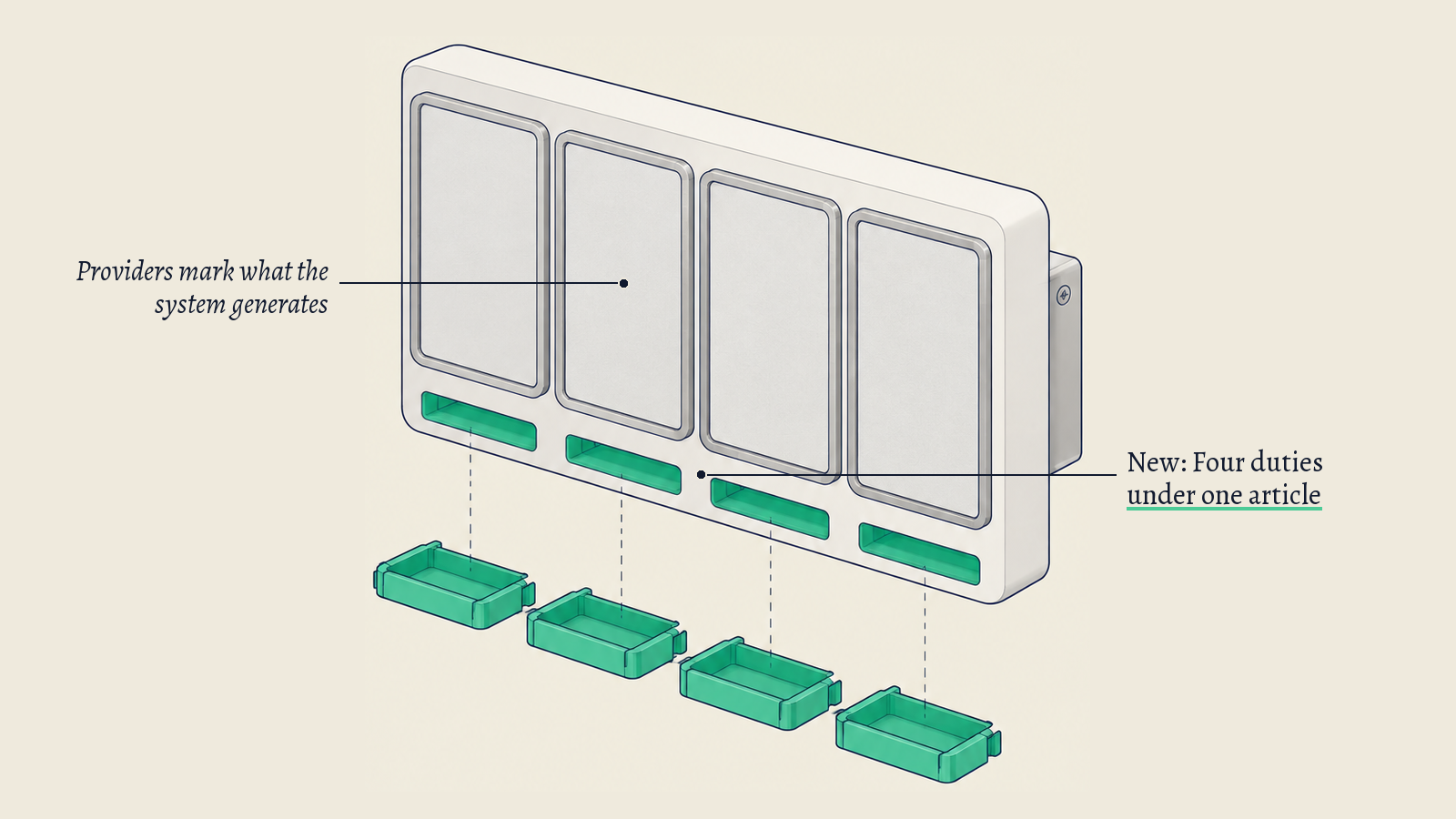
Laws EU AI Act Article 50 sets four duties for AI providers and deployers Four duties sit under one article: say when someone is talking to AI, mark what AI generates, tell people about emotion recognition, and label deepfakes and AI text on public matters.
In brief 3 more today
0 of 3 read
Drag a card to start Drag left or right · tap to read more Hover to lift a card · tap to bring it forward Tap again to put it back Tap a card to open it Tap again to close it Tap a headline to read it as a card